PUBLISHER: Mordor Intelligence | PRODUCT CODE: 2044052

PUBLISHER: Mordor Intelligence | PRODUCT CODE: 2044052
Asia-Pacific Vehicle-Embedded Software - Market Share Analysis, Industry Trends & Statistics, Growth Forecasts (2026 - 2031)
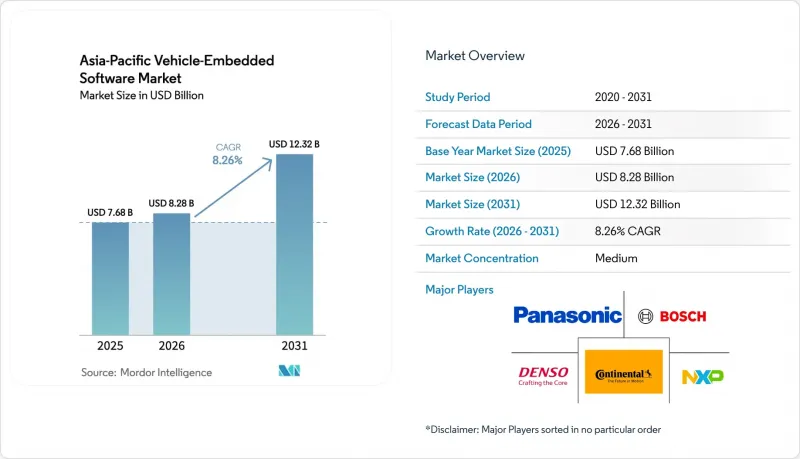
The Asia-Pacific vehicle-embedded software market size is expected to grow from USD 7.68 billion in 2025 to USD 8.28 billion in 2026 and is forecast to reach USD 12.32 billion by 2031 at 8.26% CAGR over 2026-2031.
Pervasive electrification, mandatory advanced driver assistance functions, and the rapid pivot toward centralized compute platforms are expanding software spend per vehicle far faster than hardware costs. New cybersecurity mandates such as China's GB 44495-2024 and Japan's revised Road Transport Vehicle Act are accelerating the migration from distributed electronic control units to zonal and domain architectures that rely on scalable middleware. Open-source AUTOSAR Adaptive stacks and Linux-based operating systems are lowering entry barriers for regional suppliers, while over-the-air update ecosystems are unlocking post-sale revenue streams for original equipment manufacturers. Competitive intensity is rising as Chinese software houses, Indian engineering service providers, and global tier-1s race to deliver validated code bases that can pass ISO 26262 audits on compressed timelines within the Asia-Pacific vehicle-embedded software market.
Asia-Pacific Vehicle-Embedded Software Market Trends and Insights
Accelerating Electrification of Passenger Cars
Battery electric vehicle deliveries in China surpassed 9.5 million units in 2025, accounting for 38% of passenger-car sales and driving demand for software-managed battery management systems. Indian manufacturers embed real-time operating systems in sub-USD 1,500 scooters to regulate lithium iron phosphate packs and deliver predictive range functions. Japan's April 2025 efficiency rules require software-validated power-train optimization during type approval, pulling tier-1s into joint algorithm development with semiconductor partners. Each premium electric sedan now ships with more than 300 million lines of code, triple the load of a conventional model, magnifying middleware revenue opportunities.
Mandatory Advanced Driver Assistance Systems in China and Japan
China's automatic emergency braking and lane-keeping mandate effective January 2026 covers roughly 25 million new vehicles a year. Japan amended its Road Transport Vehicle Act in March 2025 to extend adaptive cruise control to trucks over 3.5 tons, widening ADAS reach into commercial fleets. Renesas shipped over 2 million R-Car V4H chips to Toyota in 2025, supporting consolidation of ADAS and infotainment loads on one compute domain. Continental's CAEdge platform reaches 15-millisecond detection latency by offloading neural-net preprocessing to dedicated accelerators. Functional-safety validation at ASIL-D continues to add up to 18 months to release cycles, driving tighter OEM-supplier collaboration across the region.
Cybersecurity Vulnerabilities in Vehicle ECUs
UN R155 compliance audits show 23% of legacy architectures lack hardware cryptography, forcing OEM retrofits costing more than USD 40 per unit. Hong Kong will align with R155 and R156 by December 2026, adding fresh retrofit demand across gray-market imports. China's GB 44495-2024 mandates full-lifecycle cybersecurity management, spurring cloud-based security operation centers that watch CAN-bus traffic for anomalies. Semiconductor shortages slow the rollout of security-enhanced microcontrollers, extending exposure windows for known vulnerabilities.
Other drivers and restraints analyzed in the detailed report include:
- Over-The-Air Update Ecosystems Scaling Across OEMs
- Emerging Software-Defined Vehicle Architectures
- Scarcity of Functional Safety-Certified Developers
For complete list of drivers and restraints, kindly check the Table Of Contents.
Segment Analysis
Two-wheelers are projected to expand at 9.23% CAGR, propelled by Indian and Southeast Asian start-ups that bundle Linux dashboards, Bluetooth, and remote diagnostics into scooters below USD 1,500. Passenger cars retained 55.21% of Asia-Pacific vehicle-embedded software market share in 2025, buoyed by China's 21 million-unit output and Japan's electronics heritage. Light commercial vehicles integrate fleet telematics to comply with real-time tracking mandates in South Korea and Australia. Heavy trucks adopt predictive maintenance that analyzes vibration and oil quality data, reducing unplanned downtime by 15%.
While two-wheelers drive unit growth, passenger cars remain the largest revenue engine for the Asia-Pacific vehicle-embedded software market size, yet cost-sensitive sedans in Indonesia and the Philippines often strip advanced middleware to hit target price points. Light-duty vans benefit from mandated electronic logging devices, fostering incremental software sales per vehicle. Heavy commercial vehicles pay higher average selling prices for prognostics platforms that schedule service visits only when sensors flag abnormal patterns, further widening embedded software margins.
Middleware is forecast to rise at 9.56% CAGR as zonal controllers need service-oriented frameworks that broker data among heterogeneous processors. Application software held 38.43% of Asia-Pacific vehicle-embedded software market size in 2025, yet is shifting to containerized deployment for faster updates. Operating systems converge around Linux for infotainment and QNX or similar microkernels for safety, enabling common toolchains. Firmware revenue declines proportionally as value migrates upward.
Tier-1s increasingly offer proprietary middleware bundles tuned to specific system-on-chips, raising switching costs for automakers. Consortia such as COVESA publish open interface definitions to preserve interoperability. The resulting blend of closed performance-optimized stacks and open community code forces OEMs to balance time-to-market against long-term vendor lock-in across the Asia-Pacific vehicle-embedded software industry.
The Asia-Pacific Vehicle-Embedded Software Market Report is Segmented by Vehicle Type (Passenger Cars, Light Commercial Vehicles, and More), Software Type (Operating System, Middleware, Application Software, and Firmware), Application (ADAS and Safety, Infotainment, Powertrain, and More), Propulsion Type (Internal Combustion Engine, and More), and Country. The Market Forecasts are Provided in Terms of Value (USD).
List of Companies Covered in this Report:
- Robert Bosch GmbH
- Denso Corporation
- Continental AG
- Panasonic Holdings Corporation
- NXP Semiconductors N.V.
- Renesas Electronics Corporation
- BlackBerry Limited
- NVIDIA Corporation
- Qualcomm Incorporated
- Elektrobit Automotive GmbH
- ETAS GmbH
- Tata Elxsi Limited
- KPIT Technologies Limited
- Aptiv PLC
- Huawei Technologies Co. Ltd.
- Baidu Inc.
- Hyundai AutoEver Corporation
- Mahindra Electric Automobile Limited
- Fujitsu Limited
- Hitachi Ltd.
Additional Benefits:
- The market estimate (ME) sheet in Excel format
- 3 months of analyst support
TABLE OF CONTENTS
1 INTRODUCTION
- 1.1 Study Assumptions and Market Definition
- 1.2 Scope of the Study
2 RESEARCH METHODOLOGY
3 EXECUTIVE SUMMARY
4 MARKET LANDSCAPE
- 4.1 Market Overview
- 4.2 Market Drivers
- 4.2.1 Accelerating Electrification of Passenger Cars
- 4.2.2 Mandatory Advanced Driver Assistance Systems in China and Japan
- 4.2.3 Over-the-Air Update Ecosystems Scaling Across OEMs
- 4.2.4 Open-Source AUTOSAR Adoption by Tier-1s
- 4.2.5 Emerging Software-Defined Vehicle Architectures
- 4.2.6 AI-Centric Embedded Platforms for Autonomous Shuttles
- 4.3 Market Restraints
- 4.3.1 Cybersecurity Vulnerabilities in Vehicle ECUs
- 4.3.2 Scarcity of Functional Safety-Certified Developers
- 4.3.3 Rising BOM Cost Pressure on Low-End Two-Wheeler Makers
- 4.3.4 Fragmented Asia Pacific Regulatory Compliance Landscape
- 4.4 Industry Value Chain Analysis
- 4.5 Regulatory Landscape
- 4.6 Technological Outlook
- 4.7 Porter's Five Forces Analysis
- 4.7.1 Threat of New Entrants
- 4.7.2 Bargaining Power of Suppliers
- 4.7.3 Bargaining Power of Buyers
- 4.7.4 Threat of Substitutes
- 4.7.5 Intensity of Competitive Rivalry
- 4.8 Impact of Macroeconomic Factors on the Market
5 MARKET SIZE AND GROWTH FORECASTS (VALUE)
- 5.1 By Vehicle Type
- 5.1.1 Passenger Cars
- 5.1.2 Light Commercial Vehicles
- 5.1.3 Heavy Commercial Vehicles
- 5.1.4 Two-Wheelers
- 5.2 By Software Type
- 5.2.1 Operating System
- 5.2.2 Middleware
- 5.2.3 Application Software
- 5.2.4 Firmware
- 5.3 By Application
- 5.3.1 ADAS and Safety
- 5.3.2 Infotainment
- 5.3.3 Powertrain
- 5.3.4 Body Control and Comfort
- 5.3.5 Telematics
- 5.4 By Propulsion Type
- 5.4.1 Internal Combustion Engine
- 5.4.2 Battery Electric Vehicle
- 5.4.3 Hybrid Electric Vehicle
- 5.4.4 Fuel Cell Electric Vehicle
- 5.5 By Country
- 5.5.1 China
- 5.5.2 Japan
- 5.5.3 South Korea
- 5.5.4 India
- 5.5.5 Australia and New Zealand
- 5.5.6 Rest of Asia-Pacific
6 COMPETITIVE LANDSCAPE
- 6.1 Market Concentration
- 6.2 Strategic Moves
- 6.3 Market Share Analysis
- 6.4 Company Profiles (includes Global level Overview, Market level overview, Core Segments, Financials as Available, Strategic Information, Market Rank/Share for Key Companies, Products and Services, and Recent Developments)
- 6.4.1 Robert Bosch GmbH
- 6.4.2 Denso Corporation
- 6.4.3 Continental AG
- 6.4.4 Panasonic Holdings Corporation
- 6.4.5 NXP Semiconductors N.V.
- 6.4.6 Renesas Electronics Corporation
- 6.4.7 BlackBerry Limited
- 6.4.8 NVIDIA Corporation
- 6.4.9 Qualcomm Incorporated
- 6.4.10 Elektrobit Automotive GmbH
- 6.4.11 ETAS GmbH
- 6.4.12 Tata Elxsi Limited
- 6.4.13 KPIT Technologies Limited
- 6.4.14 Aptiv PLC
- 6.4.15 Huawei Technologies Co. Ltd.
- 6.4.16 Baidu Inc.
- 6.4.17 Hyundai AutoEver Corporation
- 6.4.18 Mahindra Electric Automobile Limited
- 6.4.19 Fujitsu Limited
- 6.4.20 Hitachi Ltd.
7 MARKET OPPORTUNITIES AND FUTURE OUTLOOK
- 7.1 White-space and Unmet-need Assessment

