
PUBLISHER: Mordor Intelligence | PRODUCT CODE: 2044061

PUBLISHER: Mordor Intelligence | PRODUCT CODE: 2044061
Central And Eastern Europe (CEE) Facility Management - Market Share Analysis, Industry Trends & Statistics, Growth Forecasts (2026 - 2031)
The CEE facility management market size is expected to grow from USD 15.71 billion in 2025 to USD 16.47 billion in 2026 and is forecast to reach USD 20.84 billion by 2031 at 4.82% CAGR over 2026-2031.
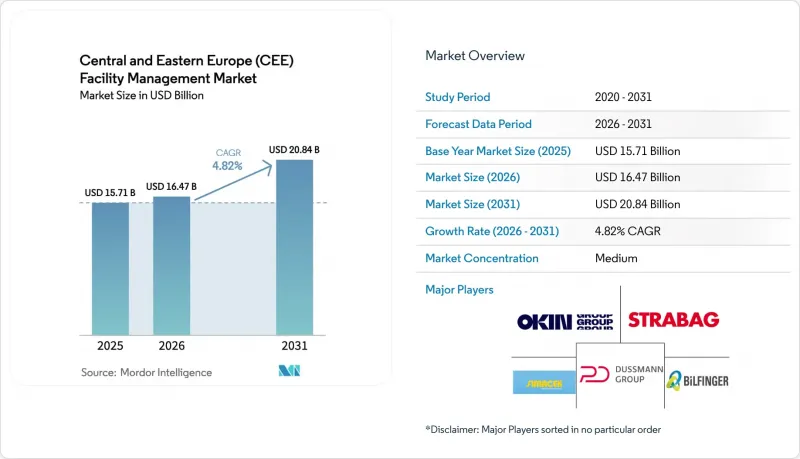
This expansion is propelled by sustained infrastructure modernization, stringent EU-aligned efficiency rules, and the preference for outsourced, technology-enabled services that cut operating costs while ensuring regulatory compliance. Technology adoption, notably AI-driven predictive maintenance and IoT-enabled energy management, is moving the market toward data-led, performance-based contracts that help clients meet ESG targets. Consolidation among global and regional providers is intensifying but local specialists still capture niche contracts that demand on-the-ground expertise. Labor cost inflation and supply-chain volatility pose near-term pressures, yet the drive for energy savings and standardized service levels in commercial real estate keeps overall demand resilient.
Central And Eastern Europe (CEE) Facility Management Market Trends and Insights
Increasing Infrastructure Development
Government-backed construction programs, new building codes, and foreign direct investment are reshaping service demand across the CEE facility management market. Poland's technical conditions that took effect in August 2024 introduced stricter energy-efficiency and spacing rules, prompting developers to seek specialist FM partners for asset compliance. The Czech Republic's BIM requirement for public projects above USD 11.23 million starting 2025 is creating new revenue streams for data-rich lifecycle management services. Romania's USD 40.6 million EIB-financed university campus upgrade underscores broader public-sector modernization that relies on integrated FM to manage complex utilities and safety systems. Large industrial investments, such as onsemi's USD 2 billion semiconductor plant in the Czech Republic, are further lifting demand for high-specification hard services. The cumulative effect is a steady pipeline of assets needing long-term technical stewardship that fuels market growth.
Rising Outsourcing in Building Management
Regulatory complexity and standardized service expectations are accelerating the switch from in-house teams to professional providers across the CEE facility management market. Hungary's amended energy-efficiency law, which doubles mandatory savings to 1.4% per year from 2025, is compelling asset owners to tap external expertise that can implement specialized retrofits at scale. Poland's digitalized work-permit regime effective June 2025 eases cross-border labor deployment, helping multinational FM firms mobilize skilled technicians quickly. Region-wide adoption of the EU Minimum Wage Directive is harmonizing pay structures and amplifying economies of scale that favor large, integrated vendors. High-value multi-site wins exemplified by ISS's 7-year contract for the UK Department for Work and Pensions highlight the cost and performance advantages driving outsourcing momentum.
Complex and Varying Regulatory Frameworks for New Market Entrants
Cross-border expansion is slowed by disparate tax rules, permitting procedures, and labor codes, each requiring distinct compliance toolkits. Poland's 2025 property-tax reform introduces separate definitions for buildings and structures, forcing FM firms to re-evaluate asset classifications and documentation processes. The Czech Republic's new construction law adds compulsory energy-performance certificates at the occupancy stage, lengthening project timelines. Romania's lease approvals on state-owned educational property now demand ministerial clearance, adding administrative overhead for FM bids on campus upgrades. Such divergence obliges multinational providers to maintain multiple legal teams, raising fixed costs and slowing market penetration.
Other drivers and restraints analyzed in the detailed report include:
- Heightened Safety and Security Needs
- Technological Advancements in Facility Management
- Sensitivity of FM Demand to Macroeconomic Indicators and Construction Cycles
For complete list of drivers and restraints, kindly check the Table Of Contents.
Segment Analysis
Hard services anchored 57.62% of 2025 revenue, reflecting building-owner priorities around asset protection, mandatory inspections, and fire-safety system uptime. Poland's post-2024 code revisions that mandate enhanced insulation and modern HVAC systems have spurred a wave of retro-commissioning contracts that keep the hard-services pipeline active. Predictive maintenance is shortening repair cycles and extending asset life, delivering the highest return on investment among service lines.
Soft services will outpace at a 6.05% CAGR as occupiers sharpen focus on workplace hygiene, security, and user experience. High-density office hubs in Warsaw, Prague, and Budapest are adopting smart-cleaning programs using telemetry data to align staffing to real-time occupancy, a shift that improves quality while trimming labor hours. Catering and reception services are being redesigned around hybrid work patterns, with modular menus and digital visitor management enhancing flexibility.
The Central and Eastern Europe (CEE) Facility Management Market Report is Segmented by Service Type (Hard Services, and Soft Services), Offering Type (In-House, and Outsourced), End-User Industry (Commercial, Hospitality, Institutional and Public Infrastructure, Healthcare, Industrial and Process, and More), and Country. The Market Forecasts are Provided in Terms of Value (USD).
List of Companies Covered in this Report:
- Strabag SE
- Bilfinger SE
- Dussmann Group
- CBRE Group, Inc.
- OKIN Facility (OKIN Group)
- Vinci Facilities Limited
- Asura Group
- Cushman and Wakefield PLC
- ISS A/S (ISS Facilities Services Inc.)
- SIMACEK GmbH
- FCC Medio Ambiente
- Sodexo SA
- Atalian Global Services
- SPIE SA
- Securitas AB
- Compass Group PLC
- G4S Limited
- JLL Incorporated
- ENGIE Cofely (Cofely Services)
- Colliers International Group Inc.
Additional Benefits:
- The market estimate (ME) sheet in Excel format
- 3 months of analyst support
TABLE OF CONTENTS
1 INTRODUCTION
- 1.1 Study Assumptions and Market Definition
- 1.2 Scope of the Study
2 RESEARCH METHODOLOGY
3 EXECUTIVE SUMMARY
4 MARKET LANDSCAPE
- 4.1 Market Overview
- 4.1.1 Current Occupancy Rates in CEE Commercial Real Estate
- 4.1.2 Profitability Benchmarks of Major FM Providers
- 4.1.3 Workforce Indicators - Skilled and Unskilled Labor Participation
- 4.1.4 Facility Management Market Share (%) by Service Type
- 4.1.5 Facility Management Market Share (%) by Hard Services
- 4.1.6 Facility Management Market Share (%) by Soft Services
- 4.1.7 Urbanization and Population Growth in Top Metro Areas
- 4.1.8 Sector Investment Priorities in Central & Eastern Europe Infrastructure Pipeline
- 4.1.9 Regulatory Drivers Specific to Labour & Safety Standards
- 4.2 Market Driver
- 4.2.1 Increasing Infrastructure Development
- 4.2.2 Rising Outsourcing in Building Management
- 4.2.3 Heightened Safety and Security Needs
- 4.2.4 Technological Advancements in Facility Management
- 4.2.5 Expansion of commercial real estate with more international tenants seeking standardized FM solutions
- 4.2.6 Growing emphasis on ESG compliance and energy-efficient operations in buildings
- 4.3 Market Restraint
- 4.3.1 Regulatory and Legislative Framework for Market Entrants
- 4.3.2 Impact of Macroeconomic Indicators on FM Demand
- 4.3.3 Complex and varying regulatory and legislative frameworks for new market entrants
- 4.3.4 Sensitivity of FM demand to macroeconomic indicators and construction cycles
- 4.4 Value Chain Analysis
- 4.5 PESTEL Analysis
- 4.6 Regulatory and Legislative Framework for Market Entrants
- 4.7 Impact of Macroeconomic Indicators on FM Demand
- 4.8 Porter's Five Forces Analysis
- 4.8.1 Bargaining Power of Suppliers
- 4.8.2 Bargaining Power of Buyers
- 4.8.3 Threat of New Entrants
- 4.8.4 Threat of Substitute Services
- 4.8.5 Intensity of Competitive Rivalry
- 4.9 Investment and Funding Analysis
5 MARKET SIZE AND GROWTH FORECASTS (VALUES)
- 5.1 By Service Type
- 5.1.1 Hard Services
- 5.1.1.1 Asset Management
- 5.1.1.2 MEP and HVAC Services
- 5.1.1.3 Fire Systems and Safety
- 5.1.1.4 Other Hard FM Services
- 5.1.2 Soft Services
- 5.1.2.1 Office Support and Security
- 5.1.2.2 Cleaning Services
- 5.1.2.3 Catering Services
- 5.1.2.4 Other Soft FM Services
- 5.1.1 Hard Services
- 5.2 By Offering Type
- 5.2.1 In-house
- 5.2.2 Outsourced
- 5.2.2.1 Single FM
- 5.2.2.2 Bundled FM
- 5.2.2.3 Integrated FM
- 5.3 By End-user Industry
- 5.3.1 Commercial (IT and Telecom, Retail and Warehouses)
- 5.3.2 Hospitality (Hotels, Eateries, Large-scale Restaurants)
- 5.3.3 Institutional and Public Infrastructure (Govt, Education, Transportation)
- 5.3.4 Healthcare (Public and Private Facilities)
- 5.3.5 Industrial and Process (Manufacturing, Energy, Mining)
- 5.3.6 Other End-user Industries (Multi-housing, Entertainment, Sports and Leisure)
- 5.4 By Country
- 5.4.1 Poland
- 5.4.2 Hungary
- 5.4.3 Romania
- 5.4.4 Slovak Republic
- 5.4.5 Slovenia
- 5.4.6 Czech Republic
- 5.4.7 Bosnia and Herzegovina
- 5.4.8 Serbia
- 5.4.9 Croatia
- 5.4.10 Russia
- 5.4.11 Rest of Central and Eastern Europe
6 COMPETITIVE LANDSCAPE
- 6.1 Market Concentration
- 6.2 Strategic Moves and Partnerships
- 6.3 Market Share Analysis
- 6.4 Company Profiles (includes Global level Overview, Market level overview, Core Segments, Financials as available, Strategic Information, Market Rank/Share for key companies, Products and Services, and Recent Developments)
- 6.4.1 Strabag SE
- 6.4.2 Bilfinger SE
- 6.4.3 Dussmann Group
- 6.4.4 CBRE Group, Inc.
- 6.4.5 OKIN Facility (OKIN Group)
- 6.4.6 Vinci Facilities Limited
- 6.4.7 Asura Group
- 6.4.8 Cushman and Wakefield PLC
- 6.4.9 ISS A/S (ISS Facilities Services Inc.)
- 6.4.10 SIMACEK GmbH
- 6.4.11 FCC Medio Ambiente
- 6.4.12 Sodexo SA
- 6.4.13 Atalian Global Services
- 6.4.14 SPIE SA
- 6.4.15 Securitas AB
- 6.4.16 Compass Group PLC
- 6.4.17 G4S Limited
- 6.4.18 JLL Incorporated
- 6.4.19 ENGIE Cofely (Cofely Services)
- 6.4.20 Colliers International Group Inc.
7 MARKET OPPORTUNITIES AND FUTURE OUTLOOK
- 7.1 White-space and Unmet-Need Assessment
- 7.2 Technology-led Integrated FM (IoT, BMS, AI-based Predictive Maintenance)
- 7.3 ESG-Compliant FM Solutions Demand
- 7.4 Future Service-Model Shifts (Outcome-Based Contracts)

