
PUBLISHER: Mordor Intelligence | PRODUCT CODE: 2044069

PUBLISHER: Mordor Intelligence | PRODUCT CODE: 2044069
Digital Accessibility Software - Market Share Analysis, Industry Trends & Statistics, Growth Forecasts (2026 - 2031)
The digital accessibility software market size is projected to be USD 0.79 billion in 2025, USD 0.85 billion in 2026, and reach USD 1.15 billion by 2031, growing at a CAGR of 6.23% from 2026 to 2031.
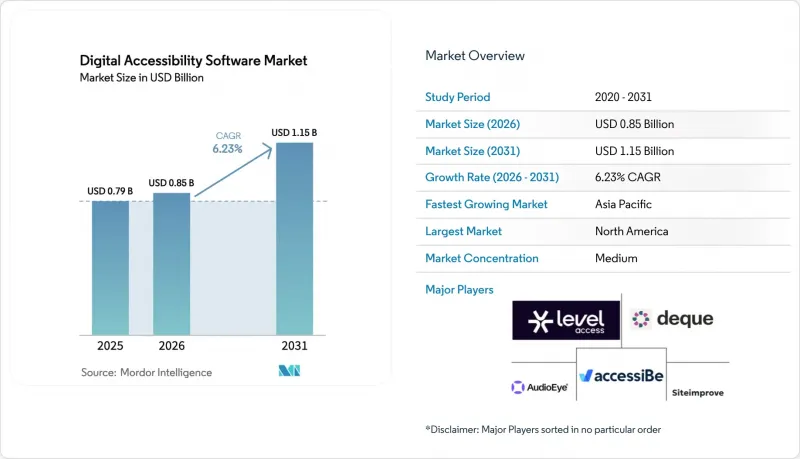
Growth now comes from recurrent subscriptions rather than one-time audits because buyers must show continuous conformance in government tenders and ESG scorecards. October 2025 ISO adoption of WCAG 2.2 and June 2025 enforcement of the European Union Accessibility Act re-positioned accessible design as a revenue prerequisite instead of a legal afterthought. Cloud APIs that scan code during every commit, AI models that propose instant fixes, and procurement toolkits that auto-populate Accessibility Conformance Reports have turned conformance into a DevOps metric. North American demand remains anchored by Section 508 rules, yet Asia-Pacific is set to lead incremental spending as Japan, India, and Australia align private-sector contracts with mandatory guidelines. Platform differentiation now pivots on AI accuracy, mobile-first testing, and the depth of human audit services that validate machine output.
Global Digital Accessibility Software Market Trends and Insights
Rapid Adoption of WCAG 2.2 Standards
ISO/IEC 40500:2025 elevated WCAG 2.2 from voluntary guidance to a formal benchmark, and Fortune 500 sourcing teams now list Level AA conformance as a mandatory bid criterion. European regulators allow members to upgrade from WCAG 2.1, so vendors must support multi-version testing to win continental contracts. German and French agencies plan to adopt WCAG 2.2 by 2027, accelerating refresh cycles for legacy scanning engines. Platforms with modular rule libraries ingest new criteria faster, giving them a first-mover advantage when procurement deadlines tighten. Deque Systems' January 2026 release claims four-fold faster testing after retraining models on the expanded rule set, highlighting how algorithmic agility influences renewal rates.
AI-Driven Remediation Accuracy Exceeding 90 Percent
Large language models fine-tuned on accessibility data reached 92% precision in 2025, reducing false positives that historically eroded buyer confidence. Automated code suggestions now cut developer fix time from hours to minutes, making continuous scanning economically viable for mid-market firms. Google's March 2026 Natively Adaptive Interfaces framework pushes AI to the browser layer, letting UIs auto-adjust for motor impairments. As automation scales, organizations uncover hidden issues in legacy apps, which sustains consulting demand for edge-case validation. Vendors pairing AI triage with on-demand human auditors therefore capture both volume and complexity revenue streams.
Lack of Unified Global Enforcement Mechanisms
Corporations operating across continents juggle WCAG 2.0, 2.1, and 2.2 plus country-specific acts, each with unique timelines and penalties, elevating compliance overhead. Vendors must maintain multiple rule sets, which inflates R&D and sales enablement costs. Adoption in jurisdictions without fines, such as several Indian states, lags below 40%, diluting the total demand pool. Regional incumbents thrive by tailoring offerings to local nuances, complicating global platform rollouts. The absence of a unifying body akin to the ITU means certifications rarely transfer across borders, capping economies of scale.
Other drivers and restraints analyzed in the detailed report include:
- Government Procurement Rules Mandating Section 508 Compliance
- Low-Code and No-Code Tools Reducing Buyer TCO
- High False-Positive Rates in Legacy Engines
For complete list of drivers and restraints, kindly check the Table Of Contents.
Segment Analysis
Mobile suites delivered the fastest growth trajectory, posting a projected 7.39% CAGR from 2026 to 2031 as banking, payments, and retail activity shifted to smartphone-centric super-apps in India, Indonesia, and Brazil. While website platforms still held 36.32% of the digital accessibility software market share in 2025, their growth tempers as desktop traffic plateaus. Mobile testing demands distinct capabilities, gesture simulation, biometric workflow checks, and API coverage for UIAccessibility and TalkBack, that many legacy scanners lack. Vendors such as Deque Systems cut mobile scan time by 75% after embedding gesture AI, giving them an edge with app-first enterprises.
Pressure on niche categories is rising. Color-contrast analyzers and captioning helpers are increasingly bundled into broader suites, pushing single-function products toward commoditization. Document and PDF remediation software enjoys sticky demand in government and finance, but loses share where workflows migrate to born-digital formats. Platforms that weave these tasks into one dashboard capture higher average selling prices and lower churn, reinforcing consolidation trends in the digital accessibility software market.
Cloud deployments accounted for 64.13% of 2025 revenue thanks to elastic pricing and instant integration with GitHub, GitLab, and Bitbucket pipelines. Continuous scans at every commit reduce defect escape rates, so development teams see accessibility the same way they treat security testing. On-premise tools persist in defense and healthcare segments that must isolate source code, yet their growth lags behind the broader digital accessibility software market by several points. Hyperscalers intensified price pressure by embedding baseline scans in DevOps templates, forcing independent vendors to differentiate on accuracy, rule depth, or industry-specific presets.
The digital accessibility software market size for cloud subscriptions will expand as API-metered models align costs with surges in web traffic during holiday campaigns or live-streamed events. Conversely, perpetual-license models tied to on-premise installations face revenue headwinds because they lack usage-based upsell levers.
Digital Accessibility Software Market Report is Segmented by Type (Website Accessibility Platforms, Automated Scan and Audit Tools, and More), Deployment Mode (Cloud-Based, and On-Premise), Organization Size (Large Enterprises, and Small and Medium Enterprises), End-User Industry (E-Commerce and Retail, BFSI, Government and Public Sector, and More), and Geography. The Market Forecasts are Provided in Terms of Value (USD).
Geography Analysis
North America retained 39.87% of 2025 spending because of two decades of Section 508 oversight and a deep bench of certified auditors. Conformance budgets have now shifted from project implementations to continuous monitoring subscriptions, moderating regional growth. Asia-Pacific is projected to record a 7.21% CAGR to 2031, the fastest among all regions, driven by Japan's private-sector mandate effective 2024, India's extension of WCAG requirements to state portals, and Australia's deadline for Level AA government sites. Singapore's SGD 3 billion (USD 2.2 billion) inclusion program further accelerates regional demand.
Europe's trajectory depends on the European Union Accessibility Act, which began enforcement in June 2025. Regulators have granted a soft grace period, focusing on guidance rather than penalties, creating a temporary plateau. German and French intentions to adopt WCAG 2.2 by 2027 will restart upgrade cycles, forcing vendors to juggle dual rule sets within a single platform.
South America shows rising interest as Brazil's law requires digital services to be accessible, yet uneven enforcement slows procurement. Middle East and Africa adoption is nascent; South Africa's 2025 draft Digital Inclusion Policy and the United Arab Emirates' Smart Dubai framework hint at future momentum. Vendors eye channel partnerships with regional system integrators to navigate local tenders, while self-service overlays cater to cash-constrained buyers. The digital accessibility software market therefore evolves at uneven velocities, compelling suppliers to tailor commercial models to regional maturity levels.
- Level Access, Inc.
- Siteimprove A/S
- AudioEye, Inc.
- Deque Systems, Inc.
- UserWay Inc.
- Monsido ApS
- Crownpeak Technology, Inc.
- Silktide Ltd.
- accessiBe Ltd.
- EqualWeb Ltd.
- UsableNet, Inc.
- TPGi, A Vispero Company
- Allyant, Inc.
- Google LLC
- Microsoft Corporation
- International Business Machines Corporation
- WebAIM, Utah State University
- Dubbot LLC
- Applause App Quality, Inc.
- Testlio, Inc.
Additional Benefits:
- The market estimate (ME) sheet in Excel format
- 3 months of analyst support
TABLE OF CONTENTS
1 INTRODUCTION
- 1.1 Study Assumptions and Market Definition
- 1.2 Scope of the Study
2 RESEARCH METHODOLOGY
3 EXECUTIVE SUMMARY
4 MARKET LANDSCAPE
- 4.1 Market Overview
- 4.2 Industry Value Chain Analysis
- 4.3 Market Drivers
- 4.3.1 Rapid Adoption of WCAG 2.2 Standards
- 4.3.2 AI-Driven Remediation Accuracy Exceeding 90 Percent
- 4.3.3 Government Procurement Rules Mandating Section 508 Compliance
- 4.3.4 Low-Code and No-Code Tools Reducing Buyer TCO
- 4.3.5 ESG Scorecards Adding Digital-First CX KPIs
- 4.3.6 Expansion of Streaming Services Requiring Accessible Video
- 4.4 Market Restraints
- 4.4.1 Lack of Unified Global Enforcement Mechanisms
- 4.4.2 High False-Positive Rates in Legacy Engines
- 4.4.3 Shortage of Certified Accessibility Auditors
- 4.4.4 Overlay-Fatigue Backlash Among Disability Advocates
- 4.5 Regulatory Landscape
- 4.6 Technological Outlook
- 4.7 Impact of Macroeconomic Factors on the Market
- 4.8 Porter's Five Forces Analysis
- 4.8.1 Bargaining Power of Suppliers
- 4.8.2 Bargaining Power of Buyers
- 4.8.3 Threat of New Entrants
- 4.8.4 Threat of Substitutes
- 4.8.5 Competitive Rivalry
- 4.9 Industry Ecosystem Analysis
- 4.10 Key Use Cases and Case Studies
- 4.11 Investment Analysis
5 MARKET SIZE AND GROWTH FORECASTS (VALUE)
- 5.1 By Type
- 5.1.1 Website Accessibility Platforms
- 5.1.2 Automated Scan and Audit Tools
- 5.1.3 Color-Contrast and Readability Checkers
- 5.1.4 Mobile and App Accessibility Suites
- 5.1.5 Video and Captioning Assist Tools
- 5.1.6 Document and PDF Remediation Software
- 5.2 By Deployment Mode
- 5.2.1 Cloud-Based
- 5.2.2 On-Premise
- 5.3 By Organization Size
- 5.3.1 Large Enterprises
- 5.3.2 Small and Medium Enterprises
- 5.4 By End-User Industry
- 5.4.1 E-Commerce and Retail
- 5.4.2 Banking, Financial Services and Insurance
- 5.4.3 Government and Public Sector
- 5.4.4 Healthcare and Life Sciences
- 5.4.5 Education
- 5.4.6 Media and Entertainment
- 5.5 By Geography
- 5.5.1 North America
- 5.5.1.1 United States
- 5.5.1.2 Canada
- 5.5.1.3 Mexico
- 5.5.2 South America
- 5.5.2.1 Brazil
- 5.5.2.2 Argentina
- 5.5.2.3 Colombia
- 5.5.2.4 Rest of South America
- 5.5.3 Europe
- 5.5.3.1 Germany
- 5.5.3.2 United Kingdom
- 5.5.3.3 France
- 5.5.3.4 Italy
- 5.5.3.5 Spain
- 5.5.3.6 Russia
- 5.5.3.7 Netherlands
- 5.5.3.8 Rest of Europe
- 5.5.4 Asia-Pacific
- 5.5.4.1 China
- 5.5.4.2 Japan
- 5.5.4.3 South Korea
- 5.5.4.4 India
- 5.5.4.5 Australia
- 5.5.4.6 Singapore
- 5.5.4.7 Rest of Asia-Pacific
- 5.5.5 Middle East
- 5.5.5.1 Saudi Arabia
- 5.5.5.2 United Arab Emirates
- 5.5.5.3 Rest of Middle East
- 5.5.6 Africa
- 5.5.6.1 South Africa
- 5.5.6.2 Egypt
- 5.5.6.3 Rest of Africa
- 5.5.1 North America
6 COMPETITIVE LANDSCAPE
- 6.1 Market Concentration
- 6.2 Strategic Moves
- 6.3 Market Share Analysis
- 6.4 Company Profiles (includes Global Level Overview, Market Level Overview, Core Segments, Financials as available, Strategic Information, Market Rank/Share, Products and Services, Recent Developments)
- 6.4.1 Level Access, Inc.
- 6.4.2 Siteimprove A/S
- 6.4.3 AudioEye, Inc.
- 6.4.4 Deque Systems, Inc.
- 6.4.5 UserWay Inc.
- 6.4.6 Monsido ApS
- 6.4.7 Crownpeak Technology, Inc.
- 6.4.8 Silktide Ltd.
- 6.4.9 accessiBe Ltd.
- 6.4.10 EqualWeb Ltd.
- 6.4.11 UsableNet, Inc.
- 6.4.12 TPGi, A Vispero Company
- 6.4.13 Allyant, Inc.
- 6.4.14 Google LLC
- 6.4.15 Microsoft Corporation
- 6.4.16 International Business Machines Corporation
- 6.4.17 WebAIM, Utah State University
- 6.4.18 Dubbot LLC
- 6.4.19 Applause App Quality, Inc.
- 6.4.20 Testlio, Inc.
7 MARKET OPPORTUNITIES AND FUTURE OUTLOOK
- 7.1 White-Space and Unmet-Need Assessment

