
PUBLISHER: Mordor Intelligence | PRODUCT CODE: 2044071

PUBLISHER: Mordor Intelligence | PRODUCT CODE: 2044071
United States Flat Glass - Market Share Analysis, Industry Trends & Statistics, Growth Forecasts (2026 - 2031)
The United States Flat Glass Market size is expected to grow from USD 12.32 billion in 2025 to USD 12.99 billion in 2026 and is forecast to reach USD 16.91 billion by 2031 at a 5.42% CAGR over 2026-2031.
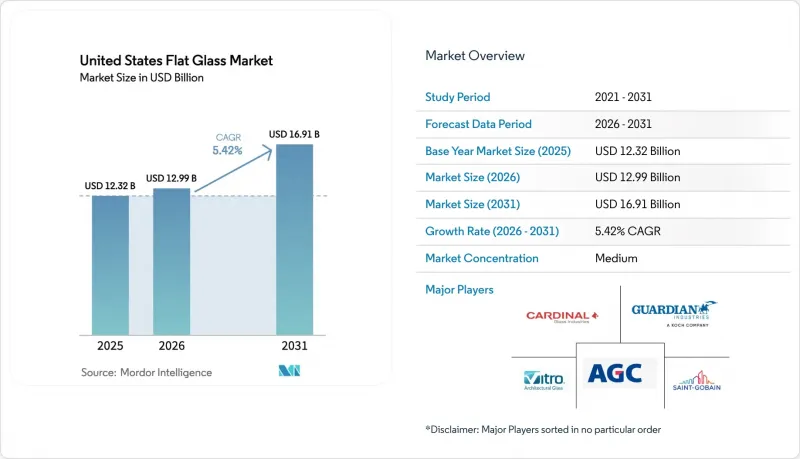
Demand is pivoting from commodity float toward higher-margin coated and processed products as solar-manufacturing incentives, energy-efficient retrofit mandates, and electric-vehicle glazing needs reshape procurement strategies. The United States flat glass market is also contending with skilled-labor shortages and tightening carbon rules that raise operating costs, nudging producers toward value-added segments where pricing power offsets compliance outlays. Vertically integrated solar-glass producers are already securing sustainable margins, while traditional architectural suppliers face intensified import competition even after recent anti-dumping actions. Consolidation among the seven domestic float operators co-exists with a vibrant downstream fabricator base, so customer leverage varies sharply along the chain. Overall, the United States flat glass market now rewards firms that can deliver multi-layer lamination, dynamic tinting, or ultra-low-emissivity sputtering rather than raw tonnage alone.
United States Flat Glass Market Trends and Insights
Expansion of Domestic Solar-Panel Manufacturing Under IRA Incentives
Federal Section 45X credits pay USD 12 per m2 of solar glass, underpinning multi-billion-dollar greenfield projects that insulate vertically integrated lines from merchant-float volatility. First Solar added 3.5 GW lines in Louisiana and Alabama in 2025, bringing the United States' capacity to 14 GW. Pilkington converted its Rossford, Ohio float into a transparent-conductive-oxide supply, illustrating how the United States flat glass market is birthing a parallel solar substrate chain with distinct cost drivers. Loan Programs Office guidance further lowers financing barriers, encouraging new entrants to target solar rather than architectural float.
Rising Construction-Retrofit Activity for Energy-Efficient Buildings
IRA-funded General Services Administration procurement now specifies low-embodied-carbon limits of 1,331 kg CO2e (carbon dioxide-equivalent)/ton for top-tier flat glass, shifting demand toward furnaces with high cullet ratios or electric boosting. Berkeley Lab finds Low-E coatings already cover 80% of United States homes, yet triple-pane units with U-factors below 0.20 are emerging as the next retrofit standard. That dynamic elevates the United States flat glass market as fabricators are able to automate spacer-bar and edge-seal lines, capturing rising per-square-foot values.
Tightening US Carbon-Emission Rules on Float Furnaces
EPA Subpart N reporting plus particulate and SOx limits under Subpart CC compel costly abatement retrofits; Guardian's 2024 closure of its Kingsburg, California float underscores vulnerability to regional energy and carbon policies. Producers must decide whether to invest in electric boosting, relocate, or exit commodity float, pushing the United States flat glass market toward high-value coatings where margins can absorb compliance premiums.
Other drivers and restraints analyzed in the detailed report include:
- Automotive Lightweighting and Safety-Glazing Mandates
- Growing Demand for Electronic Displays
- Skilled-Labor Shortages in Advanced Glass Processing
For complete list of drivers and restraints, kindly check the Table Of Contents.
Segment Analysis
Annealed Glass retained 62.33% of 2025 revenue, yet its share is slipping as hurricanes, blasts, and overhead codes move more applications to tempered or laminated forms. Processed Glass expanded at a 6.78% CAGR during the forecast period (2026-2031), outstripping the overall United States Flat Glass market. The United States flat glass market size for processed offerings rose in tandem with code adoption, rewarding integrated shops able to move quickly from cutting to tempering to edge-sealing.
Fabricators that consolidate tempering, laminating, gas filling, and quality inspection on one line earn roughly 30-40% higher revenue per square foot than peers selling stand-alone annealed sheets. New installs from Glaston and Fenzi's E-Coat printing platform validate the capital shift toward downstream automation, reinforcing the momentum behind processed product leadership inside the United States Flat Glass market.
The United States Flat Glass Market Report is Segmented by Product Type (Annealed Glass (Including Tinted Glass), Coater Glass, Patterned Glass, and More), Coating Type (Low-E (Hard-Coat), Solar-Control (Soft-Coat), and More), End-User Industry (Building and Construction, Automotive, Solar Glass, and Other End-User Industries (Electronics, Aerospace, and More)). The Market Size and Forecasts are Provided in Terms of Value (USD).
List of Companies Covered in this Report:
- AGC Inc.
- CARDINAL GLASS INDUSTRIES, INC
- Central Glass Co., Ltd.
- China CSG Group Co., Ltd.
- Corning Incorporated
- First Solar
- Fuyao Group
- Guardian Industries
- Nippon Sheet Glass Co., Ltd
- Saint-Gobain
- SCHOTT
- Sisecam
- Specialty Glass Products
- Swift Glass
- Vitro
- Xinyi Glass Holdings Limited
Additional Benefits:
- The market estimate (ME) sheet in Excel format
- 3 months of analyst support
TABLE OF CONTENTS
1 Introduction
- 1.1 Study Assumptions & Market Definition
- 1.2 Scope of the Study
2 Research Methodology
3 Executive Summary
4 Market Landscape
- 4.1 Market Overview
- 4.2 Market Drivers
- 4.2.1 Growing demand for electronic displays
- 4.2.2 Rising construction-retrofit activity for energy-efficient buildings
- 4.2.3 Expansion of domestic solar-panel manufacturing under IRA incentives
- 4.2.4 Automotive lightweighting and safety-glazing mandates
- 4.2.5 Emergence of dynamic/smart glass in commercial real estate
- 4.3 Market Restraints
- 4.3.1 Tightening US carbon-emission rules on float furnaces
- 4.3.2 Skilled-labor shortages in advanced glass processing
- 4.3.3 Competition from imported low-cost processed glass
- 4.4 Value Chain Analysis
- 4.5 Porter's Five Forces
- 4.5.1 Bargaining Power of Suppliers
- 4.5.2 Bargaining Power of Buyers
- 4.5.3 Threat of New Entrants
- 4.5.4 Threat of Substitutes
- 4.5.5 Degree of Competition
5 Market Size & Growth Forecasts (Value)
- 5.1 By Product Type
- 5.1.1 Annealed Glass (Including Tinted Glass)
- 5.1.2 Coater Glass
- 5.1.3 Patterned Glass
- 5.1.4 Processed Glass
- 5.1.5 Mirrors
- 5.2 By Coating Type
- 5.2.1 Low-E (Hard-Coat)
- 5.2.2 Solar-Control (Soft-Coat)
- 5.2.3 Self-Cleaning
- 5.2.4 Anti-Reflective
- 5.2.5 Others
- 5.3 By End-User Industry
- 5.3.1 Building and Construction
- 5.3.2 Automotive
- 5.3.3 Solar Glass
- 5.3.4 Other End-user Industries (Electronics, Aerospace, and more)
6 Competitive Landscape
- 6.1 Market Concentration
- 6.2 Strategic Moves
- 6.3 Market Share(%)/Ranking Analysis
- 6.4 Company Profiles (includes Global Overview, Market Overview, Core Segments, Financials, Strategic Information, Products and Services, Recent Developments)
- 6.4.1 AGC Inc.
- 6.4.2 CARDINAL GLASS INDUSTRIES, INC
- 6.4.3 Central Glass Co., Ltd.
- 6.4.4 China CSG Group Co., Ltd.
- 6.4.5 Corning Incorporated
- 6.4.6 First Solar
- 6.4.7 Fuyao Group
- 6.4.8 Guardian Industries
- 6.4.9 Nippon Sheet Glass Co., Ltd
- 6.4.10 Saint-Gobain
- 6.4.11 SCHOTT
- 6.4.12 Sisecam
- 6.4.13 Specialty Glass Products
- 6.4.14 Swift Glass
- 6.4.15 Vitro
- 6.4.16 Xinyi Glass Holdings Limited
7 Market Opportunities and Future Outlook
- 7.1 White-Space and Unmet-Need Assessment

