PUBLISHER: Mordor Intelligence | PRODUCT CODE: 2044076

PUBLISHER: Mordor Intelligence | PRODUCT CODE: 2044076
Podcasting - Market Share Analysis, Industry Trends & Statistics, Growth Forecasts (2026 - 2031)
The podcasting market size is projected to expand from USD 30.43 billion in 2025 and USD 32.65 billion in 2026 to USD 81.32 billion by 2031, registering a CAGR of 20.02% between 2026-2031.
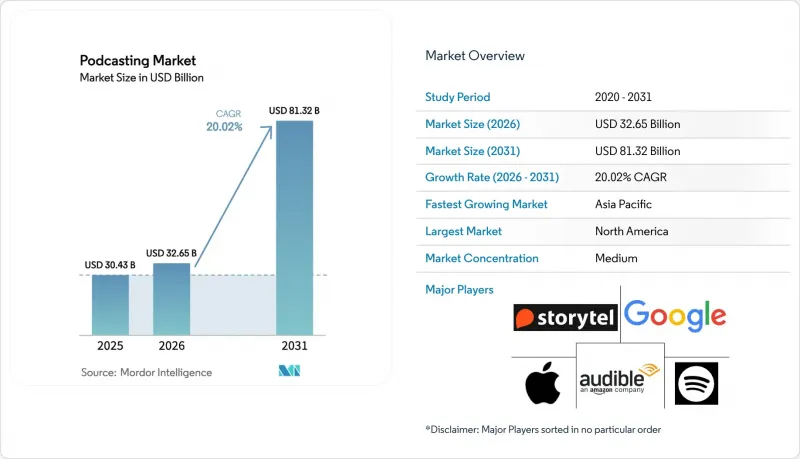
Robust growth reflects the migration of linear-television dollars into video podcasts, the rapid rollout of programmatic audio infrastructure, and the deepening integration of podcasts into smart-speaker and connected-TV ecosystems. Platform economics are shifting in favor of creators who deliver both audio and video, because higher video CPMs lift overall revenue per episode and diversify distribution risk. Advertiser demand is also rising as dynamic ad-insertion tools let brands target listeners by geography, device, and daypart while still preserving host-read authenticity. On the supply side, greater compression efficiency and cloud editing tools reduce production costs, encouraging more creators to launch serialized shows that keep audiences engaged across seasons.
Global Podcasting Market Trends and Insights
Growing Monetization of Video Podcasts on YouTube and Connected-TV Platforms
Video podcasts are siphoning brand budgets away from broadcast television as advertisers follow younger viewers online. High-definition filming now costs a fraction of studio television, letting creators capture CPMs near USD 35, almost double traditional audio rates. Roku and Amazon Fire TV report double-digit growth in podcast viewing hours, proving that living-room audiences treat long-form episodes like niche cable channels. Creators benefit from dual monetization because the same content streams as audio on Spotify and Apple Podcasts while adding pre-roll and mid-roll video inventory on YouTube. As more hosts record in 16:9 formats, the podcasting market deepens its competition with YouTube long-form entertainment without abandoning RSS-based distribution.
Programmatic Audio Ad Buying Penetration Exceeding 35 Percent in North America
Automated ad buying simplifies podcast placement for brand managers used to display and search campaigns. Demand-side and supply-side platforms now stitch podcast inventory into omnichannel dashboards, letting agencies optimize frequency in real time. Dynamic ad insertion pins messages to listener profiles, boosting conversion rates compared with evergreen host-read spots. Independent creators tap self-service marketplaces on Acast and Megaphone, which democratize premium ad demand previously reserved for the top 10. As Europe enforces GDPR-compliant targeting and Asia-Pacific rolls out similar exchanges, global programmatic share is set to climb beyond North America's benchmark, lifting overall podcasting market revenue.
Heightened Content Moderation Costs Amid Misinformation Regulations in Europe
The Digital Services Act and the European Media Freedom Act force platforms to hire reviewers, deploy AI filters, and issue transparency reports, adding annual compliance costs between EUR 50,000 and 200,000 (USD 53,000-212,000) for mid-size hosts. Small providers struggle to absorb these expenses, prompting exits or mergers that shrink creator choice. Extraterritorial provisions mean even non-EU firms must appoint legal representatives, deterring cross-border expansion. Creators respond by self-censoring controversial topics that risk takedown, which could dilute content diversity. The result is slower European revenue growth compared with other developed regions.
Other drivers and restraints analyzed in the detailed report include:
- Rising Adoption of Smart Speakers in Gen Z Households
- Corporate Communications Pivot to Branded Podcasts in Asia-Pacific Multinationals
- Low In-Car Internet Penetration Limiting Listenership in Africa
For complete list of drivers and restraints, kindly check the Table Of Contents.
Segment Analysis
True Crime captured the zeitgeist with deeply serialized narratives that transform casual listeners into binge cohorts and premium subscribers. The segment's 20.62% CAGR reflects growing studio investment in multi-season investigations and courtroom dramas, often spun off into documentaries or book deals. CPMs averaging USD 42 validate advertiser appetite for hyper-engaged audiences. While News and Politics retains the largest slice of the podcasting market share, audience growth there is flattening as partisanship fragments habitual listening. Comedy, Sports, and Society content remain vibrant but face fiercer competition from short-form video platforms.
Advertisers like fintech apps and direct-to-consumer brands prioritize True Crime due to high completion rates and female-skewing demographics. Studios such as Wondery and Parcast release international localizations, supporting multilanguage growth in South America and Europe. Meanwhile, documentary-style narrative techniques spill into Business, Technology, and Health genres, raising overall production standards across the podcasting market. The diversification of storytelling styles is broadening reach beyond early-adopter segments and stabilizing lifetime value for creators.
Narrative and Storytelling show advances at a 20.88% CAGR, overtaking the interview format in listener growth. Investments in writers' rooms, foley artists, and licensed scores elevate production values to near-audiobook quality. Advertisers reward the reduced ad-skipping with mid-roll CPM uplifts above 25%, reinforcing the format's premium positioning. Interview podcasts still dominate output volume because of low setup costs and the ease of weekly releases, supporting stable advertiser inventory for the broader podcasting market.
Hybrid formats blend live panels with scripted narrative arcs, a structure popular on YouTube where visual cues amplify engagement. Solo monologues cater to thought leaders offering master-class-style insight, while conversational panel shows leverage audience chat on live streams to surface user-generated questions. Across every format, creators increasingly capture 4K video simultaneously with audio, maximizing distribution across podcast apps, YouTube, and connected-TV channels.
The Podcasting Market Report is Segmented by Genre (News and Politics, Comedy, Society and Culture, and More), Format (Interview, Conversational/Panel, and More), Revenue Model (Advertising-Supported, Subscription-Based, and More, Device/Access Point (Smartphones, Computers and Laptops, and More)), End-User Sector (Consumer Media and Entertainment, and More), and Geography. The Market Forecasts are Provided in Terms of Value (USD).
Geography Analysis
North America generated 45.61% of 2025 revenue, buoyed by programmatic audio, which accounts for over one-third of digital ad budgets and funnels them into podcast inventory. The United States remains the epicenter thanks to a large advertiser base and mature DSP-SSP infrastructure. Canada and Mexico add bilingual growth, leveraging English-Spanish and English-French content to extend campaign reach. High smart-speaker adoption embeds podcasts into household routines, lifting average listening hours per user and supporting premium CPMs.
Asia-Pacific posts the highest regional CAGR at 21.25% through 2031. Japan's corporates spearhead branded podcasts featuring executive hosts, while India and China spread adoption via technology workforces and commuter-friendly short-episode formats. Ximalaya's 280 million monthly users in China showcase the potential of hybrid audiobook-podcast platforms. In Southeast Asia, mobile bandwidth constraints are mitigated by sub-30 MB episode compression, expanding reach into secondary cities and rural districts with affordable data plans.
Europe is growing more slowly due to the compliance burden of the Digital Services Act, which increases operating costs for mid-size hosts. Germany leads consumption in true crime and investigative journalism, whereas the United Kingdom excels in comedy and panel formats. South America witnesses a language-led boom as Spanish and Portuguese series triple output in Brazil and Argentina. Middle East markets like the United Arab Emirates pilot government-backed podcast incubators, yet adoption concentrates in urban areas with high smartphone usage. Africa trails because only 18% of vehicles have in-car connectivity and mobile data prices remain high, limiting the daypart that elsewhere fuels sustained listening.
- Apple Inc.
- Spotify AB
- Amazon.com Inc. (Audible and Amazon Music)
- Google LLC
- iHeartMedia Inc.
- Sirius XM Holdings Inc. (Stitcher)
- Acast AB
- Podbean LLC
- Anchor FM Inc.
- Megaphone LLC
- Wondery LLC
- Luminary Media LLC
- TuneIn Inc.
- Pandora Media LLC
- Cumulus Media Inc. (Westwood One Podcast Network)
- PRX Public Radio Exchange
- Tencent Holdings Ltd. (Ximalaya)
- Castbox FM Pte. Ltd.
- Buzzsprout (Higher Pixels Inc.)
- Libsyn Corp.
Additional Benefits:
- The market estimate (ME) sheet in Excel format
- 3 months of analyst support
TABLE OF CONTENTS
1 INTRODUCTION
- 1.1 Study Assumptions and Market Definition
- 1.2 Scope of the Study
2 RESEARCH METHODOLOGY
3 EXECUTIVE SUMMARY
4 MARKET LANDSCAPE
- 4.1 Market Overview
- 4.2 Market Drivers
- 4.2.1 Growing Monetization of Video Podcasts on YouTube and Connected-TV Platforms
- 4.2.2 Programmatic Audio Ad Buying Penetration Exceeding 35 Percent in North America
- 4.2.3 Rising Adoption of Smart Speakers in Gen Z Households, Especially United States and United Kingdom
- 4.2.4 Corporate Communications Pivot to Branded Podcasts in Asia-Pacific Multinationals
- 4.2.5 Surging Demand for Local-Language Podcasts Across South America
- 4.2.6 Sub-30 MB Mobile Episode Compression Improving Reach in Emerging Asia
- 4.3 Market Restraints
- 4.3.1 Heightened Content Moderation Costs Amid Misinformation Regulations in Europe
- 4.3.2 Low In-Car Internet Penetration Limiting Listenership in Africa
- 4.3.3 Fragmented Rights Management for Cross-Border Podcast Licensing
- 4.3.4 Apple and Spotify Store Commission Structures Squeezing Independent Creators
- 4.4 Value-Chain Analysis
- 4.5 Regulatory Outlook
- 4.6 Technological Outlook
- 4.7 Porter's Five Forces Analysis
- 4.7.1 Bargaining Power of Suppliers
- 4.7.2 Bargaining Power of Buyers
- 4.7.3 Threat of New Entrants
- 4.7.4 Threat of Substitutes
- 4.7.5 Intensity of Competitive Rivalry
- 4.8 Impact of Macroeconomic Factors on the Market
5 MARKET SIZE AND GROWTH FORECASTS (VALUE)
- 5.1 By Genre
- 5.1.1 News and Politics
- 5.1.2 Comedy
- 5.1.3 Society and Culture
- 5.1.4 True Crime
- 5.1.5 Sports
- 5.1.6 Education
- 5.1.7 Health and Wellness
- 5.1.8 Technology
- 5.1.9 Business and Finance
- 5.1.10 Arts and Entertainment
- 5.2 By Format
- 5.2.1 Interview
- 5.2.2 Conversational / Panel
- 5.2.3 Solo Monologue
- 5.2.4 Narrative / Storytelling
- 5.2.5 Hybrid / Experimental
- 5.3 By Revenue Model
- 5.3.1 Advertising-Supported
- 5.3.2 Subscription-Based
- 5.3.3 Crowdfunding and Donations
- 5.3.4 Branded and Corporate-Sponsored
- 5.4 By Device / Access Point
- 5.4.1 Smartphones
- 5.4.2 Computers and Laptops
- 5.4.3 Smart Speakers
- 5.4.4 Connected TVs
- 5.4.5 In-Car Infotainment Systems
- 5.4.6 Wearables
- 5.5 By End-User Sector
- 5.5.1 Consumer Media and Entertainment
- 5.5.2 Education and E-Learning Institutions
- 5.5.3 Corporations and Enterprises
- 5.5.4 Non-Profit and Government Organizations
- 5.6 By Geography
- 5.6.1 North America
- 5.6.1.1 United States
- 5.6.1.2 Canada
- 5.6.1.3 Mexico
- 5.6.2 South America
- 5.6.2.1 Brazil
- 5.6.2.2 Argentina
- 5.6.2.3 Rest of South America
- 5.6.3 Europe
- 5.6.3.1 Germany
- 5.6.3.2 United Kingdom
- 5.6.3.3 France
- 5.6.3.4 Italy
- 5.6.3.5 Spain
- 5.6.3.6 Rest of Europe
- 5.6.4 Asia-Pacific
- 5.6.4.1 China
- 5.6.4.2 Japan
- 5.6.4.3 South Korea
- 5.6.4.4 India
- 5.6.4.5 Australia
- 5.6.4.6 New Zealand
- 5.6.4.7 Rest of Asia-Pacific
- 5.6.5 Middle East
- 5.6.5.1 United Arab Emirates
- 5.6.5.2 Saudi Arabia
- 5.6.5.3 Rest of Middle East
- 5.6.6 Africa
- 5.6.6.1 South Africa
- 5.6.6.2 Rest of Africa
- 5.6.1 North America
6 COMPETITIVE LANDSCAPE
- 6.1 Market Concentration
- 6.2 Strategic Moves
- 6.3 Market Share Analysis
- 6.4 Company Profiles (includes Global Level Overview, Market Level Overview, Core Segments, Financials as available, Strategic Information, Market Rank/Share, Products and Services, Recent Developments)
- 6.4.1 Apple Inc.
- 6.4.2 Spotify AB
- 6.4.3 Amazon.com Inc. (Audible and Amazon Music)
- 6.4.4 Google LLC
- 6.4.5 iHeartMedia Inc.
- 6.4.6 Sirius XM Holdings Inc. (Stitcher)
- 6.4.7 Acast AB
- 6.4.8 Podbean LLC
- 6.4.9 Anchor FM Inc.
- 6.4.10 Megaphone LLC
- 6.4.11 Wondery LLC
- 6.4.12 Luminary Media LLC
- 6.4.13 TuneIn Inc.
- 6.4.14 Pandora Media LLC
- 6.4.15 Cumulus Media Inc. (Westwood One Podcast Network)
- 6.4.16 PRX Public Radio Exchange
- 6.4.17 Tencent Holdings Ltd. (Ximalaya)
- 6.4.18 Castbox FM Pte. Ltd.
- 6.4.19 Buzzsprout (Higher Pixels Inc.)
- 6.4.20 Libsyn Corp.
7 MARKET OPPORTUNITIES AND FUTURE OUTLOOK
- 7.1 White-Space and Unmet-Need Assessment

