PUBLISHER: Mordor Intelligence | PRODUCT CODE: 2044086

PUBLISHER: Mordor Intelligence | PRODUCT CODE: 2044086
Digital Legacy - Market Share Analysis, Industry Trends & Statistics, Growth Forecasts (2026 - 2031)
The Digital Legacy Market size is projected to expand from USD 23.02 billion in 2025 and USD 24.74 billion in 2026 to USD 47.09 billion by 2031, registering a CAGR of 13.74% between 2026 to 2031.
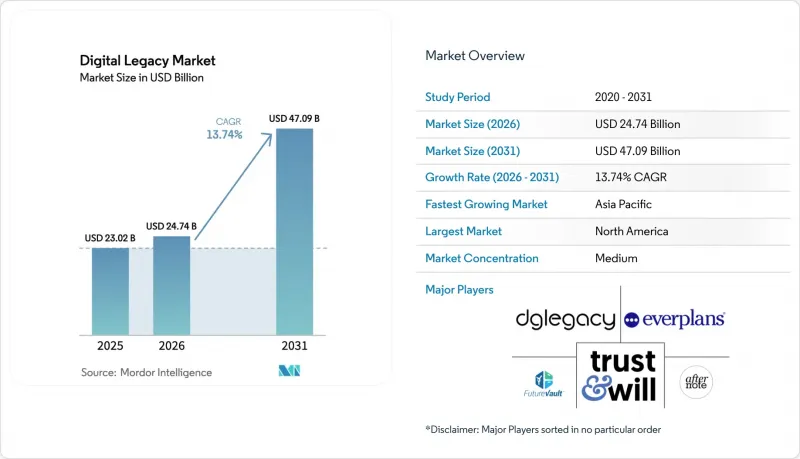
Demand acceleration stems from new succession statutes that treat online accounts and encrypted assets as inheritable property, compelling service providers to embed probate-ready transfer features. Financial institutions increasingly bundle vault services into wealth-management portals, while cloud vendors promote cold-storage tiers that preserve ultra-high-definition memories for pennies per gigabyte. Venture investment remains robust as quantum-resilient encryption, AI-driven asset curation, and Sharia-compliant workflows emerge as next-wave differentiators. Competitive intensity is rising because life-insurers, password managers, and fintech platforms are converging on the same customer problem: painless, regulator-ready transfer of every credential, file, and token.
Global Digital Legacy Market Trends and Insights
Exploding Volume of Personal Digital Assets
More than 6 billion people used the internet and maintained 9.2 billion mobile subscriptions in 2025, creating unprecedented digital footprints across cloud drives, social media, and crypto wallets.Low-cost deep-archive storage from AWS and Microsoft Azure lets consumers amass terabytes of 4K video that families now expect to inherit. Estate platforms therefore redesign interfaces around bulk media transfer and long-term retention, shifting the conversation from "which files" to "how many petabytes." Providers that streamline posthumous data portability gain a first-mover advantage in a market where sentimental value increasingly trumps physical heirlooms.
Rising Cyber-Crime Risk Driving Demand for Secure Vaults
Phishing and credential theft remained the dominant attack vectors in Europol's 2025 threat assessment, confirming that compromised accounts serve as gateways to identity fraud. Digital legacy vaults encrypt estate records at rest and in transit, then release decryption keys only to verified heirs, closing the exposure window for both living owners and beneficiaries. FutureVault's March 2025 SOC 2 Type II certification and USD 3 million capital raise signal institutional demand for auditable vault infrastructure. LastPass integrated a beneficiary designation into its password vault, validating the convergence of cybersecurity and succession workflows.
Complex Cross-Border Succession Laws
Under § 1922 BGB, German heirs have the legal right to inherit a Facebook account. However, French CNIL regulations impose restrictions on data transfers, creating significant legal and operational challenges. This situation underscores the complex jurisdictional hurdles that vault operators must navigate when dealing with cross-border data management. In China, the Personal Information Protection Law grants close relatives the authority to access personal data, but platforms continue to classify accounts as non-transferable licenses. This classification limits the relief available to users and their families. Consequently, providers are compelled to invest heavily in localized legal counsel to ensure compliance with varying regulations. These investments significantly increase operating costs and contribute to delays in cross-border expansions, further complicating global operations.
Other drivers and restraints analyzed in the detailed report include:
- Growing Awareness of Estate Planning for Online Accounts
- Regulatory Mandates on Data Portability and User Control
- Persistent Data-Privacy and Security Concerns
For complete list of drivers and restraints, kindly check the Table Of Contents.
Segment Analysis
The 500 MB-5 GB tier accounted for the largest share of digital legacy market size in 2025 because text wills, PDFs, and smartphone photos typically fit that envelope. Above-30 GB plans, however, are expected to post a 14.80% CAGR as 4K and 8K family videos, VR tributes, and raw photo libraries push estate volumes well beyond the free allowances most cloud users enjoy. Providers differentiate with cold-archive pricing below USD 0.001 per GB monthly, zero-egress policies for heirs, and AI codecs that transcode HEVC or AV1 versions on demand. As petabyte-scale personal libraries shift from enthusiasts to mainstream consumers, premium tiers graduate from a niche upsell to a core revenue engine.
From a competitive lens, mid-tier plans (5 GB-10 GB and 10 GB-30 GB) remain sticky because photo-heavy but video-light households rarely exceed them, yet providers increasingly bundle these tiers with quantum-safe key storage and API access for attorneys. That bundling positions storage size as a proxy for overall relationship value instead of a mere capacity meter, tightening customer lock-in.
Media and entertainment users led the digital legacy market share in 2025 because influencers, record labels, and rightsholders monetize posthumous content streams worldwide. Healthcare, nonetheless, will outpace all other sectors with a 13.92% CAGR to 2031 as HIPAA-aligned portals let patients pre-authorize release of electronic health records and device telemetry to heirs. Early adopters such as Huntington Hospital integrate estate planning links beside advance-directive forms, solving a compliance headache while improving patient experience.
Financial institutions leverage charter clarity, illustrated by Fidelity Digital Assets' national trust bank license, to store cryptocurrency keys alongside equities and insurance documents. Retail and public-sector users lag but show steady uptake as loyalty points, e-commerce wallets, and citizen-service IDs accrue tangible economic value. The sector mix underscores a universal insight: wherever regulation defines data ownership, digital legacy adoption accelerates.
The Digital Legacy Market Report is Segmented by Storage Capacity (Up To 500 MB, 500 MB-5 GB, 5 GB-10 GB, 10 GB-30 GB, and Above 30 GB), End-User (Media and Entertainment, Healthcare, BFSI, and More), Service Type (Digital Vault, Estate Planning Tools, Online Wills, and More), Delivery Model (Cloud, On-Premises, and Hybrid), Platform (Web, Mobile, and More), and Geography. The Market Forecasts are Provided in Terms of Value (USD).
Geography Analysis
North America retained the largest slice of digital legacy market size in 2025 because U.S. and Canadian consumers exhibit high digital-asset penetration and proactive estate-planning habits. Trust and Will's USD 25 million Series C in March 2025 highlights investor confidence, and its partnerships with UBS, Northwestern Mutual, and USAA embed estate workflows directly inside wealth-advisory software, shortening customer acquisition cycles. Federal fragmentation still complicates multi-state probate, yet the market welcomes solutions that auto-map vault contents to each jurisdiction's disclosure rules. Increasing cyber-crime losses, documented at USD 16.6 billion by the FBI in 2024, also push families toward encrypted succession tools.
Asia-Pacific will be the fastest-growing region, propelled by statutory mandates in Japan and South Korea that force platforms to expose inheritance interfaces. NTT Data's Memory Container aligns with Japan's demographic crest of 1.68 million projected deaths in 2031, converting a societal challenge into a technology opportunity. China's Civil Code Article 127 and 458 publicly recorded digital-asset wills in 2024 validate the potential scale, although localization rules require local data centers and real-name verification. India remains an untapped frontier where smartphone ubiquity contrasts with low estate-planning literacy, signaling upside for Hindi and Tamil interfaces plus voice-first enrollment journeys.
Europe presents a compliance-heavy but lucrative landscape. GDPR Article 20 and Germany's § 1922 BGB ensure that any provider without data-portability or inheritance features risks sanction. Farewill's GBP 12.9 million sale to Dignity in 2024 shows that funeral operators see strategic value in bundling wills with end-of-life services. The UK Property (Digital Assets) Act 2025 eliminates ambiguity over virtual property rights, lowering legal-opinion costs for platforms entering the market. However, divergent succession codes among France, Spain, and Italy force vault providers to maintain jurisdiction-aware templates, slowing pan-European releases.
- DGLegacy Inc.
- Everplans Inc.
- Trust and Will Inc.
- FutureVault Inc.
- Afternote B.V.
- SecureSafe (DSwiss AG)
- PartingWishes Inc.
- Farewill Ltd.
- Digital Beyond LLC
- SafeBeyond Ltd.
- GoodTrust Inc.
- OneDay Ltd.
- Memories Group Ltd.
- Clocr Inc.
- Cake Technologies Inc.
- My Digital Estate Pty Ltd.
- Vault12 Inc.
- Eterniam
- Afternote
- Cirrus Legacy
- MemoCloud GmbH
Additional Benefits:
- The market estimate (ME) sheet in Excel format
- 3 months of analyst support
TABLE OF CONTENTS
1 INTRODUCTION
- 1.1 Study Assumptions and Market Definition
- 1.2 Scope of the Study
2 RESEARCH METHODOLOGY
3 EXECUTIVE SUMMARY
4 MARKET LANDSCAPE
- 4.1 Market Overview
- 4.2 Market Drivers
- 4.2.1 Exploding Volume of Personal Digital Assets
- 4.2.2 Rising Cyber-crime Risk Driving Demand for Secure Vaults
- 4.2.3 Growing Awareness of Estate Planning for Online Accounts
- 4.2.4 Regulatory Mandates on Data Portability and User Control
- 4.2.5 Blockchain-based Self-Sovereign Identity Adoption
- 4.2.6 AI-Driven Sentimental Asset Allocation Features
- 4.3 Market Restraints
- 4.3.1 Complex Cross-Border Succession Laws
- 4.3.2 Persistent Data-Privacy and Security Concerns
- 4.3.3 Interoperability Gaps with Decentralized Storage Networks
- 4.3.4 Cultural Reluctance to Discuss Post-Mortem Data Planning
- 4.4 Industry Value-Chain Analysis
- 4.5 Regulatory Landscape
- 4.6 Technological Outlook
- 4.7 Porter's Five Forces Analysis
- 4.7.1 Bargaining Power of Buyers
- 4.7.2 Bargaining Power of Suppliers
- 4.7.3 Threat of New Entrants
- 4.7.4 Threat of Substitutes
- 4.7.5 Competitive Rivalry
5 MARKET SIZE AND GROWTH FORECASTS (VALUE)
- 5.1 By Storage Capacity
- 5.1.1 Up to 500 MB
- 5.1.2 500 MB - 5 GB
- 5.1.3 5 GB - 10 GB
- 5.1.4 10 GB - 30 GB
- 5.1.5 Above 30 GB
- 5.2 By End-User
- 5.2.1 Media and Entertainment
- 5.2.2 Healthcare
- 5.2.3 BFSI
- 5.2.4 Retail
- 5.2.5 Government and Public Sector
- 5.2.6 Other End-Users
- 5.3 By Service Type
- 5.3.1 Digital Vault Services
- 5.3.2 Digital Estate Planning Tools
- 5.3.3 Online Will Creation Platforms
- 5.3.4 Social Media Memorialization
- 5.3.5 Password Management Solutions
- 5.3.6 Other Service Types
- 5.4 By Delivery Model
- 5.4.1 Cloud-Based
- 5.4.2 On-Premises
- 5.4.3 Hybrid
- 5.5 By Platform
- 5.5.1 Web
- 5.5.2 Mobile Apps
- 5.5.3 Browser Extensions
- 5.5.4 Smart Device Integration
- 5.5.5 Other Platforms
- 5.6 By Geography
- 5.6.1 North America
- 5.6.1.1 United States
- 5.6.1.2 Canada
- 5.6.1.3 Mexico
- 5.6.2 South America
- 5.6.2.1 Brazil
- 5.6.2.2 Argentina
- 5.6.2.3 Rest of South America
- 5.6.3 Europe
- 5.6.3.1 Germany
- 5.6.3.2 United Kingdom
- 5.6.3.3 France
- 5.6.3.4 Italy
- 5.6.3.5 Spain
- 5.6.3.6 Rest of Europe
- 5.6.4 Asia-Pacific
- 5.6.4.1 China
- 5.6.4.2 India
- 5.6.4.3 Japan
- 5.6.4.4 South Korea
- 5.6.4.5 Australia and New Zealand
- 5.6.4.6 Rest of Asia-Pacific
- 5.6.5 Middle East
- 5.6.5.1 Saudi Arabia
- 5.6.5.2 United Arab Emirates
- 5.6.5.3 Turkey
- 5.6.5.4 Rest of Middle East
- 5.6.6 Africa
- 5.6.6.1 South Africa
- 5.6.6.2 Nigeria
- 5.6.6.3 Egypt
- 5.6.6.4 Rest of Africa
- 5.6.1 North America
6 COMPETITIVE LANDSCAPE
- 6.1 Market Concentration
- 6.2 Strategic Moves
- 6.3 Market Share Analysis
- 6.4 Company Profiles (includes Global Level Overview, Market Level Overview, Core Segments, Financials as available, Strategic Information, Market Rank/Share, Products and Services, Recent Developments)
- 6.4.1 DGLegacy Inc.
- 6.4.2 Everplans Inc.
- 6.4.3 Trust and Will Inc.
- 6.4.4 FutureVault Inc.
- 6.4.5 Afternote B.V.
- 6.4.6 SecureSafe (DSwiss AG)
- 6.4.7 PartingWishes Inc.
- 6.4.8 Farewill Ltd.
- 6.4.9 Digital Beyond LLC
- 6.4.10 SafeBeyond Ltd.
- 6.4.11 GoodTrust Inc.
- 6.4.12 OneDay Ltd.
- 6.4.13 Memories Group Ltd.
- 6.4.14 Clocr Inc.
- 6.4.15 Cake Technologies Inc.
- 6.4.16 My Digital Estate Pty Ltd.
- 6.4.17 Vault12 Inc.
- 6.4.18 Eterniam
- 6.4.19 Afternote
- 6.4.20 Cirrus Legacy
- 6.4.21 MemoCloud GmbH
7 MARKET OPPORTUNITIES AND FUTURE OUTLOOK
- 7.1 White-Space and Unmet-Need Assessment

