PUBLISHER: Mordor Intelligence | PRODUCT CODE: 2044092

PUBLISHER: Mordor Intelligence | PRODUCT CODE: 2044092
Private Credit - Market Share Analysis, Industry Trends & Statistics, Growth Forecasts (2025 - 2031)
The Private Credit Market size is projected to expand from USD 1.75 trillion in 2025 and USD 1.96 trillion in 2026 to USD 3.48 trillion by 2031, registering a CAGR of 12.13% between 2026 to 2031.
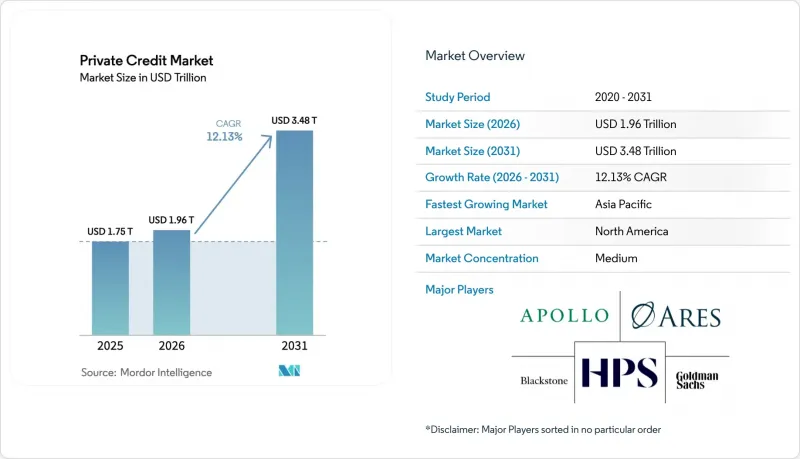
The growth path reflects the shift from an alternative asset class to a mainstream financing channel that now supports a wide range of middle-market and large corporate borrowers. Competitive tension from banks has increased since late 2025, which is likely to moderate pricing and growth while not changing the long-term adoption trend. Structural bank capital constraints under finalized and pending Basel frameworks continue to steer select lending exposures toward nonbank channels, which supports ongoing origination for the private credit market. Platform scale and specialization are differentiators, as managers expand into asset-backed finance and risk transfer partnerships with banks to sustain deal flow and defend returns.
Global Private Credit Market Trends and Insights
Basel III Endgame and Bank Lending Retrenchment
United States and European regulatory reforms are recalibrating capital allocation at large banks, which is raising the relative capital intensity of select corporate, leveraged, and project finance exposures and reinforcing a shift in lending activity toward nonbank channels. European lenders are already acting under Basel 3.1 through greater use of significant risk transfer to optimize risk-weighted assets, evidenced by ABN AMRO's inaugural USD 2.35 billion portfolio SRT that reduced risk-weighted assets by USD 1.88 billion. Banks are also using synthetic protection on the United States portfolios to manage concentration and reduce tail risk while retaining client relationships, as shown by Deutsche Pfandbriefbank's SRT, where credit protection covered a mezzanine tranche of a performing United States loan book. These actions create steady, diversified asset flow to private credit platforms that specialize in first loss and mezzanine tranches, which can meet banks' capital relief goals and deliver attractive risk adjusted returns to investors. As implementation timelines continue in Europe and the United Kingdom, and as United States rulemaking advances, the private credit market retains a structural role as a complementary source of financing alongside banks.
Refinancing Wall Dynamics and Maturity-Driven Deal Flow
A multi year refinancing cycle across leveraged finance and commercial real estate is increasing demand for bespoke recapitalizations and senior plus capital structures that the private credit market can price and deliver with speed and certainty. Tighter bank underwriting and floating rate cost pressures elevate the need for hybrid solutions that blend senior secured debt, mezzanine layers, and preferred equity to bridge valuation gaps that arose from the low rate 2020 2021 issuance window. The result is a larger opportunity set in sectors that face maturity concentration, where private vehicles can tailor structures to asset quality, business plan, and sponsor profile rather than rely on standardized syndication. Managers with asset backed expertise and restructuring know how are positioned to underwrite DSCR sensitive properties and operating companies with variable cash flows, allowing prudent leverage and tighter covenants to protect downside. The private credit market is therefore not only a lender of last resort in these cycles but a primary liquidity source that can stabilize healthy borrowers and accelerate resolution for weaker credits.
Spread Compression and BSL Market Competition
Reopened syndicated markets have tightened pricing and increased refinancing optionality for upper mid-market and large-cap borrowers, which compresses the illiquidity premium that supported recent private credit returns. As competition rises, deal terms trend toward borrower-friendly structures, with some transactions clearing at spreads that are closer to BSL levels. The impact is most visible in larger club deals where sponsors can syndicate risk across multiple lenders in either channel, pressuring private terms unless lenders enforce discipline on leverage, covenants, and documentation. Scale platforms with deep origination pipelines and sector breadth can be more selective, but mid-tier managers face deployment pressure that can erode risk-adjusted returns. In contrast, true middle market niches with smaller EBITDA still support firmer pricing and stronger creditor protections, which sustain differentiation for specialist lenders.
Other drivers and restraints analyzed in the detailed report include:
- Insurance Capital Allocation and Regulatory Clarity
- Bank Risk Transfer and SRT/CRT Market Expansion
- Documentation Erosion and LME Risk
For complete list of drivers and restraints, kindly check the Table Of Contents.
Segment Analysis
Direct lending accounted for 65.85% of the 2025 private credit market share, anchored by sponsor-backed buyouts and middle-market corporate financing, where untrenched and senior plus structures deliver certainty and speed. Sponsors have increasingly selected direct lenders as lead providers for leveraged transactions, which supports scale and consistency of deployment for large platforms with strong relationships. While competition is moderating forward growth in this segment, discipline around leverage, cash interest coverage, and governance keeps performance aligned with the profile of senior secured portfolios. In parallel, bank retrenchment in select corporate exposures and active risk transfer programs expand flow to nonbank channels, which supports steady origination even as public windows reopen. As a result, the private credit market continues to provide reliable sponsor finance, while pushing managers to differentiate on underwriting quality, sector focus, and portfolio construction.
Specialty finance is the fastest-growing application with a 13.97% CAGR to 2031, reflecting the rise of asset-backed finance, NAV lending, and credit secondaries as scaled, institutional strategies within the private credit market. Asset backed finance is gaining traction because collateral, structural features, and shorter durations can offset spread compression, while diversified loan pools help mitigate idiosyncratic risk. NAV lending has become a durable portfolio level tool, evidenced by record fund closes and balanced deployment across North America and Europe. Credit secondaries add another liquidity path for LPs and GPs and are now supported by multi billion dollar dedicated vehicles from leading platforms. Together, these strategies expand the private credit market size at the application level by adding diverse pools of risk that complement corporate direct lending and support smoother deployment across cycles.
The Private Credit Market Report Segmented by Application (Direct Lending, Mezzanine Financing, Distressed Debt, and Specialty Finance), by End-User (Small and Medium Enterprises (SMEs) and Large Corporations), and by Geography (North America, South America, Europe, Asia-Pacific, and Middle East & Africa). The Report Offers Market Size and Forecasts for the Private Credit Market in Value (USD) for all the Above Segments.
Geography Analysis
North America held 60.12% of the private credit market in 2025, supported by the region's deep sponsor ecosystem, institutional capital pools, and non traded vehicles that expanded access for a broader investor base. Fundraising slowed in late 2025 as borrowers tapped reopened public channels and banks re engaged on select leveraged financings, which contributed to tighter spreads in upper mid market deals. Even so, the private credit market continues to anchor sponsor backed transactions with execution speed and relationship depth, while serving as a liquidity backstop for maturities that require structured solutions. The private credit market share in North America remains supported by scaled platforms with cross cycle underwriting records and sector specialization.
Europe's growth accelerated in 2025 as Basel 3.1 implementation raised capital costs for select bank exposures and directed balance sheets toward risk transfer, which expanded origination opportunities for large private lenders. Deployment and deal counts reached record levels in the region, reflecting both sponsor activity and growing demand from founder-owned businesses that value certainty and confidentiality. European banks' use of SRT structures shows a durable path for banks and private lenders to collaborate on capital optimization, which expands the private credit market's addressable pool across corporate and real estate assets. As regional regulations like CCD2 for consumer credit take effect, lenders are refining processes, disclosures, and oversight, which should improve transparency and investor confidence.
Asia Pacific is the fastest growing region with a projected 12.50% CAGR, supported by supply chain shifts, infrastructure buildouts, and regulatory evolution that enable more flexible nonbank lending. Dedicated Asia private credit funds have scaled, with managers targeting healthcare, education, logistics, real estate, and digital infrastructure across major markets with creditor friendly regimes. Real estate and infrastructure financing underpin much of the regional demand as local banks face balance sheet constraints and sponsors seek quick closes. On this path, the private credit market size in the Asia Pacific is set to rise as specialized managers expand origination and adapt structures to local legal frameworks while maintaining global risk standards.
- Ares Management
- Blackstone Credit & Insurance
- HPS Investment Partners
- KKR Private Credit
- Apollo Global Management (Private Credit)
- Blue Owl Capital
- Goldman Sachs Asset Management Private Credit
- Oaktree Capital Management (Credit)
- Golub Capital
- Antares Capital
- Bain Capital Credit
- Carlyle Global Credit
- Barings Global Private Finance
- ICG (Intermediate Capital Group)
- Pemberton Asset Management
- Hayfin Capital Management
- Tikehau Capital
- Arcmont Asset Management (Nuveen Private Capital)
- Crescent Capital
- Monroe Capital
- Sixth Street Specialty Lending
- Permira Credit
- H.I.G. WhiteHorse
Additional Benefits:
- The market estimate (ME) sheet in Excel format
- 3 months of analyst support
TABLE OF CONTENTS
1 Introduction
- 1.1 Study Assumptions & Market Definition
- 1.2 Scope of the Study
2 Research Methodology
3 Executive Summary
4 Market Landscape
- 4.1 Market Overview
- 4.2 Market Drivers
- 4.2.1 Bank retrenchment under Basel III Endgame raises bank capital costs, shifting corporate lending to private credit
- 4.2.2 Refinancing and maturity walls in leveraged finance and CRE create multiyear private credit deal flow
- 4.2.3 Insurance capital accelerates allocations to private credit as Solvency II/NAIC clarifications improve capital efficiency
- 4.2.4 Bank risk-transfer deals (SRT/CRT) open new flow of assets to private credit platforms
- 4.2.5 NAV financing and private credit secondaries expand liquidity and the addressable market
- 4.2.6 AI/data-center and energy transition capex require bespoke, large-ticket private financings
- 4.3 Market Restraints
- 4.3.1 Spread compression from reopened syndicated markets narrows the private credit illiquidity premium
- 4.3.2 Documentation erosion (loose maintenance covenants, LME risk) can increase loss severity
- 4.3.3 Valuation opacity and thin secondary liquidity elevate exit risk and NAV smoothing concerns
- 4.3.4 Regulatory recalibration risk (Basel reproposal, NAIC RBC tweaks) may soften bank pullback or raise insurer capital
- 4.4 Value / Supply Chain Analysis
- 4.5 Regulatory Landscape
- 4.6 Technological Outlook
- 4.7 Porter's Five Forces Analysis
- 4.7.1 Threat of New Entrants
- 4.7.2 Bargaining Power of Capital Providers
- 4.7.3 Bargaining Power of Borrowers
- 4.7.4 Threat of Substitutes
- 4.7.5 Industry Rivalry
5 Market Size & Growth Forecasts
- 5.1 By Application
- 5.1.1 Direct Lending
- 5.1.2 Mezzanine Financing
- 5.1.3 Distressed Debt
- 5.1.4 Specialty Finance
- 5.2 By End-User
- 5.2.1 Small and Medium Enterprises (SMEs)
- 5.2.2 Large Corporations
- 5.3 By Geography
- 5.3.1 North America
- 5.3.1.1 Canada
- 5.3.1.2 United States
- 5.3.1.3 Mexico
- 5.3.2 South America
- 5.3.2.1 Brazil
- 5.3.2.2 Peru
- 5.3.2.3 Chile
- 5.3.2.4 Argentina
- 5.3.2.5 Rest of South America
- 5.3.3 Europe
- 5.3.3.1 United Kingdom
- 5.3.3.2 Germany
- 5.3.3.3 France
- 5.3.3.4 Spain
- 5.3.3.5 Italy
- 5.3.3.6 BENELUX (Belgium, Netherlands, Luxembourg)
- 5.3.3.7 NORDICS (Denmark, Finland, Iceland, Norway, Sweden)
- 5.3.3.8 Rest of Europe
- 5.3.4 Asia-Pacific
- 5.3.4.1 India
- 5.3.4.2 China
- 5.3.4.3 Japan
- 5.3.4.4 Australia
- 5.3.4.5 South Korea
- 5.3.4.6 South East Asia (Singapore, Malaysia, Thailand, Indonesia, Vietnam, Philippines)
- 5.3.4.7 Rest of Asia-Pacific
- 5.3.5 Middle East and Africa
- 5.3.5.1 United Arab Emirates
- 5.3.5.2 Saudi Arabia
- 5.3.5.3 South Africa
- 5.3.5.4 Nigeria
- 5.3.5.5 Rest of Middle East and Africa
- 5.3.1 North America
6 Competitive Landscape
- 6.1 Market Concentration
- 6.2 Strategic Moves
- 6.3 Market Share Analysis
- 6.4 Company Profiles {(includes Global level Overview, Market level overview, Core Segments, Financials as available, Strategic Information, Market Rank/Share for key companies, Products & Services, and Recent Developments)}
- 6.4.1 Ares Management
- 6.4.2 Blackstone Credit & Insurance
- 6.4.3 HPS Investment Partners
- 6.4.4 KKR Private Credit
- 6.4.5 Apollo Global Management (Private Credit)
- 6.4.6 Blue Owl Capital
- 6.4.7 Goldman Sachs Asset Management Private Credit
- 6.4.8 Oaktree Capital Management (Credit)
- 6.4.9 Golub Capital
- 6.4.10 Antares Capital
- 6.4.11 Bain Capital Credit
- 6.4.12 Carlyle Global Credit
- 6.4.13 Barings Global Private Finance
- 6.4.14 ICG (Intermediate Capital Group)
- 6.4.15 Pemberton Asset Management
- 6.4.16 Hayfin Capital Management
- 6.4.17 Tikehau Capital
- 6.4.18 Arcmont Asset Management (Nuveen Private Capital)
- 6.4.19 Crescent Capital
- 6.4.20 Monroe Capital
- 6.4.21 Sixth Street Specialty Lending
- 6.4.22 Permira Credit
- 6.4.23 H.I.G. WhiteHorse
7 Market Opportunities & Future Outlook
- 7.1 White space & Unmet need Assessment

