PUBLISHER: Mordor Intelligence | PRODUCT CODE: 2044103

PUBLISHER: Mordor Intelligence | PRODUCT CODE: 2044103
Enterprise Resource Planning - Market Share Analysis, Industry Trends & Statistics, Growth Forecasts (2026 - 2031)
The Enterprise Resource Planning Market size was valued at USD 71.62 billion in 2025 and is estimated to grow from USD 78.15 billion in 2026 to reach USD 120.96 billion by 2031, at a CAGR of 9.12% during the forecast period (2026-2031).
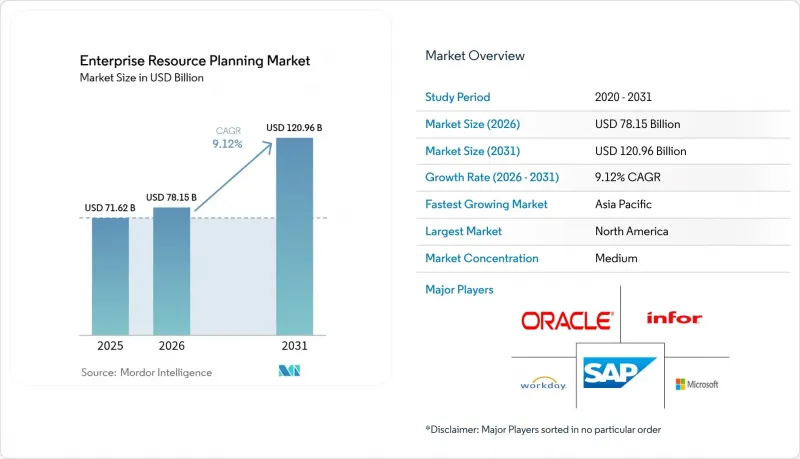
Strong demand for integrated process automation, faster cloud migration, and AI-enabled analytics is propelling expansion across manufacturing, services, and public-sector organizations. Vendors have shifted road maps toward cloud-native suites that lower infrastructure costs, while enterprises accelerate modernization to improve real-time visibility and regulatory compliance. Spurred by mandatory e-invoicing laws and ESG accounting requirements, companies are prioritizing embedded compliance capabilities that reduce audit risk and support cross-border operations. Competitive dynamics are shaped by a shortfall of skilled consultants, prompting providers to invest in low-code configuration tools that shorten deployment timelines and lower total cost of ownership.
Global Enterprise Resource Planning Market Trends and Insights
Cloud-First Migration Momentum
Enterprises are accelerating the shift from on-premise suites to cloud deployments in the enterprise resource planning market to unlock elastic scalability, subscription pricing, and continuous functional updates. Mid-market firms embrace operating-expense models that free cash for growth, while large companies leverage vendor programs such as RISE with SAP to consolidate fragmented landscapes. In addition, hyperscale hosting options enable customers to localize sensitive ledgers for data sovereignty compliance without sacrificing unified reporting. Continuous release cycles keep tax codes and security patches up to date, reducing audit exposure and disruption during upgrades. As a result, cloud conversions help the market add new subscribers faster than traditional license refreshes.
AI-Driven Analytics Embedded in ERP
Artificial intelligence is recasting the enterprise resource planning market as a real-time decision engine rather than a static record repository. Acumatica's AI-first strategy, unveiled at its 2025 summit, embeds machine-learning models that predict late payments, optimize production runs, and recommend purchase quantities. Similar natural-language query features in Oracle NetSuite let staff build multi-dimensional reports without SQL expertise. Internal vendor benchmarks show that AI-assisted forecasting can reduce safety-stock buffers by up to 30%, freeing up cash for investment. Low-code AI builders are also democratizing algorithm customization, enabling finance and operations teams to prototype use cases without data science support. These advances expand the market beyond compliance automation, enabling revenue growth.
High Implementation and Switching Costs
Upfront license fees, process redesign workshops, and staff training can push ERP projects for a mid-size organization above USD 1 million. Panorama Consulting surveys reveal that total outlays often double when data migration and change-management services are factored in, extending payback periods beyond 3 years. Budget constraints in emerging regions amplify sensitivity to large capital commitments. Although SaaS contracts distribute expense over time, hidden integration work and temporary parallel-run costs remain significant. Consequently, some firms postpone modernization until regulatory deadlines or customer mandates force action, which caps short-term market growth.
Other drivers and restraints analyzed in the detailed report include:
- SME SaaS Adoption Surge
- Mandatory E-Invoicing Mandates
- Shortage of Micro-Vertical ERP Talent
For complete list of drivers and restraints, kindly check the Table Of Contents.
Segment Analysis
Solutions maintained a commanding 58.91% share of the enterprise resource planning market in 2025, reflecting the universal need for integrated financial, supply chain, and human capital modules. Yet service revenue is rising at a 13.89% CAGR as customers seek industry-specific consulting, data cleansing, and user adoption coaching. The market for professional services is on track to nearly double by 2031, surpassing traditional customization budgets. Vendors such as Acumatica introduced professional-services editions bundling project accounting, resource scheduling, and revenue recognition to streamline deployment for law, design, and consulting agencies. Growing demand for continuous improvement and AI tuning offsets narrowing software gross margins and secures annuity streams for providers.
Implementation roadmaps now prioritize business-process redesign over feature parity, elevating the strategic role of consulting partners. Low-code workflow builders enable rapid prototyping of industry-specific variants, reducing coding volume while increasing advisory hours. Customers also purchase subscription-based success plans that include quarterly health checks, regulatory patching, and AI model retraining. These shifts reposition services from ancillary to core revenue, reinforcing the hybrid product-plus-consulting value proposition that defines the contemporary market.
Cloud architectures accounted for 55.73% of the market in 2025, securing the majority of new installations thanks to predictable operating expenses and automatic upgrades. However, hybrid configurations that blend private, public, and on-premises assets are advancing at a 16.12% CAGR. Multinational manufacturers frequently retain financial ledgers in local data centers for sovereignty compliance while hosting analytics and collaboration tools in regional clouds. As a result, the enterprise resource planning market size for hybrid solutions is projected to outpace that of pure cloud segments.
SAP's RISE program exemplifies this trend by enabling customers to deploy S/4HANA on hyperscalers while keeping manufacturing execution systems on-site. Pharmaceutical firms value the ability to preserve plant-floor latency budgets while sharing centralized quality data for global batch release. Hybrid blueprints also support phased migrations, allowing legacy add-ons to retire gradually without the risk of a big bang. Consequently, the market's deployment landscape is evolving toward coexistence models that balance control, performance, and elasticity.
The Enterprise Resource Planning Market Report is Segmented by Offering (Solutions, and Services), Deployment (On-Premise, Cloud, Hybrid), Enterprise Size (Large Enterprises, and Small and Medium-Sized Enterprises), End-User Industry (Manufacturing, Retail and E-Commerce, BFSI, IT and Telecom, Healthcare, and More), and Geography. The Market Forecasts are Provided in Terms of Value (USD).
Geography Analysis
North America accounted for 34.02% of the market revenue in 2025, driven by several key factors, including high cloud adoption rates, robust partner networks, and the presence of a significant number of Fortune 500 organizations. The region benefits from its early adoption of SaaS solutions, supported by a mature venture-capital ecosystem that continues to fuel demand for modern ERP suites. These suites are increasingly integrating advanced technologies like artificial intelligence (AI) and sophisticated analytics to meet evolving business needs. Additionally, digital-first government procurement policies are playing a crucial role in encouraging public-sector agencies to adopt ERP systems, further solidifying the region's leadership in the market.
Europe maintains steady market growth, with widespread adoption across key sectors such as manufacturing and public administration. However, the introduction of mandatory e-invoicing laws is triggering a new replacement cycle for ERP systems. To address these regulatory changes, vendors are offering solutions equipped with localized tax engines, GDPR-compliant data-residency features, and pre-configured charts of accounts tailored to regional requirements. These capabilities are enabling businesses to transition from outdated on-premise platforms to modern subscription-based models. As a result, the region is experiencing stable mid-single-digit growth, driven by the need for compliance and operational efficiency.
Asia-Pacific is emerging as the fastest-growing region in the market, with a CAGR of 11.96%. This growth is fueled by rapid industrial expansion in countries such as China, India, and those in Southeast Asia. Government initiatives, including grants and subsidies, combined with the increasing affordability of mobile broadband and the growing availability of cloud infrastructure, are significantly boosting cloud ERP deployments. These deployments are particularly prominent among mid-tier manufacturers and service-oriented firms. Furthermore, hyperscale cloud providers are investing in the development of regional data centers, which not only comply with data-sovereignty regulations but also enhance user response times. These advancements are ensuring that the enterprise resource planning market in Asia-Pacific continues to experience robust double-digit growth, driven by the region's dynamic economic landscape and technological advancements.
- SAP SE
- Oracle Corporation
- Microsoft Corporation
- Infor Inc.
- Sage Group plc
- Epicor Software Corporation
- IFS AB
- Infor Inc.
- Unit4 NV
- Acumatica, Inc.
- Odoo SA
- QAD Inc.
- Plex Systems, Inc.
- Deltek, Inc.
- Priority Software Ltd.
- Ramco Systems
- Syspro
- TOTVS
- Yonyou
- HashMicro
Additional Benefits:
- The market estimate (ME) sheet in Excel format
- 3 months of analyst support
TABLE OF CONTENTS
1 INTRODUCTION
- 1.1 Study Assumptions and Market Definition
- 1.2 Scope of the Study
2 RESEARCH METHODOLOGY
3 EXECUTIVE SUMMARY
4 MARKET LANDSCAPE
- 4.1 Market Overview
- 4.2 Market Drivers
- 4.2.1 Cloud-First Migration Momentum
- 4.2.2 AI-Driven Analytics Embedded in ERP
- 4.2.3 SME SaaS Adoption Surge
- 4.2.4 Mandatory E-Invoicing Mandates (VAT, CTC)
- 4.2.5 ESG Accounting Add-Ons For Scope-3 Tracking
- 4.2.6 Increasing Adoption of Cloud-Based ERP Solutions
- 4.3 Market Restraints
- 4.3.1 High Implementation and Switching Costs
- 4.3.2 Data Integration and Legacy Complexity
- 4.3.3 Rising Data-Sovereignty / Residency Laws
- 4.3.4 Shortage Of Micro-Vertical ERP Talent
- 4.4 Industry Value Chain Analysis
- 4.5 Regulatory Landscape
- 4.6 Technological Outlook
- 4.7 Porter's Five Forces Analysis
- 4.7.1 Bargaining Power of Suppliers
- 4.7.2 Bargaining Power of Buyers
- 4.7.3 Threat of New Entrants
- 4.7.4 Threat of Substitutes
- 4.7.5 Intensity of Competitive Rivalry
- 4.8 Pricing Analysis
- 4.9 Ecosystem Analysis
5 MARKET SIZE AND GROWTH FORECASTS (VALUE)
- 5.1 By Offering
- 5.1.1 Solutions
- 5.1.2 Services
- 5.2 By Deployment
- 5.2.1 On-premise
- 5.2.2 Cloud
- 5.2.3 Hybrid
- 5.3 By Function
- 5.3.1 Human Resources
- 5.3.2 Supply Chain
- 5.3.3 Finance
- 5.3.4 Marketing
- 5.3.5 Other Functions
- 5.4 By Enterprise Size
- 5.4.1 Large Enterprises
- 5.4.2 Small and Medium-Sized Enterprises
- 5.5 By End-user Industry
- 5.5.1 Manufacturing
- 5.5.2 Retail and E-commerce
- 5.5.3 BFSI
- 5.5.4 IT and Telecom
- 5.5.5 Government and Public Sector
- 5.5.6 Energy and Utilities
- 5.5.7 Healthcare
- 5.5.8 Other End-user Industries
- 5.6 By Geography
- 5.6.1 North America
- 5.6.1.1 United States
- 5.6.1.2 Canada
- 5.6.1.3 Mexico
- 5.6.2 South America
- 5.6.2.1 Brazil
- 5.6.2.2 Argentina
- 5.6.2.3 Rest of South America
- 5.6.3 Europe
- 5.6.3.1 United Kingdom
- 5.6.3.2 Germany
- 5.6.3.3 France
- 5.6.3.4 Italy
- 5.6.3.5 Spain
- 5.6.3.6 Rest of Europe
- 5.6.4 Asia-Pacific
- 5.6.4.1 China
- 5.6.4.2 Japan
- 5.6.4.3 India
- 5.6.4.4 South Korea
- 5.6.4.5 Rest of Asia-Pacific
- 5.6.5 Middle East and Africa
- 5.6.5.1 Middle East
- 5.6.5.1.1 United Arab Emirates
- 5.6.5.1.2 Saudi Arabia
- 5.6.5.1.3 Rest of Middle East
- 5.6.5.2 Africa
- 5.6.5.2.1 South Africa
- 5.6.5.2.2 Egypt
- 5.6.5.2.3 Rest of Africa
- 5.6.5.1 Middle East
- 5.6.1 North America
6 COMPETITIVE LANDSCAPE
- 6.1 Market Concentration
- 6.2 Strategic Moves
- 6.3 Market Share Analysis
- 6.4 Company Profiles (includes Global level Overview, Market level overview, Core Segments, Financials as available, Strategic Information, Market Rank/Share for key companies, Products and Services, and Recent Developments)
- 6.4.1 SAP SE
- 6.4.2 Oracle Corporation
- 6.4.3 Microsoft Corporation
- 6.4.4 Infor Inc.
- 6.4.5 Sage Group plc
- 6.4.6 Epicor Software Corporation
- 6.4.7 IFS AB
- 6.4.8 Infor Inc.
- 6.4.9 Unit4 NV
- 6.4.10 Acumatica, Inc.
- 6.4.11 Odoo SA
- 6.4.12 QAD Inc.
- 6.4.13 Plex Systems, Inc.
- 6.4.14 Deltek, Inc.
- 6.4.15 Priority Software Ltd.
- 6.4.16 Ramco Systems
- 6.4.17 Syspro
- 6.4.18 TOTVS
- 6.4.19 Yonyou
- 6.4.20 HashMicro
7 MARKET OPPORTUNITIES AND FUTURE TRENDS
- 7.1 White-Space and Unmet-Need Assessment

