PUBLISHER: Mordor Intelligence | PRODUCT CODE: 2044136

PUBLISHER: Mordor Intelligence | PRODUCT CODE: 2044136
Healthcare IT - Market Share Analysis, Industry Trends & Statistics, Growth Forecasts (2026 - 2031)
The Healthcare IT Market size is expected to increase from USD 0.47 trillion in 2025 to USD 0.55 trillion in 2026 and reach USD 1.16 trillion by 2031, growing at a CAGR of 16.41% over 2026-2031.
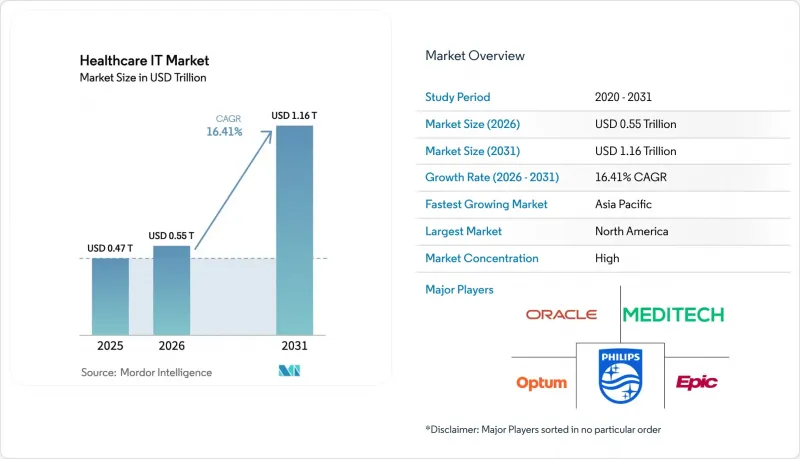
Current momentum stems from mandatory interoperability rules, replacement of on-premises stacks with cloud-native architectures, and rapid infusion of artificial intelligence into both clinical and revenue-cycle workflows.Clinical platforms account for nearly half of sector revenue as hospitals emphasize population-health analytics and AI-assisted diagnosis. Managed integration services gain traction because payers, providers, and life-science firms must re-architect data pipelines on compressed timelines. Cloud hyperscalers undercut traditional vendors by bundling elastic compute, analytics, and AI toolkits, while ransomware events expose security gaps that accelerate spending on decentralized architectures and zero-trust frameworks. Regional growth disparities persist, with Asia-Pacific outpacing mature markets as national digital-health missions in China and India mandate province-level exchanges and universal health IDs.
Global Healthcare IT Market Trends and Insights
Regulatory Interoperability Mandates
The Trusted Exchange Framework and Common Agreement, finalized in December 2024, obliges qualified health-information networks to support HL7 FHIR APIs by July 2025. The rule removes proprietary data blocking that once cost providers USD 8.3 billion each year in manual reconciliation. Twenty-three U.S. states codified similar laws for Medicaid managed-care plans during 2024, raising the compliance floor for vendors. CMS will require payers to answer urgent prior-authorization requests within 72 hours beginning January 2026, which benefits platform vendors that embed real-time eligibility checks. Suppliers dependent on batch EDI transactions now face margin pressure as penalties grow for delays.
Cloud Migration and SaaS Adoption Across Provider and Payer IT
Public-cloud infrastructure processed more than 40% of electronic-health-record workloads in 2024, up from 28% in 2022, as hospitals sought elastic compute for AI training and disaster recovery at lower cost. AWS HealthLake handled over 2 billion clinical records in 2024, while Microsoft combined Nuance's ambient-documentation engine with Teams-based telehealth to reduce physician paperwork by two hours per day in a 2024 multi-site study. Cloud lock-in risk persists because some vendors bundle proprietary middleware with EHR upgrades, raising exit costs for customers.
Escalating Data Privacy, Cyber Risk, and Compliance Costs
A February 2024 ransomware strike on Change Healthcare encrypted claims systems for 900,000 providers and exposed records for over 100 million individuals, triggering the largest HIPAA breach notification to date. UnitedHealth booked USD 2.3 billion in remediation and revenue loss during 2024. Cyber-insurance premiums for hospitals rose 47% in 2024, and carriers now require multi-factor authentication, endpoint detection, and annual penetration testing, raising average security budgets by USD 1.8 million per facility. Multinational vendors must also comply with GDPR fines of up to 4% of their global revenue and China's local data residency rules, which can lead to infrastructure duplication and delay product rollouts.
Other drivers and restraints analyzed in the detailed report include:
- AI/ML Deployment Across Clinical and Administrative Workflows
- Telehealth, RPM, and Digital Front-Door Integration at Scale
- Integration Complexity and Vendor Lock-In
For complete list of drivers and restraints, kindly check the Table Of Contents.
Geography Analysis
North America held 46.77% of 2025 revenue, buoyed by Medicare Advantage enrollment exceeding half of beneficiaries and CMS policies tying physician payments to interoperability metrics. The TEFCA mandate requires HL7 FHIR Release 4 APIs by mid-2025, spurring integration spending across health-information networks. Canada earmarked CAD 2.1 billion (USD 1.55 billion) in 2024 for provincial EHR upgrades, while Mexico launched a nationwide EHR pilot covering 12 million beneficiaries, aiming for full deployment by 2027.
Asia-Pacific is the fastest-growing region with a 17.81% CAGR, led by China's Healthy China 2030 drive and India's Ayushman Bharat Digital Mission, which enrolled more than 500 million citizens in unique health IDs by late 2024. China's national policy required all tertiary hospitals to run electronic medical records by December 2024, sparking new contracts for international and domestic vendors. Japan invested JPY 450 billion (USD 3.1 billion) in 2024 to merge My Number Cards with insurance claims, and South Korea's health-insurance agency deployed AI claims-adjudication to spot fraudulent billing worth KRW 1.2 trillion (USD 900 million) yearly.
Europe benefits from the European Health Data Space regulation that mandates cross-border EHR access by 2025 under GDPR-aligned consent rules. Germany is rolling out biometric health cards, France enrolled 38 million citizens in its Mon Espace Sante portal, and the United Kingdom is centralizing data from 42 integrated-care systems into a federated analytics platform. The Middle East, Africa, and South America trail in absolute spending yet display niche surges: the UAE mandated EHR interoperability for all hospitals by December 2024, and Brazil's Conecte SUS enrolled 160 million citizens in a national health ID by late 2024.
- Epic Systems Corp.
- Oracle Health (Cerner)
- McKesson Corp.
- Koninklijke Philips
- GE Healthcare
- Siemens Healthineers
- Allscripts (Altera Digital Health)
- athenahealth
- IBM
- Optum
- Teladoc Health
- Amwell
- InterSystems Corp.
- Meditech
- Change Healthcare
- R1 RCM
- Accenture Health
- Cognizant Digital Health
- Tata Consultancy Services (TCS)
- Wipro HealthEdge
Additional Benefits:
- The market estimate (ME) sheet in Excel format
- 3 months of analyst support
TABLE OF CONTENTS
1 Introduction
- 1.1 Study Assumptions & Market Definition
- 1.2 Scope of the Study
2 Research Methodology
3 Executive Summary
4 Market Landscape
- 4.1 Market Overview
- 4.2 Market Drivers
- 4.2.1 AI-Driven Clinical Decision Support Adoption
- 4.2.2 Rapid Telehealth Uptake in Rural Areas
- 4.2.3 Rise in the Demand for Paper-less Technology
- 4.2.4 Increased Government Funding on Healthcare Services and Infrastructure
- 4.2.5 Aging Population Driving Remote Patient-Monitoring Deployment
- 4.3 Market Restraints
- 4.3.1 Complexity of Regulations
- 4.3.2 Shortage of Skilled Health-IT Workforce
- 4.3.3 Capital-Budget Constaint in Small and Medium sized Healthcare facilities
- 4.4 Supply-Chain Analysis
- 4.5 Technological Outlook
- 4.6 Porter's Five Forces
- 4.6.1 Threat of New Entrants
- 4.6.2 Bargaining Power of Buyers
- 4.6.3 Bargaining Power of Suppliers
- 4.6.4 Threat of Substitutes
- 4.6.5 Intensity of Competitive Rivalry
5 Market Size & Growth Forecasts (Value, USD)
- 5.1 By Application
- 5.1.1 Electronic Health Records (EHR)
- 5.1.2 Picture Archiving & Communication Systems (PACS)
- 5.1.3 Medical Imaging Information Systems (RIS)
- 5.1.4 Laboratory Information Systems (LIS)
- 5.1.5 Computerized Physician Order Entry (CPOE)
- 5.1.6 Clinical Decision Support Systems (CDSS)
- 5.1.7 Telehealth Solutions
- 5.1.8 Remote Patient Monitoring
- 5.1.9 Revenue Cycle Management (RCM)
- 5.1.10 Pharmacy Information Systems (PIS)
- 5.1.11 Clinical Information systems
- 5.1.12 Digital Healthcare Supply chain management systems
- 5.1.13 Customer Relationship Management (CRM)
- 5.1.14 Healthcare Payer Solutions
- 5.1.15 Fraud Detection & Payment Integrity
- 5.1.16 Others
- 5.2 By Component
- 5.2.1 Software
- 5.2.2 Hardware
- 5.2.3 Services
- 5.3 By Delivery Mode
- 5.3.1 On-Premise
- 5.3.2 Cloud-Based
- 5.4 By End-User
- 5.4.1 Hospitals & Health Systems
- 5.4.2 Diagnostic & Imaging Centers
- 5.4.3 Others
- 5.5 Geography
- 5.5.1 North America
- 5.5.1.1 United States
- 5.5.1.2 Canada
- 5.5.1.3 Mexico
- 5.5.2 Europe
- 5.5.2.1 Germany
- 5.5.2.2 United Kingdom
- 5.5.2.3 France
- 5.5.2.4 Italy
- 5.5.2.5 Spain
- 5.5.2.6 Rest of Europe
- 5.5.3 Asia-Pacific
- 5.5.3.1 China
- 5.5.3.2 Japan
- 5.5.3.3 India
- 5.5.3.4 Australia
- 5.5.3.5 South Korea
- 5.5.3.6 Rest of Asia-Pacific
- 5.5.4 Middle East and Africa
- 5.5.4.1 GCC
- 5.5.4.2 South Africa
- 5.5.4.3 Rest of Middle East and Africa
- 5.5.5 South America
- 5.5.5.1 Brazil
- 5.5.5.2 Argentina
- 5.5.5.3 Rest of South America
- 5.5.1 North America
6 Competitive Landscape
- 6.1 Market Concentration
- 6.2 Market Share Analysis
- 6.3 Company Profiles (includes Global level Overview, Market level overview, Core Business Segments, Financials, Headcount, Key Information, Market Rank, Market Share, Products and Services, and analysis of Recent Developments)
- 6.3.1 Epic Systems Corp.
- 6.3.2 Oracle Health (Cerner)
- 6.3.3 McKesson Corp.
- 6.3.4 Philips Healthcare
- 6.3.5 GE HealthCare
- 6.3.6 Siemens Healthineers
- 6.3.7 Allscripts (Altera Digital Health)
- 6.3.8 athenahealth
- 6.3.9 IBM Watson Health
- 6.3.10 Optum Inc.
- 6.3.11 Teladoc Health
- 6.3.12 Amwell
- 6.3.13 InterSystems Corp.
- 6.3.14 MEDITECH
- 6.3.15 Change Healthcare
- 6.3.16 R1 RCM Inc.
- 6.3.17 Accenture Health
- 6.3.18 Cognizant Digital Health
- 6.3.19 Tata Consultancy Services (TCS)
- 6.3.20 Wipro HealthEdge
7 Market Opportunities & Future Outlook
- 7.1 White-space & Unmet-need Assessment

