PUBLISHER: Mordor Intelligence | PRODUCT CODE: 2044176

PUBLISHER: Mordor Intelligence | PRODUCT CODE: 2044176
Disposable Syringes - Market Share Analysis, Industry Trends & Statistics, Growth Forecasts (2026 - 2031)
The Disposable Syringes Market size is expected to increase from USD 17.48 billion in 2025 to USD 18.36 billion in 2026 and reach USD 24.94 billion by 2031, growing at a CAGR of 6.32% over 2026-2031.
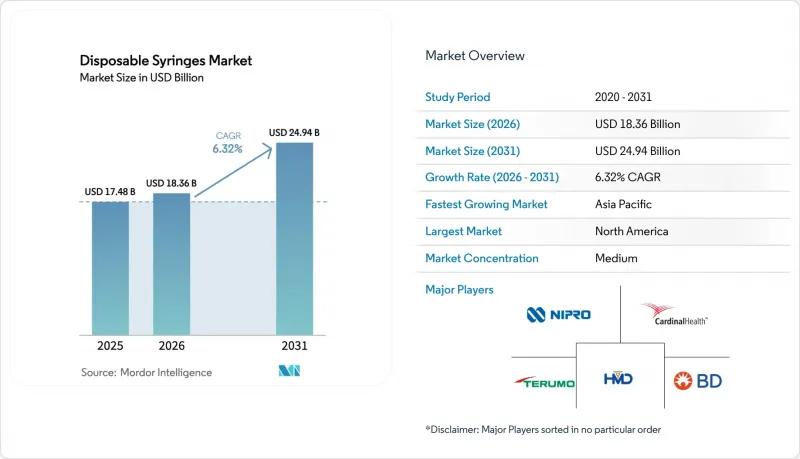
Regulatory mandates that favor single-use safety mechanisms, continuing immunization drives in low- and middle-income countries, and greater use of prefilled formats for biologics and GLP-1 receptor agonists anchor current growth. Hospitals still purchase the largest volumes, yet home-based care is gathering pace as payers reimburse patient self-administration kits and telehealth platforms track adherence. Material selection is also in flux as polypropylene remains dominant on cost grounds while early biodegradable blends enter pilot use. Competitive strategy now centers on capacity expansions, line automation, and differentiated safety technologies that lower needlestick liability and win group-purchasing contracts.
Global Disposable Syringes Market Trends and Insights
Rising Global Immunization & Booster Programs
WHO's Immunization Agenda 2030 targets 90% coverage for essential childhood vaccines, a goal that demands up to 10 billion single-use syringes every year.The 2023 "Big Catch-Up" mobilized USD 500 million in donor funding and lifted 2025 auto-disable syringe shipments above 2 billion units. Booster programs for COVID-19, influenza, and mpox cement single-use devices as standard practice. UNICEF's 2025 Supply Division noted a 22% jump in auto-disable orders, with 65% flowing to low- and middle-income countries. Pharmaceutical companies now bundle vaccines in prefilled syringes, reducing reconstitution errors and tightening cold-chain logistics.
Increasing Prevalence of Chronic Diseases Requiring Injectable Therapies
Diabetes, rheumatoid arthritis, multiple sclerosis, and cardiovascular diseases together affect more than 1.5 billion people, and injectables dominate new treatment protocols. GLP-1 agonists generated USD 50 billion in 2025 sales, prompting Novo Nordisk and Eli Lilly to expand prefilled syringe capacity by over one-third. The CDC counted 8.7 million U.S. insulin users in 2024, consuming roughly 3.2 billion syringe units yearly. An aging Japanese, German, and Italian population amplifies demand because patients over 65 now hold 60% of injectable prescriptions.
Stringent Disposal & Plastic-Waste Regulations
The EU's Single-Use Plastics Directive spurred member states to launch extended producer responsibility schemes; France now makes syringe suppliers fund half of municipal sharps collection programs. Germany's Packaging Act requires 30% recycled content in polypropylene medical devices by 2028. California passed a Medical Device Stewardship Act in 2025 that obliges manufacturers to run take-back programs. Compliance costs compress margins on high-volume conventional syringes.
Other drivers and restraints analyzed in the detailed report include:
- Regulatory Mandates Promoting Single-Use Safety-Engineered Devices
- Growing Demand for Prefilled & Self-Administered Syringes
- High-Cost Sensitivity for Safety Syringes in Low-Income Settings
For complete list of drivers and restraints, kindly check the Table Of Contents.
Segment Analysis
Safety disposable syringes held 53.53% revenue share in 2025. Auto-disable syringes, insulated from reuse risk and compliant with WHO standards, will post a 9.45% CAGR to 2031, surpassing all other formats. Conventional units persist in cost-sensitive laboratories. Retractable safety designs appeal to emergency departments seeking fast disposal and lower liability. Prefilled devices now capture over 30% of revenue despite lower volumes. Smart connected models remain at pilot scale because cybersecurity validation stretches product timelines.
Producers invest in 64-cavity molds and automated assembly to cut per-unit costs. Becton, Dickinson and Company's BD Integra has secured 12% of U.S. hospital contracts through group-purchasing deals, illustrating how feature differentiation wins share. Venture funding of USD 120 million in 2024-2025 signals investor confidence in connected devices that may leverage cloud analytics for adherence.
Therapeutic injections controlled 62.55% of 2025 revenue, propelled by diabetes and oncology regimens relying on subcutaneous delivery. Immunization injections will grow 9.22% annually to 2031 as catch-up drives close pandemic gaps. Blood-collection devices account for small value but high frequency.
Subcutaneous reformulation of blockbuster monoclonal antibodies adds an estimated 500 million syringes annually. Point-of-care microsampling may chip away at venous draws, yet adoption remains limited to high-resource clinics.
The Disposable Syringes Market Report is Segmented by Product Type (Conventional, Safety [Non-Retractable Safety Syringes and More], and More, Application (Immunization, Therapeutic, Blood Collection), End User (Hospitals, Blood Centers, Ascs, Home Healthcare), Material (Plastic, Glass, Biodegradable), Technology (Passive, and More), and Geography (North America, and More)). Market Forecasts are Provided in Value (USD).
Geography Analysis
North America contributed 37.12% of global revenue in 2025. Vendor-managed inventory contracts allow the U.S. Strategic National Stockpile to hold 150 million syringes on a rolling basis, creating a stable baseline of orders. CMS reimbursement favors safety-engineered devices and accelerates home-care uptake. Canada expanded its National Emergency Strategic Stockpile to 80 million units in 2024. Mexico's IMSS procured 120 million syringes in 2025, incorporating local assembly clauses to spur domestic industry.
Asia-Pacific is forecast at an 8.03% CAGR from 2026-2031. Hindustan Syringes & Medical Devices will double auto-disable capacity after a USD 50 million investment, aiming at UNICEF and WHO tenders. Nipro's Welsh expansion added 1.2 billion units to European supply chains. China's NMPA harmonized standards with WHO criteria in 2024, opening global markets for local producers. Japan's aging population encourages prefilled devices for home-based insulin delivery and GLP-1 therapy.
Europe enforces MDR Class IIa conformity, raising barriers for new entrants. Germany, France, the U.K., Italy, and Spain make up two-thirds of European demand. The NHS aims for 25% bio-based devices by 2030. France's decree obliges suppliers to fund half of sharps collection, increasing per-unit costs. The Middle East and Africa build capacity: GCC states ordered 80 million syringes in 2025, while South Africa inked a 150 million-unit contract with BD. In South America, Brazil's SUS bought 200 million units and Argentina expanded coverage under its 2024 immunization plan.
- B. Braun
- Baxter
- Beckton Dickinson
- Cardinal Health
- Fresenius
- Gerresheimer
- Henke Sass Wolf
- Hindustan Syringes & Medical Devices Ltd.
- Jiangsu Kanghua (KDL) Medical Devices
- Medtronic
- Nipro
- Novo Nordisk
- Poly Medicure
- Retractable Technologies
- SCHOTT
- Smiths Group
- Stevanato Group
- Terumo
- Weigao Group Medical Polymer Co. Ltd.
- West Pharmaceutical Services
Additional Benefits:
- The market estimate (ME) sheet in Excel format
- 3 months of analyst support
TABLE OF CONTENTS
1 Introduction
- 1.1 Study Assumptions & Market Definition
- 1.2 Scope of the Study
2 Research Methodology
3 Executive Summary
4 Market Landscape
- 4.1 Market Overview
- 4.2 Market Drivers
- 4.2.1 Rising Global Immunization & Booster Programs
- 4.2.2 Increasing Prevalence of Chronic Diseases Requiring Injectable Therapies
- 4.2.3 Regulatory Mandates Promoting Single-Use Safety-Engineered Devices
- 4.2.4 Growing Demand for Prefilled & Self-Administered Syringes
- 4.2.5 Government Pandemic Stockpiling & Strategic Syringe Reserves
- 4.2.6 Biodegradable & Smart-Connected Syringe Innovations Gaining Traction
- 4.3 Market Restraints
- 4.3.1 Stringent Disposal & Plastic-Waste Regulations
- 4.3.2 High-Cost Sensitivity for Safety Syringes in Low-Income Settings
- 4.3.3 Gradual Substitution by Glass Syringes for Sensitive Biologics
- 4.3.4 Recall Risks from Heparin/Contaminant Events Undermining Confidence
- 4.4 Value / Supply-Chain Analysis
- 4.5 Regulatory Landscape
- 4.6 Technological Outlook
- 4.7 Porter's Five Forces Analysis
- 4.7.1 Threat of New Entrants
- 4.7.2 Bargaining Power of Suppliers
- 4.7.3 Bargaining Power of Buyers
- 4.7.4 Threat of Substitute Products
- 4.7.5 Intensity of Competitive Rivalry
5 Market Size & Growth Forecasts (Value in USD)
- 5.1 By Product Type
- 5.1.1 Conventional Disposable Syringes
- 5.1.2 Safety Disposable Syringes
- 5.1.2.1 Non-Retractable Safety Syringes
- 5.1.2.2 Retractable Safety Syringes
- 5.1.3 Auto-Disable Syringes
- 5.1.4 Prefilled Disposable Syringes
- 5.1.5 Smart / Connected Disposable Syringes
- 5.2 By Application
- 5.2.1 Immunization Injections
- 5.2.2 Therapeutic Injections
- 5.2.3 Blood Collection & Diagnostics
- 5.3 By End User
- 5.3.1 Hospitals & Clinics
- 5.3.2 Blood Collection Centres & Diagnostic Labs
- 5.3.3 Ambulatory Surgical Centres
- 5.3.4 Home Healthcare
- 5.4 By Material
- 5.4.1 Plastic (Polypropylene, Polycarbonate, COP/COC)
- 5.4.2 Glass
- 5.4.3 Biodegradable / Bio-polymer Blends
- 5.5 By Technology / Safety Mechanism
- 5.5.1 Passive Needle-Guard Safety
- 5.5.2 Manual Retractable Safety
- 5.5.3 Automatic Retractable Safety
- 5.5.4 Auto-Disable Mechanism
- 5.6 By Geography
- 5.6.1 North America
- 5.6.1.1 United States
- 5.6.1.2 Canada
- 5.6.1.3 Mexico
- 5.6.2 Europe
- 5.6.2.1 Germany
- 5.6.2.2 France
- 5.6.2.3 United Kingdom
- 5.6.2.4 Italy
- 5.6.2.5 Spain
- 5.6.2.6 Rest of Europe
- 5.6.3 Asia-Pacific
- 5.6.3.1 China
- 5.6.3.2 Japan
- 5.6.3.3 India
- 5.6.3.4 South Korea
- 5.6.3.5 Australia
- 5.6.3.6 Rest of Asia-Pacific
- 5.6.4 Middle East & Africa
- 5.6.4.1 GCC
- 5.6.4.2 South Africa
- 5.6.4.3 Rest of Middle East & Africa
- 5.6.5 South America
- 5.6.5.1 Brazil
- 5.6.5.2 Argentina
- 5.6.5.3 Rest of South America
- 5.6.1 North America
6 Competitive Landscape
- 6.1 Market Concentration
- 6.2 Market Share Analysis
- 6.3 Company Profiles (includes Global level Overview, Market level overview, Core Segments, Financials as available, Strategic Information, Market Rank/Share for key companies, Products & Services, and Recent Developments)
- 6.3.1 B. Braun Melsungen AG
- 6.3.2 Baxter International Inc.
- 6.3.3 Becton, Dickinson and Company (BD)
- 6.3.4 Cardinal Health, Inc.
- 6.3.5 Fresenius Kabi AG
- 6.3.6 Gerresheimer AG
- 6.3.7 Henke-Sass, Wolf GmbH
- 6.3.8 Hindustan Syringes & Medical Devices Ltd.
- 6.3.9 Jiangsu Kanghua (KDL) Medical Devices
- 6.3.10 Medtronic plc
- 6.3.11 Nipro Corporation
- 6.3.12 Novo Nordisk A/S
- 6.3.13 Poly Medicure Ltd
- 6.3.14 Retractable Technologies, Inc.
- 6.3.15 Schott AG
- 6.3.16 Smiths Medical (ICU Medical)
- 6.3.17 Stevanato Group
- 6.3.18 Terumo Corporation
- 6.3.19 Weigao Group Medical Polymer Co. Ltd.
- 6.3.20 West Pharmaceutical Services
7 Market Opportunities & Future Outlook
- 7.1 White-space & Unmet-Need Assessment

