PUBLISHER: Mordor Intelligence | PRODUCT CODE: 2044178

PUBLISHER: Mordor Intelligence | PRODUCT CODE: 2044178
Computer Vision - Market Share Analysis, Industry Trends & Statistics, Growth Forecasts (2026 - 2031)
The computer vision market size is projected to be USD 27.39 billion in 2025, USD 32.88 billion in 2026, and reach USD 68.38 billion by 2031, growing at a CAGR of 15.77% from 2026 to 2031.
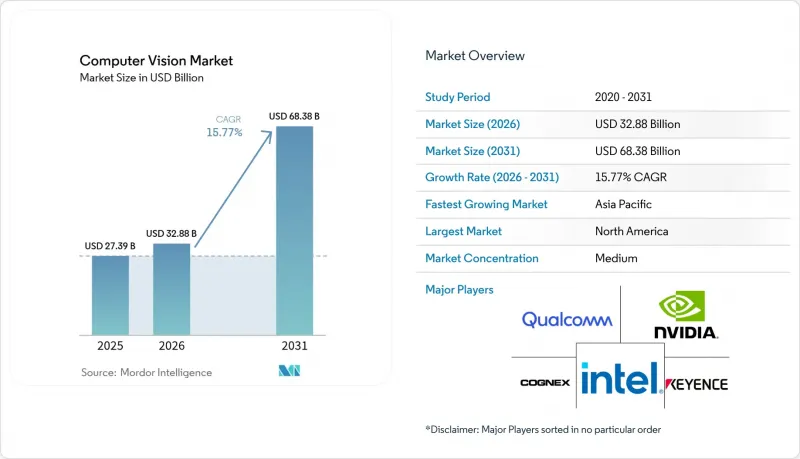
Edge-inference chipsets that collapse latency, regulatory mandates pushing Advanced Driver-Assistance Systems (ADAS) cameras into every new vehicle, and quality-control rules in pharmaceuticals and food have combined to anchor multi-year capital budgets around vision technologies. North American subsidies under the CHIPS and Science Act are strengthening sensor supply, while Asia-Pacific incentives are driving rapid adoption on the factory floor. Hardware still dominates revenue, yet subscription-based deep-learning software is capturing margin, and edge deployment is rising fastest as data-sovereignty laws in the EU and China limit cloud transfers. Competitive pressure intensifies as processors from AMD, Qualcomm, and Intel now embed vision accelerators, eliminating the need for discrete cards in many use cases.
Global Computer Vision Market Trends and Insights
Edge-AI Chipsets Lowering Latency and Power for On-Device Vision
NVIDIA's Rubin platform integrates HBM4 memory with a dedicated vision-processing unit, executing YOLOv8 at 240 frames per second while drawing under 15 watts, and therefore removes the network overhead that previously hindered cloud-dependent systems. Qualcomm's Snapdragon X2 Plus embeds a Hexagon neural-processing unit that delivers 75 TOPS, allowing handset makers to run facial recognition without rapidly draining batteries. AMD's Ryzen AI 400 Series accelerates convolutional models for industrial inspection, letting electronics assemblers replace programmable-logic-controller vision stacks with adaptive classifiers. Ambarella's CV7 delivers 120 TOPS at 5 watts, giving Tier-1 automotive suppliers ISO 26262-ready compute budgets for cabin cameras. Across these families, round-trip latency has fallen from 80 milliseconds to below 10 milliseconds, the threshold needed for robotic grasping and emergency vehicle braking.
Surge in Automotive ADAS Camera Integration
Tesla's Full Self-Driving v13 uses eight surround-view cameras and a custom inference chip to execute lane changes without driver confirmation in 47 U.S. states. BYD's Seal sedan pairs Sony sensors with Horizon Robotics silicon to deliver Level 2+ capability at price points 30% below comparable Western models, accelerating uptake in Southeast Asia. Mercedes-Benz expanded Drive Pilot to California highways, employing stereo cameras and LiDAR fusion to satisfy Level 3 certification that lets drivers avert their gaze in slow traffic. Volkswagen's ID.7 electric vehicle uses infrared-based gaze tracking to comply with Euro NCAP's 2025 driver-monitoring rule. Combined with Chinese and European safety mandates that make forward-collision warning compulsory by 2026, global ADAS camera shipments are expected to reach 240 million in 2026, up from 200 million in 2025.
Complex System-Integration Requirements
Connecting new cameras using GigE Vision, CoaXPress, and Camera Link to programmable-logic controllers demands middleware that translates proprietary streams into OPC UA or MQTT, consuming up to 40% of project budgets and extending commissioning by three months. Enterprises juggling multi-vendor estates face firmware conflicts that inflate costs and delay ramps; a European auto supplier spent an extra USD 250,000 synchronizing Basler cameras with Cognex processors, postponing production by six weeks. Annual software-maintenance fees average 18% of license price, and recalibration labor resurfaces each time lines are re-tooled. Smaller plants lacking in-house automation talent must hire integrators who charge USD 150-300 per hour, making projects economical only for high-volume lines that exceed 500,000 units yearly. The absence of standardized benchmarks equivalent to MLPerf obliges buyers to run long proof-of-concept trials, slowing computer vision market penetration.
Other drivers and restraints analyzed in the detailed report include:
- Rising Adoption of Vision-Guided Robotics in Manufacturing
- Stringent Quality-Control Mandates Across Regulated Industries
- Shortage of Skilled Computer-Vision Engineers
For complete list of drivers and restraints, kindly check the Table Of Contents.
Segment Analysis
Hardware delivered 65.21% of 2025 revenue as manufacturers bought high-resolution cameras, specialized processors, and controlled-illumination optics. Within this slice, Basler shipped more than 400,000 industrial cameras, Teledyne FLIR broadened its A700 thermal line, and Allied Vision released a 20.5-megapixel global-shutter unit ideal for fast conveyors. The computer vision market size for hardware is forecast to grow steadily, but the software layer is set to expand faster as enterprises transition from perpetual licenses to subscription models that bundle updates and cloud connectivity.
OpenCV 4.9, TensorFlow Lite 2.15, and commercial middleware from AWS Panorama and Azure IoT Edge simplify deployment, spurring a 15.87% CAGR for software through 2031. Enterprises value these platforms because they shorten time-to-production and lower device-side compute needs via quantization and pruning. As a result, the computer vision market increasingly rewards vendors that package turnkey inferencing stacks rather than stand-alone cameras or boards.
Manufacturing contributed 28.49% of the computer vision market share in 2025 thanks to large-scale inspection on electronics lines and food-packaging belts. Cognex, Keyence, and Omron dominate here by offering bundled optics, lighting, and software tuned for industrial conditions. Life sciences held 12% after drug makers upgraded vial inspection to meet revised Annex 1 rules, while defense and security reached 8% on the back of Teledyne FLIR sales.
Automotive, however, is charting the highest growth at an 18.23% CAGR because camera counts per vehicle continue to climb. Tesla, Mercedes-Benz, and BYD collectively added more than 200 million ADAS cameras in 2025, and Euro NCAP mandates for driver monitoring are pushing in-cabin units into mass-market models. Over the forecast horizon, plant retrofits supporting electric-vehicle production and OEM commitments to Level 3 autonomy will tilt incremental spending toward automotive, tightening competition for integration talent.
The Computer Vision Market Report is Segmented by Components (Hardware and Software), End-User Industry (Life Sciences, Manufacturing, Automotive, Retail, Logistics, Agriculture, and More), Application (Inspection, Measurement, Classification, Surveillance, and 3D Modeling), Deployment (Edge, On-Premise, and Cloud), and Geography. The Market Forecasts are in Value (USD).
Geography Analysis
North America held 49.01% of 2025 revenue, buoyed by USD 52 billion in CHIPS Act incentives that expanded domestic fab capacity for vision processors. U.S. defense contracts worth USD 420 million for thermal imaging strengthened Teledyne FLIR's pipeline, while Canadian AI hubs such as the Vector Institute partnered with auto suppliers on ADAS algorithms. Historical 2020-2025 CAGR of 13.2% is stepping up to 14.8% during 2026-2031 because FDA clarity on medical-image AI unlocks deferred hospital investment.
Asia-Pacific is the fastest-growing region, projected at a 16.39% CAGR. China alone generated 22% of global 2025 revenue, but U.S. export controls on high-end GPUs are motivating a shift toward Huawei Ascend processors. India's Production-Linked Incentive scheme funnels USD 2 billion into electronics plants that consume vision systems for surface-mount inspection. Japan funds 340 smart-factory pilots, and South Korea invests USD 1.8 billion to commercialize mobile neuromorphic sensors. Australia and New Zealand rely on vision-guided haul trucks that raise ore-extraction rates by 30%.
Europe captured 18% share in 2025. Germany disbursed EUR 500 million for Industrie 4.0 upgrades, yet EU AI Act conformity assessments costing about EUR 300,000 per system slow smaller plants. The United Kingdom integrated 12 million ADAS cameras in 2025 production, while France applied vision inspection to turbine blades. Middle Eastern smart-city projects in Saudi Arabia and the UAE are installing multi-million-camera networks, and South American agriculture is turning to drone imaging that cuts pesticide use by 40%. Collectively, these deployments showcase a widening global foundation for the computer vision market.
- Intel Corporation
- Cognex Corporation
- Keyence Corporation
- Qualcomm Inc.
- NVIDIA Corporation
- Omron Corporation
- Basler AG
- Teledyne FLIR LLC
- Sony Group Corp.
- Google LLC
- Advanced Micro Devices (AMD)
- Adlink Technology Inc.
- Hikvision Robotics
- Stemmer Imaging AG
- Dahua Technology
- Zebra Technologies Corp.
- Amazon Web Services Inc.
- Clarifai Inc.
- Allied Vision Technologies GmbH
- OpenCV.ai
- Matrox Imaging
Additional Benefits:
- The market estimate (ME) sheet in Excel format
- 3 months of analyst support
TABLE OF CONTENTS
1 INTRODUCTION
- 1.1 Study Assumptions and Market Definition
- 1.2 Scope of the Study
2 RESEARCH METHODOLOGY
3 EXECUTIVE SUMMARY
4 MARKET LANDSCAPE
- 4.1 Market Overview
- 4.2 Market Drivers
- 4.2.1 Rising Adoption of Vision-Guided Robotics in Manufacturing
- 4.2.2 Stringent Quality-Control Mandates Across Regulated Industries
- 4.2.3 Surge in Automotive ADAS Camera Integration
- 4.2.4 Edge-AI Chipsets Lowering Latency and Power for On-Device Vision
- 4.2.5 Hyperspectral and Neuromorphic Sensors Opening New Use-Cases
- 4.2.6 Rapid Proliferation of Smart Cameras in IoT-Enabled Retail
- 4.3 Market Restraints
- 4.3.1 Complex System-Integration Requirements
- 4.3.2 Shortage of Skilled Computer-Vision Engineers
- 4.3.3 Escalating Data-Labeling Cost Inflation
- 4.3.4 Export-Control Curbs on Advanced Vision Processors
- 4.4 Industry Value-Chain Analysis
- 4.5 Regulatory Landscape
- 4.6 Technological Outlook
- 4.7 Porter's Five Forces Analysis
- 4.7.1 Bargaining Power of Buyers
- 4.7.2 Bargaining Power of Suppliers
- 4.7.3 Threat of New Entrants
- 4.7.4 Threat of Substitutes
- 4.7.5 Competitive Rivalry
5 MARKET SIZE AND GROWTH FORECASTS (VALUE)
- 5.1 By Components
- 5.1.1 Hardware
- 5.1.2 Cameras
- 5.1.3 Processors (GPUs / ASIC / FPGA)
- 5.1.4 Optics and Lighting
- 5.1.5 Software
- 5.1.6 Traditional Algorithms
- 5.1.7 Deep-Learning Frameworks
- 5.1.8 Edge Middleware
- 5.2 By End-User Industry
- 5.2.1 Life Sciences
- 5.2.2 Manufacturing
- 5.2.3 Electronics Assembly
- 5.2.4 Food and Beverage
- 5.2.5 Packaging
- 5.2.6 Defense and Security
- 5.2.7 Automotive
- 5.2.8 Retail and E-Commerce
- 5.2.9 Logistics and Warehousing
- 5.2.10 Agriculture and Forestry
- 5.2.11 Other End-User Industries
- 5.3 By Application
- 5.3.1 Inspection and Quality Assurance
- 5.3.2 Measurement and Metrology
- 5.3.3 Classification and Sorting
- 5.3.4 Surveillance and Monitoring
- 5.3.5 3D Modeling and Reconstruction
- 5.4 By Deployment
- 5.4.1 Edge
- 5.4.2 On-Premise
- 5.4.3 Cloud
- 5.5 By Geography
- 5.5.1 North America
- 5.5.1.1 United States
- 5.5.1.2 Canada
- 5.5.1.3 Mexico
- 5.5.2 South America
- 5.5.2.1 Brazil
- 5.5.2.2 Argentina
- 5.5.2.3 Rest of South America
- 5.5.3 Europe
- 5.5.3.1 Germany
- 5.5.3.2 United Kingdom
- 5.5.3.3 France
- 5.5.3.4 Italy
- 5.5.3.5 Spain
- 5.5.3.6 Rest of Europe
- 5.5.4 Asia-Pacific
- 5.5.4.1 China
- 5.5.4.2 India
- 5.5.4.3 Japan
- 5.5.4.4 South Korea
- 5.5.4.5 Australia and New Zealand
- 5.5.4.6 Rest of Asia-Pacific
- 5.5.5 Middle East
- 5.5.5.1 Saudi Arabia
- 5.5.5.2 United Arab Emirates
- 5.5.5.3 Turkey
- 5.5.5.4 Rest of Middle East
- 5.5.6 Africa
- 5.5.6.1 South Africa
- 5.5.6.2 Nigeria
- 5.5.6.3 Egypt
- 5.5.6.4 Rest of Africa
- 5.5.1 North America
6 COMPETITIVE LANDSCAPE
- 6.1 Market Concentration
- 6.2 Strategic Moves
- 6.3 Market Share Analysis
- 6.4 Company Profiles (includes Global Level Overview, Market Level Overview, Core Segments, Financials as available, Strategic Information, Market Rank/Share, Products and Services, Recent Developments)
- 6.4.1 Intel Corporation
- 6.4.2 Cognex Corporation
- 6.4.3 Keyence Corporation
- 6.4.4 Qualcomm Inc.
- 6.4.5 NVIDIA Corporation
- 6.4.6 Omron Corporation
- 6.4.7 Basler AG
- 6.4.8 Teledyne FLIR LLC
- 6.4.9 Sony Group Corp.
- 6.4.10 Google LLC
- 6.4.11 Advanced Micro Devices (AMD)
- 6.4.12 Adlink Technology Inc.
- 6.4.13 Hikvision Robotics
- 6.4.14 Stemmer Imaging AG
- 6.4.15 Dahua Technology
- 6.4.16 Zebra Technologies Corp.
- 6.4.17 Amazon Web Services Inc.
- 6.4.18 Clarifai Inc.
- 6.4.19 Allied Vision Technologies GmbH
- 6.4.20 OpenCV.ai
- 6.4.21 Matrox Imaging
7 MARKET OPPORTUNITIES AND FUTURE OUTLOOK
- 7.1 White-Space and Unmet-Need Assessment

