PUBLISHER: Mordor Intelligence | PRODUCT CODE: 2044182

PUBLISHER: Mordor Intelligence | PRODUCT CODE: 2044182
Production Printer - Market Share Analysis, Industry Trends & Statistics, Growth Forecasts (2026 - 2031)
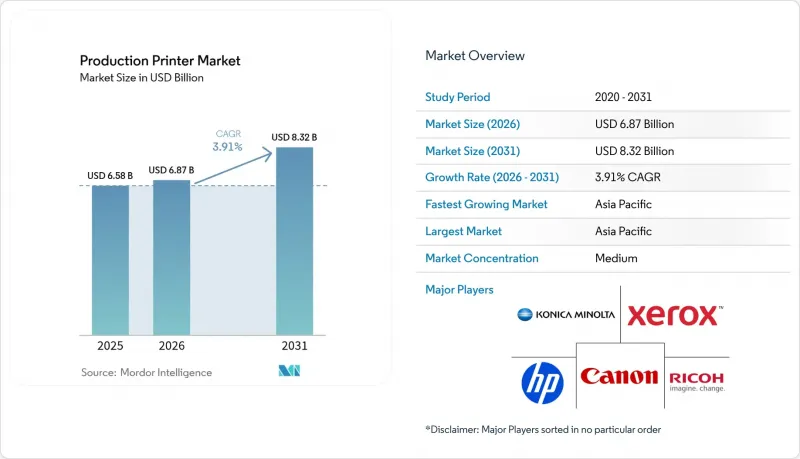
The production printer market size is projected to expand from USD 6.58 billion in 2025 and USD 6.87 billion in 2026 to USD 8.32 billion by 2031, registering a 3.91% CAGR between 2026 and 2031.
A shift away from legacy publishing and transactional mail toward packaging, labels, and on-demand commercial work is reshaping profit pools, with digital workflows enabling mass customization that offsets falling volumes in traditional segments. Brand owners are adopting variable-data workflows to launch limited-edition stock-keeping units, comply with complex labeling regulations, and manage shorter order cycles, all of which favor digitally driven presses over analog equipment. Capital spending is gradually recovering as semiconductor supply chains normalize, reducing the delivery lead times that constrained high-speed inkjet installations through mid-2024. Competitive intensity is increasing, yet service-contract economics and outcome-based pricing models are helping vendors defend margins even as equipment list prices come under pressure from low-cost Asian entrants.
Global Production Printer Market Trends and Insights
Growth Of Printing Applications In Packaging
Digital presses are penetrating flexible film, corrugated, and folding-carton lines as converters eliminate minimum order constraints that once favored long-run analog workflows. Ongoing European Union rules mandating recyclable mono-material structures by 2030 accelerate the shift toward water-based inkjet, especially for polyethylene and polypropylene films. Press makers that can certify food-contact inks and achieve color-consistency within Delta E 2.0 have become preferred suppliers, particularly in Germany and Italy where brand owners demand uniform shelf impact. Early adopters report material cost savings of up to 15% thanks to single-layer barrier coatings that replace multi-layer laminates.
Short-Run, On-Demand Print Requirements
Commercial printers now generate more than half of revenue from jobs under 5,000 impressions, a segment that has grown rapidly as retailers localize promotions and pharmaceutical firms comply with serialization codes. Cut-sheet inkjet platforms deliver profitable runs below 1,000 impressions because changeovers can occur in under 10 minutes, far quicker than continuous-feed setups. Faster turnaround raises margins despite smaller volumes, and premium pricing is attainable when 48-hour delivery is contractually guaranteed.
Shift To Digital Marketing And E-Reading
Programmatic advertising continues to capture budget share, cutting direct-mail volumes that once filled continuous-feed webs. E-book penetration above one-third of U.S. trade-book sales further compresses short-run publishing demand. While packaging and labels remain insulated, commercial printers must compete aggressively on the remaining work, and average operating margins have slid several points since 2020.
Other drivers and restraints analyzed in the detailed report include:
- Advances In High-Speed Inkjet Technology
- AI-Driven Predictive Maintenance
- High Capital Expenditure Of Production Printers
For complete list of drivers and restraints, kindly check the Table Of Contents.
Segment Analysis
Color devices generated 69.42% of 2025 revenue, and their share of the production printer market size is forecast to climb on a 4.28% CAGR through 2031. Brand owners willingly pay premiums for metallic finishes and precise spot-color matching that protect shelf identity across global supply chains. Metallic and functional inks, now printable on standard piezo heads, extend addressable applications from luxury spirits labels to RFID antennas.
Monochrome engines, with 30.58% revenue, persist in transactional mail and book interiors where cost-per-page below USD 0.01 outweighs color requirements. Even those niches are eroding as statements migrate online and publishers pivot to color-capable platforms that handle both text blocks and cover art without dual workflows. As inkjet consumable costs continue to fall, many commercial printers retire black-only fleets and route simple text work to color presses during off-peak shifts to maximize asset utilization.
Continuous-feed lines retained 57.12% of 2025 revenue, dominating jobs above 50,000 impressions thanks to low running costs per page and integrated finishing. Yet changeover complexity, multihour setup windows, and dedicated operators limit their suitability for today's shorter orders. Cut-sheet lines, projected to outpace market growth at a 4.31% CAGR, have become the default choice for fast-turn commercial and packaging work below 5,000 impressions. They switch substrates in minutes, accept mixed media within a shift, and pair with inline die-cutting or lamination units to eliminate off-press handling.
Asset flexibility is particularly attractive to converters serving consumer goods brands that launch dozens of regional variants each year. These converters build schedules around multiple customers per day, a pattern incompatible with the continuous-feed economies of scale that presuppose multi-hour single-customer blocks. As postal regulators tighten automation-rate barcode rules, cut-sheet platforms capable of merging variable databases in line are winning direct-mail placements in the United States.
The Production Printer Market Report is Segmented by Type (Monochrome and Color), Production Method (Cut Sheet, and Continuous Feed), Technology (Inkjet, Electrophotographic, and More), Application (Commercial Printing, Publishing, and More), and Geography. The Market Forecasts are Provided in Terms of Value (USD).
Geography Analysis
Asia-Pacific anchored 35.32% of 2025 revenue, and its contribution to the production printer market size is set to widen by a 4.93% CAGR through 2031. China's USD 180 billion packaging sector is consolidating as regulators shutter solvent-based flexographic sites, prompting converters to fast-track inkjet installations that reduce water usage by 70-80%. India's corrugated segment, posting double-digit growth, is likewise embracing digital workflows to serve e-commerce fulfillment that demands variable regional graphics. Vietnam's label clusters ride supply-chain diversification, with multinational consumer-goods companies commissioning just-in-time runs near final assembly nodes.
North America ranks second in market size but faces structural volume erosion in direct mail and publishing as digital advertising and e-reading broaden reach. Packaging growth in food, beverage, and personal-care channels partially offsets those declines, and converters continue to invest in high-speed inkjet to comply with evolving state recycling mandates. The United States Postal Service's barcode incentives further spur adoption of cut-sheet variable-data presses for targeted mailings.
Europe holds the third-largest slice of the production printer market. Adoption is driven by regulations targeting PFAS chemicals, compelling ink formulators to retool pigment dispersions and delaying press launches by up to one year in some cases. South America, the Middle East, and Africa collectively remain below one-quarter of worldwide revenue. Currency volatility and limited vendor financing lengthen capital payback, slowing equipment turnover, although regional packaging opportunities encourage gradual upgrades.
- Xerox Holdings Corporation
- HP Inc.
- Canon Inc.
- Ricoh Company, Ltd.
- Konica Minolta, Inc.
- Eastman Kodak Company
- Fujifilm Holdings Corporation
- Screen Holdings Co., Ltd.
- Heidelberger Druckmaschinen AG
- Durst Group AG
- Xeikon NV (Flint Group)
- Inca Digital Printers Ltd
- Agfa-Gevaert N.V.
- Mark Andy Inc.
- Koenig and Bauer AG
- Riso Kagaku Corporation
- Seiko Epson Corporation
- Domino Printing Sciences plc
- Gallus Ferd. Ruesch AG
- Kyocera Document Solutions Inc.
Additional Benefits:
- The market estimate (ME) sheet in Excel format
- 3 months of analyst support
TABLE OF CONTENTS
1 INTRODUCTION
- 1.1 Study Assumptions and Market Definition
- 1.2 Scope of the Study
2 RESEARCH METHODOLOGY
3 EXECUTIVE SUMMARY
4 MARKET LANDSCAPE
- 4.1 Market Overview
- 4.2 Market Drivers
- 4.2.1 Growth of Printing Applications in Packaging
- 4.2.2 Short-Run, On-Demand Print Requirements
- 4.2.3 Advances in High-Speed Inkjet Technology
- 4.2.4 Industrial-Grade Metallic and Functional Ink Demand
- 4.2.5 Digital Textile Microfactory Adoption
- 4.2.6 AI-Driven Predictive Maintenance Reducing Downtime
- 4.3 Market Restraints
- 4.3.1 Shift to Digital Marketing and E-Reading
- 4.3.2 High Capital Expenditure of Production Printers
- 4.3.3 Semiconductor Supply-Chain Volatility
- 4.3.4 Regulatory Push for PFAS-Free Ink Formulations Raising R and D Costs
- 4.4 Industry Value / Supply-Chain Analysis
- 4.5 Regulatory Landscape
- 4.6 Technological Outlook
- 4.7 Porter's Five Forces Analysis
- 4.7.1 Bargaining Power of Suppliers
- 4.7.2 Bargaining Power of Consumers
- 4.7.3 Threat of New Entrants
- 4.7.4 Threat of Substitutes
- 4.7.5 Intensity of Competitive Rivalry
- 4.8 Impact of Macroeconomic Factors on the Market
5 MARKET SIZE AND GROWTH FORECASTS (VALUE)
- 5.1 By Type
- 5.1.1 Monochrome
- 5.1.2 Color
- 5.2 By Production Method
- 5.2.1 Cut Sheet
- 5.2.2 Continuous Feed
- 5.3 By Technology
- 5.3.1 Inkjet
- 5.3.2 Electrophotographic (Toner)
- 5.3.3 Other Technologies
- 5.4 By Application
- 5.4.1 Commercial Printing
- 5.4.2 Publishing
- 5.4.3 Packaging
- 5.4.4 Transactional and Direct Mail
- 5.4.5 Other Applications
- 5.5 By Geography
- 5.5.1 North America
- 5.5.1.1 United States
- 5.5.1.2 Canada
- 5.5.1.3 Mexico
- 5.5.2 South America
- 5.5.2.1 Brazil
- 5.5.2.2 Argentina
- 5.5.2.3 Chile
- 5.5.2.4 Rest of South America
- 5.5.3 Europe
- 5.5.3.1 United Kingdom
- 5.5.3.2 Germany
- 5.5.3.3 France
- 5.5.3.4 Spain
- 5.5.3.5 Italy
- 5.5.3.6 Rest of Europe
- 5.5.4 Asia-Pacific
- 5.5.4.1 China
- 5.5.4.2 India
- 5.5.4.3 Japan
- 5.5.4.4 Australia
- 5.5.4.5 South Korea
- 5.5.4.6 Vietnam
- 5.5.4.7 Rest of Asia-Pacific
- 5.5.5 Middle East
- 5.5.5.1 Saudi Arabia
- 5.5.5.2 United Arab Emirates
- 5.5.5.3 Turkey
- 5.5.5.4 Rest of Middle East
- 5.5.6 Africa
- 5.5.6.1 South Africa
- 5.5.6.2 Nigeria
- 5.5.6.3 Egypt
- 5.5.6.4 Rest of Africa
- 5.5.1 North America
6 COMPETITIVE LANDSCAPE
- 6.1 Market Concentration
- 6.2 Strategic Moves
- 6.3 Market Share Analysis
- 6.4 Company Profiles (includes Global Level Overview, Market Level Overview, Core Segments, Financials as available, Strategic Information, Market Rank/Share, Products and Services, Recent Developments)
- 6.4.1 Xerox Holdings Corporation
- 6.4.2 HP Inc.
- 6.4.3 Canon Inc.
- 6.4.4 Ricoh Company, Ltd.
- 6.4.5 Konica Minolta, Inc.
- 6.4.6 Eastman Kodak Company
- 6.4.7 Fujifilm Holdings Corporation
- 6.4.8 Screen Holdings Co., Ltd.
- 6.4.9 Heidelberger Druckmaschinen AG
- 6.4.10 Durst Group AG
- 6.4.11 Xeikon NV (Flint Group)
- 6.4.12 Inca Digital Printers Ltd
- 6.4.13 Agfa-Gevaert N.V.
- 6.4.14 Mark Andy Inc.
- 6.4.15 Koenig and Bauer AG
- 6.4.16 Riso Kagaku Corporation
- 6.4.17 Seiko Epson Corporation
- 6.4.18 Domino Printing Sciences plc
- 6.4.19 Gallus Ferd. Ruesch AG
- 6.4.20 Kyocera Document Solutions Inc.
7 MARKET OPPORTUNITIES AND FUTURE OUTLOOK
- 7.1 White-Space and Unmet-Need Assessment

