PUBLISHER: Mordor Intelligence | PRODUCT CODE: 2044192

PUBLISHER: Mordor Intelligence | PRODUCT CODE: 2044192
Print Equipment - Market Share Analysis, Industry Trends & Statistics, Growth Forecasts (2026 - 2031)
The Print Equipment Market size is projected to expand from USD 19.98 billion in 2025 and USD 20.67 billion in 2026 to USD 24.22 billion by 2031, registering a CAGR of 3.22% between 2026 to 2031.
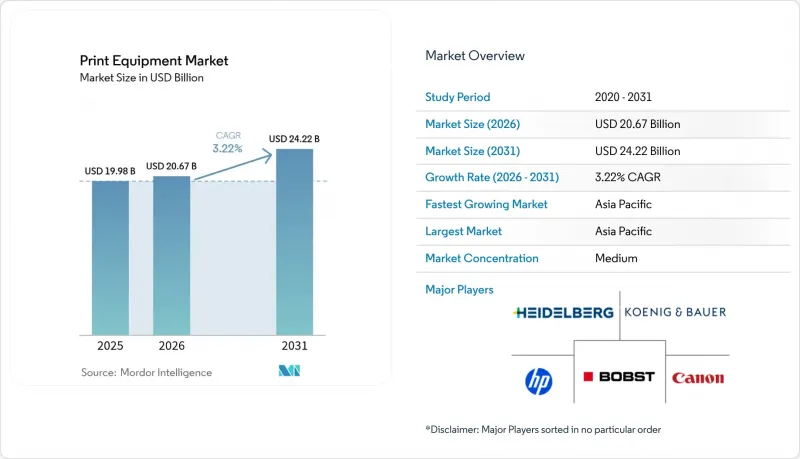
Demand is shifting from offset-dominated lines toward digital and hybrid presses as converters chase fast changeovers, minimal makeready, and variable-data features. Food and pharmaceutical labeling rules in the European Union and the United States are pulling capital toward presses that support serialization and allergen declarations. E-commerce fulfillment centers are buying narrow-web digital equipment to print shipping boxes on the day of dispatch, while brand owners widen SKU counts to serve micro-segments. Competitive pressure from software-centric entrants is forcing incumbent press makers to add cloud-connected workflow platforms and subscription plans, a pivot that raises refinancing needs but promises sticky service revenue.
Global Print Equipment Market Trends and Insights
Regulatory Tailwinds For Food And Pharma Digital Labels
EU and U.S. labeling mandates now require digital watermarks, variable allergen labeling, and batch-level traceability, pushing converters toward inkjet retrofits and greenfield digital press purchases. India added QR serialization for export drugs in April 2025, reinforcing this global convergence. Brand owners are prequalifying suppliers based on ISO 12647 compliance, so press vendors bundle spectrophotometers and closed-loop calibration with every sale to pass customer audits. Digital presses also help converters avoid penalties that EU regulators can levy at up to 4% of global turnover for mislabeled food products, a risk that makes analog changeover errors untenable. To hedge against future rule changes, pharmaceutical packagers now specify presses that accept both water-based and UV-curable inks, ensuring headroom for low-migration formulations once PFAS restrictions tighten. The net effect is that digital serialization has become a board-level CAPEX trigger rather than a mere regulatory checkbox.
On-Demand Book And Packaging Runs Driving CAPEX
Short-run economics flipped after 2024, when 62% of commercial printers accepted jobs below 500 units, up from 41% in 2020, thanks to toner and inkjet lines that erase plate cost and makeready waste. E-commerce hubs now print corrugated boxes on-site, reducing inventory costs and enabling same-day seasonal promotions. Cimpress committed more than USD 100 million for HP Indigo units to localize production and cut order-to-ship cycles from 72 to 24 hours. Publishers such as Springer Nature moved 78% of backlist titles to print-on-demand, eliminating the need to pulp unsold stock. Offset press makers are racing to bolt inkjet bars onto web lines so they can chase jobs that fall in the 1,000-10,000 range, where analog speed still matters. As these hybrid prototypes prove reliable, lenders are starting to offer structure-specific leasing packages that bundle service and consumables, lowering the hurdle rate for mid-size shops.
Volatile Graphic-Paper Prices Squeeze Margins
Nordic and Brazilian pulp spikes in early 2025 lifted coated-sheet prices 18%, squeezing printer EBITDA and delaying press upgrades. EU circular-economy rules encourage recycled fiber, but variable sheet quality forces operators to recalibrate presses more often, increasing downtime and ink lay-down. Converters with thin 8-12% margins struggle to pass these hikes through multi-year customer contracts, so CAPEX for new lines slips down the priority list. Some offset printers hedge pulp risk with futures contracts, yet hedging fees rose 22% in 2025, eroding the benefit. Digital vendors pitch reduced waste, but high-coverage inkjet jobs consume expensive ink and drums, muting savings. As a result, investment bifurcates: large groups lock multi-year paper deals and adopt high-speed inkjet, while small shops defer upgrades and ride spot-market volatility.
Other drivers and restraints analyzed in the detailed report include:
- Brand-Owner Push For SKU Proliferation
- Hybrid Press Adoption Cuts Total Cost Of Ownership
- Skilled Press-Operator Shortage
For complete list of drivers and restraints, kindly check the Table Of Contents.
Segment Analysis
Digital captured 41.32% of the print equipment market in 2025 and rose at 4.02% annually. Inkjet and toner lines appeal to converters who need variable graphics without plate costs, a value that offsets slower raw speed. The print equipment market size for digital presses is forecast to expand significantly as publishers pivot to print-on-demand. Offset retains long runs, yet its slice narrows each year. Flexographic units stay vital for high-opacity flexible films, while gravure holds ultra-long decorative work. Screen equipment remains a niche for textiles and electronics. Converters increasingly choose hybrid rigs that bolt inkjet bars onto flexo webs, balancing run length and personalization.
Canon and Heidelberg joined forces in 2024 on a B2 electrophotographic engine, aiming to anchor hybrid mid-volume models. Ricoh's production inkjet roadmap targets label converters craving plate elimination. Advances in aqueous inkjet have improved adhesion on uncoated stock, yet rub resistance still trails solvent systems.
Press hardware held 37.32% of 2025 tonnage, but post-press equipment is the fastest-growing segment, with a 3.84% CAGR, as plants automate die-cutting, folding, and inspection. The print equipment market share for finishing lines is growing as labor shortages make robotic blank separation and vision QC more attractive. Heidelberg's Cartonmaster integrates these steps, showing how turnkey cells compress floor space and cycle time. Pre-press systems commoditize under cloud workflows, yet remain essential for color control. Ancillary gear, such as slitters and laminators, sustains demand in flexible packaging, where converters juggle multiple substrates each shift.
Bobst logged a 28% order rise for Mastercut die-cutters in 2024, reflecting the urgency to cut downtime. Sheet-fed presses still dominate commercial work thanks to their format agility, whereas roll-fed lines shrink as magazine volume declines. Format-wise, B1 and B2 classes secure mid-runs, while B3 serves quick printers. Proprietary ancillary bundles raise switching costs and draw antitrust scrutiny in the EU and the United States.
The Print Equipment Market Report is Segmented by Technology (Web-Offset Lithographic, Flexographic, Gravure, Screen Printing, and Digital), Equipment Type (Pre-Press Systems, Press, and More), Application (Books and Publishing, Advertising and Signage, and More), End-User Industry (Packaging Converters, Commercial Printers, and More), and Geography. The Market Forecasts are Provided in Terms of Value (USD).
Geography Analysis
Asia-Pacific accounted for 41.43% of global volume in 2025 and is projected to grow at 4.12% through 2031. China's CNY 8 billion (USD 1.1 billion) subsidy funds digital press rollouts in smaller cities, shrinking logistics miles. India's drug exporters are retrofitting lines for EU serialization, boosting inkjet demand. Japan's majors embrace hybrid presses for short-run packaging, while Australia faces import-duty drag on new equipment. South Korea grows in screen systems for semiconductor packaging.
Europe and North America together account for about 45% of the 2025 tons, but growth is slow. EU traceability rules push converters toward digital serialization, straining small operators. Germany saw 4% fewer overall installs in 2024, yet digital orders rose 12% as firms pursued waste-cutting initiatives. The United States splits: large packaging houses pour money into high-speed inkjet, while many commercial shops sweat legacy offset assets. Canada consolidates as mid-sized printers fold or merge.
South America, the Middle East, and Africa hold the rest. Brazil invests in flexo for food packaging but fights import-cost volatility. Saudi Arabia backs local printing under Vision 2030 with soft loans for presses. The United Arab Emirates markets free-zone print hubs to serve Gulf and Africa. South Africa grapples with energy costs but sees selective inkjet buys for pharma cartons, while Kenya scales packaging lines for regional consumer demand.
- Heidelberger Druckmaschinen AG
- Koenig and Bauer AG
- Bobst Group SA
- HP Inc.
- Canon Inc.
- Seiko Epson Corporation
- Fujifilm Holdings Corporation
- Ricoh Company Ltd.
- Electronics for Imaging, Inc.
- Durst Phototechnik AG
- Mark Andy Inc.
- Nilpeter A/S
- Gallus Ferd. Ruesch AG (Heidelberg)
- OMET S.r.l.
- MPS Systems B.V.
- Uteco Converting SpA
- Manroland Goss Web Systems GmbH
- Agfa-Gevaert Group NV
- Brother Industries Ltd.
- AB Graphic International Ltd.
Additional Benefits:
- The market estimate (ME) sheet in Excel format
- 3 months of analyst support
TABLE OF CONTENTS
1 INTRODUCTION
- 1.1 Study Assumptions and Market Definition
- 1.2 Scope of the Study
2 RESEARCH METHODOLOGY
3 EXECUTIVE SUMMARY
4 MARKET LANDSCAPE
- 4.1 Market Overview
- 4.2 Industry Value Chain Analysis
- 4.3 Market Drivers
- 4.3.1 Regulatory Tailwinds for Food and Pharma Digital Labels
- 4.3.2 On-Demand Book and Packaging Runs Driving CAPEX
- 4.3.3 Brand-Owner Push for SKU Proliferation
- 4.3.4 Hybrid Press Adoption Cuts Total Cost of Ownership
- 4.3.5 AI-Based Predictive Maintenance Reduces Press Downtime
- 4.3.6 Rise of Decentralised Micro-Factories Near End Users
- 4.4 Market Restraints
- 4.4.1 Volatile Graphic-Paper Prices Squeeze Margins
- 4.4.2 Skilled Press-Operator Shortage
- 4.4.3 Escalating Cyber-Security Risks in Cloud-Connected Presses
- 4.4.4 PFAS Regulations Limiting Certain Ink Chemistries
- 4.5 Regulatory Landscape
- 4.6 Technological Outlook
- 4.7 Impact of Macroeconomic Factors on the Market
- 4.8 Porter's Five Forces Analysis
- 4.8.1 Threat of New Entrants
- 4.8.2 Bargaining Power of Suppliers
- 4.8.3 Bargaining Power of Buyers
- 4.8.4 Threat of Substitutes
- 4.8.5 Competitive Rivalry
5 MARKET SIZE AND GROWTH FORECASTS (VALUE)
- 5.1 By Technology
- 5.1.1 Web-offset Lithographic
- 5.1.2 Flexographic
- 5.1.3 Gravure
- 5.1.4 Screen Printing
- 5.1.5 Digital
- 5.2 By Equipment Type
- 5.2.1 Pre-press Systems
- 5.2.2 Press(Sheet-fed, Roll-fed)
- 5.2.3 Post-press and Finishing
- 5.2.4 Ancillary and Inline Converting
- 5.3 By Application
- 5.3.1 Books and Publishing
- 5.3.2 Advertising and Signage
- 5.3.3 Security and Transactional
- 5.3.4 Packaging
- 5.3.5 Other Applications
- 5.4 By End-User Industry
- 5.4.1 Packaging Converters
- 5.4.2 Commercial Printers
- 5.4.3 In-plant/Corporate
- 5.4.4 Quick Print and Copy Shops
- 5.5 By Geography
- 5.5.1 North America
- 5.5.1.1 United States
- 5.5.1.2 Canada
- 5.5.1.3 Mexico
- 5.5.2 South America
- 5.5.2.1 Brazil
- 5.5.2.2 Argentina
- 5.5.2.3 Rest of South America
- 5.5.3 Europe
- 5.5.3.1 United Kingdom
- 5.5.3.2 Germany
- 5.5.3.3 France
- 5.5.3.4 Spain
- 5.5.3.5 Italy
- 5.5.3.6 Rest of Europe
- 5.5.4 Asia-Pacific
- 5.5.4.1 China
- 5.5.4.2 India
- 5.5.4.3 Japan
- 5.5.4.4 Australia
- 5.5.4.5 South Korea
- 5.5.4.6 Rest of Asia-Pacific
- 5.5.5 Middle East
- 5.5.5.1 Saudi Arabia
- 5.5.5.2 United Arab Emirates
- 5.5.5.3 Turkey
- 5.5.5.4 Rest of Middle East
- 5.5.6 Africa
- 5.5.6.1 South Africa
- 5.5.6.2 Kenya
- 5.5.6.3 Rest of Africa
- 5.5.1 North America
6 COMPETITIVE LANDSCAPE
- 6.1 Market Concentration
- 6.2 Strategic Moves
- 6.3 Market Share Analysis
- 6.4 Company Profiles (includes Global Level Overview, Market Level Overview, Core Segments, Financials as available, Strategic Information, Market Rank/Share, Products and Services, Recent Developments)
- 6.4.1 Heidelberger Druckmaschinen AG
- 6.4.2 Koenig and Bauer AG
- 6.4.3 Bobst Group SA
- 6.4.4 HP Inc.
- 6.4.5 Canon Inc.
- 6.4.6 Seiko Epson Corporation
- 6.4.7 Fujifilm Holdings Corporation
- 6.4.8 Ricoh Company Ltd.
- 6.4.9 Electronics for Imaging, Inc.
- 6.4.10 Durst Phototechnik AG
- 6.4.11 Mark Andy Inc.
- 6.4.12 Nilpeter A/S
- 6.4.13 Gallus Ferd. Ruesch AG (Heidelberg)
- 6.4.14 OMET S.r.l.
- 6.4.15 MPS Systems B.V.
- 6.4.16 Uteco Converting SpA
- 6.4.17 Manroland Goss Web Systems GmbH
- 6.4.18 Agfa-Gevaert Group NV
- 6.4.19 Brother Industries Ltd.
- 6.4.20 AB Graphic International Ltd.
7 MARKET OPPORTUNITIES AND FUTURE OUTLOOK
- 7.1 White-Space and Unmet-Need Assessment

