PUBLISHER: Mordor Intelligence | PRODUCT CODE: 2044205

PUBLISHER: Mordor Intelligence | PRODUCT CODE: 2044205
India Feminine Hygiene - Market Share Analysis, Industry Trends & Statistics, Growth Forecasts (2026 - 2031)
The India feminine hygiene products market was valued at USD 1.16 billion in 2025 and estimated to grow from USD 1.32 billion in 2026 to reach USD 2.29 billion by 2031, registering a compound annual growth rate (CAGR) of 11.67% during the forecast period (2026-2031).
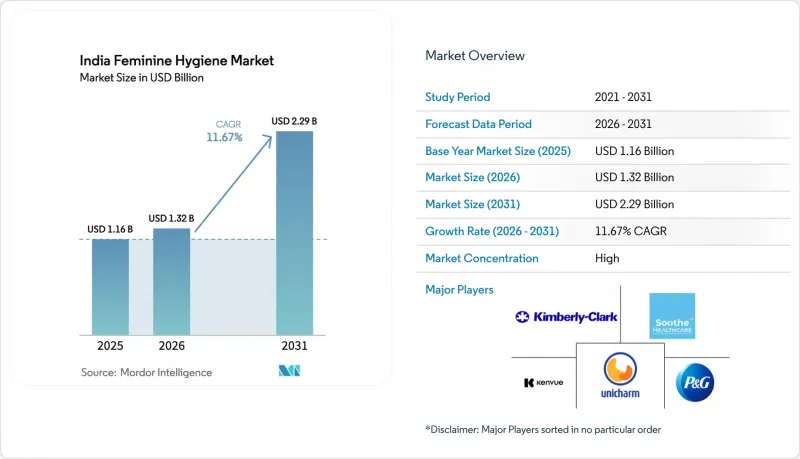
This growth is driven by several factors. Policy initiatives aimed at improving menstrual hygiene awareness and accessibility have played a significant role in expanding the market. Additionally, there is a growing consumer preference for organic and biodegradable materials, reflecting increased environmental consciousness and health awareness. Furthermore, the rapid digitization of distribution channels has enabled easier access to feminine hygiene products, bypassing traditional retail outlets and catering to a broader consumer base.
India Feminine Hygiene Market Trends and Insights
Rising consumer preference for organic, chemical-free, and hypoallergenic menstrual products
Brands are increasingly adopting organic cotton and bamboo-fiber formulations in response to consumer concerns about rashes and irritation, which affect approximately 70% of menstruators. This shift reflects a growing willingness among consumers to pay premium prices for chemical-free alternatives. In May 2025, Kenvue introduced Stayfree Tampons with Dynamic Fit technology and a SilkTouch cover, aimed at urban millennials who value comfort and hypoallergenic materials. Saathi's biodegradable pads, made from banana and bamboo fibers, emphasize sustainability as accessible rather than exclusive. The product is BIS IS 5405:2019 certified, addressing safety concerns effectively. This segment expansion is compressing the dominance of synthetic materials, which historically offered lower unit costs but are now perceived as health liabilities. The shift is most pronounced in urban centers where disposable income and health literacy converge, creating a bifurcated market where incumbents must defend volume share in rural areas while investing in premium organic lines to protect margin in metros.
Growing awareness around menstrual health, hygiene, and safe period practices
The Union Health Ministry's approval of a national Menstrual Hygiene Policy for School-Going Girls in November 2024 institutionalizes awareness campaigns that previously relied on fragmented NGO efforts. Moreover, the Swasth Nari, Sashakt Parivar Abhiyaan conducted menstrual hygiene awareness sessions in Ladakh. Awareness and education are key drivers in the adoption of hygienic methods, playing a significant role in market penetration. However, their impact varies across regions, with some areas exhibiting higher adoption rates while others experience relatively low usage. This disparity underscores the need for awareness campaigns to be supplemented with affordability-focused initiatives to ensure that increased knowledge leads to actual purchasing behavior, especially in economically disadvantaged regions.
Persistent social stigma and cultural taboos surrounding menstruation limiting adoption
Many menstruating women face multiple restrictions during their periods, such as being prohibited from entering temples or kitchens, and many also experience shame when discussing menstruation openly. Religious restrictions are widespread, and feelings of uncleanliness are common, creating psychological barriers that suppress demand even when products are affordable and accessible. These taboos influence purchasing behavior, as women often avoid in-store purchases due to embarrassment. This has contributed to the increasing preference for online retail channels that offer discreet home delivery. The strategic challenge is that awareness campaigns alone cannot dismantle deeply embedded cultural norms; brands must instead design distribution models that minimize social friction, such as subscription services and quick-commerce platforms that eliminate the need for face-to-face transactions.
Other drivers and restraints analyzed in the detailed report include:
- Supportive government initiatives and menstrual equity programs improving product accessibility
- Increasing shift toward sustainable, biodegradable, and eco-friendly menstrual solutions
- Limited awareness and inadequate education in rural and underserved regions
For complete list of drivers and restraints, kindly check the Table Of Contents.
Segment Analysis
Sanitary napkins/pads commanded 98.21% market share in 2025 and are projected to grow at 11.57% CAGR through 2031, reflecting entrenched consumer familiarity and the product format's compatibility with both urban and rural distribution networks. The overwhelming dominance of pads creates both inertia and opportunity. Incumbents benefit from established supply chains and consumer trust, but the format's association with bulk and disposal challenges opens space for disruptors offering thinner, biodegradable, or reusable alternatives. The emergence of the tampon category, although currently limited in size, provides an opportunity for international players to introduce internal protection formats that offer premium pricing and higher per-unit margins.
Kenvue's launch of Stayfree Tampons in May 2025 marks a strategic bet that urban millennials will adopt internal protection despite cultural hesitancy, leveraging Dynamic Fit technology and SilkTouch cover to differentiate on comfort. Tampons remain a niche segment, constrained by misconceptions about virginity and internal use, yet the format offers higher margin potential and appeals to working women seeking discretion and mobility. Panty liners serve a complementary role for light-flow days and daily freshness, while other product types, including menstrual cups and period underwear, are gaining traction among sustainability-focused consumers who prioritize reusability over convenience.
Disposable products dominated the Indian feminine hygiene products market, accounting for 91.21% of total market share in 2025. This category includes items like sanitary pads, panty liners, tampons, and other single-use products. These products are widely preferred due to their convenience, affordability, and easy availability. The strong distribution networks in both urban and rural areas have made these products accessible to a large population. Additionally, government initiatives aimed at raising awareness about menstrual hygiene have played a significant role in boosting their adoption. Innovations such as ultra-thin pads, organic cotton options, and improved absorbency are further driving demand in this segment.
On the other hand, reusable feminine hygiene products are anticipated to grow at a CAGR of 12.07% during the forecast period of 2026-2031. This segment includes menstrual cups, reusable cloth pads, and period panties, which are becoming increasingly popular among environmentally conscious consumers. These products offer benefits such as long-term cost savings and a reduced environmental footprint, making them an attractive option. Awareness campaigns on social media and educational efforts by health organizations are helping to promote sustainable menstruation practices. These initiatives are particularly effective in encouraging younger and urban consumers to adopt reusable alternatives, contributing to the segment's growth.
The India Feminine Hygiene Market is Segmented by Product Type (Sanitary Napkins/Pads, Tampons, Panty Liners, and More), Product Category (Disposable Products and Reusable Products), Nature (Conventional and Natural/Organic), Distribution Channel (Supermarkets/Hypermarkets, Drug Store/Pharmacies, Online Retail Stores, and More), and Region (North India and More). The Market Forecasts are Provided in Terms of Value (USD).
List of Companies Covered in this Report:
- Procter and Gamble Company
- Kenvue Inc.
- Kimberly-Clark Corporation
- Unicharm Corporation
- Piramal Pharma Limited (i-Activ)
- Edgewell Personal Care Company
- Redcliffe Hygiene Private Limited
- Soothe Healthcare Pvt Ltd. (Paree)
- Sirona Hygiene Pvt Ltd.
- Kao Corporation
- Ontex Group
- Universal Corporation Limited
- Saathi Eco
- AZAH
- Mylaiqa
- Plush
- TZMO Group
- Wet and Dry Personal Care Pvt Ltd.
- Heyday Care LLP
- Amrutanjan Health Care Limited
Additional Benefits:
- The market estimate (ME) sheet in Excel format
- 3 months of analyst support
TABLE OF CONTENTS
1 INTRODUCTION
- 1.1 Study Assumptions and Market Definition
- 1.2 Scope of the Study
2 RESEARCH METHODOLOGY
3 EXECUTIVE SUMMARY
4 MARKET LANDSCAPE
- 4.1 Market Overview
- 4.2 Market Drivers
- 4.2.1 Rising consumer preference for organic, chemical-free, and hypoallergenic menstrual products
- 4.2.2 Growing awareness around menstrual health, hygiene, and safe period practices
- 4.2.3 Supportive government initiatives and menstrual equity programs improving product accessibility
- 4.2.4 Increasing shift toward sustainable, biodegradable, and eco-friendly menstrual solutions
- 4.2.5 Positive cultural transformation supported by education and awareness campaigns
- 4.2.6 Expanding focus on women's health and holistic wellness trends
- 4.3 Market Restraints
- 4.3.1 Persistent social stigma and cultural taboos surrounding menstruation limiting adoption
- 4.3.2 Limited awareness and inadequate education in rural and underserved regions
- 4.3.3 Higher product costs coupled with strong price sensitivity among consumers
- 4.3.4 Environmental and waste management concerns related to product disposal
- 4.4 Consumer Behaviour Analysis
- 4.5 Regulatory Outlook
- 4.6 Porter's Five Forces
- 4.6.1 Threat of New Entrants
- 4.6.2 Bargaining Power of Buyers
- 4.6.3 Bargaining Power of Suppliers
- 4.6.4 Threat of Substitute Products
- 4.6.5 Intensity of Competitive Rivalry
5 MARKET SIZE AND GROWTH FORECASTS (VALUE)
- 5.1 By Product Type
- 5.1.1 Sanitary Pads/Napkins
- 5.1.2 Tampons
- 5.1.3 Menstrual Cups
- 5.1.4 Panty Liners
- 5.1.5 Feminine Wipes and Intimate Washes
- 5.1.6 Others (External Intimate Care Products, etc.)
- 5.2 By Product Category
- 5.2.1 Disposable Products
- 5.2.2 Reusable Products
- 5.3 By Nature
- 5.3.1 Conventional
- 5.3.2 Natural/Organic
- 5.4 By Distribution Channel
- 5.4.1 Supermarkets/Hypermarkets
- 5.4.2 Pharmacies/Drug Stores
- 5.4.3 Online Retail Stores
- 5.4.4 Other Distribution Channels
- 5.5 By Region
- 5.5.1 North India
- 5.5.2 South India
- 5.5.3 East India
- 5.5.4 West India
6 COMPETITIVE LANDSCAPE
- 6.1 Market Concentration
- 6.2 Strategic Moves
- 6.3 Market Share Analysis
- 6.4 Company Profiles (includes Global-level Overview, Market-level Overview, Core Segments, Financials (if available), Strategic Information, Market Rank/Share, Products and Services, Recent Developments)
- 6.4.1 Procter and Gamble Company
- 6.4.2 Kenvue Inc.
- 6.4.3 Kimberly-Clark Corporation
- 6.4.4 Unicharm Corporation
- 6.4.5 Piramal Pharma Limited (i-Activ)
- 6.4.6 Edgewell Personal Care Company
- 6.4.7 Redcliffe Hygiene Private Limited
- 6.4.8 Soothe Healthcare Pvt Ltd. (Paree)
- 6.4.9 Sirona Hygiene Pvt Ltd.
- 6.4.10 Kao Corporation
- 6.4.11 Ontex Group
- 6.4.12 Universal Corporation Limited
- 6.4.13 Saathi Eco
- 6.4.14 AZAH
- 6.4.15 Mylaiqa
- 6.4.16 Plush
- 6.4.17 TZMO Group
- 6.4.18 Wet and Dry Personal Care Pvt Ltd.
- 6.4.19 Heyday Care LLP
- 6.4.20 Amrutanjan Health Care Limited
7 MARKET OPPORTUNITIES AND FUTURE OUTLOOK

