
PUBLISHER: Mordor Intelligence | PRODUCT CODE: 2044206

PUBLISHER: Mordor Intelligence | PRODUCT CODE: 2044206
Automotive Acoustic Material - Market Share Analysis, Industry Trends & Statistics, Growth Forecasts (2026 - 2031)
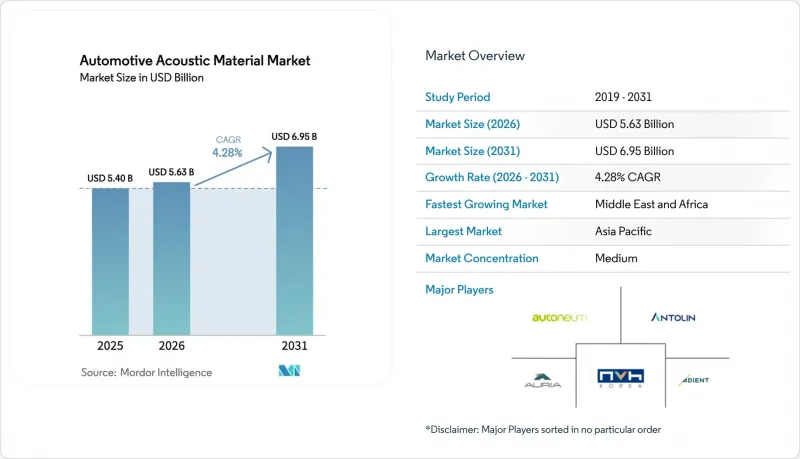
The automotive acoustic material market size is expected to increase from USD 5.40 billion in 2025 to USD 5.63 billion in 2026 and reach USD 6.95 billion by 2031, reflecting a 4.28% CAGR during the forecast period (2026 to 2031). Increasing electric vehicle production, intensifying interior noise regulations, and the push for lightweight multifunctional composites underpin this steady advance. OEMs focus on integrating thermal and acoustic functions into single-layer packages to free up space in skateboard EV platforms while meeting stringent cabin-noise limits. Polyurethane retains its lead because of proven damping performance, yet polypropylene gains traction as recycling mandates tighten. Geographic growth remains anchored in Asia-Pacific, but the Middle East and Africa outpace global averages as new assembly plants start production. Competitive intensity is shaped by material science breakthroughs and strategic acquisitions that expand regional footprints and diversify product portfolios.
Global Automotive Acoustic Material Market Trends and Insights
Stringent Global Interior Noise Regulations for EVs and HEVs
Electric and hybrid models now face cabin-noise caps under Regulation (EU) 540/2014 and China's GB 1495-2024 standards, driving an immediate spike in demand for high-density foams, multilayer laminates, and precision-tuned frequency absorbers . OEMs must secure certified materials within a two-year window, creating pricing leverage for suppliers already validated. Product selection increasingly revolves around low-thickness polyurethane composites that block inverter whine without sacrificing foot-well space. Regulations now spill into the aftermarket, compelling replacement parts to match original acoustic specifications, thereby enlarging total addressable demand. Suppliers that align R&D pipelines with certification schedules can command premiums and lock in multiyear contracts.
OEM Shift Toward Lightweight, Multifunctional Acoustic-Thermal Composites
Manufacturers are merging NVH dampers with thermal barriers into single panels that deliver notable mass savings over legacy multilayer stacks. Polypropylene-rich matrices are preferred because they meet recyclability thresholds emerging in Europe's Circular Economy Action Plan. The shift accelerates strategic partnerships between chemical companies and Tier 1 converters that control advanced bonding lines. Although such composites cost significantly more per square meter, OEMs recoup expenses through reduced fastener counts, faster takt times, and improved range in EVs. Suppliers with integrated compounding and laminating assets gain a competitive edge by hitting tight dimensional tolerances and dual-property targets in one production pass.
Supply-Chain Volatility in Petrochemical Feedstocks for Foams
Prices for toluene diisocyanate, a key polyurethane precursor, swung significantly during 2025 because of geopolitical tensions affecting Middle Eastern production. Margins for smaller converters without hedging mechanisms experienced a significant contraction. OEMs responded by dual-sourcing and negotiating pass-through clauses, raising procurement complexity. While bio-feedstock routes promise stability, they remain cost-additive and limited in capacity. Suppliers with backward-integrated chemical lines or long-term contracts insulate themselves from near-term shocks and retain preferred-vendor status.
Other drivers and restraints analyzed in the detailed report include:
- Rapid Urbanization Spurring Demand for In-Cabin Comfort in Emerging Asia
- Growing Ride-Sharing and Robo-Taxi Fleets Prioritizing Durable NVH Interiors
- Space Constraints in Skateboard EV Platforms Limiting Insulation Thickness
For complete list of drivers and restraints, kindly check the Table Of Contents.
Segment Analysis
Polyurethane remained the anchor at 40.25% share in 2025 because of reliable damping, established supply chains, and broad OEM validation. The automotive acoustic material market benefits from polyurethane's tuning versatility, enabling bespoke cell structures for specific frequency bands. Yet recyclability pressures and the search for lower density drive polypropylene's 6.55% CAGR, positioning it as the standout growth vector. Suppliers pivot to PP-rich blends that trim significant mass while meeting flammability codes. Bio-sourced feedstocks emerge but require scaling to match volume contracts, keeping them in pilot phases for now.
Polyurethane producers respond with renewable polyol grades and low-VOC formulations that align with EU REACH thresholds. The automotive acoustic material market size for polyurethane is set for further expansion, reflecting a solid base for incremental innovation. Polypropylene's rise invites capacity expansions in Asia, where integrated petrochemical complexes cut resin costs. Fiberglass and specialty textiles hold niche roles in commercial and premium interiors, respectively, balancing cost, weight, and aesthetics.
Interior solutions delivered 53.18% revenue in 2025, a testament to long-standing focus on occupant comfort and regulatory compliance. Door panels, floor carpets, and dash insulators form stable, high-volume programs that anchor supplier cash flows. The automotive acoustic material market continues to innovate in interior trims through composite felts that double as design surfaces, easing assembly and enhancing perceived quality. However, the exterior segment grows faster at 7.58% CAGR, propelled by EV aerodynamics and wind-noise management mandates.
Underbody shields, wheel-arch liners, and A-pillar trims leverage polypropylene and thermoformed PET blends that resist stone impact while dampening broadband noise. The automotive acoustic material market size assigned to exterior components is forecast to grow significantly by 2031. Integrated aero-acoustic modules lower drag and suppress vortex-induced noise, feeding OEM range and cabin-quietness targets in one assembly. Suppliers refine weather-stable composites able to survive thermal cycling and road-salt exposure without acoustic drift, locking in long-term durability claims.
The Automotive Acoustic Material Market Report is Segmented by Material Type (Polyurethane, Polypropylene, Polyvinyl Chloride, Fiberglass, and More), Application Area (Interior and Exterior), Vehicle Type (Passenger Cars, Light Commercial Vehicles (LCVs), and More), Sales Channel (OEM and Aftermarket), and Geography (North America, South America, Europe, and More). The Market Forecasts are Provided in Terms of Value (USD).
Geography Analysis
Asia-Pacific retained 38.16% of global revenue in 2025, anchored by China's 12.4 million electric car production count and India's expanding assembly clusters . Local acoustic suppliers co-locate near OEM plants in Shanghai, Pune, and Ulsan to meet just-in-time targets and adapt formulations to regional climate conditions. The automotive acoustic material market in China also absorbs local content rules, pushing foreign firms toward joint ventures for capacity scaling. Japan's hybrid expertise sustains demand for dual-mode barrier-absorber panels, while South Korea's export-focused OEMs specify global-compliant solutions to serve North American and European destinations.
The Middle East and Africa post the fastest expansion at 5.75% CAGR, led by the industrial development in the United Arab Emirates and Saudi Arabian manufacturing incentives embedded in Vision 2030. New CKD plants in Egypt and Morocco create localized demand for dash insulators and door seals tuned for high ambient temperatures. South Africa leverages established export channels to Europe, requiring materials certified to EU noise and recycling directives. Although infrastructure limitations persist, abundant petrochemical feedstocks underpin regional foam production, cushioning feedstock volatility on local converters.
Europe's premium brands keep the region at the forefront of acoustic technology. Germany's OEMs demand ultralight laminates that meet both NVH and sustainability thresholds, spurring suppliers to develop mono-material films compatible with closed-loop recycling. France and Italy prioritize felts made from recycled textile fibers, fitting circular-economy goals, while the United Kingdom nurtures start-ups exploring aerogel-hybrid absorbers. North America's transition toward electric pickup trucks intensifies the need for wheel-arch and underbody damping to manage tire roar, injecting fresh volume into plants in the United States. Across geographies, the automotive acoustic material market adapts formulations to match varying regulatory distances to curb NOx and noise emissions.
List of Companies Covered in this Report:
- Autoneum Holding AG
- Grupo Antolin
- Auria Solutions
- 3M Company
- BASF SE
- Continental AG
- Henkel AG & Co. KGaA
- NVH Korea Inc.
- Adient plc
- Compagnie de Saint-Gobain S.A.
- Toray Industries Inc.
- Sumitomo Riko Co. Ltd.
- Lear Corporation
- Forvia SE (Faurecia SE)
- Owens Corning
- Johns Manville Corporation
- Covestro AG
- Dow Inc.
- Huntsman Corporation
- LyondellBasell Industries N.V.
Additional Benefits:
- The market estimate (ME) sheet in Excel format
- 3 months of analyst support
TABLE OF CONTENTS
1 Introduction
2 Research Methodology
3 Executive Summary
4 Market Landscape
- 4.1 Market Overview
- 4.2 Market Drivers
- 4.2.1 Stringent Global Interior Noise Regulations for EVs and HEVs
- 4.2.2 OEM Shift Toward Lightweight, Multifunctional Acoustic-Thermal Composites
- 4.2.3 Rapid Urbanization Spurring Demand for In-Cabin Comfort in Emerging Asia
- 4.2.4 Growing Ride-Sharing and Robo-Taxi Fleets Prioritizing Durable NVH Interiors
- 4.2.5 Emergence of Bio-Based Foams and Recycled Textiles Aligned With ESG Mandates
- 4.2.6 Integrated Acoustic Packages Enabling Vehicle Audio-System Downsizing
- 4.3 Market Restraints
- 4.3.1 Supply-Chain Volatility in Petrochemical Feedstocks for Foams
- 4.3.2 Space Constraints in Skateboard EV Platforms Limiting Insulation Thickness
- 4.3.3 Escalating End-of-Life Recycling Mandates Increasing Material Complexity
- 4.3.4 Rising Popularity of Active Noise Cancellation Cutting Passive-Material Demand
- 4.4 Value / Supply-Chain Analysis
- 4.5 Technological Outlook
- 4.6 Regulatory Landscape
- 4.7 Porter's Five Forces
- 4.7.1 Threat of New Entrants
- 4.7.2 Threat of Substitutes
- 4.7.3 Bargaining Power of Buyers
- 4.7.4 Bargaining Power of Suppliers
- 4.7.5 Competitive Rivalry
5 Market Size & Growth Forecasts (Value in USD)
- 5.1 By Material Type
- 5.1.1 Polyurethane
- 5.1.2 Polypropylene
- 5.1.3 Polyvinyl Chloride (PVC)
- 5.1.4 Fiberglass
- 5.1.5 Textiles
- 5.1.6 Rubber
- 5.1.7 Foam
- 5.1.8 Others
- 5.2 By Application Area
- 5.2.1 Interior
- 5.2.2 Exterior
- 5.3 By Vehicle Type
- 5.3.1 Passenger Cars
- 5.3.2 Light Commercial Vehicles (LCVs)
- 5.3.3 Medium and Heavy Commercial Vehicles (MHCVs)
- 5.3.4 Buses and Coaches
- 5.4 By Sales Channel
- 5.4.1 OEM
- 5.4.2 Aftermarket
- 5.5 By Geography
- 5.5.1 North America
- 5.5.1.1 United States
- 5.5.1.2 Canada
- 5.5.1.3 Rest of North America
- 5.5.2 South America
- 5.5.2.1 Brazil
- 5.5.2.2 Argentina
- 5.5.2.3 Rest of South America
- 5.5.3 Europe
- 5.5.3.1 Germany
- 5.5.3.2 United Kingdom
- 5.5.3.3 France
- 5.5.3.4 Italy
- 5.5.3.5 Spain
- 5.5.3.6 Rest of Europe
- 5.5.4 Asia-Pacific
- 5.5.4.1 China
- 5.5.4.2 India
- 5.5.4.3 Japan
- 5.5.4.4 South Korea
- 5.5.4.5 Rest of Asia-Pacific
- 5.5.5 Middle East and Africa
- 5.5.5.1 United Arab Emirates
- 5.5.5.2 Saudi Arabia
- 5.5.5.3 Turkey
- 5.5.5.4 Egypt
- 5.5.5.5 South Africa
- 5.5.5.6 Rest of Middle East and Africa
- 5.5.1 North America
6 Competitive Landscape
- 6.1 Market Concentration
- 6.2 Strategic Moves
- 6.3 Market Share Analysis
- 6.4 Company Profiles (Includes Global Level Overview, Market Level Overview, Core Segments, Financials as Available, Strategic Information, Market Rank/Share for Key Companies, Products and Services, SWOT Analysis, and Recent Developments)
- 6.4.1 Autoneum Holding AG
- 6.4.2 Grupo Antolin
- 6.4.3 Auria Solutions
- 6.4.4 3M Company
- 6.4.5 BASF SE
- 6.4.6 Continental AG
- 6.4.7 Henkel AG & Co. KGaA
- 6.4.8 NVH Korea Inc.
- 6.4.9 Adient plc
- 6.4.10 Compagnie de Saint-Gobain S.A.
- 6.4.11 Toray Industries Inc.
- 6.4.12 Sumitomo Riko Co. Ltd.
- 6.4.13 Lear Corporation
- 6.4.14 Forvia SE (Faurecia SE)
- 6.4.15 Owens Corning
- 6.4.16 Johns Manville Corporation
- 6.4.17 Covestro AG
- 6.4.18 Dow Inc.
- 6.4.19 Huntsman Corporation
- 6.4.20 LyondellBasell Industries N.V.
7 Market Opportunities and Future Outlook
- 7.1 White-space and Unmet-Need Assessment

