PUBLISHER: Mordor Intelligence | PRODUCT CODE: 2044207

PUBLISHER: Mordor Intelligence | PRODUCT CODE: 2044207
Active Noise Cancellation Headphones - Market Share Analysis, Industry Trends & Statistics, Growth Forecasts (2026 - 2031)
The active noise cancellation headphones market size is expected to grow from USD 20.38 billion in 2025 to USD 23.24 billion in 2026 and is forecast to reach USD 44.76 billion by 2031 at a 14.01% CAGR over 2026-2031.
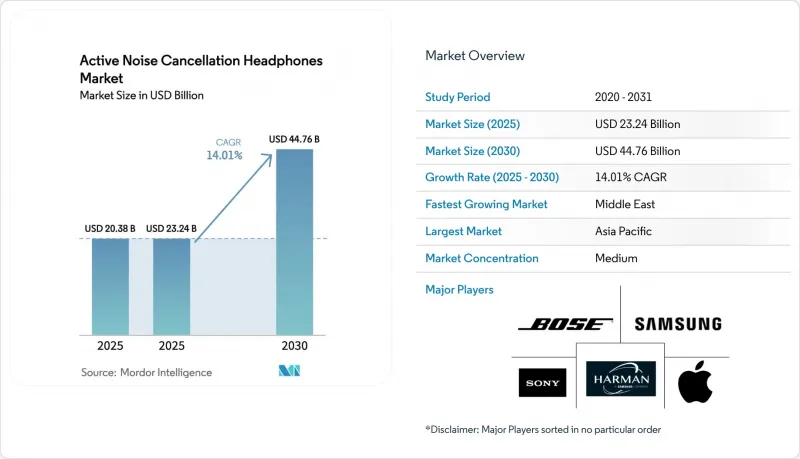
Adoption in hybrid workspaces, premium audio ecosystems, and component-level cost engineering all reinforce demand. Online channels now let brands push firmware updates that continually improve attenuation, which in turn extends product life. Spatial-audio catalogs are expanding, prompting users to trade up to devices that render immersive content accurately. Meanwhile, MEMS microphones reduce bill-of-materials costs, enabling sub-USD 100 models to offer features once reserved for flagship tiers. Rare-earth magnet volatility and stricter supply-chain audits have tempered growth but have not derailed long-term momentum in the active noise-cancellation headphones market.
Global Active Noise Cancellation Headphones Market Trends and Insights
Rising Adoption of ANC Headphones for Hybrid Work Environments
Hybrid work has recast ANC headsets as essential productivity gear rather than discretionary tech accessories. Frost and Sullivan estimated that 94% of companies will outfit employees with professional-grade headsets by 2026, up 12 percentage points from 2024, as employers link acoustic isolation to measurable gains in task accuracy. Enterprises now bundle headsets into ergonomic stipends, and call-center operators have raised procurement volumes to protect service-level targets during remote shifts. Jabra and Plantronics together held roughly 75% of the call-center submarket in 2025, leveraging DSP tuned to the 300 Hz-3.4 kHz voice band to maximize intelligibility. Short-cycle firmware updates that refine microphone beamforming strengthen the hardware's role as living infrastructure rather than fixed assets. Regulators in North America and Europe have begun citing decibel exposure thresholds for home offices, accelerating mandated deployments of ANC headsets across white-collar roles.
Millennial Preference for Premium Audio Experiences
Millennials and Gen Z buyers equate superior sound with self-care, pushing premium models to 53.72% revenue share in 2025. Apple's USD 249 AirPods Pro 3 pairs heart-rate monitoring with real-time ANC adjustments every 0.1 second, fusing wellness data with immersive listening. Sony's USD 449 WH-1000XM6 employs a QN3 processor seven times faster than its predecessor, enabling dynamic attenuation that updates 700 times per second. Bose counters with the QuietComfort Ultra, delivering USB-C lossless playback and 30-hour battery life to placate audiophiles skeptical of Bluetooth compression. Social-media culture amplifies these launches, turning unboxing videos and audio-quality comparisons into proxy status symbols for upwardly mobile consumers. As a result, spending on premium ANC headphones increasingly mirrors the historical upgrades in smartphone camera specifications.
High Capital and DSP Engineering Expertise Requirements
Cutting-edge ANC demands proprietary silicon, multi-microphone calibration rigs, and vast acoustic datasets, costs that smaller challengers cannot absorb. Sony's QN3 ASIC took seven years of R&D and access to full-size anechoic chambers to perfect real-time adaptive filtering across 12 microphones. Bose trained neural models on more than 10,000 hours of ambient recordings to cancel impulse sounds like door slams, a multimillion-dollar annotation effort. Manufacturing lines must match microphone tolerances to within fractions of a decibel, pushing capital outlays to USD 5-10 million per facility before the first unit shipment. Smaller original design manufacturers often resort to licensing Qualcomm or MediaTek DSP cores at royalty rates of 5-8%, eroding already-thin margins. Consequently, incumbent leaders fortify their moats while many mid-tier aspirants exit or pivot to lower-spec audio accessories.
Other drivers and restraints analyzed in the detailed report include:
- Expansion of Spatial-Audio and Immersive-Media Ecosystems
- Advancements in MEMS-Microphone Arrays Lowering BOM Costs
- Counterfeit and Low-Cost Substitutes Diluting Brand Equity
For complete list of drivers and restraints, kindly check the Table Of Contents.
Segment Analysis
Over-ear models accounted for 44.56% of the active noise cancellation headphones market share in 2025, reflecting their superior passive isolation, large-format drivers, and 30-hour battery endurance. Corporate studios, broadcasters, and call-center operators continue to specify circumaural headsets because the closed-back design provides a flat frequency response that preserves voice clarity during long sessions. Yet commuters and frequent flyers increasingly see bulky earcups as a trade-off, prompting a pivot toward pocketable alternatives weighing less than 6 g per ear. Samsung's February 2026 launch of a planar-magnetic true wireless earbud proved that premium fidelity no longer requires over-ear bulk, shrinking the use-case moat that once protected the larger form factor.
In-ear designs, therefore, post the fastest trajectory, advancing at a 14.68% CAGR through 2031 as hybrid dual-mike topologies overcome the limited passive seal of silicone tips. Adaptive algorithms now cancel 30 dB of cabin drone even in compact housings, letting travelers wear the buds continuously without neck strain. On-ear products occupy a narrowing middle ground, favored mainly for fashion aesthetics; absent meaningful acoustic advantages, their volume lags behind the two extremes. Across all categories, MEMS microphone arrays and denser battery chemistries compress size without sacrificing runtime, reshaping buyer expectations for everyday, all-day wearability.
The premium tier captured 53.72% of the active noise cancellation headphones market share in 2025, underpinned by the Apple, Sony, and Bose ecosystems that enable seamless device switching, spatial audio, and lossless USB-C playback. Affluent users regard these features as table stakes, sustaining a willingness to pay USD 249-USD 449 for flagships. However, chipset commoditization has armed budget challengers with hybrid ANC, Bluetooth 5.3 LE Audio, and 10-hour single-charge endurance at sub-USD 100 price points, blurring perceived performance boundaries. Mid-priced SKUs, ranging from USD 100 to USD 250, now struggle to find an identity as consumers polarize between top-shelf exclusivity and "good-enough" frugality.
Low-price models are set to expand at a 14.63% CAGR over 2026-2031, propelled by vertically integrated brands that absorb compliance costs and flood online channels during seasonal flash sales. Premium incumbents respond by layering health sensors and proprietary codecs onto hardware to justify margins, yet every budget cycle erodes that moat a little further. Modest-tier vendors increasingly chase niche audiophile tunings, studio-flat signatures, or haptic bass gimmicks to avoid direct price wars with the high-volume value segment. Overall, intensifying bifurcation forces brands to articulate clearer benefits per dollar or risk being squeezed from both ends.
The Active Noise Cancellation Headphones Market Report is Segmented by Product Type (In-Ear, On-Ear, Over-Ear), Price Range (Premium, Moderate, Low), Distribution Channel (Retail, and Online), End User (Consumer Entertainment, Professional/Studio and Broadcasting, Travel and Commuter, Gaming, and More), ANC Technology (Feedforward, Feedback, Hybrid), and Geography. The Market Forecasts are Provided in Terms of Value (USD).
Geography Analysis
Asia-Pacific accounted for 36.29% of the active noise cancellation headphones market share in 2025, blending a massive manufacturing base with rising local consumption. Vietnam's contract assemblers shipped roughly 40% of global unit volume, a scale that helped the country post 8.22% GDP growth in Q3 2025. China's domestic scene matured as Xiaomi and Anker together held a 30% share in the sub-USD 100 tier, while India's new Apple stores in Mumbai and Delhi sparked a 22.1% month-on-month spike in premium true wireless demand during late 2025. Emerging Southeast Asian markets such as Indonesia and the Philippines logged 18%-25% annual unit growth, driven by e-commerce flash sales and the adoption of installment payments. These tailwinds keep the region firmly in the lead for both production volumes and first-time buyers.
North America and Europe remain innovation hubs even as growth steadies at roughly 12% CAGR. U.S. employers subsidize headsets to comply with OSHA's 85 dB exposure limit for remote workers, thereby expanding the market for active noise-cancellation headphones. The European Union's REACH and RoHS directives add USD 2-5 per unit in compliance costs, favoring vertically integrated brands that can internalize testing overhead. Frankfurt Airport's January 2026 Auracast pilot demonstrated how public infrastructure rollouts can unlock broadcast audio opportunities that drive headset upgrades among frequent flyers. Together, these policies and pilots turn regulation into a stealth growth lever for premium devices.
The Middle East and Africa delivered the fastest regional outlook at a projected 15.07% CAGR through 2031. The United Arab Emirates and Saudi Arabia treat headphones as luxury fashion, with Bang & Olufsen boutiques offering personalized acoustic fittings in flagship malls. Nigeria leads volume gains as mobile-money platforms let consumers finance USD 99 earbuds in weekly installments, widening access beyond salaried elites. Fragmented Gulf Cooperation Council certification rules can add 3 to 6 months to product launches, disadvantaging smaller newcomers that lack dedicated regulatory teams. South America, anchored by Brazil and Argentina, grows more slowly because currency volatility inflates retail prices by 30%-50% against U.S. equivalents, leaving the region reliant on older inventory clearances.
- Apple Inc.
- Bose Corporation
- Sony Group Corporation
- Samsung Electronics Co., Ltd.
- Sennheiser electronic GmbH and Co. KG
- GN Audio A/S
- Bang and Olufsen A/S
- Audio-Technica Corporation
- Harman International Industries, Inc.
- Plantronics, Inc.
- Logitech International S.A.
- Skullcandy Inc.
- Anker Innovations Ltd.
- Shure Incorporated
- Turtle Beach Corporation
- AsusTek Computer Inc.
- Pioneer Corporation
- Xiaomi Corporation
- Creative Technology Ltd.
- Shenzhen Meidong Acoustics Co., Ltd.
- Bowers and Wilkins Group Ltd.
- OnePlus Technology (Shenzhen) Co., Ltd.
Additional Benefits:
- The market estimate (ME) sheet in Excel format
- 3 months of analyst support
TABLE OF CONTENTS
1 INTRODUCTION
- 1.1 Study Assumptions and Market Definition
- 1.2 Scope of the Study
2 RESEARCH METHODOLOGY
3 EXECUTIVE SUMMARY
4 MARKET LANDSCAPE
- 4.1 Market Overview
- 4.2 Market Drivers
- 4.2.1 Rising Adoption of ANC Headphones for Hybrid Work Environments
- 4.2.2 Millennial Preference for Premium Audio Experiences
- 4.2.3 Expansion of Spatial-Audio and Immersive-Media Ecosystems
- 4.2.4 Advancements in MEMS-Microphone Arrays Lowering BOM Costs
- 4.2.5 Airline Cabin Retrofits with Bluetooth Broadcasting Enabling BYOD ANC Listening
- 4.2.6 Workplace Wellbeing Regulations Setting Decibel Exposure Limits for Remote Staff
- 4.3 Market Restraints
- 4.3.1 High Capital and DSP Engineering Expertise Requirements
- 4.3.2 Counterfeit and Low-Cost Substitutes Diluting Brand Equity
- 4.3.3 Rare-Earth Magnet Price Volatility Impacting Driver Costs
- 4.3.4 Supply Chain ESG Audits Delaying Time-to-Market for ODMs
- 4.4 Industry Value Chain Analysis
- 4.5 Regulatory Landscape
- 4.6 Technological Outlook
- 4.7 Impact of Macroeconomic Factors
- 4.8 Porter's Five Forces Analysis
- 4.8.1 Threat of New Entrants Analysis
- 4.8.2 Bargaining Power of Buyers Analysis
- 4.8.3 Bargaining Power of Suppliers Analysis
- 4.8.4 Threat of Substitute Products Analysis
- 4.8.5 Intensity of Competitive Rivalry Analysis
5 MARKET SIZE AND GROWTH FORECASTS (VALUE)
- 5.1 By Product Type
- 5.1.1 In-ear
- 5.1.2 On-ear
- 5.1.3 Over-ear
- 5.2 By Price Range
- 5.2.1 Premium
- 5.2.2 Moderate
- 5.2.3 Low
- 5.3 By Distribution Channel
- 5.3.1 Retail
- 5.3.2 Online
- 5.4 By End User
- 5.4.1 Consumer Entertainment
- 5.4.2 Professional / Studio and Broadcasting
- 5.4.3 Travel and Commuter
- 5.4.4 Enterprise and Call Center
- 5.4.5 Gaming
- 5.5 By ANC Technology
- 5.5.1 Feedforward
- 5.5.2 Feedback
- 5.5.3 Hybrid
- 5.6 By Geography
- 5.6.1 North America
- 5.6.1.1 United States
- 5.6.1.2 Canada
- 5.6.1.3 Mexico
- 5.6.2 South America
- 5.6.2.1 Brazil
- 5.6.2.2 Argentina
- 5.6.2.3 Rest of South America
- 5.6.3 Europe
- 5.6.3.1 United Kingdom
- 5.6.3.2 Germany
- 5.6.3.3 France
- 5.6.3.4 Italy
- 5.6.3.5 Rest of Europe
- 5.6.4 Asia-Pacific
- 5.6.4.1 China
- 5.6.4.2 Japan
- 5.6.4.3 India
- 5.6.4.4 South Korea
- 5.6.4.5 Rest of Asia-Pacific
- 5.6.5 Middle East and Africa
- 5.6.5.1 Middle East
- 5.6.5.1.1 United Arab Emirates
- 5.6.5.1.2 Saudi Arabia
- 5.6.5.1.3 Rest of Middle East
- 5.6.5.2 Africa
- 5.6.5.2.1 South Africa
- 5.6.5.2.2 Egypt
- 5.6.5.2.3 Rest of Africa
- 5.6.5.1 Middle East
- 5.6.1 North America
6 COMPETITIVE LANDSCAPE
- 6.1 Market Concentration
- 6.2 Strategic Moves
- 6.3 Market Share Analysis
- 6.4 Company Profiles (includes Global Level Overview, Market Level Overview, Core Segments, Financials as available, Strategic Information, Market Rank/Share, Products and Services, Recent Developments)
- 6.4.1 Apple Inc.
- 6.4.2 Bose Corporation
- 6.4.3 Sony Group Corporation
- 6.4.4 Samsung Electronics Co., Ltd.
- 6.4.5 Sennheiser electronic GmbH and Co. KG
- 6.4.6 GN Audio A/S
- 6.4.7 Bang and Olufsen A/S
- 6.4.8 Audio-Technica Corporation
- 6.4.9 Harman International Industries, Inc.
- 6.4.10 Plantronics, Inc.
- 6.4.11 Logitech International S.A.
- 6.4.12 Skullcandy Inc.
- 6.4.13 Anker Innovations Ltd.
- 6.4.14 Shure Incorporated
- 6.4.15 Turtle Beach Corporation
- 6.4.16 AsusTek Computer Inc.
- 6.4.17 Pioneer Corporation
- 6.4.18 Xiaomi Corporation
- 6.4.19 Creative Technology Ltd.
- 6.4.20 Shenzhen Meidong Acoustics Co., Ltd.
- 6.4.21 Bowers and Wilkins Group Ltd.
- 6.4.22 OnePlus Technology (Shenzhen) Co., Ltd.
7 MARKET OPPORTUNITIES AND FUTURE OUTLOOK
- 7.1 White-space and Unmet-Need Assessment

