PUBLISHER: Mordor Intelligence | PRODUCT CODE: 2044209

PUBLISHER: Mordor Intelligence | PRODUCT CODE: 2044209
Thailand Flexible Packaging - Market Share Analysis, Industry Trends & Statistics, Growth Forecasts (2026 - 2031)
The Thailand flexible packaging market size was valued at USD 2.56 billion in 2025 and estimated to grow from USD 2.83 billion in 2026 to reach USD 4.64 billion by 2031, at a CAGR of 10.39% during the forecast period (2026-2031).
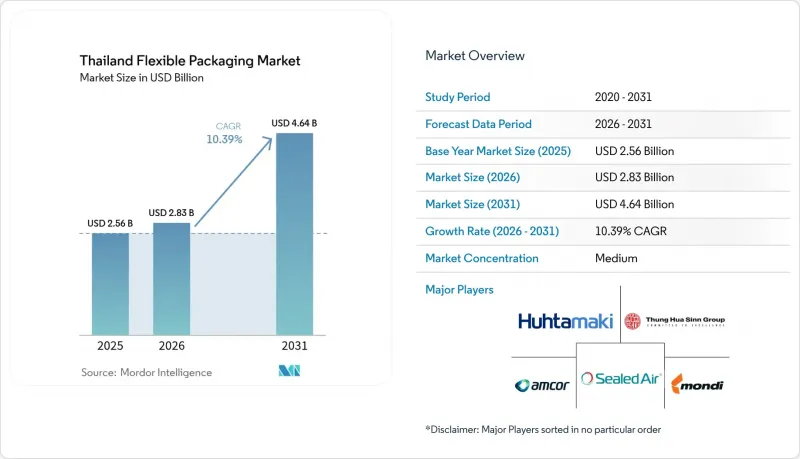
Solid e-commerce logistics growth, government bioplastic subsidies, and a steady wave of China-plus-one manufacturing relocations are accelerating demand across pouch, sachet, and mailer formats. Brand-owner commitments to recyclability are nudging converters toward mono-material, machine-direction-oriented polyethylene (MDO-PE), even as high-barrier multilayer laminates retain their critical role for oxygen-sensitive foods. The Thailand flexible packaging market is also benefiting from rising halal ready-to-eat exports, a revitalized tourism sector that favors portion-controlled sachets, and policy-backed industrial investments in the Eastern Economic Corridor. Competitive intensity remains moderate, with multinational converters investing in chemical recycling and Industry 4.0 lines while more than 200 small and medium-sized enterprises (SMEs) retain leadership in short-run jobs.
Thailand Flexible Packaging Market Trends and Insights
Surging E-Commerce Parcel Volumes Accelerating Demand for Lightweight Mailing Packs
Daily parcel throughput climbed to 7-8 million in 2025, a jump that converted corrugated shippers into lighter polyethylene mailers, enabling them to save 20-30% on last-mile freight costs. Private couriers installed automated sorters to handle peak loads of more than 12 million parcels per day, pulling in orders for peel-and-seal pouches, anti-static electronics sleeves, and insulated frozen-food bags. Converters trimmed mailer gauges to 40-60 microns, lowering resin usage without sacrificing drop resistance. Apparel and beauty brands, which dominate flash-sale events, are requesting custom graphics within one-week lead times, pressuring SMEs to adopt quick-change flexo presses. Despite the volume spike, Thailand has not imposed e-commerce packaging regulations, so voluntary take-back programs by marketplaces are the main nudge toward recyclable mono-material solutions.
Boom in Thailand's Halal and Ready-to-Eat Food Exports Requiring High-Barrier Pouches
Halal-certified exports reached roughly USD 7.8 billion in 2025, anchored by shelf-stable curries and ready meals that demand retort pouches with aluminum-foil or silicon-oxide barriers capable of 18-24 month shelf life. Certification by the Halal Science Center and the Central Islamic Council creates documentation hurdles that favor large converters with traceable supply chains. Gulf Cooperation Council importers increasingly request high-barrier, transparent films to showcase product quality, spurring investment in aluminum oxide vapor deposition. Resealable zippers and spouts command a 30-40% price premium but deliver portion control sought by urban consumers abroad. Expected expansion of halal capacity in Southern provinces is set to lift local demand for retort-grade laminates through 2030.
Ban on Imported Plastic Scrap Tightening Local rPET/rPE Availability
The 2025 prohibition on imported plastic scrap removed 150,000-200,000 t/y of recycled PET and PE feedstock, inflating recycled PET prices by 25-30% and eroding the cost edge over virgin resin. Domestic collection accounts for only a third of available PET bottles, while flexible film recovery remains negligible due to manual sorting constraints. Food-grade rPET supply now meets less than half of converter demand, pushing exporters to pay premiums for certified imported pellets or risk failing recycled-content mandates in Europe. Chemical recycling pilots by SCG Packaging and TPBI promise relief but are unlikely to reach scale before 2027. Converters serving cosmetic sachets and detergent refill packs face the sharpest squeeze as recycled-content targets tighten.
Other drivers and restraints analyzed in the detailed report include:
- Bio-Circular-Green Policy Subsidising Bioplastic Film Capacity Additions
- Brand-Owner Shifts to Mono-Material MDO-PE Film for Recyclability
- Extended Producer Responsibility Draft Law Raising Compliance Costs
For complete list of drivers and restraints, kindly check the Table Of Contents.
Segment Analysis
Pouches accounted for a commanding 36.71% of the Thai flexible packaging market in 2025, underscoring their versatility for beverages, pet food, and home-care refills. Brands prefer stand-up formats with spouts or zippers that lend billboard-like shelf presence and enable portion control at a lower total system cost than glass jars. In parallel, sachets and stick packs are growing at an 11.54% CAGR as on-the-go consumers snap up single-serve beverages, condiments, and nutraceutical powders delivered directly via e-commerce. Weight reduction is also a focal point; new linear low-density polyethylene films cut pouch gram weight by 8-10% without compromising drop resistance.
Down-gauging aside, pouches hold firm in value-added retort meals and pet food where oxygen and moisture barriers are non-negotiable. Sachets, on the other hand, are moving beyond powders into liquids such as single-dose shampoos using heat-resistant cast polypropylene layers. Multinational beverage brands are trialing perforated twin-stick formats that mix probiotic cultures with vitamins only when opened, placing extra sealing accuracy demands on equipment. Local SMEs that serve instant noodle condiments rely on flexo presses with 10,000-unit minimums, creating an opportunity for digital-only newcomers serving micro-batches for influencer-led product launches. Overall, the Thailand flexible packaging market continues to favor formats that balance consumer convenience, lightweight logistics, and evolving EPR cost structures.
Plastic retained a 54.89% share of the Thailand flexible packaging market in 2025, thanks to polyethylene, polypropylene, and PET winning on cost-performance metrics. Polyethylene's broad toolkit, from low-density grades for bread bags to high-density grades for detergent pouches, anchors converter production volumes exceeding 3 million t/y. Yet the Thailand flexible packaging market size for bioplastics is expanding quickly and is forecast to grow at an 11.36% CAGR, catalyzed by the Bio-Circular-Green subsidy scheme and falling PLA resin prices. Brand owners in fresh produce and bakery lines have switched to PLA-based films that meet marine park compostability requirements while maintaining pack integrity throughout an eight-day supply chain.
Conventional plastic stalwarts now face dual pressures: volatile crude-linked feedstock costs and EPR fees that penalize difficult-to-recycle multilayer structures. Polypropylene's clarity and heat resistance keep it relevant for boil-in-bag rice and microwave popcorn, but recycled PP streams remain underdeveloped, hurting circularity claims. PET stays critical for metallized snack films, yet shortages of food-grade rPET after the scrap-import ban mean converters often blend virgin and recycled content below the 25% thresholds specified by European customers. On the bioplastic front, early-stage PBAT blends enhance toughness, while GMO-free PLA grades answer export market labeling requirements. Converters that master coextrusion of bio-based outer layers with thin barrier tie layers are well positioned to capture premium positions as multinational FMCG buyers seek to decarbonize their regional portfolios.
The Thailand Flexible Packaging Market Report is Segmented by Product Type (Pouches, Bags, Films and Wraps, Sachets and Stick Packs, Labels and Sleeves, Flexitanks and Other Product Types), Material (Plastic, Aluminum Foil, Bioplastics, and More), End-User Industry (Food, Beverage, and More), Layer Structure (Mono-Material Structures, and Multilayer Barrier Laminates). The Market Forecasts are Provided in Terms of Value (USD).
List of Companies Covered in this Report:
- Amcor plc
- Thung Hua Sinn Group
- Huhtamaki Oyj
- Sealed Air Corporation
- T. Tarutani Pack Co Ltd
- SCG Packaging Public Co Ltd
- Mondi plc
- JR Pack Co Ltd
- Thai Artec Co Ltd
- TPBI Public Co Ltd
- Innopack Industry Co Ltd
- Scientex Packaging (Ayer Keroh) Berhad
- Kim Pai Co Ltd
- Print Master Co Ltd
- South East Packaging Industry Co Ltd
- LLH Printing and Packaging
- Majend Macks Co Ltd
- Fuji Seal International Inc.
- Royal Meiwa Pax Co Ltd
- Craftz Co Ltd
- Alpla (Thailand) Co Ltd
- Shrinkflex (Thailand) Public Co Ltd
Additional Benefits:
- The market estimate (ME) sheet in Excel format
- 3 months of analyst support
TABLE OF CONTENTS
1 INTRODUCTION
- 1.1 Study Assumptions and Market Definition
- 1.2 Scope of the Study
2 RESEARCH METHODOLOGY
3 EXECUTIVE SUMMARY
4 MARKET LANDSCAPE
- 4.1 Market Overview
- 4.2 Market Drivers
- 4.2.1 Surging E-commerce Parcel Volumes Accelerating Demand for Lightweight Mailing Packs
- 4.2.2 Boom in Thailand's Halal and Ready-to-Eat Food Exports Requiring High-Barrier Pouches
- 4.2.3 Bio-Circular-Green (BCG) Policy Subsidising Bioplastic Film Capacity Additions
- 4.2.4 Brand-Owner Shift to Mono-Material MDO-PE Film for Recyclability
- 4.2.5 Adoption of Industry 4.0 Flexo Presses Improving Short-Run Economics for SMEs
- 4.2.6 International FMCG Near-Shoring to Thailand amid China+1 Strategy
- 4.3 Market Restraints
- 4.3.1 Ban on Imported Plastic Scrap Tightening Local rPET/rPE Availability
- 4.3.2 Extended Producer Responsibility Draft Law Raising Compliance Costs
- 4.3.3 Skilled-Labour Shortage in Advanced Printing and Converting
- 4.3.4 Volatile Feedstock Prices Eroding Converter Margins
- 4.4 Industry Value Chain Analysis
- 4.5 Regulatory Landscape
- 4.6 Technological Outlook
- 4.7 Impact of Macroeconomic Factors on the Market
- 4.8 Impact of Current Geo-Political Scenarios on the Market
- 4.9 Porter's Five Forces Analysis
- 4.9.1 Bargaining Power of Suppliers
- 4.9.2 Bargaining Power of Buyers
- 4.9.3 Threat of New Entrants
- 4.9.4 Threat of Substitutes
- 4.9.5 Intensity of Competitive Rivalry
- 4.10 Vendor Level Presence in Major Verticals
- 4.11 Investment Analysis
5 MARKET SIZE AND GROWTH FORECASTS (VALUE)
- 5.1 By Product Type
- 5.1.1 Pouches
- 5.1.2 Bags
- 5.1.3 Films and Wraps
- 5.1.4 Sachets and Stick Packs
- 5.1.5 Labels and Sleeves
- 5.1.6 Flexitanks and Other Product Types
- 5.2 By Material
- 5.2.1 Plastic
- 5.2.1.1 Polyethylene (PE)
- 5.2.1.2 Polypropylene (PP)
- 5.2.1.3 Polyethylene Terephthalate (PET)
- 5.2.1.4 Polyvinyl Chloride (PVC)
- 5.2.1.5 Other Plastics
- 5.2.2 Paper
- 5.2.3 Aluminum Foil
- 5.2.4 Bioplastics
- 5.2.5 Multilayer Barrier Structures
- 5.2.1 Plastic
- 5.3 By End-User Industry
- 5.3.1 Food
- 5.3.2 Beverage
- 5.3.3 Personal Care and Cosmetics
- 5.3.4 Pharmaceuticals and Healthcare
- 5.3.5 Pet Food and Animal Feed
- 5.3.6 Home-Care and Industrial
- 5.3.7 E-Commerce and Logistics
- 5.4 By Layer Structure
- 5.4.1 Mono-Material Structures
- 5.4.2 Multilayer Barrier Laminates
6 COMPETITIVE LANDSCAPE
- 6.1 Market Concentration
- 6.2 Strategic Moves
- 6.3 Market Share Analysis
- 6.4 Company Profiles (includes Global Level Overview, Market Level Overview, Core Segments, Financials as available, Strategic Information, Market Rank/Share, Products and Services, Recent Developments)
- 6.4.1 Amcor plc
- 6.4.2 Thung Hua Sinn Group
- 6.4.3 Huhtamaki Oyj
- 6.4.4 Sealed Air Corporation
- 6.4.5 T. Tarutani Pack Co Ltd
- 6.4.6 SCG Packaging Public Co Ltd
- 6.4.7 Mondi plc
- 6.4.8 JR Pack Co Ltd
- 6.4.9 Thai Artec Co Ltd
- 6.4.10 TPBI Public Co Ltd
- 6.4.11 Innopack Industry Co Ltd
- 6.4.12 Scientex Packaging (Ayer Keroh) Berhad
- 6.4.13 Kim Pai Co Ltd
- 6.4.14 Print Master Co Ltd
- 6.4.15 South East Packaging Industry Co Ltd
- 6.4.16 LLH Printing and Packaging
- 6.4.17 Majend Macks Co Ltd
- 6.4.18 Fuji Seal International Inc.
- 6.4.19 Royal Meiwa Pax Co Ltd
- 6.4.20 Craftz Co Ltd
- 6.4.21 Alpla (Thailand) Co Ltd
- 6.4.22 Shrinkflex (Thailand) Public Co Ltd
7 MARKET OPPORTUNITIES AND FUTURE OUTLOOK
- 7.1 White-Space and Unmet-Need Assessment

