PUBLISHER: Mordor Intelligence | PRODUCT CODE: 2044212

PUBLISHER: Mordor Intelligence | PRODUCT CODE: 2044212
Procurement Software - Market Share Analysis, Industry Trends & Statistics, Growth Forecasts (2026 - 2031)
The procurement software market size is projected to expand from USD 9.81 billion in 2025 and USD 10.74 billion in 2026 to USD 17.11 billion by 2031, registering a CAGR of 9.76% between 2026 to 2031.
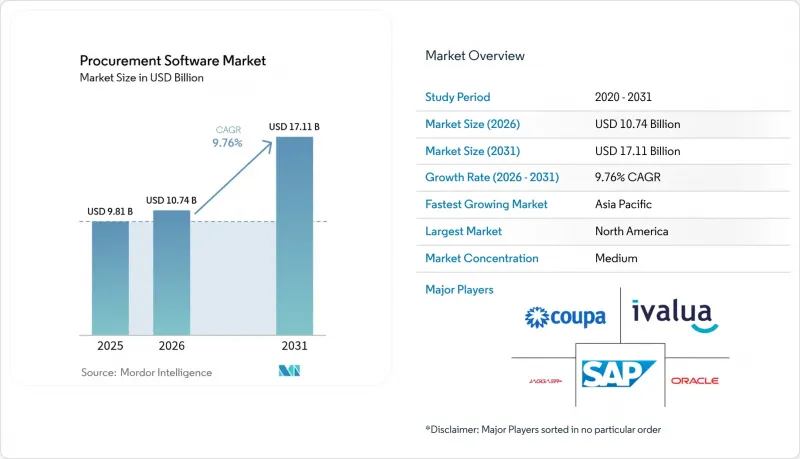
Demand pivots around autonomous workflows that combine cloud-native architectures, generative-AI copilots, and tokenized cross-border payment rails, each lowering cost-to-serve while accelerating decision cycles. Cloud deployment dominates because elastic SaaS platforms slash data-center overhead, give real-time spend visibility, and update features for every tenant in near-real time. End-user uptake broadens as healthcare group purchasing organizations link sourcing decisions to value-based reimbursement, while SMEs gain entry through freemium tiers and embedded finance that convert capital expense into operating expense. Regionally, North American maturity anchors current revenue, yet Asia Pacific outpaces on growth as public e-procurement mandates and leapfrog cloud adoption converge.
Global Procurement Software Market Trends and Insights
Automating End-to-End Procurement Workflows
Organizations collapse requisition, approval, supplier discovery, contracting, and invoicing into a single platform that removes manual handoffs and prunes cycle time by up to half. Robotic process automation now drafts the bulk of purchase orders, reallocating human effort toward supplier relationship management. The resulting operating-expense reduction approaches 20% in industries exposed to volatile input prices, giving early adopters headroom to negotiate volume discounts that shield margins during commodity swings. Real-time dashboards redirect budgets within hours when disruptions hit, a capability that proved decisive during the 2025 semiconductor shortage. Firms that achieve this level of automation also report materially faster supplier onboarding, strengthening resiliency against single-source risk.
Seamless ERP and e-Procurement Integration
Bidirectional data flow between core ERP systems and procurement suites eliminates duplicate master records, curbing invoice discrepancies and shortening monthly close cycles. Pre-built adapters from leading vendors now synchronize contract terms, chart-of-accounts codes, and tax data without custom code, shrinking integration risk for multisuite enterprises. Middleware further federates data for conglomerates running multiple ERP instances, enabling unified spend analytics that surface maverick spend and unlock volume-discount leverage. Firms completing clean integrations often cite double-digit productivity gains across procurement staff because requisitioners transact from within the familiar ERP interface. This integration stickiness, in turn, raises switching costs and underpins vendor renewal rates.
Legacy-System Integration Complexity
Enterprises with aging, highly customized ERP codebases require months of mapping, testing, and remediation before procurement suites can go live. Custom extensions in legacy SAP or Oracle environments create brittle dependencies that break during upgrades, inflating budgets and delaying ROI. Data-quality problems such as duplicate supplier records further hamper synchronization, often forcing businesses to postpone platform rollouts until parallel ERP modernization concludes. Vendors now offer pre-certified connectors that shift part of the integration risk onto themselves, yet highly tailored deployments still overrun initial schedules. These hurdles make integration complexity the single most cited reason for stalled digital-procurement programs.
Other drivers and restraints analyzed in the detailed report include:
- Migration to Cloud-Native Platforms
- Generative AI Copilots Accelerating Autonomous Sourcing
- Data-Security and Regulatory Compliance Concerns
For complete list of drivers and restraints, kindly check the Table Of Contents.
Segment Analysis
Cloud deployment captured 67.92% of the procurement software market share in 2025, reflecting enterprise preference for elastic capacity that absorbs traffic spikes without capital expense. The segment's 9.81% CAGR underscores how multi-tenant SaaS platforms spread AI model-training costs across thousands of customers, making autonomous invoice matching and predictive risk scoring financially viable for mid-size firms. On-premise installations persist in defense and banking, where data-sovereignty rules limit external hosting, but hybrid architectures increasingly bridge local transaction processing with centralized analytics. Edge computing also gains favor among retailers operating in connectivity-challenged regions, lowering latency and ensuring continuous transaction flow during network outages.
The procurement software market benefits when cloud vendors roll updates in hours rather than quarters, enabling rapid response to regulatory changes such as electronic-invoice mandates or carbon-reporting rules. Conversely, on-premise buyers face six-to-twelve-month upgrade cycles that delay access to new functionality and inflate total cost of ownership. Even regulated entities are piloting shielded SaaS models that encrypt sensitive fields yet retain multi-tenant economics, signaling a gradual erosion of the long-standing on-premise stronghold. Taken together, these trends reinforce cloud's leadership position for the foreseeable horizon.
Manufacturing led 2025 revenue with 21.63% share, underpinned by complex bill-of-materials management and just-in-time inventory strategies that reward tight supplier coordination. Yet healthcare is the fastest riser, tracking a 9.79% CAGR as hospitals tie procurement savings to value-based reimbursement metrics, making every percentage point of supply cost a bottom-line imperative. Procedure-level integration with electronic health records allows clinicians to benchmark implant utilization and negotiate evidence-based pricing, cutting orthopedic spend by double digits. Group-purchasing organizations amplify buying power and help hospitals adjudicate supplier performance on infection-control or readmission measures.
Elsewhere, retail and e-commerce platforms automate tariff calculations and customs documentation to mitigate border friction, while BFSI institutions deploy software to meet third-party risk obligations under global capital rules. Government agencies adopt e-procurement to meet transparency and accessibility mandates, and IT-telecom firms use spend analytics to tame SaaS subscription sprawl. The ability to configure sector-specific workflows-such as subcontractor compliance checklists for construction-positions vertical SaaS vendors to seize whitespace overlooked by horizontal suites. Consequently, the procurement software market broadens not only by enterprise size but also by depth of industry fit.
The Procurement Software Market Report is Segmented by Deployment (Cloud and On-Premise), End-User Industry (Retail, Manufacturing, Transportation and Logistics, Healthcare, BFSI, IT and Telecom, and More), Organization Size (Large Enterprises and SMEs), Application Module (e-Sourcing, Contract Management, Spend Analysis, and More), Component (Software and Services), and Geography. The Market Forecasts are Provided in Value (USD).
Geography Analysis
North America generated 33.64% of 2025 revenue, thanks to mature ERP ecosystems, supplier-diversity mandates under Executive Order 14091, and early adoption of generative-AI-enabled procurement copilots. Federal transparency requirements that demand machine-readable contract data drive platform penetration across civilian agencies, while Canadian entities migrate to comply with digital-accessibility rules. Mexico's export-focused manufacturers embed software to automate United States-Mexico-Canada Agreement origin certifications, underscoring how trade pacts can catalyze digital procurement.
Asia Pacific advances at a 9.87% CAGR, the fastest worldwide, propelled by government portals such as India's GeM and China's centralized public-procurement reforms that oblige electronic sourcing above specified thresholds. Japan allocates substantial funds to API-ready government systems, and Australia applies modern slavery legislation that forces businesses to audit supply chains for forced-labor risk, bringing procurement platforms to the front line of ESG compliance. Companies leapfrog legacy infrastructure entirely, opting for cloud-native suites that offer localized language packs, tax rules, and payment integrations from day one.
Europe balances North American maturity with Asia Pacific's growth velocity. The European Union's forthcoming eForms mandates standardize contract notices, cutting cross-border tender costs and favoring platforms with built-in schema support. Green-deal initiatives require lifecycle carbon accounting, compelling software to ingest emissions data and present cradle-to-gate footprints during bid evaluation. Germany's supply-chain due-diligence act extends human-rights audits to first-tier suppliers, and similar legislation is debated across the bloc, reinforcing compliance-driven adoption. South America and Middle East markets remain nascent but gather momentum as Brazil and Saudi Arabia roll out national e-procurement portals, while much of Africa still contends with connectivity gaps that delay widescale deployment.
- SAP SE
- Coupa Software Incorporated
- Oracle Corporation
- Microsoft Corporation
- Jaggaer, LLC
- Infor Inc. (GT Nexus)
- Ivalua Inc.
- GEP Worldwide (GEP Solutions Private Ltd.)
- Basware Oyj
- Proactis Holdings Limited
- Zycus Incorporated
- Epicor Software Corporation
- Workday Inc.
- Tradeshift Holdings Inc.
- SynerTrade (Econocom Digital Solutions GmbH)
- Corcentric LLC (Determine)
- Rosslyn Data Technologies PLC
- Proxima Group Ltd.
- Scout RFP LLC (Workday)
- Mercateo AG
- Prospend Pty Ltd.
Additional Benefits:
- The market estimate (ME) sheet in Excel format
- 3 months of analyst support
TABLE OF CONTENTS
1 INTRODUCTION
- 1.1 Study Assumptions and Market Definition
- 1.2 Scope of the Study
2 RESEARCH METHODOLOGY
3 EXECUTIVE SUMMARY
4 MARKET LANDSCAPE
- 4.1 Market Overview
- 4.2 Market Drivers
- 4.2.1 Automating End-to-End Procurement Workflows
- 4.2.2 Seamless ERP and e-Procurement Integration
- 4.2.3 Migration to Cloud-Native Platforms
- 4.2.4 Generative AI Copilots Accelerating Autonomous Sourcing
- 4.2.5 Tokenized B2B Payment Rails Lowering Cross-Border Costs
- 4.2.6 Green Public Procurement Linked to Carbon Accounting APIs
- 4.3 Market Restraints
- 4.3.1 Legacy-System Integration Complexity
- 4.3.2 Data-Security and Regulatory Compliance Concerns
- 4.3.3 Algorithmic Bias Risks in AI Spend Analytics
- 4.3.4 Disruptive FinTech Entrants Eroding SaaS Price Leverage
- 4.4 Value Chain Analysis
- 4.5 Regulatory Landscape
- 4.6 Porter's Five Forces Analysis
- 4.6.1 Bargaining Power of Suppliers
- 4.6.2 Bargaining Power of Buyers
- 4.6.3 Threat of New Entrants
- 4.6.4 Threat of Substitutes
- 4.6.5 Competitive Rivalry
- 4.7 Impact of Macroeconomic Factors on the Market
5 MARKET SIZE AND GROWTH FORECASTS (VALUE)
- 5.1 By Deployment
- 5.1.1 Cloud
- 5.1.2 On-Premise
- 5.2 By End-User Industry
- 5.2.1 Retail
- 5.2.2 Manufacturing
- 5.2.3 Transportation and Logistics
- 5.2.4 Healthcare
- 5.2.5 BFSI
- 5.2.6 IT and Telecom
- 5.2.7 Government and Public Sector
- 5.2.8 Other End-User Industries
- 5.3 By Organization Size
- 5.3.1 Large Enterprises
- 5.3.2 Small and Medium Enterprises (SMEs)
- 5.4 By Application Module
- 5.4.1 e-Sourcing
- 5.4.2 Contract Management
- 5.4.3 Spend Analysis and Analytics
- 5.4.4 Procure-to-Pay
- 5.4.5 Supplier Relationship Management
- 5.4.6 Catalog Management
- 5.5 By Component
- 5.5.1 Software
- 5.5.2 Services
- 5.6 By Geography
- 5.6.1 North America
- 5.6.1.1 United States
- 5.6.1.2 Canada
- 5.6.1.3 Mexico
- 5.6.2 South America
- 5.6.2.1 Brazil
- 5.6.2.2 Argentina
- 5.6.2.3 Rest of South America
- 5.6.3 Europe
- 5.6.3.1 Germany
- 5.6.3.2 United Kingdom
- 5.6.3.3 France
- 5.6.3.4 Italy
- 5.6.3.5 Spain
- 5.6.3.6 Rest of Europe
- 5.6.4 Asia-Pacific
- 5.6.4.1 China
- 5.6.4.2 Japan
- 5.6.4.3 South Korea
- 5.6.4.4 India
- 5.6.4.5 Australia
- 5.6.4.6 Rest of Asia-Pacific
- 5.6.5 Middle East
- 5.6.5.1 Saudi Arabia
- 5.6.5.2 United Arab Emirates
- 5.6.5.3 Rest of Middle East
- 5.6.6 Africa
- 5.6.6.1 South Africa
- 5.6.6.2 Egypt
- 5.6.6.3 Rest of Africa
- 5.6.1 North America
6 COMPETITIVE LANDSCAPE
- 6.1 Market Concentration
- 6.2 Strategic Moves
- 6.3 Market Share Analysis
- 6.4 Company Profiles (includes Global Level Overview, Market Level Overview, Core Segments, Financials as available, Strategic Information, Market Rank/Share, Products and Services, Recent Developments)
- 6.4.1 SAP SE
- 6.4.2 Coupa Software Incorporated
- 6.4.3 Oracle Corporation
- 6.4.4 Microsoft Corporation
- 6.4.5 Jaggaer, LLC
- 6.4.6 Infor Inc. (GT Nexus)
- 6.4.7 Ivalua Inc.
- 6.4.8 GEP Worldwide (GEP Solutions Private Ltd.)
- 6.4.9 Basware Oyj
- 6.4.10 Proactis Holdings Limited
- 6.4.11 Zycus Incorporated
- 6.4.12 Epicor Software Corporation
- 6.4.13 Workday Inc.
- 6.4.14 Tradeshift Holdings Inc.
- 6.4.15 SynerTrade (Econocom Digital Solutions GmbH)
- 6.4.16 Corcentric LLC (Determine)
- 6.4.17 Rosslyn Data Technologies PLC
- 6.4.18 Proxima Group Ltd.
- 6.4.19 Scout RFP LLC (Workday)
- 6.4.20 Mercateo AG
- 6.4.21 Prospend Pty Ltd.
7 MARKET OPPORTUNITIES AND FUTURE OUTLOOK
- 7.1 White-space and Unmet-Need Assessment

