PUBLISHER: Mordor Intelligence | PRODUCT CODE: 2044277

PUBLISHER: Mordor Intelligence | PRODUCT CODE: 2044277
Commercial Aircraft Disassembly - Market Share Analysis, Industry Trends & Statistics, Growth Forecasts (2026 - 2031)
The commercial aircraft disassembly market size is expected to grow from USD 7.75 billion in 2025 to USD 8.23 billion in 2026 and is forecast to reach USD 11.09 billion by 2031 at a 6.15% CAGR over 2026-2031.
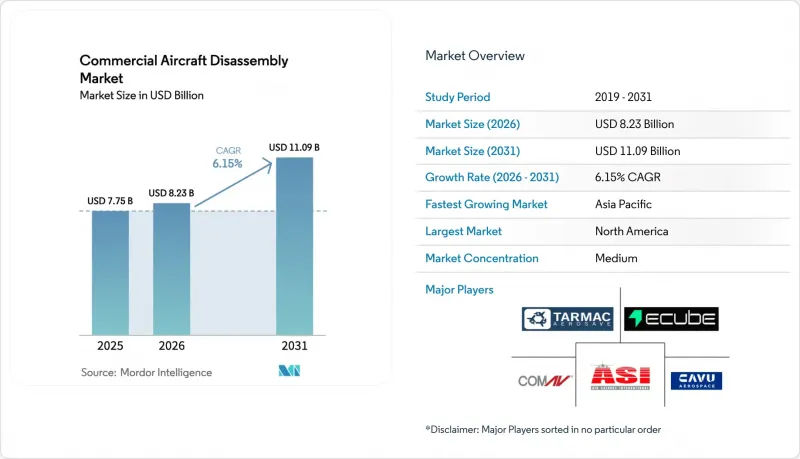
Rising adoption of certified used serviceable material (USM), persistent engine shop-visit backlogs, and delivery delays are shifting value from scrap to component recovery as operators seek cost certainty and uptime. Lessors are formalizing end-of-life playbooks to monetize assets through teardown when lease economics weaken, while OEMs are integrating lifecycle programs to protect quality and improve supply resilience. Asia-Pacific is building capability and throughput to support a fast-growing installed base, while North America remains the largest teardown hub by volume and certifications. Circular design and improved composite recovery methods support higher reuse rates over time, though composite-heavy airframes still pose processing and certification hurdles for high-value reintegration.
Global Commercial Aircraft Disassembly Market Trends and Insights
Post-2027 Retirement Wave And Replacement Cycle Expand Part-Out Volumes
A replacement cycle is building as large narrowbody cohorts from the 2010s approach economic transition points in the late 2020s, supporting elevated teardown volumes and a deeper pool of certified components. Boeing's 2025 Commercial Market Outlook signals extensive fleet replacement over the next two decades, with North America positioned to deliver the highest replacement share among regions, creating a steady teardown pipeline as older aircraft exit service. Retirement timing was suppressed in 2024 by lease extensions and delivery backlogs, a trend that tightened component supply and reset valuations for high-demand parts. As operators normalize fleet plans and OEM supply recovers, a catch-up pulse of removals is expected to flow into certified teardown channels rather than general scrap, reinforcing the commercial aircraft disassembly market. Standardized decommissioning and AFRA(Aircraft Fleet Recycling Association) best practices now act as a threshold for access to many lessor programs, which aligns with Boeing's policy to use AFRA-accredited partners in its expanded USM consignment model. These structural shifts create more predictable part-out volumes, improving planning and pricing outcomes for buyers and sellers in the commercial aircraft disassembly market.
Persistent Parts Shortages And Inflation Push Wider USM Adoption
Airline maintenance costs have been pressured by supply bottlenecks and longer repair cycles, which has raised the appeal of certified used components that can be delivered on short lead times. IATA estimates that supply chain constraints carried a multi-billion-dollar cost burden in 2025, reinforcing the case for reliable and traceable alternatives to sourcing new parts from backlogged channels. USM programs offer operators faster AOG recovery windows through established logistics, quality assurance, and dual regulatory certifications, which can reduce service disruptions in high-utilization fleets. Vertically integrated teardown and repair models further support cost and time efficiency by consolidating inspection, repair, and certification within the same enterprise, which accelerates component release to service. Industry bodies and regulators have tightened documentation and distributor accreditation requirements, which has raised confidence in certified USM and helped the commercial aircraft disassembly market absorb more demand from operators who value rigorous compliance. As backlogs persist, robust traceability, strong quality assurance, and predictable logistics continue to drive the adoption of certified USM pathways across major fleets, sustaining momentum in the commercial aircraft disassembly market.
Near-Term Feedstock Scarcity From Low Retirements And Lease Extensions
Retirements have been below historical norms as airlines extend leases and keep mid-life aircraft in service to bridge new-delivery shortfalls, which constrains the immediate flow of teardown candidates. This near-term scarcity reduces the availability of high-demand serviceable engines and high-turn parts, which raises competition for certified inventory. Lower inductions also limit the variety of part numbers entering circulation at any given time, which can lengthen sourcing searches for specific configurations. IATA has highlighted how constrained supply and maintenance bottlenecks impede capacity recovery, which reinforces why feedstock scarcity is a binding factor for operators relying on USM to keep fleets flying. As deliveries normalize and deferred retirements resume, more material should re-enter the commercial aircraft disassembly market, though near-term pricing may remain firm for select components. Operators that pre-position parts and work with accredited suppliers are better insulated from temporary shortages and delays.
Other drivers and restraints analyzed in the detailed report include:
- Engine Shop-Visit Surge And Reliability Issues Accelerate Engine Part-Outs
- OEM/Lessor Lifecycle Programs Increase Supply Chain Integration
- Composite-Heavy Airframes Remain Costly To Process
For complete list of drivers and restraints, kindly check the Table Of Contents.
Segment Analysis
USM held 53.25% of 2025 revenue and is projected to grow at an 8.24% CAGR through 2031, reflecting the clear customer preference for certified, quick-turn components during prolonged new-part backlogs. The commercial aircraft disassembly market continues to absorb demand that was redirected from delayed OEM deliveries and long repair queues, with USM providing predictable availability through accredited networks. Airlines and MROs report greater reliance on USM for high-turn items that drive AOG exposure, a pattern supported by formal distributor accreditation and dual FAA/EASA certifications that maintain traceability. Boeing's consignment program increases supply chain visibility and accelerates recertification throughput, which lowers time to market for parts harvested from retirements and managed transitions. As USM becomes a standard cost lever for operators, the commercial aircraft disassembly market is positioned to support deeper rotables coverage for critical part families.
The rotable parts segment leverages predictive maintenance insights to position inventory near hubs ahead of scheduled interventions, improving dispatch reliability and reducing AOG risk. Integrated teardown and repair models unlock speed by aligning inspection, repair, and documentation, streamlining release-to-service, and reducing logistics friction for time-sensitive components. AFRA best practices for depollution and documentation continue to standardize disassembly and reduce quality variance, which protects the value of the recovered pool. As a result, certified USM and rotable pools reinforce each other, with the former supplying depth and the latter optimizing availability. These effects help the commercial aircraft disassembly market reduce operating risk for airlines facing tight capacity, thereby increasing reliance on accredited USM suppliers. The commercial aircraft disassembly industry has therefore moved from episodic to programmatic adoption across leading carriers and MRO alliances, making quality systems and accreditation central to supplier selection.
Narrowbody platforms accounted for 58.47% of the market in 2025, and the category is projected to expand at 6.35% through 2031 as fleets cycle into replacement and operators arbitrage engine economics in select cases. The commercial aircraft disassembly market benefits from the scale of the installed B737 and A320 families, where teardown inputs convert into large pools of serviceable engines, airframe components, and avionics suitable for cross-fleet use. New-technology engine reliability measures and shop capacity expansions by OEMs and licensed shops should gradually stabilize turn times. Still, airlines maintain a strong appetite for certified USM to mitigate disruptions. Asia-Pacific teardown projects have demonstrated compressed turnaround times for A320neo disassembly, suggesting a greater regional role in narrowbody part-outs over the forecast period. These trends keep a high proportion of near-term value concentrated in narrowbodies as they account for the bulk of removals and serviceable part demand in short-haul networks.
Widebody inductions tend to be less frequent, but they often yield higher per-aircraft value through engine and nacelle systems alongside specialized avionics. Durability initiatives on engines such as the Trent XWB-97 illustrate how reliability improvements can shift the timing of parts needs, while not eliminating the strategic role of USM in managing costs and risk. The commercial aircraft disassembly market remains responsive to cargo fleet dynamics and long-haul network plans, which influence lease decisions and phase-outs that release larger engines and structures into certified channels. Accredited operators are meeting higher documentation thresholds for widebody components to ensure acceptability in cross-border transfers and to support more complex integration tasks. Narrowbody and widebody dynamics together ensure a balanced induction flow, with narrowbodies delivering volume and widebodies anchoring premium engine material that supports global engine shops.
The Commercial Aircraft Disassembly Market Report is Segmented by Application (Disassembly and Dismantling, Recycling and Storage, Used Serviceable Material, and Rotable Parts), Aircraft Type (Narrowbody Aircraft, Widebody Aircraft, and Regional Jets), Component Type (Engines, and More), End-User (MRO Service Providers, and More), and Geography (North America, and More). The Market Forecasts are Provided in Terms of Value (USD).
Geography Analysis
North America held a 41.65% share in 2025, supported by a large installed base, established storage and dismantling sites in arid climates, and a deep ecosystem of AFRA-accredited and FAA-certified operators. The regional advantage includes faster logistics to major MRO hubs and a long record of compliance with hazardous-materials handling and depollution standards, which builds buyer confidence in certified parts. Demand for high-turn components remains strong as airlines balance capacity plans with maintenance constraints and delivery timing, which keeps sourcing strategies focused on trusted suppliers. North American shops continue to work through tight engine capacity conditions and related schedules, which sustains appetite for certified engine materials that can be released quickly under dual certification. This combination of scale, accreditation, and logistics keeps the commercial aircraft disassembly market anchored in North America for near-term supply needs.
Europe benefits from stringent circular frameworks, standardized accreditation, and large-scale teardown and recycling programs operated under the oversight of leading OEMs and partners. EASA guidance on end-of-life practices and EU circular policies support higher recovery targets, which promote selective disassembly and material reuse under audited conditions. Airbus and partners have demonstrated practical composite repurposing at industrial quality, adding momentum to advanced recovery pathways that can scale as methods standardize. European buyers prioritize dual certification, full chain-of-custody, and AFRA membership, which influences sourcing decisions and concentrates demand among accredited suppliers. These attributes sustain competitive pricing for certified parts and support greater utilization of rotable pools, thereby reducing AOG risk across dense intra-European networks.
Asia-Pacific is the fastest-advancing region, growing at a 7.57% CAGR in capability, as teardown and MRO capacity expand to serve a growing fleet footprint. Recent A320neo disassembly projects completed in the Philippines have indicated improved throughput and greater discipline on newer platforms, strengthening regional credibility for high-value part recovery. Logistics providers are co-locating services and building bonded facilities to shorten the time from induction to shipment, which reduces lead times for regional carriers. Engine MRO investments, including new LEAP shops in India and OEM-aligned expansions, support the maintenance ecosystem required to absorb more USM locally. As new projects come online, the commercial aircraft disassembly market gains a more balanced global footprint, reducing shipping distances and helping match parts supply with regional fleet needs. This geographic rebalancing enhances resilience for operators across Asia-Pacific and deepens liquidity in global parts exchanges that rely on certified, traceable components.
- TARMAC AEROSAVE S.A.S
- Air Salvage International Limited
- Aircraft End-of-Life Solutions (AELS) B.V.
- eCube Solutions Ltd
- CAVU Aerospace, Inc.
- GA Telesis
- AerSale, Inc.
- AAR CORP.
- A J Walter Aviation Limited
- Vallair Group SA
- Universal Asset Management, Inc.
- VAS Aero Services, LLC (Satair)
- EirTrade Aviation Ireland Limited
- ComAv Asset Management, LLC
- AerCap Holdings N.V.
- Ascent Aviation Services Corporation
- Aerocycle Inc.
- APOC Aviation B.V.
Additional Benefits:
- The market estimate (ME) sheet in Excel format
- 3 months of analyst support
TABLE OF CONTENTS
1 INTRODUCTION
- 1.1 Study Assumptions and Market Definition
- 1.2 Scope of the Study
2 RESEARCH METHODOLOGY
3 EXECUTIVE SUMMARY AND KEY FINDINGS
4 MARKET LANDSCAPE
- 4.1 Market Overview
- 4.2 Market Drivers
- 4.2.1 Post-2027 retirement wave and replacement cycle expand part-out volumes
- 4.2.2 Persistent parts shortages and inflation push wider USM adoption
- 4.2.3 Engine shop-visit surge and reliability issues accelerate engine part-outs
- 4.2.4 OEM/lessor lifecycle programs (recycling + USM) increase supply chain integration
- 4.2.5 Circular-economy mandates and recovery-tech breakthroughs lift recyclability
- 4.2.6 Emerging Asia-Pacific teardown hubs as fleets mature
- 4.3 Market Restraints
- 4.3.1 Near-term feedstock scarcity from low retirements and lease extensions
- 4.3.2 Composite-heavy airframes remain costly to process
- 4.3.3 OEM control and lessor preferences limit USM on specific platforms
- 4.3.4 Counterfeit/traceability risks raise compliance costs and TATs
- 4.4 Value Chain Analysis
- 4.5 Regulatory Landscape
- 4.6 Technological Outlook
- 4.7 Porter's Five Forces Analysis
- 4.7.1 Bargaining Power of Suppliers
- 4.7.2 Bargaining Power of Buyers
- 4.7.3 Threat of New Entrants
- 4.7.4 Threat of Substitutes
- 4.7.5 Intensity of Competitive Rivalry
5 MARKET SIZE AND GROWTH FORECASTS (VALUE)
- 5.1 By Application
- 5.1.1 Disassembly and Dismantling
- 5.1.2 Recycling and Storage
- 5.1.3 Used Serviceable Material (USM)
- 5.1.4 Rotable Parts
- 5.2 By Aircraft Type
- 5.2.1 Narrowbody Aircraft
- 5.2.2 Widebody Aircraft
- 5.2.3 Regional Jets
- 5.3 By Component Type
- 5.3.1 Engines
- 5.3.2 Landing Gear
- 5.3.3 Avionics and Electronics
- 5.3.4 Fuselage and Structures
- 5.3.5 Cabin Interiors
- 5.4 By End-User
- 5.4.1 MRO Service Providers
- 5.4.2 Leasing Companies
- 5.4.3 Parts Traders and Brokers
- 5.4.4 OEMs and Tier-1 Suppliers
- 5.5 By Geography
- 5.5.1 North America
- 5.5.1.1 United States
- 5.5.1.2 Canada
- 5.5.1.3 Mexico
- 5.5.2 Europe
- 5.5.2.1 United Kingdom
- 5.5.2.2 France
- 5.5.2.3 Germany
- 5.5.2.4 Russia
- 5.5.2.5 Rest of Europe
- 5.5.3 Asia-Pacific
- 5.5.3.1 China
- 5.5.3.2 India
- 5.5.3.3 Japan
- 5.5.3.4 South Korea
- 5.5.3.5 Rest of Asia-Pacific
- 5.5.4 South America
- 5.5.4.1 Brazil
- 5.5.4.2 Rest of South America
- 5.5.5 Middle East and Africa
- 5.5.5.1 Middle East
- 5.5.5.1.1 Saudi Arabia
- 5.5.5.1.2 United Arab Emirates
- 5.5.5.1.3 Rest of Middle East
- 5.5.5.2 Africa
- 5.5.5.2.1 South Africa
- 5.5.5.2.2 Rest of Africa
- 5.5.5.1 Middle East
- 5.5.1 North America
6 COMPETITIVE LANDSCAPE
- 6.1 Market Concentration
- 6.2 Strategic Moves
- 6.3 Market Share Analysis
- 6.4 Company Profiles (includes Global Overview, Market level overview, Core Segments, Financials as available, Strategic Information, Market Rank/Share for Key Companies, Products and Services, and Recent Developments)
- 6.4.1 TARMAC AEROSAVE S.A.S
- 6.4.2 Air Salvage International Limited
- 6.4.3 Aircraft End-of-Life Solutions (AELS) B.V.
- 6.4.4 eCube Solutions Ltd
- 6.4.5 CAVU Aerospace, Inc.
- 6.4.6 GA Telesis
- 6.4.7 AerSale, Inc.
- 6.4.8 AAR CORP.
- 6.4.9 A J Walter Aviation Limited
- 6.4.10 Vallair Group SA
- 6.4.11 Universal Asset Management, Inc.
- 6.4.12 VAS Aero Services, LLC (Satair)
- 6.4.13 EirTrade Aviation Ireland Limited
- 6.4.14 ComAv Asset Management, LLC
- 6.4.15 AerCap Holdings N.V.
- 6.4.16 Ascent Aviation Services Corporation
- 6.4.17 Aerocycle Inc.
- 6.4.18 APOC Aviation B.V.
7 MARKET OPPORTUNITIES AND FUTURE OUTLOOK
- 7.1 White-space and Unmet-need Assessment

