PUBLISHER: Mordor Intelligence | PRODUCT CODE: 2044285

PUBLISHER: Mordor Intelligence | PRODUCT CODE: 2044285
Liquor Chocolate - Market Share Analysis, Industry Trends & Statistics, Growth Forecasts (2026 - 2031)
The liquor chocolate market size was valued at USD 1.03 billion in 2025 and is estimated to grow from USD 1.09 billion in 2026 to reach USD 1.53 billion by 2031, at a CAGR of 7.08% during the forecast period (2026-2031).
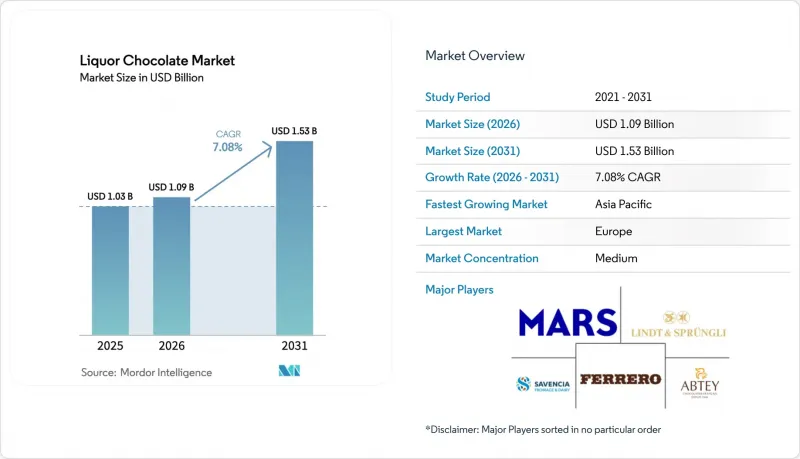
Premium gifting, cross-branding with spirits, and duty-free expansion are driving the liquor chocolate market's growth, despite challenges posed by increasing cocoa prices and alcohol regulations. Collaborations with spirit brands position these products as experiential offerings, supporting significant price premiums. Electronic commerce (e-commerce) platforms and specialty stores are expanding consumer access, even with shipping restrictions. Travel-retail outlets benefit from recovering passenger traffic, capturing impulse purchases, and delivering strong profit margins that help mitigate ingredient cost fluctuations. Additionally, sustainability initiatives and halal-compliant product innovations are creating new demand opportunities while maintaining the luxury appeal of the market.
Global Liquor Chocolate Market Trends and Insights
Collaborations between chocolate makers and spirit brands
Collaborations between confectionery companies and distilleries are opening new opportunities for co-branding and market expansion by combining the premium appeal of craft spirits with artisan chocolate. For example, Woodford Reserve has extended its partnership with Compartes, introducing limited-edition bourbon-infused chocolate bars that capitalize on the distillery's heritage and command a premium price compared to standard chocolate bars. Similarly, LOTTE Corporation launched Rummy x Bacchus, a product that blends rum-flavored chocolate with its well-known Bacchus candy brand, targeting nostalgic consumers and encouraging trial purchases through convenience store channels. Whitman's collaborated with Boulevard Brewing to develop beer-infused truffles, which are sold exclusively through specialty retailers. This partnership highlights how regional craft brewers can gain access to national confectionery distribution networks. Additionally, Heritage Distilling's Cocoa Bomb Chocolate Whiskey earned the title of "Best Flavored Whiskey" at the American Distilling Institute competition, showcasing the category's appeal to spirits judges and indicating potential for premium placements in on-premise locations. These collaborations help reduce customer acquisition costs by leveraging shared brand audiences and creating limited-edition products that drive impulse purchases. However, they require careful alignment on alcohol-content thresholds to avoid triggering federal excise taxes in the United States.
Increasing preference for experiential and gourmet food products
Consumers are increasingly viewing food as a way to share stories and express themselves socially. This shift has led to a change in spending patterns, moving away from basic commodity staples toward curated, visually appealing indulgences that convey sophistication. According to Barry Callebaut's February 2026 trend report, "Minorstones" was identified as one of the top five consumer behaviors, with a significant majority of respondents celebrating smaller personal milestones rather than waiting for major holidays. This trend has created consistent demand throughout the year for premium gifting formats. The report also highlighted that a large proportion of consumers actively avoid ultra-processed foods, with most preferring ingredient lists containing fewer than five components. As a result, manufacturers are reformulating products to include recognizable ingredients, such as single-malt whiskey or aged rum, instead of artificial flavorings. Additionally, Lindt reported that premium chocolate sales among users of glucagon-like peptide-1 (GLP-1) receptor agonist medications grew at a faster rate compared to non-users. This indicates that individuals using weight-management drugs are opting for higher-quality, lower-volume indulgences rather than eliminating treats entirely. This trend has positively impacted liquor chocolates, which are priced significantly higher than standard assortments. These products align with the "treat yourself" mindset while offering indulgence in smaller portion sizes.
Stringent alcohol regulations varying by jurisdiction
Liquor chocolates operate within a complex regulatory framework where confectionery and alcohol-beverage regulations overlap. Manufacturers must navigate dual oversight, state-specific licensing, and labeling requirements, which complicate distribution and increase compliance costs. In the United States, the Food and Drug Administration (FDA) regulates chocolate standards under Title 21 of the Code of Federal Regulations (CFR) Part 163, which defines chocolate liquor as the solid or semi-plastic mass derived from roasted cacao nibs containing a significant percentage of cacao fat . At the same time, the Alcohol and Tobacco Tax and Trade Bureau (TTB) assumes jurisdiction when the alcohol content reaches or exceeds a specific threshold by volume, imposing federal excise taxes, age-verification requirements, and state-specific distribution licenses. Lindt has stated that it does not import liqueur-filled chocolates into the United States due to the complexity of federal and state alcohol regulations, leaving this market segment to smaller domestic producers willing to bear the compliance costs. In Ireland, mandatory alcohol health-warning labels have been postponed until a later year, offering a temporary competitive advantage to European producers exporting to non-European Union (EU) markets without requiring packaging modifications. In Indonesia, a halal certification deadline set for a specific date under Government Regulation Number 42 of 2024, requires all food and beverage products to display either BPJPH (Halal Product Assurance Organizing Agency) halal certification or explicit "Non-Halal" labeling. Non-compliance will result in fines, market withdrawal, and public notices. This regulation effectively excludes alcohol-infused chocolates from the world's fourth most populous country unless reformulated to be alcohol-free.
Other drivers and restraints analyzed in the detailed report include:
- Demand for sustainable, organic, and fair-trade liquor chocolates
- Growing gifting culture for special occasions
- Health concerns over alcohol consumption and calorie content
For complete list of drivers and restraints, kindly check the Table Of Contents.
Segment Analysis
Bars are projected to grow at an annual rate of 8.28% from 2026 to 2031, outperforming other formats due to their convenience, portion control, and suitability for travel-retail distribution. These individually wrapped, on-the-go options cater to consumer preferences for portability. In 2024, Woodford Reserve and Compartes introduced a bourbon-infused chocolate bar and extended their partnership through 2026. This product is positioned as a portable alternative to boxed assortments, particularly for male-oriented gifting occasions. The bar format also streamlines production compared to filled pralines, as processes like enrobing and molding require fewer manual steps than shell-forming and liqueur injection. This enables higher throughput on automated production lines.
Boxed assortments accounted for 38.11% of the market share in 2025, supported by their popularity in corporate gifting, seasonal holidays, and premium retail displays. Their presentation and variety justify higher price points, appealing to consumers seeking premium options. Neuhaus, the inventor of the praline in 1912, launched a Chocolate Cocktails collection in collaboration with Belgian mixologist Noa Van Ongevalle. This collection features spirit-infused pralines designed to replicate cocktail flavor profiles, targeting consumers interested in experiential products.
The Liquor Chocolate Market Report is Segmented by Type (Bar, Tablets, Box Assortment, and Other Types), Nature (Organic and Conventional), Distribution Channel (Supermarkets/Hypermarkets, Specialty Stores and More), and Geography (North America, Europe, Asia-Pacific, South America, and Middle East and Africa). The Market Forecasts are Provided in Terms of Value (USD) and Volume (tonnes).
Geography Analysis
In 2025, Europe accounted for 45.32% of the global market share, driven by Belgium's annual chocolate production, Switzerland's luxury chocolate heritage, and a dense network of artisan chocolatiers specializing in liqueur-filled pralines. Belgium hosts thousands of chocolatiers, with Neuhaus credited for inventing the praline in 1912. Leonidas offers pure liqueur boxes containing 5% liqueur content and 28% chocolate by weight, while Godiva markets a chocolate liqueur with 15% alcohol by volume, positioning it as a dessert spirit competing with cream liqueurs such as Baileys Irish Cream. Tchelo, a Belgian liqueur brand launched in 2024, introduced a Praline flavor. Germany, the United Kingdom, the Netherlands, Poland, and Spain contribute significant volumes through supermarket and discount-channel distribution. However, premiumization remains concentrated in Switzerland, Belgium, and France, where artisan margins of 48% support reinvestment in innovation and sustainability.
The Asia-Pacific region is forecasted to grow at an annual rate of 7.93% from 2026 to 2031, making it the fastest-growing regional market. This growth is fueled by rising middle-class incomes in China, India, and Southeast Asia, urbanization that increases exposure to Western confectionery formats, and the expansion of airport duty-free retail targeting affluent travelers. China and India recorded approximately 18% annual growth in chocolate confectionery consumption, while Japan and South Korea lead in premium adoption through department-store concessions and a strong gift-set culture. However, cultural and regulatory barriers fragment the region. For example, Indonesia's halal certification deadline in October 2026, under Government Regulation Number 42 of 2024, requires all food and beverage products to display Badan Penyelenggara Jaminan Produk Halal (BPJPH) halal approval or "Non-Halal" labeling, effectively excluding alcohol-infused chocolates unless reformulated. Mondelez expanded its partnership with Evirth, a cakes and pastries manufacturer in China, to leverage brands and create premium offerings in the rapidly growing Chinese bakery segment, showcasing how multinational confectioners adapt to local preferences.
North America, South America, and the Middle East and Africa collectively represent the remaining market share. In the United States, fragmented state-by-state alcohol regulations deter multinational players like Lindt from importing liqueur-filled chocolates. Canada and Mexico have more streamlined federal oversight, but lower per capita chocolate consumption and price sensitivity limit the penetration of the premium segment. In South America, Brazil's Cacau Show dominates domestic distribution through a franchise model emphasizing affordability and local flavors. Meanwhile, Argentina, Colombia, Chile, and Peru remain underpenetrated due to economic volatility and import tariffs on premium spirits.
- Mars Incorporated
- Chocoladefabriken Lindt & Sprungli AG
- Ferrero International S.A.
- Abtey Chocolaterie
- Savencia Fromage & Dairy Suisse SA
- Lotte Corporation
- Compagnie du Bois Sauvage SA (Neuhaus)
- Oy Karl Fazer Ab
- Anthon Berg A/S
- Mondelez International
- The Hershey Company
- Charbonnel et Walker
- Toms Gruppen A/S
- Boozedrops Ltd.
- Vinoos by AMS
- Thorntons Ltd.
- Godiva Chocolatier
- Leonidas NV
- Babaevsky Confectionery Concern
- Cacau Show
Additional Benefits:
- The market estimate (ME) sheet in Excel format
- 3 months of analyst support
TABLE OF CONTENTS
1 INTRODUCTION
- 1.1 Study Assumptions and Market Definition
- 1.2 Scope of the Study
2 RESEARCH METHODOLOGY
3 EXECUTIVE SUMMARY
4 MARKET LANDSCAPE
- 4.1 Market Overview
- 4.2 Market Drivers
- 4.2.1 Collaborations between chocolate makers and spirit brands
- 4.2.2 Increasing preference for experiential and gourmet food product
- 4.2.3 Demand for sustainable, organic, and fair-trade liquor chocolates
- 4.2.4 Growing gifting culture for special occasions
- 4.2.5 Airport duty-free sales targeting travelers
- 4.2.6 Rise in specialty stores offering expert-curated selections
- 4.3 Market Restraints
- 4.3.1 Stringent alcohol regulations varying by jurisdiction
- 4.3.2 Health concerns over alcohol consumption and calorie content
- 4.3.3 High production costs from quality ingredients and spirits
- 4.3.4 Cultural taboos against alcohol in certain regions
- 4.4 Consumer Behaviour Analysis
- 4.5 Regulatory Outlook
- 4.6 Porter's Five Forces
- 4.6.1 Threat of New Entrants
- 4.6.2 Bargaining Power of Buyers
- 4.6.3 Bargaining Power of Suppliers
- 4.6.4 Threat of Substitute Products
- 4.6.5 Intensity of Competitive Rivalry
5 MARKET SIZE AND GROWTH FORECASTS (VALUE AND VOLUME)
- 5.1 By Type
- 5.1.1 Bar
- 5.1.2 Tablets
- 5.1.3 Box Assortment
- 5.1.4 Other Types
- 5.2 By Nature
- 5.2.1 Organic
- 5.2.2 Conventional
- 5.3 By Distribution Channel
- 5.3.1 Supermarkets and Hypermarkets
- 5.3.2 Speciality Stores
- 5.3.3 Online Retail
- 5.3.4 Other Distribution Channels
- 5.4 By Geography
- 5.4.1 North America
- 5.4.1.1 United States
- 5.4.1.2 Canada
- 5.4.1.3 Mexico
- 5.4.1.4 Rest of North America
- 5.4.2 Europe
- 5.4.2.1 Germany
- 5.4.2.2 United Kingdom
- 5.4.2.3 Italy
- 5.4.2.4 France
- 5.4.2.5 Spain
- 5.4.2.6 Netherlands
- 5.4.2.7 Poland
- 5.4.2.8 Belgium
- 5.4.2.9 Sweden
- 5.4.2.10 Rest of Europe
- 5.4.3 Asia-Pacific
- 5.4.3.1 China
- 5.4.3.2 India
- 5.4.3.3 Japan
- 5.4.3.4 Australia
- 5.4.3.5 Indonesia
- 5.4.3.6 South Korea
- 5.4.3.7 Thailand
- 5.4.3.8 Singapore
- 5.4.3.9 Rest of Asia-Pacific
- 5.4.4 South America
- 5.4.4.1 Brazil
- 5.4.4.2 Argentina
- 5.4.4.3 Colombia
- 5.4.4.4 Chile
- 5.4.4.5 Peru
- 5.4.4.6 Rest of South America
- 5.4.5 Middle East and Africa
- 5.4.5.1 South Africa
- 5.4.5.2 Saudi Arabia
- 5.4.5.3 United Arab Emirates
- 5.4.5.4 Rest of Middle East and Africa
- 5.4.1 North America
6 COMPETITIVE LANDSCAPE
- 6.1 Market Concentration
- 6.2 Strategic Moves
- 6.3 Market Ranking Analysis
- 6.4 Company Profiles (includes Global-level Overview, Market-level Overview, Core Segments, Financials (if available), Strategic Information, Market Rank/Share, Products and Services, Recent Developments)
- 6.4.1 Mars Incorporated
- 6.4.2 Chocoladefabriken Lindt & Sprungli AG
- 6.4.3 Ferrero International S.A.
- 6.4.4 Abtey Chocolaterie
- 6.4.5 Savencia Fromage & Dairy Suisse SA
- 6.4.6 Lotte Corporation
- 6.4.7 Compagnie du Bois Sauvage SA (Neuhaus)
- 6.4.8 Oy Karl Fazer Ab
- 6.4.9 Anthon Berg A/S
- 6.4.10 Mondelez International
- 6.4.11 The Hershey Company
- 6.4.12 Charbonnel et Walker
- 6.4.13 Toms Gruppen A/S
- 6.4.14 Boozedrops Ltd.
- 6.4.15 Vinoos by AMS
- 6.4.16 Thorntons Ltd.
- 6.4.17 Godiva Chocolatier
- 6.4.18 Leonidas NV
- 6.4.19 Babaevsky Confectionery Concern
- 6.4.20 Cacau Show
7 MARKET OPPORTUNITIES AND FUTURE OUTLOOK

