PUBLISHER: Mordor Intelligence | PRODUCT CODE: 2044286

PUBLISHER: Mordor Intelligence | PRODUCT CODE: 2044286
Sterile Injectable Contract Manufacturing - Market Share Analysis, Industry Trends & Statistics, Growth Forecasts (2026 - 2031)
The Sterile Injectable Contract Manufacturing Market size is projected to be USD 14.93 billion in 2025, USD 16.89 billion in 2026, and reach USD 29.21 billion by 2031, growing at a CAGR of 11.58% from 2026 to 2031.
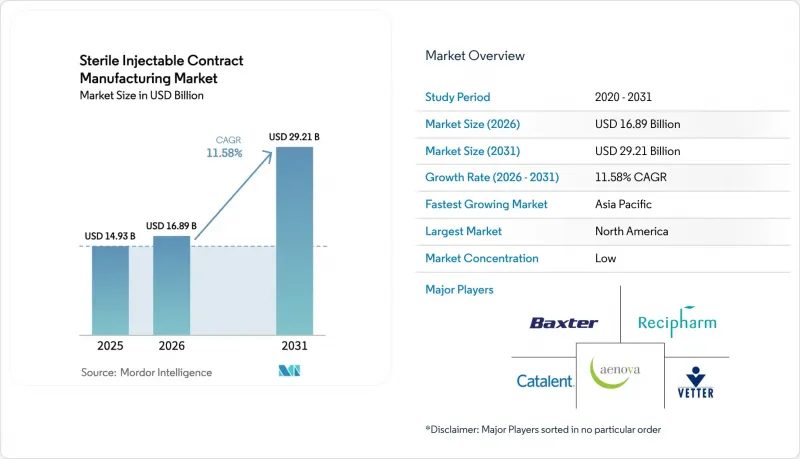
The uptrend is anchored in drug-sponsor preference for asset-light supply chains, swelling biologics pipelines, and tighter drug-shortage rules that institutionalize dual sourcing. Capacity investments announced since 2024 illustrate how sponsors are outsourcing capital-intensive aseptic infrastructure while retaining product ownership. Prefilled devices for chronic therapies are increasingly displacing vials, thereby elevating demand for high-speed syringe filling and combination-product assembly. Biosimilar launches linked to looming patent cliffs add further volume and complexity, pulling CDMOs with proven regulatory credentials into long-term master service agreements. At the same time, supply-chain bottlenecks for borosilicate glass and single-use components temper near-term expansion of throughput.
Global Sterile Injectable Contract Manufacturing Market Trends and Insights
Biologics Pipeline Expansion Boosts Demand for Specialized Aseptic Capacity
The FDA cleared 16 novel biologics in 2024, up from 12 approvals the previous year, while the EMA approved 14 new biologicals, underscoring steady momentum in innovation. Cytotoxic antibody-drug conjugates require dedicated isolator suites, and fewer than 20 CDMOs presently offer such capacity at commercial scale. Cell and gene therapies add further complexity because autologous batches typically run below 100 units, prompting providers to adopt modular cleanrooms and single-use bioreactors that can be configured on demand. Catalent commissioned a USD 150 million biologics facility in Maryland in 2025, which features four independent high-potency suites, highlighting the capital expenditure (capex) race among top players.
Outsourcing Surge to Cut Cap-Ex & Accelerate Time-To-Market
Pfizer closed two legacy U.S. sterile plants in late 2024 and shifted output to partners, freeing USD 300 million in annual operating expense. More than 60% of Phase II oncology trials in 2025 were sponsored by virtual biotechs lacking internal manufacturing, increasing CDMO reliance for GMP supply. Continuous aseptic processing, now recognized under the FDA's Emerging Technology Program, can shorten lot-release times, yet it demands specialized know-how that most innovators source from contract partners.
Capital-Intensive GMP Sterile Facilities
Greenfield aseptic plants now exceed USD 200 million and require 3-5 years to qualify, deterring newcomers and limiting aggressive expansion among midsized providers. PwC measured ISO 5 cleanroom costs at USD 15,000 per square meter in 2025, up 22% from 2023, due to inflation in HVAC and validation. European CDMOs endured a 40% jump in utility bills during the 2024 gas-price spike, further squeezing project ROIs. Modular prefabs shrink timelines to 18 months but still face regulatory uncertainty about reconfiguration controls.
Other drivers and restraints analyzed in the detailed report include:
- Chronic-Disease Prevalence Growing Parenteral Volumes
- Patent Cliffs Spur Generic & Biosimilar Injectables
- Complex & Evolving Global Regulatory Compliance
For complete list of drivers and restraints, kindly check the Table Of Contents.
Segment Analysis
Small molecules retained a 62.83% revenue share in 2025; however, biologics revenue is forecast to expand at a 14.69% CAGR, meaning that the Sterile Injectable Contract Manufacturing market size for biologics will accelerate faster than the broader service pool. Pfizer CentreOne confirmed that biologics represent 55% of pipeline deals, up sharply from 38% two years earlier. CDMOs with isolator-based cytotoxic suites enjoy premium pricing for ADC campaigns. Small-molecule volumes remain vital for saline, dextrose, and anesthetic lines, yet overcapacity in Eastern Europe has driven an 8% price decline since 2023. Subcutaneous biologics, recently cleared by the FDA for home use, are steering investment toward high-viscosity syringe filling. WuXi Biologics allocated USD 240 million to expand ADC capacity in Ireland, reflecting the scale of sponsor demand.
The Sterile Injectable Contract Manufacturing Market Report is Segmented by Molecule Type (Small Molecule, Large Molecule/Biologics), Service Stage (Pre-Clinical, Clinical, Commercial), Delivery Format (Vials, Prefilled Syringes, Cartridges, Ampoules & Others), and Geography (North America, Europe, Asia-Pacific, Middle East & Africa, South America). The Market Forecasts are Provided in Terms of Value (USD).
Geography Analysis
North America generated 37.26% of 2025 revenue thanks to dense clusters of FDA-inspected suites in North Carolina, New Jersey, and Maryland. Sponsors value proximity for tech-transfer collaboration, and premium pricing offsets higher labor costs. Nonetheless, Asia-Pacific is forecast to lead growth at a 16.04% CAGR through 2031. China's "bio-security" policy encourages domestic fill-finish, and WuXi Biologics' USD 200 million Wuxi plant exemplifies the surge in localization. India leverages the WHO prequalification to export biosimilars to cost-sensitive regions, thereby meeting demand well above its local needs.
The EMA centralized review process enables a single qualified site to serve all EU members, providing regional CDMOs with the flexibility to scale. High European energy prices, however, narrowed margins by 2024 and spurred interest in renewable power purchase agreements. Middle East & Africa, though tiny, is gaining relevance after Saudi Vision 2030 set a 40% local drug-manufacturing target, leading several CDMOs to scope greenfield projects.
South America benefits from Brazil's streamlined biosimilar interchangeability rules, established in 2024, which attract foreign joint ventures seeking entry into the local market. National content mandates provide volume commitments critical for financing sterile suites, and they reduce regulatory risk for early-stage CDMOs entering the region.
- Aenova Group
- Ajinomoto Bio-Pharma Services
- Baxter BioPharma Solutions
- Boehringer Ingelheim BioXcellence
- Bushu Pharmaceuticals
- Catalent
- Cipla
- Emergent Bio Solutions
- Fresenius
- Grand River Aseptic Manufacturing
- HALIX B.V.
- Jubilant HollisterStier
- LSNE Contract Manufacturing
- NextPharma Technologies
- Pfizer CentreOne
- Recipharm
- Seikagaku
- Symbiosis Pharmaceutical Services
- Unither Pharmaceuticals
- Vetter Pharma-Fertigung GmbH & Co. KG
- Wuxi Biologics
Additional Benefits:
- The market estimate (ME) sheet in Excel format
- 3 months of analyst support
TABLE OF CONTENTS
1 Introduction
- 1.1 Study Assumptions & Market Definition
- 1.2 Scope of the Study
2 Research Methodology
3 Executive Summary
4 Market Landscape
- 4.1 Market Overview
- 4.2 Market Drivers
- 4.2.1 Biologics Pipeline Expansion Boosts Demand for Specialized Aseptic Capacity
- 4.2.2 Outsourcing Surge to Cut Cap-Ex & Accelerate Time-To-Market
- 4.2.3 Chronic-Disease Prevalence Growing Parenteral Volumes
- 4.2.4 Patent Cliffs Spur Generic & Biosimilar Injectables
- 4.2.5 Drug-Shortage Mitigation Rules Create Mandatory Dual-Sourcing
- 4.2.6 Modular Micro-Fill Isolators Enable Personalized Therapy Batches
- 4.3 Market Restraints
- 4.3.1 Capital-Intensive GMP Sterile Facilities
- 4.3.2 Complex & Evolving Global Regulatory Compliance
- 4.3.3 Supply-Chain Pinch on Pharma-Grade Borosilicate Glass & SUT
- 4.3.4 Long Lead Times for Isolator Equipment Causing Capacity Bottlenecks
- 4.4 Regulatory Landscape
- 4.5 Technological Outlook
- 4.6 Porter's Five Forces Analysis
- 4.6.1 Threat of New Entrants
- 4.6.2 Bargaining Power of Buyers
- 4.6.3 Bargaining Power of Suppliers
- 4.6.4 Threat of Substitutes
- 4.6.5 Competitive Rivalry
5 Market Size & Growth Forecasts
- 5.1 By Molecule Type
- 5.1.1 Small Molecule
- 5.1.2 Large Molecule / Biologics
- 5.2 By Service Stage
- 5.2.1 Pre-clinical Manufacturing
- 5.2.2 Clinical Manufacturing
- 5.2.3 Commercial Manufacturing
- 5.3 By Delivery Format
- 5.3.1 Vials
- 5.3.2 Prefilled Syringes
- 5.3.3 Cartridges
- 5.3.4 Ampoules & Others
- 5.4 By Geography
- 5.4.1 North America
- 5.4.1.1 United States
- 5.4.1.2 Canada
- 5.4.1.3 Mexico
- 5.4.2 Europe
- 5.4.2.1 Germany
- 5.4.2.2 United Kingdom
- 5.4.2.3 France
- 5.4.2.4 Italy
- 5.4.2.5 Spain
- 5.4.2.6 Rest of Europe
- 5.4.3 Asia-Pacific
- 5.4.3.1 China
- 5.4.3.2 Japan
- 5.4.3.3 India
- 5.4.3.4 Australia
- 5.4.3.5 South Korea
- 5.4.3.6 Rest of Asia-Pacific
- 5.4.4 Middle East & Africa
- 5.4.4.1 GCC
- 5.4.4.2 South Africa
- 5.4.4.3 Rest of Middle East & Africa
- 5.4.5 South America
- 5.4.5.1 Brazil
- 5.4.5.2 Argentina
- 5.4.5.3 Rest of South America
- 5.4.1 North America
6 Competitive Landscape
- 6.1 Market Concentration
- 6.2 Market Share Analysis
- 6.3 Company Profiles (includes Global level Overview, Market-level Overview, Core Segments, Financials, Strategic Information, Market Rank/Share, Products & Services, Recent Developments)
- 6.3.1 Aenova Group
- 6.3.2 Ajinomoto Bio-Pharma Services
- 6.3.3 Baxter BioPharma Solutions
- 6.3.4 Boehringer Ingelheim BioXcellence
- 6.3.5 Bushu Pharmaceuticals
- 6.3.6 Catalent Inc.
- 6.3.7 Cipla Ltd.
- 6.3.8 Emergent BioSolutions
- 6.3.9 Fresenius Kabi
- 6.3.10 Grand River Aseptic Manufacturing
- 6.3.11 HALIX B.V.
- 6.3.12 Jubilant HollisterStier
- 6.3.13 LSNE Contract Manufacturing
- 6.3.14 NextPharma Technologies
- 6.3.15 Pfizer CentreOne
- 6.3.16 Recipharm AB
- 6.3.17 Seikagaku Corporation
- 6.3.18 Symbiosis Pharmaceutical Services
- 6.3.19 Unither Pharmaceuticals
- 6.3.20 Vetter Pharma-Fertigung GmbH & Co. KG
- 6.3.21 WuXi Biologics
7 Market Opportunities & Future Outlook
- 7.1 White-space & Unmet-need Assessment

