PUBLISHER: Mordor Intelligence | PRODUCT CODE: 2044292

PUBLISHER: Mordor Intelligence | PRODUCT CODE: 2044292
Asia-Pacific Engineering Research And Development Services - Market Share Analysis, Industry Trends & Statistics, Growth Forecasts (2026 - 2031)
The Asia-Pacific engineering research and development services market size is expected to grow from USD 462.96 billion in 2025 to USD 533.28 billion in 2026 and is forecast to reach USD 1,081.51 billion by 2031 at 15.19% CAGR over 2026-2031.
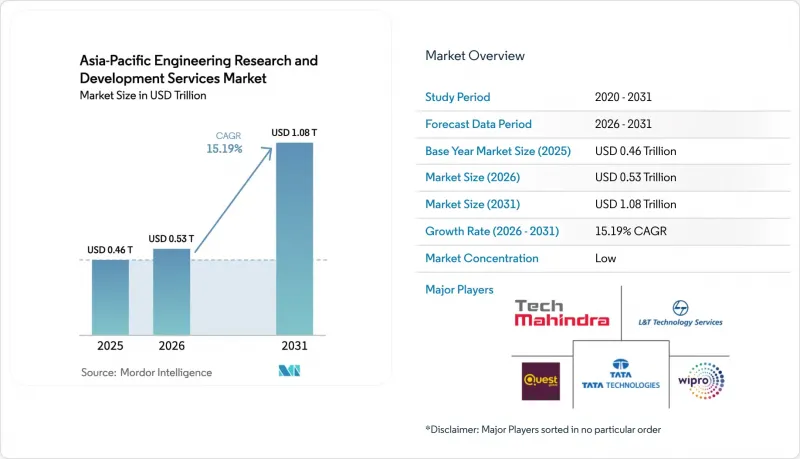
Cost advantages of 50-70% versus Western peers, sovereign-AI mandates that keep inference engineering onshore, and government-funded 5G-6G test beds combine to pull core product-development cycles into the region. India remains the single largest revenue hub, while China and Japan diversify the vendor base with indigenous-innovation and Beyond-5G programs. Engineering service providers and global capability centers intensify competition for AI-ready talent, nudging both groups toward tier-2 city micro-hubs that lower attrition and real-estate costs. Heightened export-control scrutiny since 2025 is reinforcing a structural pivot toward in-house engineering models and hybrid delivery architectures.
Asia-Pacific Engineering Research And Development Services Market Trends and Insights
Shift to Digital-First Product Life-Cycles
Digital twins, model-based systems engineering, and simulation-driven validation have slashed the number of physical-prototype loops and redirected workload to Asia-Pacific centers equipped with cloud-native product lifecycle management stacks. Japan's 2025 Integrated Innovation Strategy earmarks more than USD 200 billion for HPC-enabled design. Firms adopting generative AI tooling report 25% shorter time-to-market but face skill shortages; only 1 in 5 self-identified AI professionals in India deploys models in production . ISO 15288 and IEC 62443 certifications are, therefore, becoming table stakes for regional vendors that must demonstrate the secure handling of digital engineering threads.
Outsourcing-Friendly Cost Differentials in Asia-Pacific
Engineering wages in Vietnam equal roughly 30% of U.S. rates and 50% of Western European levels, preserving gross margins above 40% for projects shifted offshore. Singapore-Vietnam delivery splits combine client-facing architecture in Singapore with volume execution in Ho Chi Minh City, leveraging Vietnam's streamlined STEM work-permit regime. However, rising real estate and salary inflation in tier-1 Indian cities is fueling a drift toward second-tier hubs such as Coimbatore and Visakhapatnam, where operating expenses are 20-30% lower and local governments co-invest in plug-and-play campuses.
Persistent Engineering-Talent Attrition
Annual churn of 25-30% in semiconductor and embedded design roles erodes productivity and forces premium hiring bonuses. A 2024 EY survey showed that only 43% of engineers felt organizational belonging, signaling retention risk. Compensation inflation above 15% in tier-1 Indian cities narrows the cost gap versus Eastern Europe. Providers now allocate a growing share of operating budgets to reskilling academies and wellness initiatives, which depress short-term margins yet remain essential for sustaining delivery velocity in the Asia-Pacific engineering research and development services market.
Other drivers and restraints analyzed in the detailed report include:
- Accelerated Electric Vehicle and Autonomous Platform Programs
- Government-Funded 5G-6G Test-Beds
- IP-Protection and Export-Control Compliance Costs
For complete list of drivers and restraints, kindly check the Table Of Contents.
Segment Analysis
Outsourced services controlled 68.21% of Asia-Pacific engineering research and development services market share in 2025. Captive centers, however, are projected to clock a 15.53% growth pace as export rules tighten. Multinationals like Sanofi expanded Hyderabad headcount to 4,500 in 2026, centralizing clinical and regulatory workflows once spread across three continents. That shift cuts investigational new drug filing cycles by nearly one-fifth. Captives also dovetail with India's GENESIS incentives, while allowing sensitive code to remain behind corporate firewalls, limiting third-party licensing friction.
Near-term, variable-cost flexibility keeps outsourcing relevant for platform migrations such as ICE-to-EV powertrain redesigns where providers spin up multidisciplinary squads inside 12 weeks. Yet data-localization in China and Indonesia is nudging hybrid models that reserve protected algorithms for in-house teams and farm out validation. Tax-holiday parks in Johor and Penang amplify the appeal of owned facilities by dropping corporate levies to 5% and personal taxes to 15% for knowledge staff.
Engineering service providers held 54.12% of Asia-Pacific engineering research and development services market size in 2025, but global capability centers are accelerating faster at a 15.59% CAGR. India hosts more than 1,700 GCCs generating USD 64.6 billion in fiscal 2024, and that figure could surpass USD 105 billion by 2030 as firms chase ISO 13485 and AS9100 compliance. GCC internal control of intellectual property also eases navigation of new export-control layers.
Despite the swing, scale advantages keep large ESPs center-stage for mega deals. L&T Technology Services landed a USD 100 million semiconductor program in 2025, evidencing provider agility. Private-equity interest remains strong, as a USD 4.5 billion Hillhouse stake in Quest Global showed in 2026. Still, both GCCs and ESPs confront a ferocious talent war that inflates wage premiums in second-tier cities once tapped for cost savings.
The Asia-Pacific Engineering Research and Development Services Market is Segmented by Sourcing Model (In-house/Captive Engineering, and More), Service Provider Type (Global Capability Centres, and More), Industry Vertical (Automotive, and More), Service Line (Mechanical and Electrical Engineering, and More), Delivery Model (Onshore, and More), and Country. The Market Forecasts are Provided in Terms of Value (USD).
List of Companies Covered in this Report:
- L&T Technology Services Limited
- Tata Technologies Limited
- QuEST Global Services Pte. Ltd.
- Wipro Limited
- Tech Mahindra Limited
- Infosys Limited
- Cyient Limited
- HCL Technologies Limited
- KPIT Technologies Limited
- GlobalLogic Inc.
- Persistent Systems Limited
- Tata Elxsi Limited
- Harman International Industries, Incorporated
- Capgemini SE (Capgemini Engineering)
- Accenture plc
- DXC Technology Company
- Alten S.A.
- SII Group SA
- AKKA Technologies SE
- NTT DATA Corporation
- Pactera Technology International Ltd.
- Industrial Technology Research Institute (ITRI)
Additional Benefits:
- The market estimate (ME) sheet in Excel format
- 3 months of analyst support
TABLE OF CONTENTS
1 INTRODUCTION
- 1.1 Study Assumptions and Market Definition
- 1.2 Scope of the Study
2 RESEARCH METHODOLOGY
3 EXECUTIVE SUMMARY
4 MARKET LANDSCAPE
- 4.1 Market Overview
- 4.2 Market Drivers
- 4.2.1 Shift to Digital-First Product Life-Cycles
- 4.2.2 Outsourcing-Friendly Cost Differentials in Asia-Pacific
- 4.2.3 Accelerated Electric Vehicle and Autonomous Platform Programs
- 4.2.4 Government-Funded 5G/6G Test-Beds
- 4.2.5 Tier-2 City Micro-Hubs and Tax-Holiday Parks
- 4.2.6 Generative-AI-Assisted Design-for-Manufacture
- 4.3 Market Restraints
- 4.3.1 Persistent Engineering-Talent Attrition
- 4.3.2 IP-Protection and Export-Control Compliance Costs
- 4.3.3 Rising Project-Based Billing Price Pressure
- 4.3.4 Data-Localization Laws Limiting Code-Transfer
- 4.4 Industry Value Chain Analysis
- 4.5 Regulatory Landscape and Policy Developments
- 4.6 Technological Outlook, Digital Engineering and Industry 4.0
- 4.7 Porter's Five Forces Analysis
- 4.7.1 Threat of New Entrants
- 4.7.2 Bargaining Power of Buyers
- 4.7.3 Bargaining Power of Suppliers
- 4.7.4 Threat of Substitutes
- 4.7.5 Intensity of Competitive Rivalry
- 4.8 Impact of Macroeconomic Factors on the Market
- 4.9 Key Base-Indicator Analysis
- 4.9.1 Current Available Talent Pool of Engineers
- 4.9.2 Talent Upskill Initiatives (Govt and Industry)
5 MARKET SIZE AND GROWTH FORECASTS (VALUE)
- 5.1 By Sourcing Model
- 5.1.1 In-house/Captive Engineering
- 5.1.2 Outsourced Engineering Services
- 5.2 By Service Provider Type
- 5.2.1 Global Capability Centres (GCCs)
- 5.2.2 Engineering Service Providers (ESPs)
- 5.3 By Industry Vertical
- 5.3.1 Automotive
- 5.3.2 Industrial
- 5.3.3 Aerospace and Defence
- 5.3.4 Consumer Electronics
- 5.3.5 Semiconductor
- 5.3.6 BFSI
- 5.3.7 Retail
- 5.3.8 Healthcare
- 5.3.9 IT and Telecom
- 5.3.10 Rest of Industry Verticals
- 5.4 By Service Line
- 5.4.1 Mechanical and Electrical Engineering
- 5.4.2 Embedded Engineering
- 5.4.3 Software Engineering
- 5.5 By Delivery Model
- 5.5.1 Onshore
- 5.5.2 Offshore
- 5.5.3 Near-shore
- 5.5.4 Hybrid
- 5.6 By Country
- 5.6.1 China
- 5.6.2 India
- 5.6.3 Japan
- 5.6.4 South Korea
- 5.6.5 Australia
- 5.6.6 Singapore
- 5.6.7 Malaysia
- 5.6.8 Indonesia
- 5.6.9 Rest of Asia-Pacific
6 COMPETITIVE LANDSCAPE
- 6.1 Market Concentration
- 6.2 Strategic Moves
- 6.3 Market Share Analysis
- 6.4 Company Profiles (includes Global Level Overview, Market Level Overview, Core Segments, Financials as available, Strategic Information, Market Rank/Share, Products and Services, Recent Developments)
- 6.4.1 L&T Technology Services Limited
- 6.4.2 Tata Technologies Limited
- 6.4.3 QuEST Global Services Pte. Ltd.
- 6.4.4 Wipro Limited
- 6.4.5 Tech Mahindra Limited
- 6.4.6 Infosys Limited
- 6.4.7 Cyient Limited
- 6.4.8 HCL Technologies Limited
- 6.4.9 KPIT Technologies Limited
- 6.4.10 GlobalLogic Inc.
- 6.4.11 Persistent Systems Limited
- 6.4.12 Tata Elxsi Limited
- 6.4.13 Harman International Industries, Incorporated
- 6.4.14 Capgemini SE (Capgemini Engineering)
- 6.4.15 Accenture plc
- 6.4.16 DXC Technology Company
- 6.4.17 Alten S.A.
- 6.4.18 SII Group SA
- 6.4.19 AKKA Technologies SE
- 6.4.20 NTT DATA Corporation
- 6.4.21 Pactera Technology International Ltd.
- 6.4.22 Industrial Technology Research Institute (ITRI)
7 MARKET OPPORTUNITIES AND FUTURE OUTLOOK
- 7.1 White-Space and Unmet-Need Assessment

