
PUBLISHER: Mordor Intelligence | PRODUCT CODE: 2061495

PUBLISHER: Mordor Intelligence | PRODUCT CODE: 2061495
United Kingdom Probiotics - Market Share Analysis, Industry Trends & Statistics, Growth Forecasts (2026 - 2031)
According to Mordor Intelligence, the united kingdom probiotics market size is expected to grow from USD 1.97 billion in 2025 to USD 2.04 billion in 2026 and is forecast to reach USD 2.43 billion by 2031 at 3.59% CAGR over 2026-2031.
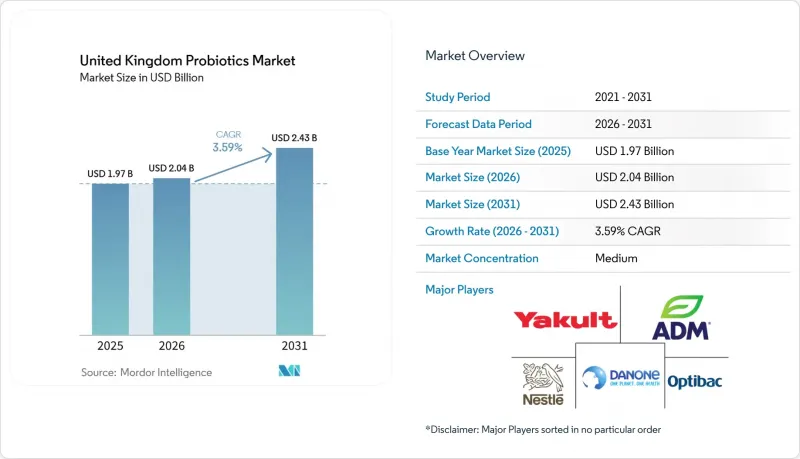
This report is Segmented by Product Type (Probiotic Foods, Probiotic Drinks, Dietary Supplements, and Animal Feeds/Foods), Source (Bacteria, and Yeast), and Distribution Channels (Supermarkets/ Hypermarkets, Pharmacies and Health Stores, Convenience Stores, Online Retail Stores, and Other Distribution Channels). The Market Forecasts are Provided in Terms of Value and Volume (USD/Tonnes).
United Kingdom Probiotics Market Trends and Insights
Growing Consumer Awareness About Gut Health and Digestive Wellness
Rising health awareness has transformed UK consumer priorities, with gut health becoming a central focus for overall wellness improvement. The NHS's 2025 probiotic guidelines confirm specific therapeutic uses while remaining conservative on general health claims. This recognition has expanded consumer acceptance of probiotic products beyond yogurt . Clinical studies demonstrating the effectiveness of probiotics in managing irritable bowel syndrome have established medical validity, with a significant majority of female participants in UK studies experiencing symptom improvement. The British Dietetic Association's 2024 guidelines emphasize the significance of specific probiotic strains, allowing companies with robust clinical research to differentiate their products . However, consumers face challenges in distinguishing between marketing claims and scientifically validated benefits.
Increasing Preference for Preventive Healthcare and Natural Supplements
The UK government's healthcare strategy focuses on shifting from treatment to prevention, which benefits natural supplement categories, including probiotics. The Department of Health introduced "Making Prevention Everyone's Business" initiative in 2024, which promotes personalized prevention services aligned with probiotic interventions . Consumer surveys indicate that UK supplement buyers show strong preference for immune support products, with probiotics representing a significant portion of the vitamins, minerals, and supplements market. The TIGRR report recommends reforming nutraceutical regulations, which may expand the probiotics segment currently limited by EU-derived health claims requirements. This regulatory change positions the UK as a potentially more favorable market for innovation compared to the EU, encouraging investment in new probiotic formulations.
Product Shelf-Life and Storage Issues Due to Probiotic Viability
The probiotic industry faces significant challenges in maintaining bacterial viability, which directly affects market expansion potential and increases operational costs across the supply chain. Recent advancements in microencapsulation technologies, incorporating materials such as whey protein, maltodextrin, and plant-based matrices, have shown promising results in extending probiotic survival during storage periods and maintaining FDA-standard viability levels. The development of double-layer microcapsule systems using shellac has further improved protection during both freeze-drying processes and gastrointestinal transit. However, these technological advancements come with increased production costs and operational complexity, creating barriers for smaller manufacturers to enter the market. The situation is further complicated by quality control issues, as highlighted in the UK Government Chemist's analysis of probiotic supplements, which revealed substantial gaps between advertised and actual viable bacteria counts. This discrepancy has created trust issues among consumers. For retailers, especially smaller establishments without sophisticated cold chain capabilities, managing inventory becomes particularly challenging as they attempt to balance product freshness requirements with optimal shelf-life management.
Other drivers and restraints analyzed in the detailed report include:
- Rising Pediatric Health Focus Promoting Probiotic Products
- Expanding Application in Animal Feed
- Lack of Standardization in Probiotic Strain Efficacy Claims
For complete list of drivers and restraints, kindly check the Table Of Contents.
Segment Analysis
The probiotic drinks market has established a commanding position, securing a substantial 56.83% market share in 2025. This dominance stems from years of successful market development and consumer education by industry pioneers such as Yakult and Danone's Actimel brand. These companies have built robust distribution networks and fostered strong consumer trust in their products, creating a solid foundation for the entire segment.
The animal feed segment has emerged as a significant growth opportunity, demonstrating a promising 4.31% CAGR through 2031. This expansion is primarily attributed to the increasing focus on livestock productivity and mounting concerns regarding antimicrobial resistance in agricultural operations. The dietary supplements category maintains its strategic market position by capitalizing on heightened consumer health awareness, despite navigating complex regulatory restrictions on therapeutic claims. In the baby food and infant formula segments, manufacturers face rigorous safety protocols, particularly in the UK market, where regulatory bodies maintain a cautious approach toward probiotic ingredients pending further clinical validation. The industry has witnessed substantial technological progress, particularly in microencapsulation techniques, where innovative double emulsion systems utilizing pea protein and cellulose nanocrystals have demonstrated enhanced probiotic viability across various product applications.
List of Companies Covered in this Report:
- Danone SA
- Yakult Honsha Co., Ltd.
- Nestle SA
- OptiBac Probiotics Ltd.
- Archer Daniels Midland Company
- BioGaia AB
- Lallemand Inc.
- Kerry Group plc
- Chr. Hansen Holding A/S
- DuPont Nutrition & Biosciences (IFF)
- General Mills Inc.
- Arla Foods amba
- Fonterra Co-operative Group
- Biotiful Gut Health Ltd.
- Symprove Ltd.
- ProVen Probiotics
- NOW Foods
- Lifeway Foods Inc.
- PepsiCo Inc. (Kevita)
- GlaxoSmithKline plc (VitaBiotics)
Additional Benefits:
- The market estimate (ME) sheet in Excel format
- 3 months of analyst support
TABLE OF CONTENTS
1 INTRODUCTION
- 1.1 Study Assumptions and Market Definition
- 1.2 Scope of the Study
2 RESEARCH METHODOLOGY
3 EXECUTIVE SUMMARY
4 MARKET LANDSCAPE
- 4.1 Market Overview
- 4.2 Market Drivers
- 4.2.1 Growing consumer awareness about gut health and digestive wellness.
- 4.2.2 Increasing preference for preventive healthcare and natural supplements.
- 4.2.3 Rising pediatric health focus promoting probiotic products.
- 4.2.4 Expanding application in animal feed
- 4.2.5 Government initiatives promoting health supplements
- 4.2.6 Technological advances improving probiotic strain stability and efficacy
- 4.3 Market Restraints
- 4.3.1 Product shelf-life and storage issues due to probiotic viability
- 4.3.2 Lack of standardization in probiotic strain efficacy claims
- 4.3.3 Taste and texture issues in some probiotic food products
- 4.3.4 Dependency on refrigerated supply chains for certain products
- 4.4 Supply Chain Analysis
- 4.5 Regulatory Outlook
- 4.6 Porter's Five Forces
- 4.6.1 Threat of New Entrants
- 4.6.2 Bargaining Power of Buyers/Consumers
- 4.6.3 Bargaining Power of Suppliers
- 4.6.4 Threat of Substitute Products
- 4.6.5 Intensity of Competitive Rivalry
5 MARKET SIZE AND GROWTH FORECASTS (VALUE AND VOLUME)
- 5.1 By Product Type
- 5.1.1 Probiotic Foods
- 5.1.1.1 Yogurt
- 5.1.1.2 Bakery/Breakfast Cereals
- 5.1.1.3 Baby Food and Infant Formula
- 5.1.1.4 Other Probiotic Foods
- 5.1.2 Probiotic Drinks
- 5.1.2.1 Fruit-based Probiotic Drinks
- 5.1.2.2 Dairy-based Probiotic Drinks
- 5.1.3 Dietary Supplements
- 5.1.4 Animal Feeds/Foods
- 5.1.1 Probiotic Foods
- 5.2 By Source
- 5.2.1 Bacteria
- 5.2.2 Yeast
- 5.3 By Distribution Channel
- 5.3.1 Supermarkets/ Hypermarkets
- 5.3.2 Pharmacies and Health Stores
- 5.3.3 Convenience Stores
- 5.3.4 Online Retail Stores
- 5.3.5 Other Distribution Channels
6 COMPETITIVE LANDSCAPE
- 6.1 Market Concentration
- 6.2 Strategic Moves
- 6.3 Market Ranking Analysis
- 6.4 Company Profiles (includes Global-level Overview, Market-level Overview, Core Segments, Financials (if available), Strategic Information, Market Rank/Share, Products and Services, Recent Developments)
- 6.4.1 Danone SA
- 6.4.2 Yakult Honsha Co., Ltd.
- 6.4.3 Nestle SA
- 6.4.4 OptiBac Probiotics Ltd.
- 6.4.5 Archer Daniels Midland Company
- 6.4.6 BioGaia AB
- 6.4.7 Lallemand Inc.
- 6.4.8 Kerry Group plc
- 6.4.9 Chr. Hansen Holding A/S
- 6.4.10 DuPont Nutrition & Biosciences (IFF)
- 6.4.11 General Mills Inc.
- 6.4.12 Arla Foods amba
- 6.4.13 Fonterra Co-operative Group
- 6.4.14 Biotiful Gut Health Ltd.
- 6.4.15 Symprove Ltd.
- 6.4.16 ProVen Probiotics
- 6.4.17 NOW Foods
- 6.4.18 Lifeway Foods Inc.
- 6.4.19 PepsiCo Inc. (Kevita)
- 6.4.20 GlaxoSmithKline plc (VitaBiotics)
7 MARKET OPPORTUNITIES AND FUTURE OUTLOOK

