PUBLISHER: Mordor Intelligence | PRODUCT CODE: 2061510

PUBLISHER: Mordor Intelligence | PRODUCT CODE: 2061510
Motorhome - Market Share Analysis, Industry Trends & Statistics, Growth Forecasts (2026 - 2031)
According to Mordor Intelligence, the motorhome market size is expected to grow from USD 14.23 billion in 2025 to USD 15.44 billion in 2026 and is forecast to reach USD 23.23 billion by 2031 at an 8.51% CAGR over 2026-2031.
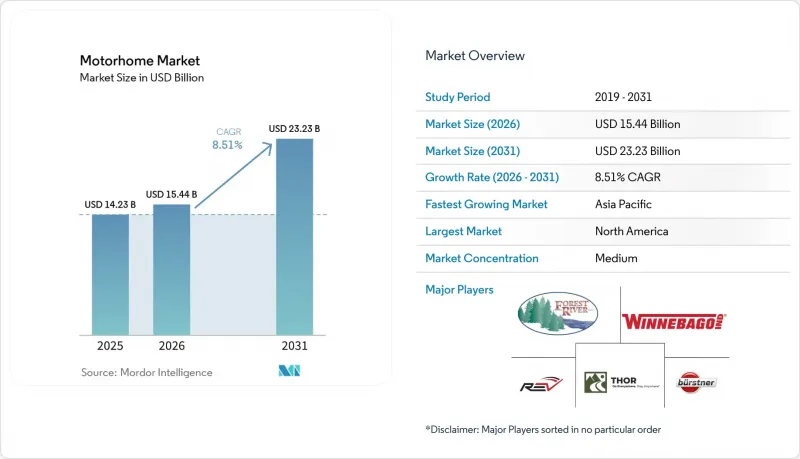
This report is Segmented by Motorhome Class (Class A, Class B, and Class C), End User (Individual Buyers, Rental Companies, and Fleet Operators), Propulsion Type (Diesel, Gasoline, and Electric), Price Range (Economy, Mid-Range, and Premium), and Geography (North America, South America, Europe, Asia-Pacific, and Middle East and Africa). The Market Forecasts are Provided in Terms of Value (USD) and Volume (Units).
Global Motorhome Market Trends and Insights
Growing RV-Centric Tourism Ecosystems
Private operators and public agencies are enhancing amenities such as electrical hookups, Wi-Fi, and dump stations to meet the growing demand for RV vacations. Kampgrounds of America has observed a notable increase in baby-boomer campers, with this demographic now representing a significant portion of all guests . Germany has seen a surge in registrations, driven by the continued opening of new parks in popular regions. In Japan, regulatory changes have allowed larger coaches on expressways, facilitating the import of premium RV models. Improved amenities have shortened campground payback periods in high-traffic corridors, creating a cycle that drives further infrastructure development.
Rising Adoption of Remote-Work Van-Life Lifestyles
The number of digital nomads has significantly increased, with a notable rise in RV households featuring at least one full-time remote worker. Younger professionals are driving demand for features such as ergonomic desks, cellular boosters, and large lithium battery banks. Starlink's antenna and monthly plan have become common additions, ensuring reliable video conferencing even in remote locations . With living costs substantially lower than those in major cities, the lifestyle offers a strong financial appeal. In response, OEMs are integrating advanced systems, solar roofs, and slide-out workstations, effectively transforming RVs into mobile offices.
High Retail Prices and Interest-Rate Sensitive Financing
Motorhome loans often come with long-term commitments and significant down payments, leaving buyers exposed to fluctuations in Federal Reserve rate policies. An increase in interest rates can substantially raise monthly payments, making it challenging for price-sensitive households to afford these loans. Prime lending primarily favors individuals with strong credit scores, while subprime borrowers face higher annual percentage rates, further widening the affordability gap. Dealers are addressing this by extending loan terms for luxury coaches, but this strategy increases the risk of negative equity for owners who trade in before the loan term ends. Entry-level Class C units are being simplified by removing non-essential features to maintain affordability and ensure eligibility for conventional RV financing.
Other drivers and restraints analyzed in the detailed report include:
- Post-Pandemic Preference for Private Travel Modes
- OEM Electrified Chassis Platforms Hitting Cost Parity
- Service-Infrastructure Shortages Outside Developed Regions
For complete list of drivers and restraints, kindly check the Table Of Contents.
Segment Analysis
Class C units commanded a 46.26% share of global deliveries in 2025, underpinned by 6- to 8-berth layouts that easily navigate 35-foot park limits. This slice of the motorhome market is favored by families seeking maneuverability and acceptable insurance premiums. Luxury Class A coaches, while smaller in volume, are projected to grow at a 9.32% CAGR as affluent retirees upgrade from towables. Manufacturers are enhancing differentiation with advanced systems and solar arrays, enabling the off-grid operation of rooftop air conditioners in response to tightening generator regulations. While Compact Class B vans cater to urban buyers seeking stealth parking and daily usability, their high pricing limits broader market penetration.
Developments in the second row are equally significant. Class C builders are now standardizing on innovative house batteries, reducing weight and extending autonomy. Meanwhile, Class B converters introduce pop-top roofs and slide-out galley areas, boosting headroom while staying within parking garage height limits. Luxury Class A models, equipped with smart-home suites that integrate with virtual assistants, not only echo home comfort standards but also maintain their premium pricing amidst ongoing economic challenges.
Retail buyers accounted for 60.28% of the 2025 volume, reflecting cultural preferences for customization and flexible travel schedules. Yet rental fleets are expanding faster, tracking a 9.09% CAGR through 2031 as digital marketplaces mainstream short-term access to high-ticket assets. The motorhome rental market is experiencing significant growth, driven by increased platform-provided liability coverage that reassures owners and high daily utilization rates, which enhance fleet ROI.
First-time buyers now account for a substantial portion of new registrations, with a younger demographic emerging compared to repeat purchasers. A large number of households expressing interest in motorhomes are expected to convert as financial conditions become more favorable. To address this demand, OEMs are offering features such as plug-and-play solar systems, video tutorials, and simplified plumbing layouts to reduce the learning curve. Fleet operators are also leveraging bulk discounts on large orders of Class C motorhomes, targeting corporate events and film crews, thereby maintaining consistent production levels.
Geography Analysis
North America accounted for 47.71% of 2025 revenue from U.S. wholesale shipments, which have declined due to inventory corrections. However, retail demand is stabilizing, supported by steady financing and an increasing number of younger, first-time buyers. With a significant number of RV-owning households and numerous campgrounds nationwide, the U.S. market remains strong. In Canada, regions like British Columbia and Alberta are enhancing amenities such as hookups and dump stations to attract retirees relocating from urban areas.
The Asia-Pacific region is the fastest-growing, with an 8.72% CAGR. Japan's reform allowing longer coaches on expressways has prompted local manufacturers, such as Annex, to increase production. Meanwhile, China's State Council has allocated subsidies to campgrounds in key regions, positioning RV tourism as a significant leisure focus. In India, the market is still developing, but a growing middle class and improved highway infrastructure are expected to drive future demand.
Europe remains a mature yet dynamic market, with Germany leading due to the opening of new year-round parks in popular regions. Low-emission zones in major cities like London and Paris are encouraging buyers to opt for compact Class B vans, which are better suited for urban environments. Coastal tourism is driving rental-fleet growth in Italy and Spain, while Eastern Europe benefits from lower shipping costs enabled by new manufacturing facilities in the region.
South America and the Middle East are still in the early stages of market development. In Brazil, import tariffs continue to drive up prices, but local producers are offering more affordable entry-level models. The United Arab Emirates and Saudi Arabia are investing in desert campgrounds to diversify their tourism offerings. Turkey is attracting OEMs with favorable tax policies, aiming to position itself as a key export hub for Europe.
- Thor Industries Inc.
- Winnebago Industries Inc.
- Forest River Inc.
- REV Group
- Erwin Hymer Group
- Jayco Inc.
- Tiffin Motorhomes Inc.
- Coachmen RV
- Newmar Corporation
- Leisure Travel Vans
- Dethleffs GmbH
- Hobby-Wohnwagenwerk
- Burstner GmbH & Co. KG
- Trigano S.A.
- Knaus Tabbert AG
Additional Benefits:
- The market estimate (ME) sheet in Excel format
- 3 months of analyst support
TABLE OF CONTENTS
1 Introduction
- 1.1 Study Assumptions and Market Definition
- 1.2 Scope of the Study
2 Research Methodology
3 Executive Summary
4 Market Landscape
- 4.1 Market Overview
- 4.2 Market Drivers
- 4.2.1 Growing RV-Centric Tourism Ecosystems
- 4.2.2 Rising Adoption of Remote-Work "Van-Life" Lifestyles
- 4.2.3 Post-Pandemic Preference for Private Travel Modes
- 4.2.4 Baby-Boomer Retirement Cohorts with High Disposable Income
- 4.2.5 OEM Electrified Chassis Platforms Hitting Cost Parity
- 4.2.6 Subscription-Based "RV-as-a-Service" Business Models
- 4.3 Market Restraints
- 4.3.1 High Retail Prices and Interest-Rate Sensitive Financing
- 4.3.2 Service-Infrastructure Shortages Outside Developed Regions
- 4.3.3 Battery-Pack Weight/Energy-Density Trade-Offs in E-Motorhomes
- 4.3.4 Rising Anti-Idling and Emission Regulations at Campsites
- 4.4 Value / Supply-Chain Analysis
- 4.5 Regulatory Landscape
- 4.6 Technological Outlook
- 4.7 Porter's Five Forces
- 4.7.1 Threat of New Entrants
- 4.7.2 Bargaining Power of Suppliers
- 4.7.3 Bargaining Power of Buyers
- 4.7.4 Threat of Substitutes
- 4.7.5 Industry Rivalry
5 Market Size and Growth Forecasts (Value (USD) Volume (Units))
- 5.1 By Motorhome Class
- 5.1.1 Class A (Luxury)
- 5.1.2 Class B (Compact)
- 5.1.3 Class C (Mid-size)
- 5.2 By End User
- 5.2.1 Individual Buyers
- 5.2.2 Rental Companies
- 5.2.3 Fleet Operators
- 5.3 By Propulsion Type
- 5.3.1 Diesel
- 5.3.2 Gasoline
- 5.3.3 Electric
- 5.4 By Price Range
- 5.4.1 Economy
- 5.4.2 Mid-Range
- 5.4.3 Premium
- 5.5 By Geography
- 5.5.1 North America
- 5.5.1.1 United States
- 5.5.1.2 Canada
- 5.5.1.3 Rest of North America
- 5.5.2 South America
- 5.5.2.1 Brazil
- 5.5.2.2 Argentina
- 5.5.2.3 Rest of South America
- 5.5.3 Europe
- 5.5.3.1 Germany
- 5.5.3.2 United Kingdom
- 5.5.3.3 France
- 5.5.3.4 Italy
- 5.5.3.5 Spain
- 5.5.3.6 Rest of Europe
- 5.5.4 Asia-Pacific
- 5.5.4.1 China
- 5.5.4.2 India
- 5.5.4.3 Japan
- 5.5.4.4 South Korea
- 5.5.4.5 Rest of Asia-Pacific
- 5.5.5 Middle East and Africa
- 5.5.5.1 United Arab Emirates
- 5.5.5.2 Saudi Arabia
- 5.5.5.3 South Africa
- 5.5.5.4 Turkey
- 5.5.5.5 Rest of Middle East and Africa
- 5.5.1 North America
6 Competitive Landscape
- 6.1 Market Concentration
- 6.2 Strategic Moves
- 6.3 Market Share Analysis
- 6.4 Company Profiles (Includes Global Level Overview, Market Level Overview, Core Segments, Financials as available, Strategic Information, Market Rank/Share for Key Companies, Products and Services, and Recent Developments)
- 6.4.1 Thor Industries Inc.
- 6.4.2 Winnebago Industries Inc.
- 6.4.3 Forest River Inc.
- 6.4.4 REV Group
- 6.4.5 Erwin Hymer Group
- 6.4.6 Jayco Inc.
- 6.4.7 Tiffin Motorhomes Inc.
- 6.4.8 Coachmen RV
- 6.4.9 Newmar Corporation
- 6.4.10 Leisure Travel Vans
- 6.4.11 Dethleffs GmbH
- 6.4.12 Hobby-Wohnwagenwerk
- 6.4.13 Burstner GmbH & Co. KG
- 6.4.14 Trigano S.A.
- 6.4.15 Knaus Tabbert AG
7 Market Opportunities and Future Outlook

