PUBLISHER: Mordor Intelligence | PRODUCT CODE: 2061511

PUBLISHER: Mordor Intelligence | PRODUCT CODE: 2061511
South America C-Arms - Market Share Analysis, Industry Trends & Statistics, Growth Forecasts (2026 - 2031)
According to Mordor Intelligence, the south america c-Arms market size is expected to increase from USD 352.75 million in 2025 to USD 372.01 million in 2026 and reach USD 485.28 million by 2031, growing at a CAGR of 5.46% over 2026-2031.
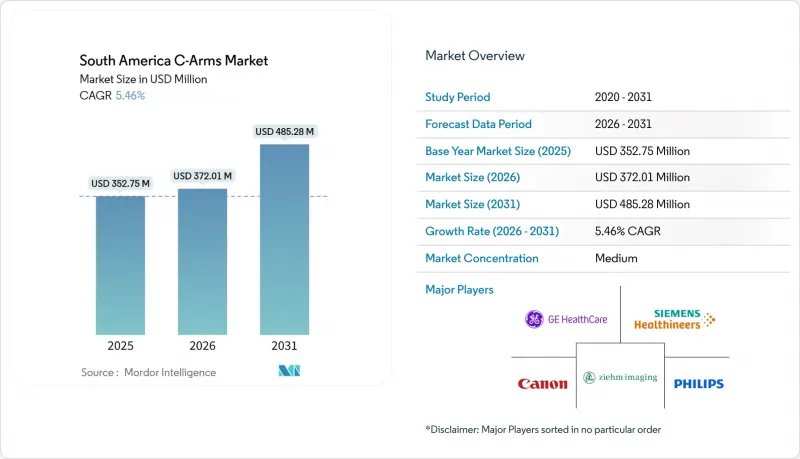
This report is Segmented by Device Type (Fixed C-Arms, Mobile C-Arms), Detector Technology (Image-Intensifier, Flat-Panel), Application (Cardiology, Gastroenterology, Neurology, Orthopedics & Trauma, and More), End User (Hospitals, Ambulatory Surgical Centres, Specialty Clinics), and Geography (Brazil, Argentina, Chile, Colombia, Peru, Rest of South America). Market Forecasts are Provided in Value (USD).
South America C-Arms Market Trends and Insights
Rising Geriatric Population and Chronic Disease Burden
Colombia is expected to perform 39,270 arthroplasties annually by 2050, a 52.7% jump that will require more intra-operative imaging cycles. Brazil recorded 202,940 traumatic amputations between 2008 and 2023, costing USD 54.87 million in yearly reimbursements, reinforcing continual capital outlays for high-throughput systems. Between 2000 and 2023, Brazil experienced a significant increase in its population aged 60 and above, rising from 8.7% to 15.6%. This demographic shift has driven higher demand for image-guided procedures in orthopedics, vascular care, and oncology. Argentina and Chile, with similar aging trends and chronic disease prevalence, are also seeing increased utilization of fluoroscopy for stenting, vertebroplasty, and tumor ablation. Public imaging facilities in metropolitan Brazil are operating at 70-80% capacity, resulting in extended wait times and prompting insured patients to seek services at private clinics equipped with mobile C-arms. To address bed shortages and upgrade outdated systems, state authorities in Sao Paulo and Minas Gerais are co-investing in ambulatory surgical centers. Despite budget constraints, this mismatch between demographic needs and technological capabilities continues to sustain demand for medical equipment.
Adoption of Minimally Invasive, Image-Guided Surgeries
Minimally invasive spine procedures are expanding across South America, aided by regional training hubs in Bogota that improve surgeon proficiency. In Brazil, bone-anchored hearing implant operations cut complication rates by 49% and operating times by half. when performed with image-guided tools. Robotic thoracic programs now operate on 41 da Vinci systems concentrated in Sao Paulo and Rio de Janeiro, confirming hospital demand for real-time fluoroscopy that syncs with robotics. As more surgeries migrate to outpatient environments, the South America C Arms market benefits from compact, mobile platforms that dock easily into hybrid ORs, ensuring workflow continuity without permanent infrastructure changes.
High Acquisition and Maintenance Costs
Brazil imposes 20-60% tariffs on imported medical devices, escalating capital budgets for tertiary hospitals even after extended 60-day payment terms were introduced in 2024. Argentine peso devaluation deepens price uncertainty, compelling facilities to prioritize essential consumables over elective imaging upgrades. Flat-panel C-Arms range from USD 50,000 to USD 175,000, deterring smaller clinics that lack volume guarantees. Access inequities persist in Chile, where privately insured patients enjoy 2.8-times greater orthopedic surgery rates than their public counterparts, highlighting the affordability divide.
Other drivers and restraints analyzed in the detailed report include:
- Technological Advances in Flat-Panel and 3D Imaging
- Post-COVID Backlog of Elective Surgeries
- Shortage of Skilled Imaging Technologists and Surgeons
For complete list of drivers and restraints, kindly check the Table Of Contents.
Segment Analysis
Fixed systems held 67.91% of the South American C-Arms market share in 2025, driven by high-throughput trauma centers that demand ceiling-mounted stability and large detector sizes. Mobile platforms are, however, forecast to outpace at a 5.82% CAGR because outpatient units prize maneuverability for multi-disciplinary theater rosters. Siemens Healthineers' autonomous CIARTIC Move, launched in 2024, reduces position setup time by half, underscoring why mobile innovation resonates at staff-constrained sites.
Implementation of cone-beam CT within mobile footprints is closing the capability gap with fixed fluoroscopy suites, allowing advanced trauma and spinal workflows in lower-acuity facilities. As refurbish-friendly regulations take hold in Brazil and Argentina, mini C-Arm adoption is accelerating among orthopedists treating extremity injuries in ambulatory settings. Continuous cross-pollination of software features across fixed and mobile lines blurs category boundaries, yet installation cost and theater configuration remain the dividing line for capital budgeting.
Flat-panel detector systems, accounting for 63.02% of 2025 sales, are expected to grow at a 5.65% CAGR. The shift from image intensifiers is being driven by 2024 dose-tracking regulations in Brazil and similar mandates in Argentina. CMOS flat panels, with higher quantum efficiency, reduce exposure by 25-30% compared to amorphous-silicon alternatives. Image-intensifier tubes, which still represent about one-third of the installed base, face challenges such as limited availability of replacement parts and high costs ranging from USD 18,000 to 22,000 per tube. These factors make flat panels more cost-effective in terms of total ownership. Furthermore, trade-in programs offering up to 30% credit on legacy systems encourage faster adoption of flat panels. As public networks in South America introduce leasing options to avoid upfront payments, the market share of image-intensifier systems in the C-Arms segment is anticipated to decline steadily.
List of Companies Covered in this Report:
- Allengers Medical Systems Ltd.
- Canon
- Carestream Health
- DMS Imaging SA
- Eurocolumbus S.p.A.
- Fujifilm Holdings Corp.
- GE Healthcare
- Hologic
- Koninklijke Philips
- Medtronic
- Nanjing Perlove Medical Equip. Co., Ltd.
- Orthoscan
- Shimadzu
- Siemens Healthineers
- Skanray Technologies Ltd.
- Stephanix
- Trivitron Healthcare
- United Imaging Healthcare Co., Ltd.
- Varian Medical Systems
- Ziehm Imaging
Additional Benefits:
- The market estimate (ME) sheet in Excel format
- 3 months of analyst support
TABLE OF CONTENTS
1 Introduction
- 1.1 Study Assumptions & Market Definition
- 1.2 Scope of the Study
2 Research Methodology
3 Executive Summary
4 Market Landscape
- 4.1 Market Overview
- 4.2 Market Drivers
- 4.2.1 Rising Geriatric Population & Chronic Disease Burden
- 4.2.2 Adoption of Minimally-Invasive, Image-Guided Surgeries
- 4.2.3 Technological Advances in Flat-Panel & 3-D Imaging
- 4.2.4 Post-COVID Backlog of Elective Surgeries
- 4.2.5 Expansion of Ambulatory Surgical Centres in Tier-2 Brazilian & Colombian Cities
- 4.2.6 OEM Financing & Leasing Models Lowering Capex Barriers
- 4.3 Market Restraints
- 4.3.1 High Acquisition & Maintenance Costs
- 4.3.2 Shortage of Skilled Imaging Technologists & Surgeons
- 4.3.3 Currency Volatility Impacting Import Pricing & Procurement
- 4.3.4 Growth of Refurbished C-Arm Market Suppressing New Sales
- 4.4 Supply-Chain Analysis
- 4.5 Regulatory Landscape
- 4.6 Technological Outlook
- 4.7 Porter's Five Forces Analysis
- 4.7.1 Threat of New Entrants
- 4.7.2 Bargaining Power of Buyers
- 4.7.3 Bargaining Power of Suppliers
- 4.7.4 Threat of Substitutes
- 4.7.5 Intensity of Competitive Rivalry
5 Market Size & Growth Forecasts (Value, USD)
- 5.1 By Device Type
- 5.1.1 Fixed C-Arms
- 5.1.2 Mobile C-Arms
- 5.1.2.1 Full-Size C-Arms
- 5.1.2.2 Mini C-Arms
- 5.2 By Detector Technology
- 5.2.1 Image-Intensifier Systems
- 5.2.2 Flat-Panel Detector Systems
- 5.3 By Application
- 5.3.1 Cardiology
- 5.3.2 Gastroenterology
- 5.3.3 Neurology
- 5.3.4 Orthopedics & Trauma
- 5.3.5 Oncology
- 5.3.6 Other Applications
- 5.4 By End User
- 5.4.1 Hospitals
- 5.4.2 Ambulatory Surgical Centres
- 5.4.3 Specialty Clinics & Diagnostic Centres
- 5.5 By Country
- 5.5.1 Brazil
- 5.5.2 Argentina
- 5.5.3 Chile
- 5.5.4 Colombia
- 5.5.5 Peru
- 5.5.6 Rest of South America
6 Competitive Landscape
- 6.1 Market Concentration
- 6.2 Market Share Analysis
- 6.3 Company Profiles (includes Global level Overview, Market-level Overview, Core Segments, Financials, Strategic Information, Market Rank/Share, Products & Services, Recent Developments)
- 6.3.1 Allengers Medical Systems Ltd.
- 6.3.2 Canon Medical Systems Corp.
- 6.3.3 Carestream Health
- 6.3.4 DMS Imaging SA
- 6.3.5 Eurocolumbus S.p.A.
- 6.3.6 Fujifilm Holdings Corp.
- 6.3.7 GE Healthcare
- 6.3.8 Hologic Inc.
- 6.3.9 Koninklijke Philips N.V.
- 6.3.10 Medtronic plc
- 6.3.11 Nanjing Perlove Medical Equip. Co., Ltd.
- 6.3.12 OrthoScan Inc.
- 6.3.13 Shimadzu Corporation
- 6.3.14 Siemens Healthineers AG
- 6.3.15 Skanray Technologies Ltd.
- 6.3.16 Stephanix
- 6.3.17 Trivitron Healthcare
- 6.3.18 United Imaging Healthcare Co., Ltd.
- 6.3.19 Varian Medical Systems Inc.
- 6.3.20 Ziehm Imaging GmbH
7 Market Opportunities & Future Outlook
- 7.1 White-space & Unmet-Need Assessment

