PUBLISHER: Mordor Intelligence | PRODUCT CODE: 2061516

PUBLISHER: Mordor Intelligence | PRODUCT CODE: 2061516
India Wound Care Management Devices - Market Share Analysis, Industry Trends & Statistics, Growth Forecasts (2026 - 2031)
According to Mordor Intelligence, the india wound care management devices market size is projected to be USD 277.27 million in 2025, USD 294.14 million in 2026, and reach USD 395.85 million by 2031, growing at a CAGR of 6.12% from 2026 to 2031.
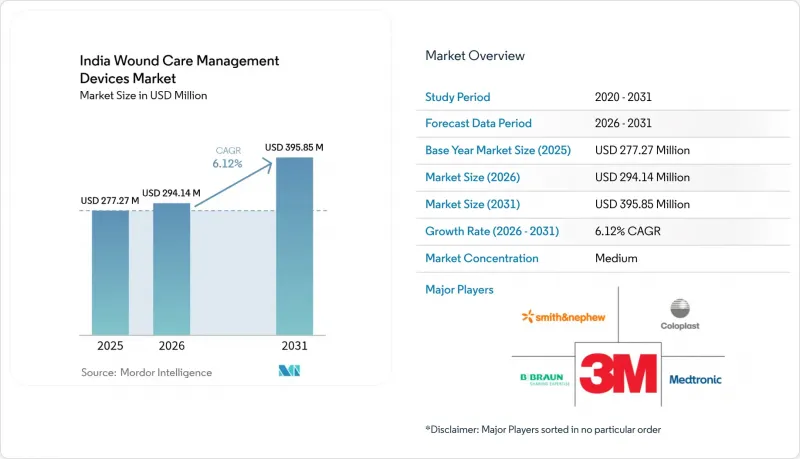
This report is Segmented by Product (Dressings, Bandages, Wound Closure Devices, and More), Wound Type (Chronic Wound and Acute Wound), and End-User (Hospitals & Clinics, Ambulatory Surgical Centers, Home Healthcare, and Others). The Market Forecasts are Provided in Terms of Value (USD).
India Wound Care Management Devices Market Trends and Insights
Rising Diabetes-Linked Diabetic Foot Ulcer Burden
India hosts more than 101 million people with diabetes and 136 million with pre-diabetes, translating into 6.2% diabetic foot ulcer prevalence. Lower-limb amputations exceed 100,000 annually, creating sustained demand for advanced dressings, offloading devices, and NPWT. Indigenous offloading alternatives, such as the Bohler and Mandakini designs, match total-contact casting outcomes yet remain confined to a few tertiary centers. Manufacturers must balance affordability with efficacy, which favors modular kits over single-use matrices.
Increasing Surgical Volumes Across India
At 1,385 surgeries per 100,000 population in 2025, India still trails the WHO benchmark, leaving headroom for hospital expansion. Surgical-site infection rates of 9% in community facilities versus 2-3% in accredited centers are driving adoption of antimicrobial dressings and NPWT to reduce dehiscence. March 2024 tenders for portable canistered NPWT and hemoglobin spray show public institutions are gearing up for advanced wound closure. Price-cutting moves such as Covidien's 60% suture discount illustrate how volume-led strategies work in price-sensitive settings.
Limited Awareness of Advanced Wound Care in Primary Care
Primary-health centers still rely on gauze and povidone-iodine, and many clinicians lack training in NPWT or hydrocolloids. National Health Mission curricula omit wound-care competencies, prolonging referrals and escalating complications. Stock-outs and cold-chain gaps further limit advanced product use outside metros. Rural areas face additional barriers: supply-chain fragility means advanced dressings frequently stock out, and cold-chain requirements for biological matrices remain unmet in facilities without reliable refrigeration.
Other drivers and restraints analyzed in the detailed report include:
- Product & Technology Innovation in Dressings & NPWT
- Indigenous Low-Cost NPWT & Smart Dressings Adoption
- High Treatment Cost of Advanced Products
For complete list of drivers and restraints, kindly check the Table Of Contents.
Segment Analysis
Dressings captured 46.06% of 2025 revenue, while bandages are on track for a 9.22% CAGR thanks to sports-medicine protocols favoring adhesive formats over gauze. Hospitals standardize dressings for diabetic ulcers, anchoring volumes, and bandage makers exploit dual distribution through institutional tenders and retail pharmacies. The India wound care management devices market for dressings will continue to outpace other categories, while bandages are carving a premium niche by positioning around rapid return-to-activity outcomes. Sensor-enabled dressings entering validation could bifurcate the category into commodity and smart-platform segments, reshaping pricing tiers.
The suture-dominated wound-closure device cluster benefits from locked-in hospital formulary contracts led by Ethicon and Covidien. NPWT, hemostats, and biological matrices remain niche as cost and reimbursement uncertainties limit scale. Once Ayushman Bharat broadens coverage, these high-margin segments are poised for catch-up growth within the India wound care management devices market.
List of Companies Covered in this Report:
- 3M
- Axio Biosolutions Private Limited
- B. Braun
- Cardinal Health
- Centaur Pharmaceuticals Private Limited
- Coloplast
- ConvaTec Group plc
- Datt Mediproducts Private Limited
- Dolphin Sutures
- Healthium Medtech Ltd
- Integra LifeSciences
- Johnson & Johnson
- Lotus Surgicals
- Medtronic
- Meril Life Science
- Molnlycke Health Care AB.
- Hartmann Group
- Rapidcure Healthcare Private Limited
- Smiths Group
- Stryker
Additional Benefits:
- The market estimate (ME) sheet in Excel format
- 3 months of analyst support
TABLE OF CONTENTS
1 Introduction
- 1.1 Study Assumptions & Market Definition
- 1.2 Scope of the Study
2 Research Methodology
3 Executive Summary
4 Market Landscape
- 4.1 Market Overview
- 4.2 Market Drivers
- 4.2.1 Rising DiabetesLinked Diabetic-Foot-Ulcer Burden
- 4.2.2 Increasing Surgical Volumes Across India
- 4.2.3 Product & Technology Innovation in Dressings & NPWT
- 4.2.4 Indigenous Low-Cost NPWT & Smart Dressings Adoption
- 4.2.5 Government PLI Scheme for Local Device Manufacturing
- 4.2.6 Growing Sports & Fitness Injuries
- 4.3 Market Restraints
- 4.3.1 Limited Awareness of Advanced Wound Care in Primary Care
- 4.3.2 High Treatment Cost of Advanced Products
- 4.3.3 Reimbursement Gaps Under Ayushman Bharat
- 4.3.4 NPPA Price-Control Risk for Imported Devices
- 4.4 Value / Supply-Chain Analysis
- 4.5 Regulatory Landscape
- 4.6 Technological Outlook
- 4.7 Porters Five Forces Analysis
- 4.7.1 Threat of New Entrants
- 4.7.2 Bargaining Power of Buyers
- 4.7.3 Bargaining Power of Suppliers
- 4.7.4 Threat of Substitutes
- 4.7.5 Intensity of Competitive Rivalry
5 Market Size & Growth Forecasts (Value, USD)
- 5.1 By Product Type
- 5.1.1 Dressings
- 5.1.2 Bandages
- 5.1.3 Wound Closure Devices
- 5.1.4 Other Wound Care Products
- 5.2 By Wound Type
- 5.2.1 Chronic Wounds
- 5.2.1.1 Diabetic Foot Ulcer
- 5.2.1.2 Pressure Ulcer
- 5.2.1.3 Other Chronic Wounds
- 5.2.2 Acute Wounds
- 5.2.2.1 Surgical Wounds
- 5.2.2.2 Burns
- 5.2.2.3 Other Acute Wounds
- 5.2.1 Chronic Wounds
- 5.3 By End User
- 5.3.1 Hospitals & Clinics
- 5.3.2 Ambulatory Surgical Centers
- 5.3.3 Home Healthcare
- 5.3.4 Others
6 Competitive Landscape
- 6.1 Market Concentration
- 6.2 Market Share Analysis
- 6.3 Company Profiles (includes Global level Overview, Market level overview, Core Segments, Financials as available, Strategic Information, Market Rank/Share for key companies, Products & Services, and Recent Developments)
- 6.3.1 3M Company
- 6.3.2 Axio Biosolutions Private Limited
- 6.3.3 B. Braun SE
- 6.3.4 Cardinal Health, Inc.
- 6.3.5 Centaur Pharmaceuticals Private Limited
- 6.3.6 Coloplast A/S
- 6.3.7 ConvaTec Group plc
- 6.3.8 Datt Mediproducts Private Limited
- 6.3.9 Dolphin Sutures
- 6.3.10 Healthium Medtech Ltd
- 6.3.11 Integra LifeSciences Holdings Corporation
- 6.3.12 Johnson & Johnson (Ethicon)
- 6.3.13 Lotus Surgicals
- 6.3.14 Medtronic plc
- 6.3.15 Meril Life Sciences Private Limited
- 6.3.16 Molnlycke Health Care AB.
- 6.3.17 Paul Hartmann AG
- 6.3.18 Rapidcure Healthcare Private Limited
- 6.3.19 Smith & Nephew plc
- 6.3.20 Stryker Corporation
7 Market Opportunities & Future Outlook
- 7.1 White-space & Unmet-need Assessment

