PUBLISHER: Mordor Intelligence | PRODUCT CODE: 2061531

PUBLISHER: Mordor Intelligence | PRODUCT CODE: 2061531
United States Maize - Market Share Analysis, Industry Trends & Statistics, Growth Forecasts (2026 - 2031)
According to Mordor Intelligence, the united states maize market size is projected to grow from USD 48.20 billion in 2025 and 49.74 billion in 2026 to USD 58.23 billion by 2031, reflecting a CAGR of 3.20% during the period 2026-2031.
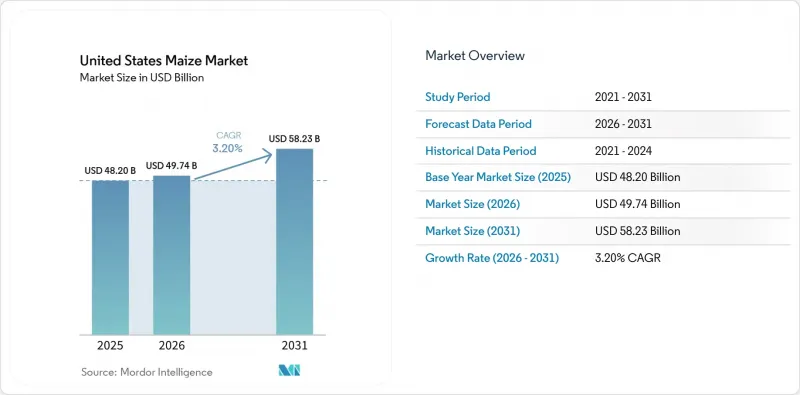
The United States Maize Market Report Includes Production Analysis (Volume), Consumption Analysis (Value and Volume), Import Analysis (Value and Volume), Export Analysis (Value and Volume), Wholesale Price Trend Analysis and Forecast, Regulatory Framework, Logistics and Infrastructure, and Seasonality Analysis. The Market Forecasts are Provided in Terms of Value (USD) and Volume (Metric Tons).
United States Maize Market Trends and Insights
Shift to High-Protein Meat Diets Sustaining Feed Demand
The increasing consumption of animal protein in the United States continues to drive maize demand through its use in animal feed, particularly in the poultry industry, which remains the leading meat category. Poultry production relies heavily on maize-based feed, establishing a direct connection between dietary trends and grain demand. According to the United States Department of Agriculture Economic Research Service, the per capita availability of broiler consumption reached 101.3 pounds in 2024, up by 0.7% over the last year, indicating sustained chicken consumption . This steady consumption level supports the inclusion of maize in feed formulations and underpins consistent demand within the United States maize market.
Record E15 Adoption Boosting Ethanol Use
The growing adoption of E15 fuel in the United States is boosting maize demand due to higher ethanol blending. Policy measures supporting year-round E15 sales and the expansion of fueling station infrastructure are contributing to the rise in ethanol consumption. According to the United States Environmental Protection Agency (EPA), the Renewable Fuel Standard requires the blending of 15 billion gallons of conventional biofuel annually, primarily sourced from maize . This regulatory framework provides a consistent demand for ethanol producers, enhancing maize utilization within the biofuel industry and bolstering overall market demand.
Volatile Global Fertilizer Prices Pressuring Margins
Fertilizer price volatility continues to create significant uncertainty in the United States maize market by directly impacting input costs and influencing farm-level decisions. According to Michigan State University Extension (2026), and the United States Department of Agriculture Agricultural Marketing Service, urea prices rose from USD 581 per metric ton on February 20, 2026, to USD 822 per metric ton on March 20, 2026. This sharp increase during the planting season places immediate financial pressure on farmers, often resulting in delayed purchases or reduced application rates. These adjustments directly affect yield potential and production consistency, contributing to supply fluctuations and overall market instability.
Other drivers and restraints analyzed in the detailed report include:
- Biotech Trait Stacks Increasing Per-Acre Returns
- Expansion of Midwest Rail and River Export Capacity
- Widespread Tar Spot Outbreaks in Corn Belt States
For complete list of drivers and restraints, kindly check the Table Of Contents.
Additional Benefits:
- The market estimate (ME) sheet in Excel format
- 3 months of analyst support
TABLE OF CONTENTS
1 Introduction
- 1.1 Study Assumptions and Market Definition
- 1.2 Scope of the Study
2 Research Methodology
3 Executive Summary
4 Market Landscape
- 4.1 Market Overview
- 4.2 Market Drivers
- 4.2.1 Shift to high-protein meat diets sustaining feed demand
- 4.2.2 Record E15 adoption boosting ethanol use
- 4.2.3 Biotech trait stacks increasing per-acre returns
- 4.2.4 Expansion of Midwest rail and river export capacity
- 4.2.5 AI-based variable-rate fertilization reducing input costs
- 4.2.6 Premiums for low-carbon corn via regenerative agriculture
- 4.3 Market Restraints
- 4.3.1 Volatile global fertilizer prices pressuring margins
- 4.3.2 Widespread tar spot outbreaks in Corn Belt states
- 4.3.3 Competition from soybeans in crop rotation
- 4.3.4 State-level water-use limits in the High Plains
- 4.4 Opportunities
- 4.5 Challenges
- 4.6 Value Chain Analysis
- 4.7 Technologies and usage of AI in the Industry
- 4.8 Input Market Analysis
- 4.8.1 Seeds
- 4.8.2 Fertilizers
- 4.8.3 Crop Protection Chemicals
- 4.9 Distribution Channel Analysis
- 4.10 Market Sentiment Analysis
- 4.11 PESTLE Analysis
5 Market Size and Growth Forecasts (Value and Volume)
- 5.1 Production Analysis
- 5.1.1 Production Volume
- 5.1.2 Area Harvested and Yield
- 5.2 Consumption Analysis (Value and Volume)
- 5.3 Trade Analysis (Value and Volume)
- 5.3.1 Import Market Analysis
- 5.3.1.1 Import Value and Volume
- 5.3.1.2 Key Supplying Markets
- 5.3.2 Export Market Analysis
- 5.3.2.1 Export Value and Volume
- 5.3.2.2 Key Destinations Markets
- 5.3.1 Import Market Analysis
- 5.4 Wholesale Price Trend Analysis and Forecast
- 5.5 Regulatory Framework
- 5.6 Logistics and Infrastructure
- 5.7 Seasonality Analysis
6 End Use and Application
- 6.1 Primary Applications and Emerging Applications
- 6.2 Consumption Breakdown by Industries
7 Competitive Landscape
- 7.1 Overview of the Competition
- 7.2 Recent Developments
- 7.3 Market Concentration Analysis
- 7.4 List of Key Players
- 7.4.1 Archer-Daniels-Midland Company
- 7.4.2 Cargill, Incorporated
- 7.4.3 Bunge Global SA
- 7.4.4 Louis Dreyfus Company B.V.
- 7.4.5 CHS Inc.
- 7.4.6 The Andersons, Inc.
- 7.4.7 Land O'Lakes, Inc.
- 7.4.8 GROWMARK, Inc.
- 7.4.9 Green Plains Inc.
- 7.4.10 POET, LLC
- 7.4.11 Valero Energy Corporation
- 7.4.12 Ingredion Incorporated
8 Market Opportunities and Future Outlook

