
PUBLISHER: Mordor Intelligence | PRODUCT CODE: 2061535

PUBLISHER: Mordor Intelligence | PRODUCT CODE: 2061535
South America Ovarian Cancer Diagnostics And Therapeutics - Market Share Analysis, Industry Trends & Statistics, Growth Forecasts (2026 - 2031)
According to Mordor Intelligence, the south america ovarian cancer diagnostics and therapeutics market size is projected to expand from USD 4.45 billion in 2025 and USD 4.86 billion in 2026 to USD 7.55 billion by 2031, registering a CAGR of 9.22% between 2026 to 2031.
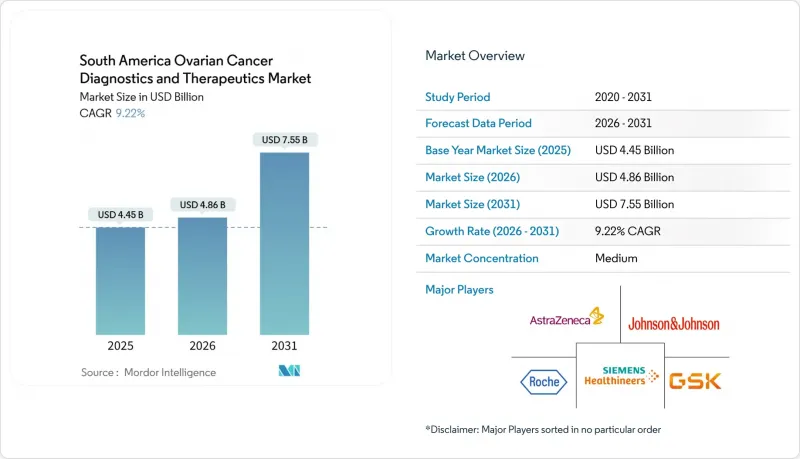
This report is Segmented by Cancer Type (Epithelial Ovarian Tumors, and More, Diagnostic Modality (Biopsy, and More)), Therapeutic Modality (Chemotherapy, Radiation Therapy, Targeted Therapy, and More), End User (Hospitals, Cancer Specialty Centers, and More), and Geography (Brazil, Argentina, and More). The Market Forecasts are Provided in Terms of Value (USD).
South America Ovarian Cancer Diagnostics And Therapeutics Market Trends and Insights
Increasing Incidences of Ovarian Cancer
In Andean nations, age-standardized incidence rates of ovarian cancer are rising at an annual rate between 2.1% and 2.7%, surpassing the global average. In 2022, Brazil reported 7,710 new ovarian cancer diagnoses and anticipates a 9% yearly increase through 2030. This projection is driven by the continued adoption of opportunistic rather than systematic screening approaches. Over 60% of diagnosed cases remain at FIGO stages III or IV, limiting overall survival to 32 months. This late-stage diagnosis has significantly increased the demand for platinum-based chemotherapy and first-line PARP inhibitor maintenance treatments. To address this, health ministries are piloting risk-stratified screening programs. For instance, Chile's hereditary registry now connects BRCA carriers directly to prophylactic surgeries. Pharmaceutical companies are prioritizing the region for drug launches, as evidenced by the eight-month approval lead for olaparib in Brazil compared to the United States.
Rising Geriatric Female Population
By 2035, the percentage of South American women aged 65 and older is projected to rise from 8.1% in 2025 to 11.3%. Since the risk of ovarian cancer peaks between ages 55 and 74, this growing elderly demographic is expected to increase both the number of incident cases and the duration of maintenance therapy. In response, tertiary centers are establishing geriatric oncology units to address challenges like polypharmacy and frailty, favoring oral targeted agents and outpatient infusions over traditional inpatient chemotherapy. With longer life expectancies, there is also a rise in surveillance testing. Serial CA-125 assays and liquid biopsies are now reimbursed, enabling earlier detection of biochemical recurrences before they progress to imaging.
Low Awareness Leading to Late-Stage Diagnosis
In rural Peru and Colombia, symptom-awareness campaigns reach fewer than 35% of women. This limited reach results in a median diagnostic delay of 7.2 months, more than double that observed in metropolitan Sao Paulo and Buenos Aires. Patients diagnosed at Stage IV are often ineligible for cytoreductive surgery and face treatment costs that are 2.8 times higher, primarily due to extended chemotherapy and palliative care. While Chile's pilot program utilizing community health workers shows potential, the issue of sustainable funding remains unresolved.
Other drivers and restraints analyzed in the detailed report include:
- Growing Healthcare Expenditure & Insurance Coverage
- Rapid Uptake of PARP Inhibitors & Other Targeted Therapies
- High Cost of Targeted Drugs & Companion Diagnostics
For complete list of drivers and restraints, kindly check the Table Of Contents.
Segment Analysis
Epithelial tumors accounted for 68.67% of South America's ovarian cancer diagnostics and therapeutics market revenue in 2025, with an anticipated growth rate of 11.5% CAGR through 2031. High-grade serous carcinoma, representing over half of all epithelial diagnoses, demonstrates the highest prevalence of BRCA and HRD, driving the adoption of PARP inhibitors. Local trials for PI3K and AKT inhibitors are gaining momentum, particularly for clear-cell and endometrioid variants, with alpelisib currently in a phase II study in Brazil involving 180 patients.
Ongoing molecular segmentation is expected to further refine treatment algorithms. The increasing adoption of comprehensive genomic profiling enables oncologists to identify actionable mutations such as PIK3CA, ARID1A, and PTEN, creating opportunities for targeted therapy combinations. Advocacy groups are actively promoting subtype-specific clinical-trial enrollment criteria to accelerate access to experimental treatments.
Blood-based CA-125 assays remain a cornerstone of diagnostic workflows, contributing 34.45% of 2025's revenue. However, their dominance is diminishing as liquid-biopsy assays gain traction, growing at a 12.80% CAGR following the approval of Guardant360 CDx, the first comprehensive ctDNA test for ovarian cancer. The market for liquid-biopsy platforms in South America is projected to approach USD 950 million by 2031, driven by their ability to detect resistance mutations without the need for invasive tissue re-biopsies.
Laboratory networks are consolidating to scale next-generation sequencing capabilities, with major players deploying advanced systems in key locations such as Sao Paulo and Buenos Aires. Additionally, payers are increasingly bundling reimbursements for molecular testing with companion therapeutics, facilitating broader adoption.
List of Companies Covered in this Report:
- Abbvie
- AstraZeneca
- Bio-Rad Laboratories
- Boehringer Ingelheim
- Bristol-Myers Squibb
- Clovis Oncology, Inc.
- Danaher Corp. (Beckman Coulter)
- Eli Lilly and Company
- Roche
- GE HealthCare Technologies Inc.
- GlaxoSmithKline
- Guardant Health, Inc.
- Hologic
- Illumina
- ImmunoGen, Inc.
- Johnson & Johnson
- Merck
- Myriad Genetics
- Novartis
- Pfizer
- QIAGEN
- Quest Diagnostics
- Siemens Healthineers
- TESARO (a GSK company)
- Thermo Fisher Scientific
Additional Benefits:
- The market estimate (ME) sheet in Excel format
- 3 months of analyst support
TABLE OF CONTENTS
1 Introduction
- 1.1 Study Assumptions & Market Definition
- 1.2 Scope of the Study
2 Research Methodology
3 Executive Summary
4 Market Landscape
- 4.1 Market Overview
- 4.2 Market Drivers
- 4.2.1 Increasing Incidences of Ovarian Cancer
- 4.2.2 Rising Geriatric Female Population
- 4.2.3 Growing Healthcare Expenditure & Insurance Coverage
- 4.2.4 Rapid Uptake of PARP Inhibitors & Other Targeted Therapies
- 4.2.5 Expansion of BRCA/HRD Testing Reimbursement Programs
- 4.2.6 On-Shoring of Oncology API Manufacturing Following 2025 Tariff Shifts
- 4.3 Market Restraints
- 4.3.1 Low Awareness Leading to Late-Stage Diagnosis
- 4.3.2 High Cost of Targeted Drugs & Companion Diagnostics
- 4.3.3 Pathology Workforce Shortages Causing Biomarker Test Delays
- 4.3.4 Fragmented Reimbursement for Companion Diagnostics Vs. Drugs
- 4.4 Supply-Chain Analysis
- 4.5 Regulatory Landscape
- 4.6 Technological Outlook
- 4.7 Porter's Five Forces Analysis
- 4.7.1 Threat of New Entrants
- 4.7.2 Bargaining Power of Buyers/Consumers
- 4.7.3 Bargaining Power of Suppliers
- 4.7.4 Threat of Substitute Products
- 4.7.5 Intensity of Competitive Rivalry
5 Market Size & Growth Forecasts (Value in USD)
- 5.1 By Cancer Type
- 5.1.1 Epithelial Ovarian Tumors
- 5.1.2 Ovarian Germ Cell Tumors
- 5.1.3 Others
- 5.2 By Diagnostic Modality
- 5.2.1 Biopsy
- 5.2.2 Blood Tests
- 5.2.3 Ultrasound
- 5.2.4 PET
- 5.2.5 CT Scan
- 5.2.6 MRI
- 5.2.7 Liquid Biopsy (ctDNA)
- 5.2.8 Other Diagnostics
- 5.3 By Therapeutic Modality
- 5.3.1 Chemotherapy
- 5.3.2 Radiation Therapy
- 5.3.3 Targeted Therapy
- 5.3.4 Immunotherapy
- 5.3.5 Hormonal Therapy
- 5.3.6 Others
- 5.4 By End User
- 5.4.1 Hospitals
- 5.4.2 Cancer Specialty Centers
- 5.4.3 Diagnostic Laboratories
- 5.4.4 Ambulatory Surgical Centers
- 5.4.5 Research Institutes
- 5.5 By Geography
- 5.5.1 Brazil
- 5.5.2 Argentina
- 5.5.3 Colombia
- 5.5.4 Chile
- 5.5.5 Peru
- 5.5.6 Rest of South America
6 Competitive Landscape
- 6.1 Market Concentration
- 6.2 Market Share Analysis
- 6.3 Company Profiles (includes Global level Overview, Market-level Overview, Core Segments, Financials, Strategic Information, Market Rank/Share, Products & Services, Recent Developments)
- 6.3.1 AbbVie Inc.
- 6.3.2 AstraZeneca plc
- 6.3.3 Bio-Rad Laboratories, Inc.
- 6.3.4 Boehringer Ingelheim GmbH
- 6.3.5 Bristol-Myers Squibb Company
- 6.3.6 Clovis Oncology, Inc.
- 6.3.7 Danaher Corp. (Beckman Coulter)
- 6.3.8 Eli Lilly and Company
- 6.3.9 F. Hoffmann-La Roche Ltd
- 6.3.10 GE HealthCare Technologies Inc.
- 6.3.11 GSK plc
- 6.3.12 Guardant Health, Inc.
- 6.3.13 Hologic, Inc.
- 6.3.14 Illumina, Inc.
- 6.3.15 ImmunoGen, Inc.
- 6.3.16 Johnson & Johnson Services, Inc.
- 6.3.17 Merck & Co., Inc.
- 6.3.18 Myriad Genetics, Inc.
- 6.3.19 Novartis AG
- 6.3.20 Pfizer Inc.
- 6.3.21 QIAGEN N.V.
- 6.3.22 Quest Diagnostics Incorporated
- 6.3.23 Siemens Healthineers AG
- 6.3.24 TESARO (a GSK company)
- 6.3.25 Thermo Fisher Scientific Inc.
7 Market Opportunities & Future Outlook
- 7.1 White-space & Unmet-Need Assessment

