PUBLISHER: Mordor Intelligence | PRODUCT CODE: 2061626

PUBLISHER: Mordor Intelligence | PRODUCT CODE: 2061626
Mild Traumatic Brain Injury Treatment - Market Share Analysis, Industry Trends & Statistics, Growth Forecasts (2026 - 2031)
According to Mordor Intelligence, the mild traumatic brain injury treatment market size is expected to grow from USD 5.76 billion in 2025 to USD 5.96 billion in 2026 and is forecast to reach USD 7.18 billion by 2031 at 3.81% CAGR over 2026-2031.
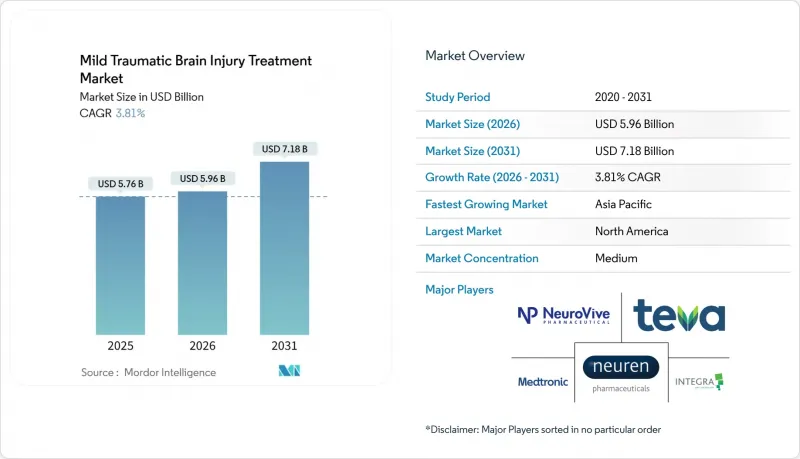
This report is Segmented by Treatment Type (Pharmacological Therapy, Surgical Intervention, Rehabilitation & Assistive Technologies), Cause of Injury (Falls, Motor-Vehicle Traffic, and More), End User (Hospitals & Trauma Centers, and More), and Geography (North America, Europe, Asia-Pacific, Middle East & Africa, South America). The Market Forecasts are Provided in Terms of Value (USD).
Global Mild Traumatic Brain Injury Treatment Market Trends and Insights
Rising Incidence of mTBI From Falls & Road Traffic Accidents
Falls and vehicle crashes generate more than 70% of mild TBI globally, but the epidemiology diverges by income level. Geriatric falls dominate hospital admissions in North America, Europe, and Japan, whereas road-traffic collisions afflict working-age populations in India, China, and sub-Saharan Africa. The World Health Organization recorded 1.19 million road-traffic deaths in 2023 and estimated that up to half of the 20-50 million survivors sustain head trauma. Japan reported a 31% increase in fall-related TBI hospitalizations among citizens aged 75+ between 2020 and 2024. These patterns fuel demand for rapid triage tools that direct patients to observation, imaging, or neurosurgical care within the first hour.
Rapid Adoption of Advanced Imaging & Blood-Based Diagnostics
Point-of-care biomarker panels are rewriting the economics of emergency departments. Abbott's i-STAT TBI test, cleared by FDA and reimbursed by Medicare at USD 135 per assay, cut CT use by 38% and reduced median stay from 4.2 hours to 2.8 hours across 11 U.S. hospitals studied in 2024. Military prototypes proved rugged and fast, demonstrating 92% sensitivity and 87% specificity in forward surgical teams in 2025. Reimbursement certainty is now the critical catalyst for adoption as European regulators move to harmonize companion diagnostic pathways by 2027.
Absence of FDA-Approved Disease-Modifying Therapies
The FDA has yet to authorize a disease-modifying drug for TBI, confining U.S. prescribing to symptomatic agents and capping growth potential. Only 14 mTBI compounds were in Phase II/III globally in 2025 versus 87 for Alzheimer's, underscoring investor caution. CMS denies coverage for investigational agents, deterring early adopter hospitals.
Other drivers and restraints analyzed in the detailed report include:
- Expanding Clinical Pipeline of Neuro-Protective & Regenerative Drugs
- Post-COVID Surge in Remote Neuro-Rehabilitation & Tele-Health Demand
- High Cost of Advanced Treatment & Rehabilitation Technologies
For complete list of drivers and restraints, kindly check the Table Of Contents.
Segment Analysis
Pharmacological therapy accounted for 63.02% of the Mild Traumatic Brain Injury Treatment market share in 2025, driven by large patient volumes and reimbursed symptom control. Growth, however, is muted without disease-modifying agents, and payers are testing bundled payments that reward functional recovery rather than prescription counts. Rehabilitation & Assistive Technologies have a smaller base but will compound at a 5.85% CAGR to 2031, supported by persistent telehealth infrastructure and robotic platforms that shorten time to independent ambulation by 18 days on average. Surgical Intervention remains niche for hematoma evacuation or refractory intracranial pressure, and its share is stable as improved triage curtails unnecessary procedures.
EksoNR deployments rose from 54 centers in 2024 to 89 in mid-2025, aided by Japan's 2025 insurance coverage of JPY 12,000 (USD 80) per robotic session. Payer alignment with outcome-based models is expected to tilt capital budgets toward digital and wearable solutions more than pharmacological line extensions.
Geography Analysis
North America generated 46.18% of 2025 revenue, led by the United States, where 127 hospital systems adopted Abbott's i-STAT and reduced CT exposure by 38%, saving USD 420 per patient. Canada followed in March 2025, reimbursing CAD 180 (USD 133) per assay in provincial trauma centers. Mexico is expanding neuro-rehab under IMSS, but still relies on out-of-pocket diagnostics.
Asia-Pacific will post a 9.34% CAGR, the fastest worldwide. China's 2025 screening mandate covers 1,400 tertiary hospitals and 2.1 million annual TBI cases. Japan's trofinetide approval and robotic rehab reimbursement spur local adoption, while Australia and South Korea align conditional drug pathways. India remains two-tiered, with private metros installing biomarker labs and rural districts lacking CT access.
Europe presents moderate growth amid payer scrutiny. Germany reimburses EUR 120 (USD 130) per biomarker test as of June 2025, launching adoption in 89 hospitals. The NHS Virtual Wards program served 8,900 TBI patients remotely in 2025, cutting readmissions by 19%. Southern and Eastern Europe lag in high-cost robotic setups, though EU structural funds may narrow gaps post-2027.
Middle East & Africa and South America are underpenetrated. Brazil restricts biomarker and robotic coverage to private hospitals in Sao Paulo and Rio, while Saudi Arabia earmarked USD 320 million in 2024 to upgrade 18 trauma centers with advanced monitors. Affordability and supply-chain tariffs limit broader uptake until local assembly and donor funding expand.
- Abbott Laboratories
- Bioness (Bioventus)
- BrainScope Company
- Ekso Bionics
- GE Healthcare
- Hope Biosciences
- InfraScan
- Integra LifeSciences
- Johnson & Johnson
- Medtronic
- Natus Medical
- Neuren Pharmaceuticals
- NeuroVive Pharmaceutical
- Novartis
- Oragenics
- Oxeia Biopharmaceuticals
- Pfizer
- Koninklijke Philips
- Raumedic
- Teva Pharmaceutical Industries
Additional Benefits:
- The market estimate (ME) sheet in Excel format
- 3 months of analyst support
TABLE OF CONTENTS
1 Introduction
- 1.1 Study Assumptions & Market Definition
- 1.2 Scope of the Study
2 Research Methodology
3 Executive Summary
4 Market Landscape
- 4.1 Market Overview
- 4.2 Market Drivers
- 4.2.1 Rising Incidence of mTBI From Falls & Road Traffic Accidents
- 4.2.2 Rapid Adoption of Advanced Imaging & Blood-Based Diagnostics
- 4.2.3 Expanding Clinical Pipeline of Neuro-Protective & Regenerative Drugs
- 4.2.4 Post-COVID Surge in Remote Neuro-Rehabilitation & Tele-Health Demand
- 4.2.5 Japan's AKUUGO Conditional Approval Spurring Global Regulatory Momentum
- 4.2.6 Military-Funded AI Point-of-Care Biomarker Programs Accelerating Translation
- 4.3 Market Restraints
- 4.3.1 Absence of FDA-Approved Disease-Modifying Therapies
- 4.3.2 High Cost of Advanced Treatment & Rehabilitation Technologies
- 4.3.3 Low Clinician Adoption of CT-Substituting Biomarker Tests
- 4.3.4 US Tariffs Inflating Neuro-Monitor Device Supply-Chain Costs
- 4.4 Regulatory Landscape
- 4.5 Technological Outlook
- 4.6 Porter's Five Forces Analysis
- 4.6.1 Threat of New Entrants
- 4.6.2 Bargaining Power of Buyers
- 4.6.3 Bargaining Power of Suppliers
- 4.6.4 Threat of Substitute Products
- 4.6.5 Intensity of Competitive Rivalry
5 Market Size & Growth Forecasts
- 5.1 By Treatment Type
- 5.1.1 Pharmacological Therapy
- 5.1.2 Surgical Intervention
- 5.1.3 Rehabilitation & Assistive Technologies
- 5.2 By Cause of Injury
- 5.2.1 Falls
- 5.2.2 Motor-Vehicle Traffic
- 5.2.3 Sports & Recreation
- 5.2.4 Violence & Others
- 5.3 By End User
- 5.3.1 Hospitals & Trauma Centers
- 5.3.2 Specialty / Neurology Clinics
- 5.3.3 Rehabilitation Centers & Home-care Settings
- 5.4 By Geography
- 5.4.1 North America
- 5.4.1.1 United States
- 5.4.1.2 Canada
- 5.4.1.3 Mexico
- 5.4.2 Europe
- 5.4.2.1 Germany
- 5.4.2.2 United Kingdom
- 5.4.2.3 France
- 5.4.2.4 Italy
- 5.4.2.5 Spain
- 5.4.2.6 Rest of Europe
- 5.4.3 Asia-Pacific
- 5.4.3.1 China
- 5.4.3.2 Japan
- 5.4.3.3 India
- 5.4.3.4 Australia
- 5.4.3.5 South Korea
- 5.4.3.6 Rest of Asia-Pacific
- 5.4.4 Middle East & Africa
- 5.4.4.1 GCC
- 5.4.4.2 South Africa
- 5.4.4.3 Rest of Middle East & Africa
- 5.4.5 South America
- 5.4.5.1 Brazil
- 5.4.5.2 Argentina
- 5.4.5.3 Rest of South America
- 5.4.1 North America
6 Competitive Landscape
- 6.1 Market Concentration
- 6.2 Market Share Analysis
- 6.3 Company Profiles (includes Global Level Overview, Market Level Overview, Core Segments, Financials as Available, Strategic Information, Market Rank/Share for Key Companies, Products & Services, and Recent Developments)
- 6.3.1 Abbott
- 6.3.2 Bioness (Bioventus)
- 6.3.3 BrainScope Company
- 6.3.4 Ekso Bionics
- 6.3.5 GE Healthcare
- 6.3.6 Hope Biosciences
- 6.3.7 InfraScan
- 6.3.8 Integra LifeSciences Corporation
- 6.3.9 Johnson & Johnson
- 6.3.10 Medtronic
- 6.3.11 Natus Medical
- 6.3.12 Neuren Pharmaceuticals Ltd.
- 6.3.13 NeuroVive Pharmaceutical AB
- 6.3.14 Novartis
- 6.3.15 Oragenics
- 6.3.16 Oxeia Biopharmaceuticals
- 6.3.17 Pfizer
- 6.3.18 Philips Healthcare
- 6.3.19 Raumedic AG
- 6.3.20 TEVA Pharmaceutical Industries Ltd.
7 Market Opportunities & Future Outlook
- 7.1 White-space & Unmet-Need Assessment

