PUBLISHER: Mordor Intelligence | PRODUCT CODE: 2061641

PUBLISHER: Mordor Intelligence | PRODUCT CODE: 2061641
Dental Prosthetics - Market Share Analysis, Industry Trends & Statistics, Growth Forecasts (2026 - 2031)
According to Mordor Intelligence, the dental prosthetics market size is expected to grow from USD 9.59 billion in 2025 to USD 10.26 billion in 2026 and is forecast to reach USD 16.06 billion by 2031 at 6.99% CAGR over 2026-2031.
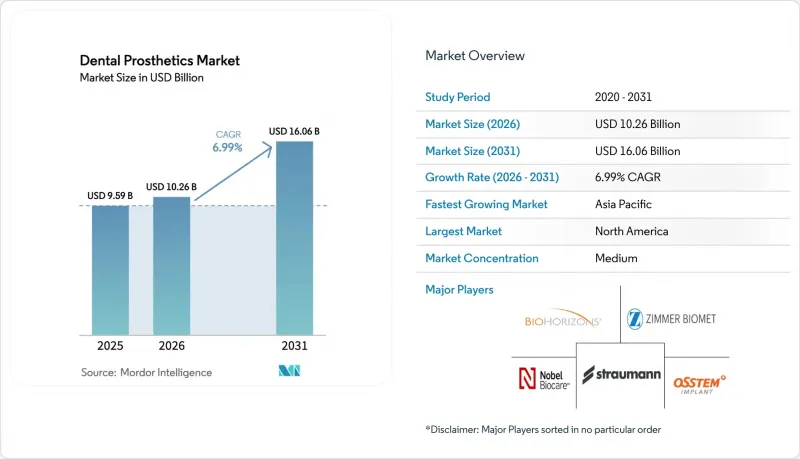
This report is Segmented by Product Type (Crowns, Bridges, Dentures, Abutments, Inlays/Onlays/Veneers, Other Prosthetics), Material (Ceramic/Zirconia, and More), Fixation Type (Fixed, Removable, Fixed-Removable Hybrid), End User (Dental Clinics, Dental Laboratories, and More), and Geography (North America, Europe, and More). The Market Forecasts are Provided in Terms of Value (USD) and Volume (Units).
Global Dental Prosthetics Market Trends and Insights
Aging Population & Edentulism Surge
Severe tooth loss affected 349 million people worldwide in 2021; prevalence already exceeds 30% among adults 65+ in Japan, Germany, and Italy. China's seniors will reach 400 million by 2030, yet only 12% use any prosthetics. Japan's insurer reimburses 70% of implant costs, raising implant-supported bridges to 41% of senior placements in 2025. National payers, rather than raw demographics, now dictate velocity as subsidies nudge patients toward crowns and implant bridges that preserve mastication and nutrition.
Rising Demand for Aesthetic Dentistry
Aesthetic-procedure revenue in the United States climbed 14 % in 2025, with veneers and all-ceramic crowns making up 68 % of electives. Video-conferencing culture increased scrutiny of tooth color, pushing professionals under 45 to treat restorations as career assets. The UAE and Saudi Arabia increased cosmetic spend by 22% in 2025 through bundled medical tourism packages. India's urban crowdlending placements rose 19% in 2024 as fintech-driven zero-interest plans spread. Peer-reviewed links between dental aesthetics and employability are reinforcing willingness to pay premiums.
High Procedure & Device Costs
The average U.S. implant-and-crown out-of-pocket cost reached USD 4,200 in 2025, up 7% year over year. Germany reimburses only 60% of metal-ceramic reference prices, leaving patients with USD 650-975 for an all-ceramic upgrade. In Brazil, a single zirconia crown costs BRL 2,800 (USD 560), 60 % of the monthly minimum wage. Capital spending on CAD/CAM forces labs to raise prices, further limiting access.
Other drivers and restraints analyzed in the detailed report include:
- Rapid Adoption of CAD/CAM & 3D Printing
- Expanding Dental Insurance Coverage
- Shortage of Digitally Skilled Technicians
For complete list of drivers and restraints, kindly check the Table Of Contents.
Segment Analysis
Crowns dominated 2025 with a 43.12% share of the dental prosthetics market, lifted by single-visit CAD/CAM, which eliminates the need for temporaries. Dentures, however, are forecast to grow at 6.85% through 2031, as aging populations in Japan, Germany, and Italy favor removable options that accommodate bone resorption. Bridges accounted for roughly 18% in 2025, stable among patients who forgo implant surgery. Abutments rose in line with an 11% global increase in implant placement in 2025.
VITA introduced a lithium-disilicate veneer with a 0.3 mm thickness, preserving enamel while increasing fracture toughness by 30 %. The product landscape rewards versatility; labs fluent in both fixed and removable workflows capture a wider patient base, while single-line specialists face margin compression.
Ceramic and zirconia accounted for 48.05% of the dental prosthetics market share in 2025, propelled by ultra-translucent grades that mimic enamel. Hybrid composites are poised to grow at 9.33% as glass-fiber polymers replicate dentin's elasticity, reducing stress at interfaces. Metal-ceramic still held 22 % for posterior durability, yet faces cosmetic headwinds. Pure metals accounted for 12%, mainly in removable frameworks and abutments.
Polymers and acrylics accounted for 10% but are being disrupted by printed resins. University of Tokyo researchers blended graded-strength zirconia into single crowns, reducing chipping risk by 40%. Ivoclar's IPS e.max ZirCAD Prime delivers 850 MPa flexural strength at 49% translucency, covering full-arch cases with a single material.
Geography Analysis
North America accounted for 35.08% of 2025 revenue, buoyed by Medicare Advantage reimbursement and USMCA-driven near-shoring. Yet 68% of labs struggle to fill CAD vacancies, and FDA 510(k) and ISO 13485 compliance add USD 200,000-500,000 in overhead, reinforcing consolidation. Mexico attracted USD 180 million in lab investment, while Canada added 1,200 jobs.
Asia-Pacific is set to grow at an 8.93% CAGR as China's copay cap sparked a 31% surge in crowdfunded placements in pilot cities. Japan reimburses 70% of senior implant costs, pushing fixed bridges to 41% of placements. India's fintech-enabled installment plans raise elective demand, while Seoul and Sydney universities pioneer AI crown design. Infrastructure gaps persist: fewer than 30 % of rural Southeast Asian clinics own intraoral scanners.
German patients pay an extra USD 650-975 for all-ceramic upgrades. NHS England's 2.1 million-appointment backlog funnels U.K. patients to private implants at USD 1,000-1,500. Southern European dental tourism undercuts northern prices by 40 %, drawing 340,000 inbound patients to Spain. The GCC posted 22% cosmetic dentistry growth, and Brazil's mandatory denture coverage lifts South American momentum.
- 3M
- Align Technology
- BioHorizons
- Coltene Holding
- Dentium Co. Ltd.
- Dentsply Sirona
- Envista Holdings (Nobel Biocare)
- GC Corporation
- Glidewell Dental
- Henry Schein
- Straumann Group
- Ivoclar Vivadent
- Kuraray Noritake Dental
- Nobel Biocare Services
- Osstem Implant Co. Ltd.
- Planmeca
- Straumann Group
- VITA Zahnfabrik
- Zimmer Biomet
- ZimVie
Additional Benefits:
- The market estimate (ME) sheet in Excel format
- 3 months of analyst support
TABLE OF CONTENTS
1 Introduction
- 1.1 Study Assumptions & Market Definition
- 1.2 Scope of the Study
2 Research Methodology
3 Executive Summary
4 Market Landscape
- 4.1 Market Overview
- 4.2 Market Drivers
- 4.2.1 Aging Population & Edentulism Surge
- 4.2.2 Rising Demand for Aesthetic Dentistry
- 4.2.3 Rapid Adoption of CAD/CAM & 3-D Printing
- 4.2.4 Expanding Dental Insurance Coverage
- 4.2.5 AI-Driven Automated Design Workflows
- 4.2.6 Near-Shoring Spurred by Tariff Barriers
- 4.3 Market Restraints
- 4.3.1 High Procedure & Device Costs
- 4.3.2 Shortage of Digitally Skilled Technicians
- 4.3.3 Volatile Zirconia & Noble-Metal Prices
- 4.3.4 Fragmented Global Data-Protection Rules
- 4.4 Regulatory Landscape
- 4.5 Technological Outlook
- 4.6 Porter's Five Forces Analysis
- 4.6.1 Threat of New Entrants
- 4.6.2 Bargaining Power of Buyers
- 4.6.3 Bargaining Power of Suppliers
- 4.6.4 Threat of Substitute Products
- 4.6.5 Intensity of Competitive Rivalry
5 Market Size & Growth Forecasts (Value & Volume)
- 5.1 By Product Type
- 5.1.1 Crowns
- 5.1.2 Bridges
- 5.1.3 Dentures
- 5.1.4 Abutments
- 5.1.5 Inlays / Onlays / Veneers
- 5.1.6 Other Prosthetics
- 5.2 By Material
- 5.2.1 Ceramic / Zirconia
- 5.2.2 Metal-Ceramic (PFM)
- 5.2.3 Metals
- 5.2.4 Polymers & Acrylics
- 5.2.5 Hybrid / Composite Materials
- 5.3 By Fixation Type
- 5.3.1 Fixed
- 5.3.2 Removable
- 5.3.3 Fixed-Removable Hybrid
- 5.4 By End User
- 5.4.1 Dental Clinics
- 5.4.2 Dental Laboratories
- 5.4.3 Hospitals & Surgical Centers
- 5.4.4 Academic & Research Institutes
- 5.5 By Geography
- 5.5.1 North America
- 5.5.1.1 United States
- 5.5.1.2 Canada
- 5.5.1.3 Mexico
- 5.5.2 Europe
- 5.5.2.1 Germany
- 5.5.2.2 United Kingdom
- 5.5.2.3 France
- 5.5.2.4 Italy
- 5.5.2.5 Spain
- 5.5.2.6 Rest of Europe
- 5.5.3 Asia-Pacific
- 5.5.3.1 China
- 5.5.3.2 Japan
- 5.5.3.3 India
- 5.5.3.4 Australia
- 5.5.3.5 South Korea
- 5.5.3.6 Rest of Asia-Pacific
- 5.5.4 Middle East & Africa
- 5.5.4.1 GCC
- 5.5.4.2 South Africa
- 5.5.4.3 Rest of Middle East & Africa
- 5.5.5 South America
- 5.5.5.1 Brazil
- 5.5.5.2 Argentina
- 5.5.5.3 Rest of South America
- 5.5.1 North America
6 Competitive Landscape
- 6.1 Market Concentration
- 6.2 Market Share Analysis
- 6.3 Company Profiles (includes Global Level Overview, Market Level Overview, Core Segments, Financials as Available, Strategic Information, Market Rank/Share for Key Companies, Products & Services, and Recent Developments)
- 6.3.1 3M
- 6.3.2 Align Technology Inc.
- 6.3.3 BioHorizons Inc
- 6.3.4 COLTENE Holding AG
- 6.3.5 Dentium Co. Ltd.
- 6.3.6 Dentsply Sirona Inc.
- 6.3.7 Envista Holdings (Nobel Biocare)
- 6.3.8 GC Corporation
- 6.3.9 Glidewell Dental
- 6.3.10 Henry Schein Inc.
- 6.3.11 Institut Straumann AG
- 6.3.12 Ivoclar Vivadent AG
- 6.3.13 Kuraray Noritake Dental
- 6.3.14 Nobel Biocare Services
- 6.3.15 Osstem Implant Co. Ltd.
- 6.3.16 Planmeca Oy
- 6.3.17 Straumann AG
- 6.3.18 VITA Zahnfabrik
- 6.3.19 Zimmer Biomet Holdings
- 6.3.20 ZimVie Inc.
7 Market Opportunities & Future Outlook
- 7.1 White-space & Unmet-Need Assessment

