PUBLISHER: Mordor Intelligence | PRODUCT CODE: 2061661

PUBLISHER: Mordor Intelligence | PRODUCT CODE: 2061661
Audio Amplifier - Market Share Analysis, Industry Trends & Statistics, Growth Forecasts (2026 - 2031)
According to Mordor Intelligence, the audio amplifier market size was valued at USD 4.07 billion in 2025 and estimated to grow from USD 4.26 billion in 2026 to reach USD 5.32 billion by 2031, at a CAGR of 4.58% during the forecast period (2026-2031).
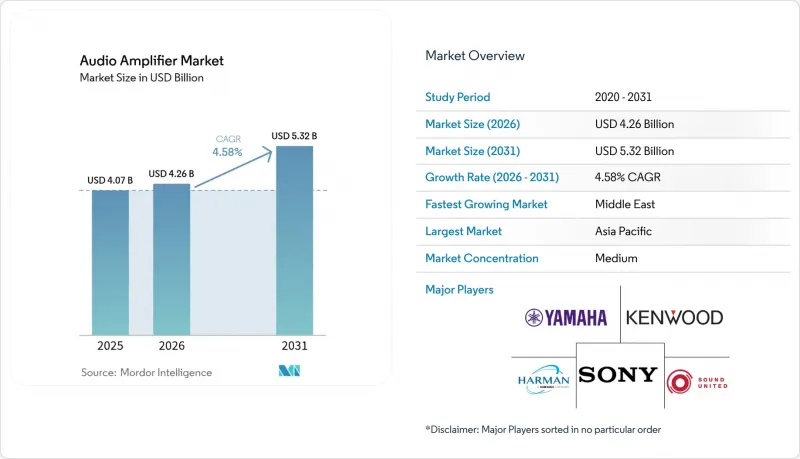
This report is Segmented by Channel Configuration (2-Channel, 4-Channel, 6-Channel, and More), Device Integration/Form Factor (Stand-Alone Audio-Amplifier IC, and More), Semiconductor Material (Silicon, Gallium Nitride (GaN), Silicon Carbide (SiC), and More), End-User Application (Consumer Electronics, Automotive, and More), and Geography. The Market Forecasts are Provided in Terms of Value (USD).
Global Audio Amplifier Market Trends and Insights
Transition to Electric and Connected Vehicles Boosting In-Vehicle Infotainment Audio Amplifiers
Electric drivetrains eliminate engine noise, prompting automakers to enhance cabin audio experiences through multi-channel Class-D amplifiers and zone-specific sound management. BMW's HypersonX soundscape uses 43 distinct signals to craft a branded acoustic signature for its Neue Klasse EV line. HARMAN's SeatSonic solution further personalizes audio per passenger, harnessing dedicated amplifiers for each seating zone. As software-defined vehicles proliferate, amplifier firmware upgrades extend product lifecycles, and Texas Instruments' one-inductor modulation cuts component count to meet automakers' cost targets
Miniaturization Needs in TWS and Wearables Driving High-Efficiency Integrated Amplifiers
True wireless stereo earbuds and smartwatches impose severe board-space and battery-life constraints, steering vendors toward SoCs that merge DSP, connectivity, and amplification. Analog Devices' ADAU1797 doubled DSP horsepower while integrating a class-D stage to extend battery runtime. Nordic Semiconductor's nRF54L15 similarly packages 1.5 MB NVM, 256 KB RAM, and LE Audio support on a 22 nm node, easing system-integration overhead. Silicon Intervention's fractal class-D topology couples buck regulation with the output stage to trim idle losses, a critical metric for all-day wearable usage.
Smartphone SoC Integration Shrinking Discrete Amplifier Addressable Market
Application processors now embed class-D outputs, eroding unit demand for standalone ICs in mid-tier phones. Qorvo's Q3 2025 revenue slid 12.4% as Android OEMs consolidated RF and audio front-ends into single die offerings. Similar design choices in tablets and thin-and-light PCs squeeze discrete suppliers, compelling them to pivot toward automotive, smart-home hubs, and pro-audio racks where thermal and output-power constraints inhibit SoC replacement.
Other drivers and restraints analyzed in the detailed report include:
- Smart-Home Audio Ecosystem Adoption Fueling Multi-Channel Amplifier Demand
- GaN-Based Switching Devices Enabling High-Power Professional-Audio Efficiency Gains
- GaN Substrate Supply Constraints Elevating BOM Costs
For complete list of drivers and restraints, kindly check the Table Of Contents.
Segment Analysis
The 8-channel-and-above segment is forecast to grow at 5.71% through 2031, driven by the rollout of Dolby Atmos in both home cinema and automotive cabins. Dedicated height and surround pathways raise amplifier counts per chassis, while dynamic channel mapping inside DSP firmware supports backward compatibility with stereo content. In contrast, cost-sensitive soundbars and desktop speakers sustain the 2-channel foothold that captured 41.65% audio amplifier market share in 2025.
The audio amplifier market size for multi-channel models is expected to expand as smart-home hubs integrate AV, lighting, and security control, favoring centralized amplifier nodes. Professional touring vendors deploy modular rack amps that are configurable from monaural subwoofer duty to immersive festival rigs, optimizing asset utilization across various event scales. These architectural flexibilities favor class-D topologies, whose efficiency advantages grow with channel density.
Stand-alone ICs still account for 54.75% of 2025 revenue, as automotive and pro-audio installations require higher voltage rails and greater thermal headroom. Yet SoCs are advancing at 5.99% CAGR as wearables and ultra-slim laptops prize PCB real estate and single-package bill of materials. Vendors utilize advanced process nodes to co-locate DSP cores, Bluetooth LE radios, and Class-D outputs, thereby minimizing I/O routing losses.
Audio amplifier market size gains from SoCs are evident in TWS earbuds, where envelope tracking and hybrid ANC algorithms benefit from on-die memory bandwidth. Conversely, discrete multichip modules remain viable where board-level heat spreading and replaceable stages are service requirements, notably in concert rental gear. Suppliers balance dual portfolios, leveraging shared silicon IP while offering pin-compatible discrete upgrades for legacy clients.
Geography Analysis
Asia Pacific commanded 47.85% of 2025 revenue on the strength of vertically integrated consumer-electronics supply chains and surging domestic EV deliveries. Mainland China anchors volume, while Japan and South Korea push premium innovation in class-D silicon and GaN wafer processing. Local smartphone champions' in-house SoC roadmaps heavily influence discrete-component demand swings throughout the region.
North America accounts for sizable professional-audio and home-theater consumption, with live-event touring recovering post-pandemic and driving rack-amplifier upgrades. Regulatory certainty and robust patent enforcement foster GaN start-ups that license dies to global OEMs. Europe displays similar maturity but imposes stringent Ecodesign power-budget ceilings; compliance efforts often pilot energy-saving firmware, which is later rolled out worldwide.
The Middle East, although smaller in absolute terms, is projected to post a 5.03% CAGR through 2031, underpinned by hospitality megaprojects that outfit stadiums, hotels, and entertainment districts with immersive sound systems. Government diversification agendas fund smart-city builds that integrate distributed audio for public information services, accelerating amplifier shipments in commercial AV channels. Africa and Latin America record steady single-digit growth, mostly driven by price-sensitive consumer electronics imports, supplemented by regional live-music cultures that sustain demand for portable PA systems.
- Yamaha Corporation
- Harman International (Crown, JBL, Mark Levinson)
- Sound United LLC (Marantz, Denon, Polk)
- Kenwood Corporation
- Sony Corporation
- Cambridge Audio (Audio Partnership PLC)
- Vervent Audio Group (Naim Audio, Focal)
- Bryston Ltd
- Allen and Heath Limited
- QSC LLC
- Bose Corporation
- DD Audio (Resonance Inc.)
- JL Audio
- Dynacord (Bosch Sicherheitssysteme GmbH)
- Luxman Corporation
- NAD Electronics International
- Peachtree Audio
- Pioneer Corporation (Onkyo)
- Rotel
- Mark Levinson Laboratories
Additional Benefits:
- The market estimate (ME) sheet in Excel format
- 3 months of analyst support
TABLE OF CONTENTS
1 INTRODUCTION
- 1.1 Study Assumptions and Market Definition
- 1.2 Scope of the Study
2 RESEARCH METHODOLOGY
3 EXECUTIVE SUMMARY
4 MARKET LANDSCAPE
- 4.1 Market Overview
- 4.2 Market Drivers
- 4.2.1 Transition to Electric and Connected Vehicles Boosting In-Vehicle Infotainment Audio Amplifiers
- 4.2.2 Miniaturization Needs in TWS and Wearables Driving High-Efficiency Integrated Amplifiers
- 4.2.3 Smart-Home Audio Ecosystem Adoption Fueling Multi-Channel Amplifier Demand
- 4.2.4 GaN-Based Switching Devices Enabling High-Power Professional-Audio Efficiency Gains
- 4.2.5 Immersive Audio (Dolby Atmos) Uptake Pushing Above 8-Channel Amplifier Sales
- 4.2.6 Live-Events Infrastructure Incentives Accelerating Professional-Amplifier Purchases
- 4.3 Market Restraints
- 4.3.1 Smartphone SoC Integration Shrinking Discrete Amplifier Addressable Market
- 4.3.2 GaN Substrate Supply Constraints Elevating BOM Costs
- 4.3.3 Bluetooth Headphones Cannibalizing Traditional Hi-Fi Amplifier Demand
- 4.3.4 EU Ecodesign Stand-by-Power Limits Raising Legacy Redesign Costs
- 4.4 industry Ecosystem Analysis
- 4.5 Technological Outlook
- 4.6 Porter's Five Forces Analysis
- 4.6.1 Threat of New Entrants
- 4.6.2 Bargaining Power of Buyers
- 4.6.3 Bargaining Power of Suppliers
- 4.6.4 Threat of Substitutes
- 4.6.5 Intensity of Competitive Rivalry
5 MARKET SIZE AND GROWTH FORECASTS (VALUES)
- 5.1 By Channel Configuration
- 5.1.1 Mono
- 5.1.2 2-Channel
- 5.1.3 4-Channel
- 5.1.4 6-Channel
- 5.1.5 8-Channel and Above
- 5.2 By Device Integration/Form Factor
- 5.2.1 Stand-Alone Audio-Amplifier IC
- 5.2.2 Integrated Audio SoC/Codec
- 5.2.3 Amplifier Modules and Boards
- 5.3 By Semiconductor Material
- 5.3.1 Silicon
- 5.3.2 Gallium Nitride (GaN)
- 5.3.3 Silicon Carbide (SiC)
- 5.3.4 Others (GaAs, etc.)
- 5.4 By End-User Application
- 5.4.1 Consumer Electronics
- 5.4.1.1 Smartphones and Tablets
- 5.4.1.2 Laptops and PCs
- 5.4.1.3 Smart TVs and Set-Top Boxes
- 5.4.1.4 Wearables and Hearables
- 5.4.1.5 Portable Speakers and Home Audio
- 5.4.2 Automotive
- 5.4.2.1 Passenger Vehicles
- 5.4.2.2 Commercial Vehicles
- 5.4.2.3 Electric Vehicles
- 5.4.3 Professional Audio and Broadcasting
- 5.4.3.1 PA Systems and Touring Sound
- 5.4.3.2 Studio and Recording Equipment
- 5.4.3.3 Broadcasting Equipment
- 5.4.4 Telecommunications Infrastructure
- 5.4.5 Industrial and IoT Devices
- 5.4.6 Others
- 5.4.1 Consumer Electronics
- 5.5 By Geography
- 5.5.1 North America
- 5.5.1.1 United States
- 5.5.1.2 Canada
- 5.5.1.3 Mexico
- 5.5.2 Europe
- 5.5.2.1 Germany
- 5.5.2.2 United Kingdom
- 5.5.2.3 France
- 5.5.2.4 Nordics
- 5.5.2.5 Rest of Europe
- 5.5.3 South America
- 5.5.3.1 Brazil
- 5.5.3.2 Rest of South America
- 5.5.4 Asia-Pacific
- 5.5.4.1 China
- 5.5.4.2 Japan
- 5.5.4.3 India
- 5.5.4.4 South-East Asia
- 5.5.4.5 Rest of Asia-Pacific
- 5.5.5 Middle East and Africa
- 5.5.5.1 Middle East
- 5.5.5.1.1 Gulf Cooperation Council Countries
- 5.5.5.1.2 Turkey
- 5.5.5.1.3 Rest of Middle East
- 5.5.5.2 Africa
- 5.5.5.2.1 South Africa
- 5.5.5.2.2 Rest of Africa
- 5.5.5.1 Middle East
- 5.5.1 North America
6 COMPETITIVE LANDSCAPE
- 6.1 Market Concentration
- 6.2 Strategic Moves
- 6.3 Market Share Analysis
- 6.4 Company Profiles {(includes Global level Overview, Market level overview, Core Segments, Financials as available, Strategic Information, Market Rank/Share for key companies, Products and Services, and Recent Developments)}
- 6.4.1 Yamaha Corporation
- 6.4.2 Harman International (Crown, JBL, Mark Levinson)
- 6.4.3 Sound United LLC (Marantz, Denon, Polk)
- 6.4.4 Kenwood Corporation
- 6.4.5 Sony Corporation
- 6.4.6 Cambridge Audio (Audio Partnership PLC)
- 6.4.7 Vervent Audio Group (Naim Audio, Focal)
- 6.4.8 Bryston Ltd
- 6.4.9 Allen and Heath Limited
- 6.4.10 QSC LLC
- 6.4.11 Bose Corporation
- 6.4.12 DD Audio (Resonance Inc.)
- 6.4.13 JL Audio
- 6.4.14 Dynacord (Bosch Sicherheitssysteme GmbH)
- 6.4.15 Luxman Corporation
- 6.4.16 NAD Electronics International
- 6.4.17 Peachtree Audio
- 6.4.18 Pioneer Corporation (Onkyo)
- 6.4.19 Rotel
- 6.4.20 Mark Levinson Laboratories
7 MARKET OPPORTUNITIES AND FUTURE OUTLOOK
- 7.1 White-Space and Unmet-Need Assessment

