PUBLISHER: Mordor Intelligence | PRODUCT CODE: 2061666

PUBLISHER: Mordor Intelligence | PRODUCT CODE: 2061666
Lanolin - Market Share Analysis, Industry Trends & Statistics, Growth Forecasts (2026 - 2031)
According to Mordor Intelligence, the lanolin market size is expected to grow from USD 383.33 million in 2025 to USD 416.84 million in 2026 and is forecast to reach USD 633.74 million by 2031 at 8.74% CAGR over 2026-2031.
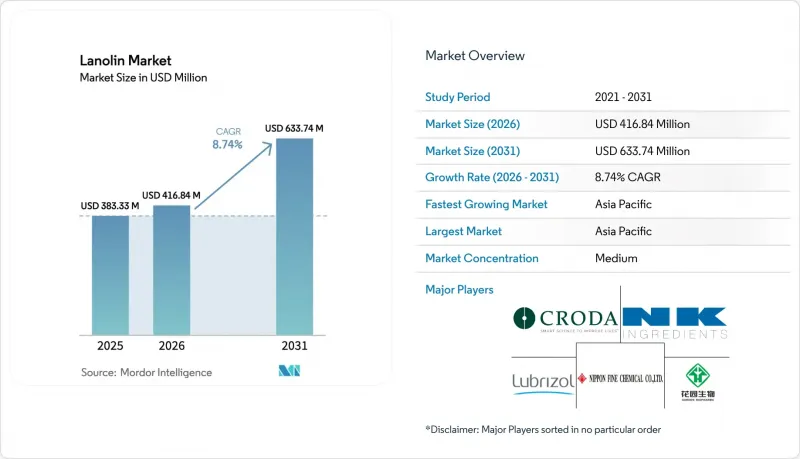
This report is Segmented by Grade (Cosmetic Grade, Pharmaceutical Grade, and Industrial Grade), Application (Cosmetics and Personal Care, Pharmaceuticals, Lubricant and Corrosion Inhibitor, Leather and Textiles, and Other Applications), and Geography (Asia-Pacific, North America, Europe, South America, and the Middle East and Africa). The Market Size and Forecasts are Provided in Terms of Value (USD).
Global Lanolin Market Trends and Insights
Rising Demand for Natural Ingredients in Cosmetics and Personal Care
Consumers now scrutinize INCI decks and reward brands that showcase recognizable, animal-welfare-vetted inputs. Lanolin retains favor in premium lipsticks and balms because its sterol-rich matrix forms stable water-in-oil films that plant alternatives cannot fully match. Formulators therefore split portfolios: mass-market SKUs adopt bis-diglyceryl polyacyladipate-2 or glyceryl rosinate blends, while luxury lines double down on HPA lanolin that contains less than or equal to 1.5% free lanolin alcohol, cutting hypersensitivity risk by about 96%. Concentration-of-use data confirm persistence at the high end; maximum lanolin levels in lipsticks remain 47%, unchanged since the prior Cosmetic Ingredient Review survey.
Growing Use in Topical Pharmaceuticals and Medicated Baby-Care
Lanolin's inclusion in hospital formularies owes to a 2024 meta-analysis showing superior efficacy against nipple trauma versus routine care. Active-ingredient status within the FDA (Food and Drug Administration) monograph M016 permits barrier-repair claims without a full New Drug Application, lowering regulatory hurdles for OTC (Over-the-Counter) ointments. Suppliers meet stringent specs, pesticides below detection, and alcohols less than or equal to 1.5%, via multi-residue HPLC-CAD protocols validated in 2025.
Availability of Plant-Based and Synthetic Emollient Substitutes
Shea unsaponifiables, glyceryl rosinate, and BDPA (1,3-bis(diphenylene)-2-phenylallyl) esters mimic lanolin's gloss and adhesion at a lower cost while satisfying vegan claims. Comparative tests show parity on immediate feel but shorter moisturization longevity, leading premium brands to retain lanolin for performance-critical formats.
Other drivers and restraints analyzed in the detailed report include:
- Expansion of Clean-Label Baby-Care Products
- Advances in Ultra-Pure/Low-Allergen Lanolin Refining Technologies
- Contact-Allergy Concerns and Tightening Safety Regulations
For complete list of drivers and restraints, kindly check the Table Of Contents.
Segment Analysis
Cosmetic grade, held 50.12% of the Lanolin market share in 2025, sees a gradual volume loss to vegan substitutes in mass cosmetics, yet preserves relevance in lipsticks, where concentration peaks at 47%. Pharmaceutical-grade lanolin is projected to expand faster than the overall lanolin market, growing at 6.34% CAGR to 2031 on the back of OTC skin-protectant demand and nipple-care protocols that insist on less than or equal to 1.5% lanolin alcohol. Industrial grade remains niche, but biodegradable anti-corrosion coatings using lanolin esters and cerium(III) nitrate achieve 26-fold higher charge-transfer resistance than neat lanolin, opening opportunities in automotive pipelines.
Quality variability is stark; cholesterol ranged 3.67-24.8% across ten industrial batches analyzed by HPLC-QAMS in 2024, pushing buyers to favor vertically integrated suppliers offering tight sterol specs. As a result, the lanolin market size for high-purity lines rises even amid flat overall tonnage.
Geography Analysis
Asia-Pacific held 36.22% market share in 2025 and is forecast to expand at 6.87% CAGR through 2031, driven by China's dual role as a major wool-processing hub and a fast-growing consumer of natural cosmetic ingredients. China's retail cosmetics sales growth reflects urbanization, rising disposable incomes, and consumer preference for natural-origin ingredients in skincare and baby-care products. Japan and South Korea adopt EU-style impurity thresholds, supporting pharmaceutical-grade uptake. India grows from a low base but remains price-sensitive; substitution with plant esters is common in mid-tier creams.
North America blends mature pharma demand with polarized cosmetic attitudes. US premium skin-protection brands champion HPA lanolin, whereas mass retailers pivot toward BDPA and shea blends for vegan certification. Canada's regulatory regime echoes the EU, reinforcing ultra-pure adoption. Mexico offers volume upside but is still dominated by cosmetic-grade imports.
Europe enforces the strictest impurity caps under Regulation 2026/78, driving vertical integration among processors able to certify pesticide totals less than 40 ppm. Germany and France dominate therapeutic lanolin demand, while Nordic countries prize clean-label baby-care balms. The United Kingdom retains strong cosmetic-lab skin-barrier research, supporting continued use in premium color lines.
- Croda International PLC
- Deutsche Lanolin Gesellschaft GmbH & Co. KG
- Dishman Carbogen Amcis Ltd
- Elementis PLC
- Gustav Heess
- ImperialOel
- Lanotec
- Lansinoh Laboratories Inc.
- Merck KGaA
- Nanjing Duoyuan Biochemistry Co., Ltd
- Nippon Fine Chemical
- NK Chemicals
- NK Ingredients Pte Ltd
- Rolex Lanolin Products Limited
- Stella
- Suru Chemicals
- The Lubrizol Corporation
- Weleda
- Wellman Advanced Materials
- Yixin Chemical Co. Ltd
- Zhejiang Garden Biochemical High-Tech Co. Ltd
Additional Benefits:
- The market estimate (ME) sheet in Excel format
- 3 months of analyst support
TABLE OF CONTENTS
1 Introduction
- 1.1 Study Assumptions & Market Definition
- 1.2 Scope of the Study
2 Research Methodology
3 Executive Summary
4 Market Landscape
- 4.1 Market Overview
- 4.2 Market Drivers
- 4.2.1 Rising demand for natural ingredients in cosmetics and personal care
- 4.2.2 Growing use in topical pharmaceuticals and medicated baby-care
- 4.2.3 Expansion of clean-label baby-care products
- 4.2.4 Advances in ultra-pure/low-allergen lanolin refining technologies
- 4.2.5 Niche uptake of lanolin-based biodegradable anti-corrosion coatings
- 4.3 Market Restraints
- 4.3.1 Availability of plant-based and synthetic emollient substitutes
- 4.3.2 Contact-allergy concerns and tightening cosmetic-safety regulations
- 4.3.3 Raw-wool price volatility and supply-chain concentration
- 4.4 Value Chain Analysis
- 4.5 Porter's Five Forces
- 4.5.1 Bargaining Power of Suppliers
- 4.5.2 Bargaining Power of Buyers
- 4.5.3 Threat of New Entrants
- 4.5.4 Threat of Substitutes
- 4.5.5 Degree of Competition
5 Market Size & Growth Forecasts (Value)
- 5.1 By Grade
- 5.1.1 Cosmetic Grade
- 5.1.2 Pharmaceutical Grade
- 5.1.3 Industrial Grade
- 5.2 By Application
- 5.2.1 Cosmetics and Personal care
- 5.2.2 Pharmaceuticals
- 5.2.3 Lubricant and Corrosion Inhibitor
- 5.2.4 Leather and Textiles
- 5.2.5 Other Applications
- 5.3 By Geography
- 5.3.1 Asia-Pacific
- 5.3.1.1 China
- 5.3.1.2 India
- 5.3.1.3 Japan
- 5.3.1.4 South Korea
- 5.3.1.5 ASEAN Countries
- 5.3.1.6 Rest of Asia-Pacific
- 5.3.2 North America
- 5.3.2.1 United States
- 5.3.2.2 Canada
- 5.3.2.3 Mexico
- 5.3.3 Europe
- 5.3.3.1 Germany
- 5.3.3.2 United Kingdom
- 5.3.3.3 France
- 5.3.3.4 Italy
- 5.3.3.5 Spain
- 5.3.3.6 Rest of Europe
- 5.3.4 South America
- 5.3.4.1 Brazil
- 5.3.4.2 Argentina
- 5.3.4.3 Rest of South America
- 5.3.5 Middle-East and Africa
- 5.3.5.1 Saudi Arabia
- 5.3.5.2 South Africa
- 5.3.5.3 Rest of Middle-East and Africa
- 5.3.1 Asia-Pacific
6 Competitive Landscape
- 6.1 Market Concentration
- 6.2 Strategic Moves
- 6.3 Market Share(%)/Ranking Analysis
- 6.4 Company Profiles (includes Global level Overview, Market level overview, Core Segments, Financials as available, Strategic Information, Products & Services, Recent Developments)
- 6.4.1 Croda International PLC
- 6.4.2 Deutsche Lanolin Gesellschaft GmbH & Co. KG
- 6.4.3 Dishman Carbogen Amcis Ltd
- 6.4.4 Elementis PLC
- 6.4.5 Gustav Heess
- 6.4.6 ImperialOel
- 6.4.7 Lanotec
- 6.4.8 Lansinoh Laboratories Inc.
- 6.4.9 Merck KGaA
- 6.4.10 Nanjing Duoyuan Biochemistry Co., Ltd
- 6.4.11 Nippon Fine Chemical
- 6.4.12 NK Chemicals
- 6.4.13 NK Ingredients Pte Ltd
- 6.4.14 Rolex Lanolin Products Limited
- 6.4.15 Stella
- 6.4.16 Suru Chemicals
- 6.4.17 The Lubrizol Corporation
- 6.4.18 Weleda
- 6.4.19 Wellman Advanced Materials
- 6.4.20 Yixin Chemical Co. Ltd
- 6.4.21 Zhejiang Garden Biochemical High-Tech Co. Ltd
7 Market Opportunities and Future Outlook
- 7.1 White-space and Unmet-need Assessment

