
PUBLISHER: Mordor Intelligence | PRODUCT CODE: 2061677

PUBLISHER: Mordor Intelligence | PRODUCT CODE: 2061677
Vanilla Bean - Market Share Analysis, Industry Trends & Statistics, Growth Forecasts (2026 - 2031)
According to Mordor Intelligence, the vanilla bean market size is projected to expand from USD 1.6 billion in 2025 and USD 1.7 billion in 2026 to USD 2.3 billion by 2031, registering a CAGR of 6.23% between 2026 and 2031.
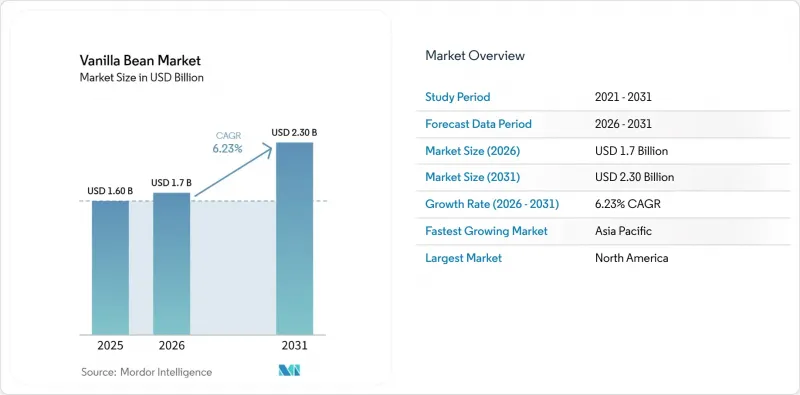
This report is Segmented by Geography (North America, Europe, and More). The Report Includes Production Analysis (Volume), Consumption Analysis (Value and Volume), Import Analysis (Value and Volume), Export Analysis (Value and Volume), Wholesale Price Trend Analysis, List of Key Players, and More. The Market Forecasts are Provided in Terms of Value (USD) and Volume (Metric Tons).
Global Vanilla Bean Market Trends and Insights
Premiumization of Natural Flavors in Packaged Foods
In the vanilla bean market, natural vanilla's "clean label" halo allows manufacturers to charge 15% to 25% more than private-label alternatives. Ice cream giants committed to 100% natural vanilla are reinforcing the value proposition that justifies these markups. Surveys show that two-thirds of North American shoppers perceive natural vanilla as healthier, despite its comparable sensory performance to synthetic vanillin. Within the vanilla bean market, flavor houses report an uptick in dessert and bakery product launches containing natural vanilla, confirming that reformulation momentum extends beyond frozen dairy. As retailers highlight origin stories on packaging, demand for traceable Madagascar vanilla grades is strengthening. The premiumization trend also supports investment in blockchain verification because consumers reward transparent sourcing with brand loyalty.
Growing Demand from Nutraceutical and Cosmeceutical Processors
Cosmetics and dietary supplement laboratories are treating vanilla as a functional active ingredient due to its polyphenol profile. A leading French dermocosmetic brand incorporated Vanilla tahitensis extract at 1% concentration in an anti-aging serum that retails at a premium price point. The Cosmetic Ingredient Review panel cataloged 370 formulations that contain vanilla compounds, confirming broader penetration into personal-care lines. In nutraceutical channels, vanilla oleoresin is positioned for relaxation and sleep health, even though clinical validation is still emerging.
Price Volatility Linked to Cyclone Risk in Madagascar
Madagascar produced 39.38% of the world's vanilla, which remains central to the vanilla bean market in 2022, leaving the global supply exposed to tropical storms that can wipe out up to 40% of annual output. Cyclone Garance damaged 123 hectares in February 2025, triggering French emergency aid of USD 1.37 million for 161 producers. Price spikes in the vanilla bean market follow weather shocks, and beans traded at USD 600 to USD 750 per kilogram after Cyclone Enawo. A government-imposed USD 250 per kilogram export floor in 2022 overshot market-clearing levels, leading to 4,500 metric tons of unsold inventory in 2023. Such volatility deters long-term contracts, prompting manufacturers to hedge with synthetic vanillin.
Other drivers and restraints analyzed in the detailed report include:
- Shift Toward Organic and Regenerative Vanilla Farming
- Rising Traceability Mandates by Confectionery Majors
- Surging Availability of Synthetic and Bio-Engineered Vanillin
For complete list of drivers and restraints, kindly check the Table Of Contents.
Geography Analysis
North America captured 37.8% in vanilla bean market share in 2025, driven by the United States' strong presence in ice cream and bakery applications, where vanilla remains the most popular flavor. The region's demand is influenced by premiumization trends, as demonstrated by Unilever's plan to remove synthetic vanillin from its ice cream portfolio by 2026, reflecting a shift toward natural ingredients with higher retail value. Canada and Mexico contribute smaller shares but exhibit stable growth, tied to the expansion of their food processing sectors. Traceability mandates are most advanced in North America, with Estee Lauder's blockchain pilot and the Sustainable Vanilla Initiative driving adoption of origin verification systems.
In the vanilla bean market, the Asia-Pacific region is projected to show the fastest CAGR of 7.2% from 2026 to 2031, driven by increasing disposable incomes and rapid urbanization. Dairy processors in China reformulate their premium ice cream lines with natural vanilla to enhance flavor perception, while India's organized bakery sector benefits from the expansion of quick-service restaurants, which increases the use of vanilla extracts in cakes and fillings. Indonesia, a top producer, also imports Madagascar vanilla for re-export after blending to meet high-spec orders, illustrating intra-regional trade dynamics. Japan's consumers value single-origin vanilla, especially Tahitian varieties, and are willing to pay higher retail prices. Australia's greenhouse pilots, if scaled commercially, would reduce regional import dependence.
Germany, France, and the United Kingdom remain major demand centers in the vanilla bean market, where confectionery and dairy manufacturers source Bourbon vanilla as a flavor benchmark. Traceability and deforestation rules compel European buyers to map supply chains at the farm level, incurring extra administrative costs that favor larger processors with digital infrastructure. South America, the Middle East, and Africa remain nascent consumer territories. Premium hospitality and specialty bakery shops in Brazil, Peru, Saudi Arabia, and the United Arab Emirates are beginning to specify single-origin vanilla.
Additional Benefits:
- The market estimate (ME) sheet in Excel format
- 3 months of analyst support
TABLE OF CONTENTS
1 Introduction
- 1.1 Study Assumptions and Market Definition
- 1.2 Scope of the Study
2 Research Methodology
3 Executive Summary
4 Market Landscape
- 4.1 Market Overview
- 4.2 Market Drivers
- 4.2.1 Premiumization of natural flavors in packaged foods
- 4.2.2 Growing demand from nutraceutical and cosmeceutical processors
- 4.2.3 Shift toward organic and regenerative vanilla farming
- 4.2.4 Rising traceability mandates by confectionery majors
- 4.2.5 Carbon-credit revenue streams for agro-forestry vanilla farms
- 4.2.6 Expansion of controlled-environment vanilla cultivation projects
- 4.3 Market Restraints
- 4.3.1 Price volatility linked to cyclone risk in Madagascar
- 4.3.2 Surging availability of synthetic and bio-engineered vanillin
- 4.3.3 Organized crime and bean theft undermining supply stability
- 4.3.4 Limited genetic diversity heightening disease susceptibility
- 4.4 Opportunities
- 4.5 Challenges
- 4.6 Value Chain Analysis
- 4.7 Technologies and usage of AI in the Industry
- 4.8 Input Market Analysis
- 4.8.1 Seeds
- 4.8.2 Fertilizers
- 4.8.3 Crop Protection Chemicals
- 4.9 Distribution Channel Analysis
- 4.10 Market Sentiment Analysis
- 4.11 PESTLE Analysis
5 Market Size and Growth Forecasts (Value and Volume)
- 5.1 By Geography
- 5.1.1 North America
- 5.1.1.1 United States
- 5.1.1.1.1 Production Analysis (Area Harvested, Yield, and Production Volume)
- 5.1.1.1.2 Consumption Analysis (Consumption Value and Volume)
- 5.1.1.1.3 Import Market Analysis (Import Value, Volume, and Key Supplying Markets)
- 5.1.1.1.4 Export Market Analysis (Export Value, Volume, and Key Destination Markets)
- 5.1.1.1.5 Wholesale Price Trend Analysis and Forecast
- 5.1.1.1.6 Regulatory Framework
- 5.1.1.1.7 List of Key Players
- 5.1.1.1.8 Logistics and Infrastructure
- 5.1.1.1.9 Seasonality Analysis
- 5.1.1.2 Canada
- 5.1.1.2.1 Production Analysis (Area Harvested, Yield, and Production Volume)
- 5.1.1.2.2 Consumption Analysis (Consumption Value and Volume)
- 5.1.1.2.3 Import Market Analysis (Import Value, Volume, and Key Supplying Markets)
- 5.1.1.2.4 Export Market Analysis (Export Value, Volume, and Key Destination Markets)
- 5.1.1.2.5 Wholesale Price Trend Analysis and Forecast
- 5.1.1.2.6 Regulatory Framework
- 5.1.1.2.7 List of Key Players
- 5.1.1.2.8 Logistics and Infrastructure
- 5.1.1.2.9 Seasonality Analysis
- 5.1.1.3 Mexico
- 5.1.1.3.1 Production Analysis (Area Harvested, Yield, and Production Volume)
- 5.1.1.3.2 Consumption Analysis (Consumption Value and Volume)
- 5.1.1.3.3 Import Market Analysis (Import Value, Volume, and Key Supplying Markets)
- 5.1.1.3.4 Export Market Analysis (Export Value, Volume, and Key Destination Markets)
- 5.1.1.3.5 Wholesale Price Trend Analysis and Forecast
- 5.1.1.3.6 Regulatory Framework
- 5.1.1.3.7 List of Key Players
- 5.1.1.3.8 Logistics and Infrastructure
- 5.1.1.3.9 Seasonality Analysis
- 5.1.1.1 United States
- 5.1.2 Europe
- 5.1.2.1 Germany
- 5.1.2.1.1 Production Analysis (Area Harvested, Yield, and Production Volume)
- 5.1.2.1.2 Consumption Analysis (Consumption Value and Volume)
- 5.1.2.1.3 Import Market Analysis (Import Value, Volume, and Key Supplying Markets)
- 5.1.2.1.4 Export Market Analysis (Export Value, Volume, and Key Destination Markets)
- 5.1.2.1.5 Wholesale Price Trend Analysis and Forecast
- 5.1.2.1.6 Regulatory Framework
- 5.1.2.1.7 List of Key Players
- 5.1.2.1.8 Logistics and Infrastructure
- 5.1.2.1.9 Seasonality Analysis
- 5.1.2.2 United Kingdom
- 5.1.2.2.1 Production Analysis (Area Harvested, Yield, and Production Volume)
- 5.1.2.2.2 Consumption Analysis (Consumption Value and Volume)
- 5.1.2.2.3 Import Market Analysis (Import Value, Volume, and Key Supplying Markets)
- 5.1.2.2.4 Export Market Analysis (Export Value, Volume, and Key Destination Markets)
- 5.1.2.2.5 Wholesale Price Trend Analysis and Forecast
- 5.1.2.2.6 Regulatory Framework
- 5.1.2.2.7 List of Key Players
- 5.1.2.2.8 Logistics and Infrastructure
- 5.1.2.2.9 Seasonality Analysis
- 5.1.2.3 France
- 5.1.2.3.1 Production Analysis (Area Harvested, Yield, and Production Volume)
- 5.1.2.3.2 Consumption Analysis (Consumption Value and Volume)
- 5.1.2.3.3 Import Market Analysis (Import Value, Volume, and Key Supplying Markets)
- 5.1.2.3.4 Export Market Analysis (Export Value, Volume, and Key Destination Markets)
- 5.1.2.3.5 Wholesale Price Trend Analysis and Forecast
- 5.1.2.3.6 Regulatory Framework
- 5.1.2.3.7 List of Key Players
- 5.1.2.3.8 Logistics and Infrastructure
- 5.1.2.3.9 Seasonality Analysis
- 5.1.2.4 Spain
- 5.1.2.4.1 Production Analysis (Area Harvested, Yield, and Production Volume)
- 5.1.2.4.2 Consumption Analysis (Consumption Value and Volume)
- 5.1.2.4.3 Import Market Analysis (Import Value, Volume, and Key Supplying Markets)
- 5.1.2.4.4 Export Market Analysis (Export Value, Volume, and Key Destination Markets)
- 5.1.2.4.5 Wholesale Price Trend Analysis and Forecast
- 5.1.2.4.6 Regulatory Framework
- 5.1.2.4.7 List of Key Players
- 5.1.2.4.8 Logistics and Infrastructure
- 5.1.2.4.9 Seasonality Analysis
- 5.1.2.5 Russia
- 5.1.2.5.1 Production Analysis (Area Harvested, Yield, and Production Volume)
- 5.1.2.5.2 Consumption Analysis (Consumption Value and Volume)
- 5.1.2.5.3 Import Market Analysis (Import Value, Volume, and Key Supplying Markets)
- 5.1.2.5.4 Export Market Analysis (Export Value, Volume, and Key Destination Markets)
- 5.1.2.5.5 Wholesale Price Trend Analysis and Forecast
- 5.1.2.5.6 Regulatory Framework
- 5.1.2.5.7 List of Key Players
- 5.1.2.5.8 Logistics and Infrastructure
- 5.1.2.5.9 Seasonality Analysis
- 5.1.2.1 Germany
- 5.1.3 Asia-Pacific
- 5.1.3.1 China
- 5.1.3.1.1 Production Analysis (Area Harvested, Yield, and Production Volume)
- 5.1.3.1.2 Consumption Analysis (Consumption Value and Volume)
- 5.1.3.1.3 Import Market Analysis (Import Value, Volume, and Key Supplying Markets)
- 5.1.3.1.4 Export Market Analysis (Export Value, Volume, and Key Destination Markets)
- 5.1.3.1.5 Wholesale Price Trend Analysis and Forecast
- 5.1.3.1.6 Regulatory Framework
- 5.1.3.1.7 List of Key Players
- 5.1.3.1.8 Logistics and Infrastructure
- 5.1.3.1.9 Seasonality Analysis
- 5.1.3.2 India
- 5.1.3.2.1 Production Analysis (Area Harvested, Yield, and Production Volume)
- 5.1.3.2.2 Consumption Analysis (Consumption Value and Volume)
- 5.1.3.2.3 Import Market Analysis (Import Value, Volume, and Key Supplying Markets)
- 5.1.3.2.4 Export Market Analysis (Export Value, Volume, and Key Destination Markets)
- 5.1.3.2.5 Wholesale Price Trend Analysis and Forecast
- 5.1.3.2.6 Regulatory Framework
- 5.1.3.2.7 List of Key Players
- 5.1.3.2.8 Logistics and Infrastructure
- 5.1.3.2.9 Seasonality Analysis
- 5.1.3.3 Japan
- 5.1.3.3.1 Production Analysis (Area Harvested, Yield, and Production Volume)
- 5.1.3.3.2 Consumption Analysis (Consumption Value and Volume)
- 5.1.3.3.3 Import Market Analysis (Import Value, Volume, and Key Supplying Markets)
- 5.1.3.3.4 Export Market Analysis (Export Value, Volume, and Key Destination Markets)
- 5.1.3.3.5 Wholesale Price Trend Analysis and Forecast
- 5.1.3.3.6 Regulatory Framework
- 5.1.3.3.7 List of Key Players
- 5.1.3.3.8 Logistics and Infrastructure
- 5.1.3.3.9 Seasonality Analysis
- 5.1.3.4 Australia
- 5.1.3.4.1 Production Analysis (Area Harvested, Yield, and Production Volume)
- 5.1.3.4.2 Consumption Analysis (Consumption Value and Volume)
- 5.1.3.4.3 Import Market Analysis (Import Value, Volume, and Key Supplying Markets)
- 5.1.3.4.4 Export Market Analysis (Export Value, Volume, and Key Destination Markets)
- 5.1.3.4.5 Wholesale Price Trend Analysis and Forecast
- 5.1.3.4.6 Regulatory Framework
- 5.1.3.4.7 List of Key Players
- 5.1.3.4.8 Logistics and Infrastructure
- 5.1.3.4.9 Seasonality Analysis
- 5.1.3.5 Indonesia
- 5.1.3.5.1 Production Analysis (Area Harvested, Yield, and Production Volume)
- 5.1.3.5.2 Consumption Analysis (Consumption Value and Volume)
- 5.1.3.5.3 Import Market Analysis (Import Value, Volume, and Key Supplying Markets)
- 5.1.3.5.4 Export Market Analysis (Export Value, Volume, and Key Destination Markets)
- 5.1.3.5.5 Wholesale Price Trend Analysis and Forecast
- 5.1.3.5.6 Regulatory Framework
- 5.1.3.5.7 List of Key Players
- 5.1.3.5.8 Logistics and Infrastructure
- 5.1.3.5.9 Seasonality Analysis
- 5.1.3.1 China
- 5.1.4 South America
- 5.1.4.1 Brazil
- 5.1.4.1.1 Production Analysis (Area Harvested, Yield, and Production Volume)
- 5.1.4.1.2 Consumption Analysis (Consumption Value and Volume)
- 5.1.4.1.3 Import Market Analysis (Import Value, Volume, and Key Supplying Markets)
- 5.1.4.1.4 Export Market Analysis (Export Value, Volume, and Key Destination Markets)
- 5.1.4.1.5 Wholesale Price Trend Analysis and Forecast
- 5.1.4.1.6 Regulatory Framework
- 5.1.4.1.7 List of Key Players
- 5.1.4.1.8 Logistics and Infrastructure
- 5.1.4.1.9 Seasonality Analysis
- 5.1.4.2 Peru
- 5.1.4.2.1 Production Analysis (Area Harvested, Yield, and Production Volume)
- 5.1.4.2.2 Consumption Analysis (Consumption Value and Volume)
- 5.1.4.2.3 Import Market Analysis (Import Value, Volume, and Key Supplying Markets)
- 5.1.4.2.4 Export Market Analysis (Export Value, Volume, and Key Destination Markets)
- 5.1.4.2.5 Wholesale Price Trend Analysis and Forecast
- 5.1.4.2.6 Regulatory Framework
- 5.1.4.2.7 List of Key Players
- 5.1.4.2.8 Logistics and Infrastructure
- 5.1.4.2.9 Seasonality Analysis
- 5.1.4.1 Brazil
- 5.1.5 Middle East
- 5.1.5.1 Saudi Arabia
- 5.1.5.1.1 Production Analysis (Area Harvested, Yield, and Production Volume)
- 5.1.5.1.2 Consumption Analysis (Consumption Value and Volume)
- 5.1.5.1.3 Import Market Analysis (Import Value, Volume, and Key Supplying Markets)
- 5.1.5.1.4 Export Market Analysis (Export Value, Volume, and Key Destination Markets)
- 5.1.5.1.5 Wholesale Price Trend Analysis and Forecast
- 5.1.5.1.6 Regulatory Framework
- 5.1.5.1.7 List of Key Players
- 5.1.5.1.8 Logistics and Infrastructure
- 5.1.5.1.9 Seasonality Analysis
- 5.1.5.2 United Arab Emirates
- 5.1.5.2.1 Production Analysis (Area Harvested, Yield, and Production Volume)
- 5.1.5.2.2 Consumption Analysis (Consumption Value and Volume)
- 5.1.5.2.3 Import Market Analysis (Import Value, Volume, and Key Supplying Markets)
- 5.1.5.2.4 Export Market Analysis (Export Value, Volume, and Key Destination Markets)
- 5.1.5.2.5 Wholesale Price Trend Analysis and Forecast
- 5.1.5.2.6 Regulatory Framework
- 5.1.5.2.7 List of Key Players
- 5.1.5.2.8 Logistics and Infrastructure
- 5.1.5.2.9 Seasonality Analysis
- 5.1.5.3 Turkey
- 5.1.5.3.1 Production Analysis (Area Harvested, Yield, and Production Volume)
- 5.1.5.3.2 Consumption Analysis (Consumption Value and Volume)
- 5.1.5.3.3 Import Market Analysis (Import Value, Volume, and Key Supplying Markets)
- 5.1.5.3.4 Export Market Analysis (Export Value, Volume, and Key Destination Markets)
- 5.1.5.3.5 Wholesale Price Trend Analysis and Forecast
- 5.1.5.3.6 Regulatory Framework
- 5.1.5.3.7 List of Key Players
- 5.1.5.3.8 Logistics and Infrastructure
- 5.1.5.3.9 Seasonality Analysis
- 5.1.5.1 Saudi Arabia
- 5.1.6 Africa
- 5.1.6.1 South Africa
- 5.1.6.1.1 Production Analysis (Area Harvested, Yield, and Production Volume)
- 5.1.6.1.2 Consumption Analysis (Consumption Value and Volume)
- 5.1.6.1.3 Import Market Analysis (Import Value, Volume, and Key Supplying Markets)
- 5.1.6.1.4 Export Market Analysis (Export Value, Volume, and Key Destination Markets)
- 5.1.6.1.5 Wholesale Price Trend Analysis and Forecast
- 5.1.6.1.6 Regulatory Framework
- 5.1.6.1.7 List of Key Players
- 5.1.6.1.8 Logistics and Infrastructure
- 5.1.6.1.9 Seasonality Analysis
- 5.1.6.2 Uganda
- 5.1.6.2.1 Production Analysis (Area Harvested, Yield, and Production Volume)
- 5.1.6.2.2 Consumption Analysis (Consumption Value and Volume)
- 5.1.6.2.3 Import Market Analysis (Import Value, Volume, and Key Supplying Markets)
- 5.1.6.2.4 Export Market Analysis (Export Value, Volume, and Key Destination Markets)
- 5.1.6.2.5 Wholesale Price Trend Analysis and Forecast
- 5.1.6.2.6 Regulatory Framework
- 5.1.6.2.7 List of Key Players
- 5.1.6.2.8 Logistics and Infrastructure
- 5.1.6.2.9 Seasonality Analysis
- 5.1.6.3 Tanzania
- 5.1.6.3.1 Production Analysis (Area Harvested, Yield, and Production Volume)
- 5.1.6.3.2 Consumption Analysis (Consumption Value and Volume)
- 5.1.6.3.3 Import Market Analysis (Import Value, Volume, and Key Supplying Markets)
- 5.1.6.3.4 Export Market Analysis (Export Value, Volume, and Key Destination Markets)
- 5.1.6.3.5 Wholesale Price Trend Analysis and Forecast
- 5.1.6.3.6 Regulatory Framework
- 5.1.6.3.7 List of Key Players
- 5.1.6.3.8 Logistics and Infrastructure
- 5.1.6.3.9 Seasonality Analysis
- 5.1.6.4 Madagascar
- 5.1.6.4.1 Production Analysis (Area Harvested, Yield, and Production Volume)
- 5.1.6.4.2 Consumption Analysis (Consumption Value and Volume)
- 5.1.6.4.3 Import Market Analysis (Import Value, Volume, and Key Supplying Markets)
- 5.1.6.4.4 Export Market Analysis (Export Value, Volume, and Key Destination Markets)
- 5.1.6.4.5 Wholesale Price Trend Analysis and Forecast
- 5.1.6.4.6 Regulatory Framework
- 5.1.6.4.7 List of Key Players
- 5.1.6.4.8 Logistics and Infrastructure
- 5.1.6.4.9 Seasonality Analysis
- 5.1.6.1 South Africa
- 5.1.1 North America
6 End Use Applications and Industries
- 6.1 Primary Applications and Emerging Applications
- 6.2 Consumption Breakdown by Industries
7 Competitive Landscape
- 7.1 Overview of the Competition
- 7.2 Recent Developments
- 7.3 Market Concentration Analysis
8 Market Opportunities and Future Outlook

