PUBLISHER: Mordor Intelligence | PRODUCT CODE: 2061696

PUBLISHER: Mordor Intelligence | PRODUCT CODE: 2061696
United States Heparin - Market Share Analysis, Industry Trends & Statistics, Growth Forecasts (2026 - 2031)
According to Mordor Intelligence, the united states heparin market size is projected to be USD 1.42 billion in 2025, USD 1.51 billion in 2026, and reach USD 2.07 billion by 2031, growing at a CAGR of 6.55% from 2026 to 2031.
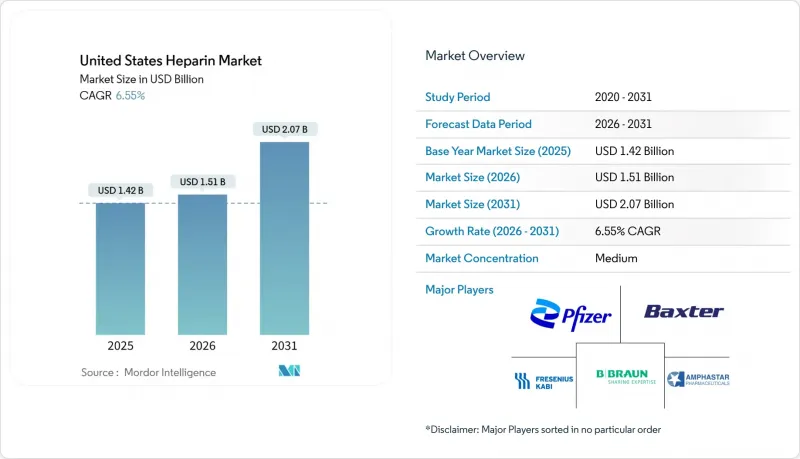
This report is Segmented Into by Product (Unfractionated Heparin, LMWH, and More), Source (Bovine and Porcine), Route of Administration (Intravenous and Sub-Cutaneous), Formulation (Vials and Ampoules and More), Application (Deep Vein Thrombosis and Pulmonary Embolism and More), and End-User (Hospitals, Ambulatory Surgical Centers and More). The Market and Forecasts are Provided in Terms of Value (USD).
United States Heparin Market Trends and Insights
High Burden of Cardiovascular & Thrombotic Diseases
Each year, venous thromboembolism (VTE) impacts nearly 900,000 individuals across the U.S., leading to 60,000 to 100,000 fatalities and incurring close to USD 10 billion in direct medical expenses. Over a third of these cases occur in hospital settings, many of which could be prevented with timely pharmacologic prophylaxis. In 2024, the prevalence of atrial fibrillation (AF) reached 6.1 million adults in the U.S., with projections indicating a doubling by 2030, driven primarily by an aging population. Oncology patients are particularly at risk, facing a 4- to 7-fold increased likelihood of VTE, which accounts for approximately 20% of all thrombotic events. Additionally, nearly 30% of these patients experience recurrent clots within a decade, highlighting a sustained demand for rapid-acting, reversible treatment agents. Given these market dynamics, the U.S. heparin market remains a critical segment, particularly in scenarios where a rapid onset and the ability to be reversed with protamine are prioritized over the convenience of oral medications.
High Surgical & Dialysis Procedure Volumes
Rising procedure volumes are driving increased prophylactic heparin use. The Centers for Disease Control and Prevention reports 51.4 million inpatient and 28.6 million outpatient surgeries annually, all of which require perioperative anticoagulation. Dialysis demand also climbs, with 809,103 patients in 2024 and 69.8% receiving in-center hemodialysis. FDA-approved Defencath is eligible for TDAPA reimbursement from July 2024, improving adoption in dialysis settings.
Porcine-Supply Volatility from African Swine Fever
African Swine Fever continues to disrupt Chinese pig herds that supply about 80% of the crude heparin used in the United States. The August 2024 Baxter recall for endotoxin contamination shows how tight supply chains can strain quality controls. Previous raw-material shocks raised hospital heparin error rates by 152% and prompted conservation protocols. Most facilities keep contingency formularies and plan supplier changes once new sources reacthe implementation of h scale. FDA review of bovine heparin offers a near-term path to diversify supply, provided manufacturers meet the required safety standards.
Other drivers and restraints analyzed in the detailed report include:
- Advances in Heparin Formulations & Delivery Devices
- FDA-Led Diversification to Bovine-Sourced APIs
- Competition From Direct Oral Anticoagulants
For complete list of drivers and restraints, kindly check the Table Of Contents.
Segment Analysis
Low molecular weight heparin controlled 62.22% of the United States heparin market share in 2025, supported by once-daily prophylaxis that usually avoids lab monitoring. Enoxaparin remains the workhorse in orthopedic and abdominal surgery protocols, and its generic status keeps per-dose costs below USD 10 for group-purchasing contracts. Unfractionated heparin sustains a vital procedural niche where real-time dose adjustment is critical, such as cardiopulmonary bypass and ECMO, ensuring steady baseline demand. Ultra-low molecular weight heparin is forecast to post a 6.90% CAGR to 2031 as refined fractionation lowers bleeding risk without sacrificing anti-Xa potency. Investment in chromatographic technologies under the FDA 505(b)(2) pathway signals an incremental shift toward precision molecules within the United States heparin market.
Porcine intestinal mucosa supplied 89.30% of heparin APIs in 2025, yet bovine alternatives are expanding at a 7.40% CAGR on the back of Brazilian and Australian extraction capacity. FDA encouragement and improved prion testing reduce regulatory friction, though potency calibration changes and label updates extend timelines. Formulary committees at academic medical centers are piloting dual-species strategies to hedge against swine disease shocks, underscoring a growing resilience mindset in the United States heparin market.
List of Companies Covered in this Report:
- Accord Healthcare, Inc.
- Amphastar Pharmaceuticals
- B. Braun
- Baxter
- Bioiberica
- Changzhou Qianhong Bio-pharma
- CorMedix Inc.
- Dr. Reddy's Laboratories
- Fresenius Kabi USA LLC
- GLAND PHARMA
- Hikma Pharmaceuticals
- Laboratorios Ferrer/ROVI
- Meitheal Pharmaceuticals, Inc.
- Nanjing King-Friend Biochemical
- Pfizer
- Sagent Pharmaceuticals
- Sanofi
- Shenzhen Hepalink Pharmaceutical Co.
- Teva Pharmaceutical Industries
- Viatris
Additional Benefits:
- The market estimate (ME) sheet in Excel format
- 3 months of analyst support
TABLE OF CONTENTS
1 Introduction
- 1.1 Study Assumptions & Market Definition
- 1.2 Scope of the Study
2 Research Methodology
3 Executive Summary
4 Market Landscape
- 4.1 Market Overview
- 4.2 Market Drivers
- 4.2.1 High Burden of Cardiovascular & Thrombotic Diseases
- 4.2.2 High Surgical & Dialysis Procedure Volumes
- 4.2.3 Advances In Heparin Formulations & Delivery Devices
- 4.2.4 FDA Led Diversification to Bovine-Sourced Apis
- 4.2.5 Bio-Engineered, Animal-Free Heparin Trial Roll-Outs
- 4.2.6 Bed-Side Anti-Xa POC Monitoring Drives Safe-Use Protocols
- 4.3 Market Restraints
- 4.3.1 Porcine-Supply Volatility from African Swine Fever
- 4.3.2 Competition From Direct Oral Anticoagulants
- 4.3.3 Stringent FDA Quality-Recall Environment
- 4.3.4 CMS Bundled-Payment Compression on Inpatient Anticoagulant Spend
- 4.4 Supply-Chain Analysis
- 4.5 Regulatory Landscape
- 4.6 Technological Outlook
- 4.7 Porter's Five Forces Analysis
- 4.7.1 Threat of New Entrants
- 4.7.2 Bargaining Power of Buyers
- 4.7.3 Bargaining Power of Suppliers
- 4.7.4 Threat of Substitutes
- 4.7.5 Competitive Rivalry
5 Market Size & Growth Forecasts (Value, USD)
- 5.1 By Product
- 5.1.1 Unfractionated Heparin (UFH)
- 5.1.2 Low Molecular Weight Heparin (LMWH)
- 5.1.3 Ultra-Low Molecular Weight Heparin (ULMWH)
- 5.2 By Source
- 5.2.1 Porcine
- 5.2.2 Bovine
- 5.3 By Route of Administration
- 5.3.1 Intravenous
- 5.3.2 Subcutaneous
- 5.4 By Formulation
- 5.4.1 Vials & Ampoules
- 5.4.2 Prefilled Syringes & Cartridges
- 5.5 By Application
- 5.5.1 Atrial Fibrillation & Acute Myocardial Infarction
- 5.5.2 Stroke & Transient Ischemic Attack
- 5.5.3 Deep Vein Thrombosis & Pulmonary Embolism
- 5.5.4 Renal Dialysis & CRRT
- 5.5.5 Cardiopulmonary Bypass / ECMO
- 5.6 By End-User
- 5.6.1 Hospitals
- 5.6.2 Ambulatory Surgical Centers
- 5.6.3 Dialysis Centers
- 5.6.4 Home-care & Specialty Pharmacies
6 Competitive Landscape
- 6.1 Market Concentration
- 6.2 Market Share Analysis
- 6.3 Company Profiles (includes Global level Overview, Market-level Overview, Core Segments, Financials, Strategic Information, Market Rank/Share, Products & Services, Recent Developments)
- 6.3.1 Accord Healthcare, Inc.
- 6.3.2 Amphastar Pharmaceuticals, Inc.
- 6.3.3 B. Braun SE
- 6.3.4 Baxter International Inc.
- 6.3.5 Bioiberica S.A.U.
- 6.3.6 Changzhou Qianhong Bio-pharma
- 6.3.7 CorMedix Inc.
- 6.3.8 Dr. Reddy's Laboratories Ltd.
- 6.3.9 Fresenius Kabi USA LLC
- 6.3.10 Gland Pharma Ltd.
- 6.3.11 Hikma Pharmaceuticals PLC
- 6.3.12 Laboratorios Ferrer/ROVI
- 6.3.13 Meitheal Pharmaceuticals, Inc.
- 6.3.14 Nanjing King-Friend Biochemical
- 6.3.15 Pfizer Inc.
- 6.3.16 Sagent Pharmaceuticals
- 6.3.17 Sanofi
- 6.3.18 Shenzhen Hepalink Pharmaceutical Co.
- 6.3.19 Teva Pharmaceutical Industries Ltd.
- 6.3.20 Viatris Inc.
7 Market Opportunities & Future Outlook
- 7.1 White-space & Unmet-Need Assessment

