
PUBLISHER: Mordor Intelligence | PRODUCT CODE: 2061716

PUBLISHER: Mordor Intelligence | PRODUCT CODE: 2061716
Vertigo Treatment - Market Share Analysis, Industry Trends & Statistics, Growth Forecasts (2026 - 2031)
According to Mordor Intelligence, the vertigo treatment market size is projected to expand from USD 2.24 billion in 2025 and USD 2.34 billion in 2026 to USD 2.98 billion by 2031, registering a CAGR of 4.89% between 2026 to 2031.
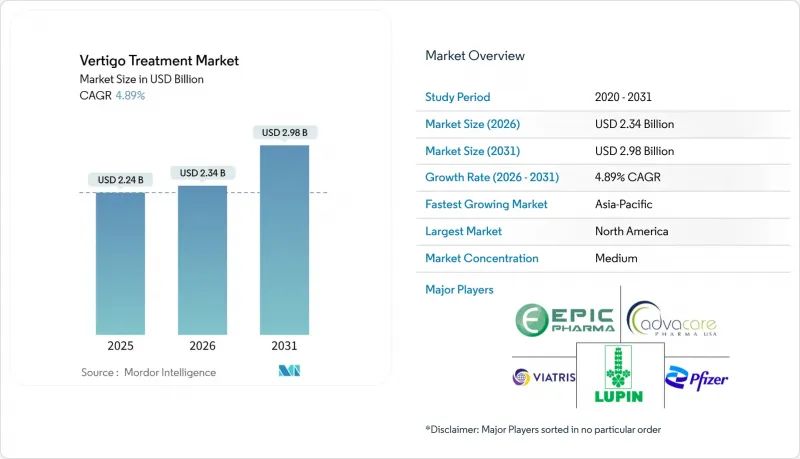
This report is Segmented by Type (Peripheral Vertigo, Central Vertigo), Treatment Type (Medication, Surgery), End User (Hospitals, Specialty Clinics, Ambulatory Surgical Centres, ENT & Neurology Centres, Homecare/Tele-rehabilitation Settings), and Geography (North America, Europe, Asia-Pacific, Middle East and Africa, South America). The Market Forecasts are Provided in Terms of Value (USD).
Global Vertigo Treatment Market Trends and Insights
Rise in Prevalence of Vertigo Among Ageing Population
As the global population ages, the demand for vertigo care is increasing. A study highlighted that 27.1% of adults aged 55 and older experienced vestibular vertigo over a decade, with 39.8% reporting dizziness or vertigo, emphasizing the persistent nature of these symptoms in older demographics. By 2030, 2.1 billion individuals worldwide will be aged 60 or older, highlighting the growing patient pool for standardized diagnostic and therapeutic interventions. This shift aligns with the rise of adherence tools and remote monitoring. Additionally, the increasing recognition of vestibular migraines in older patients is driving the off-label use of CGRP-targeted therapies, particularly for patients unresponsive to standard treatments.
Growing Healthcare Expenditure in Emerging Economies
Increased public and private healthcare spending in China and India is improving access to specialized ENT and neurology services, expanding diagnosis and treatment volumes in the vertigo market. In 2024, China allocated significant funds to healthcare, enhancing hospital capacities, procuring essential equipment, and hiring specialists to manage vestibular cases. Similarly, India's 2024-25 Union Budget allocated substantial resources for health and family welfare, broadening coverage to previously uninsured populations. India's pharmaceutical sector, valued at USD 50 billion in 2024 and projected to reach USD 130 billion by 2030, is scaling up production of cost-effective vertigo medications. This expansion caters to domestic demands and strengthens export reliability for primary care.
Ignorance or Late Reporting of Vertigo Symptoms
Many patients perceive dizziness as a harmless aspect of aging, leading to delays in seeking care in the vertigo treatment market. A 2025 global survey of clinicians highlighted that patients typically consult only after experiencing recurrent episodes or a fall. By this time, compensation patterns may diminish the effectiveness of certain therapies. This delay is more pronounced in low-income and rural areas, where access to ENT specialists is limited, and primary care providers often lack confidence in vestibular triage. Fall prevention programs frequently overlook vestibular screening, missing an opportunity to reduce injuries. Despite the high risk of serious injuries from falls among older adults, routine care does not consistently include proactive vestibular assessments. Digital self-assessments and brief triage questionnaires show potential but require patient education and seamless integration into existing workflows to achieve scalability.
Other drivers and restraints analyzed in the detailed report include:
- Expanding ENT & Neurology Specialty Centers
- Increasing Availability of Vestibular Rehabilitation Therapists
- Limited Long-Term Efficacy Data for Pharmacological Options
For complete list of drivers and restraints, kindly check the Table Of Contents.
Segment Analysis
In 2025, peripheral vertigo accounted for 63.23% of the vertigo treatment market. However, the central category is projected to grow at a 6.54% CAGR through 2031, driven by improved recognition of stroke-related and vestibular migraine subtypes. Benign paroxysmal positional vertigo significantly contributes to dizziness clinic visits, with a 15% annual recurrence rate. Half of these recurrences occur within 2 to 3 years, sustaining demand for canalith repositioning and symptomatic therapy. Meniere's disease, despite its lower prevalence, generates substantial pharmaceutical revenue due to chronic treatment needs, ranging from betahistine to intratympanic corticosteroids in select cases. Vestibular neuritis and labyrinthitis often require acute corticosteroids and vestibular suppressants, followed by rehabilitation to restore function. These conditions create recurring touchpoints across primary care, specialty clinics, and rehabilitation programs.
Geography Analysis
In 2025, North America accounted for 44.5% of the vertigo treatment market, driven by comprehensive coverage, a high concentration of specialists, and early adoption of digital solutions. Medicare provides coverage for vestibular rehabilitation under specific CPT codes, with reimbursement rates of USD 30 to 35 per 15-minute unit, establishing a baseline for therapy access. The United States leads in digital diagnostics, with the introduction of VertiGuide in 2024 to facilitate nystagmus assessment and triage beyond specialist clinics. Canada and Mexico hold smaller but growing shares, supported by cross-border telemedicine and increased availability of generics. Infrastructure developments, such as the Cleveland Clinic's upcoming neurological institute in 2027, further strengthen North America's position in advanced vestibular care.
Europe's vertigo treatment market is influenced by diverse reimbursement policies and prescribing practices, which shape therapy options and pricing. Betahistine remains widely used in Germany, France, and the United Kingdom, despite its lack of FDA approval in the United States, reflecting regional differences in regulatory standards. Germany's stable demand, along with aging populations in Italy and Spain, drives the need for chronic management and rehabilitation. The European Medicines Agency facilitates multi-country drug approvals, although national health bodies often prioritize generics to meet cost-effectiveness criteria. Northern and Eastern Europe are increasingly adopting telerehabilitation to address specialist shortages, improving adherence for older patients with mobility challenges.
The Asia-Pacific region is projected to grow at a 7.24% CAGR through 2031, fueled by expanding healthcare access in China and India and increased utilization of specialty ENT services in Southeast Asia's urban areas. China's significant healthcare investments in 2024 have enhanced hospital capacity and diagnostic capabilities for vestibular conditions. India's 2024-25 budget allocation for health and family welfare, supplemented by state-level spending and expanded coverage under Ayushman Bharat, supports the region's growth. India's pharmaceutical industry, valued at USD 50 billion in 2024 and expected to reach USD 130 billion by 2030, plays a key role in producing affordable antihistamines and vestibular suppressants for domestic and export markets, improving affordability across the region.
- AdvaCare
- Amneal Pharmaceuticals
- Auris Medical Holding AG
- Bausch Health
- Cipla
- Epic Pharma LLC
- Glenmark Pharma
- H-Lundbeck A/S
- Lupin
- Otonomy
- Pfizer
- Prestige Consumer Healthcare
- RPG Life Sciences Ltd.
- Sanofi
- Sound Pharmaceuticals Inc.
- Sun Pharma Inds.
- Teva Pharmaceutical Inds. Ltd.
- Viatris
- Zydus Lifesciences Ltd.
Additional Benefits:
- The market estimate (ME) sheet in Excel format
- 3 months of analyst support
TABLE OF CONTENTS
1 Introduction
- 1.1 Study Assumptions & Market Definition
- 1.2 Scope of the Study
2 Research Methodology
3 Executive Summary
4 Market Landscape
- 4.1 Market Overview
- 4.2 Market Drivers
- 4.2.1 Rise in Prevalence of Vertigo Among Ageing Population
- 4.2.2 Growing Healthcare Expenditure in Emerging Economies
- 4.2.3 Expanding ENT & Neurology Speciality Centres
- 4.2.4 Increasing Availability of Vestibular Rehabilitation Therapists
- 4.2.5 Ototoxic-Drug-Induced Vestibular Dysfunction Surveillance Programs
- 4.2.6 Adoption of Smartphone-Based Vestibular Diagnostic Apps
- 4.3 Market Restraints
- 4.3.1 Ignorance / Late Reporting of Vertigo Symptoms
- 4.3.2 Limited Long-Term Efficacy Data for Pharmacological Options
- 4.3.3 Shortage of Trained Neuro-Otologists in Low-Income Nations
- 4.3.4 Reimbursement Gaps for Vestibular Rehab & Home-Based Care
- 4.4 Supply-Chain Analysis
- 4.5 Regulatory Landscape
- 4.6 Technological Outlook
- 4.7 Porter's Five Forces Analysis
- 4.7.1 Threat of New Entrants
- 4.7.2 Bargaining Power of Buyers
- 4.7.3 Bargaining Power of Suppliers
- 4.7.4 Threat of Substitute Products
- 4.7.5 Intensity of Competitive Rivalry
5 Market Size & Growth Forecasts (Value in USD)
- 5.1 By Type
- 5.1.1 Peripheral Vertigo
- 5.1.1.1 Benign Paroxysmal Positional Vertigo (BPPV)
- 5.1.1.2 Meniere Disease
- 5.1.1.3 Vestibular Neuritis & Labyrinthitis
- 5.1.2 Central Vertigo
- 5.1.2.1 Vestibular Migraine
- 5.1.2.2 Stroke-related Vertigo
- 5.1.2.3 Multiple Sclerosis & Tumor-related Vertigo
- 5.1.1 Peripheral Vertigo
- 5.2 By Treatment Type
- 5.2.1 Medication
- 5.2.1.1 Antihistamines
- 5.2.1.2 Anticholinergics
- 5.2.1.3 Benzodiazepines
- 5.2.1.4 Calcium Channel Blockers
- 5.2.1.5 Corticosteroids
- 5.2.1.6 Others
- 5.2.2 Surgery
- 5.2.2.1 Vestibular Nerve Section
- 5.2.2.2 Labyrinthectomy
- 5.2.2.3 Semicircular Canal Plugging
- 5.2.1 Medication
- 5.3 By End User
- 5.3.1 Hospitals
- 5.3.2 Speciality Clinics
- 5.3.3 Ambulatory Surgical Centres
- 5.3.4 ENT & Neurology Centres
- 5.3.5 Homecare / Tele-rehabilitation Settings
- 5.4 By Geography
- 5.4.1 North America
- 5.4.1.1 United States
- 5.4.1.2 Canada
- 5.4.1.3 Mexico
- 5.4.2 Europe
- 5.4.2.1 Germany
- 5.4.2.2 United Kingdom
- 5.4.2.3 France
- 5.4.2.4 Italy
- 5.4.2.5 Spain
- 5.4.2.6 Rest of Europe
- 5.4.3 Asia-Pacific
- 5.4.3.1 China
- 5.4.3.2 India
- 5.4.3.3 Japan
- 5.4.3.4 Australia
- 5.4.3.5 South Korea
- 5.4.3.6 Rest of Asia-Pacific
- 5.4.4 Middle East and Africa
- 5.4.4.1 GCC
- 5.4.4.2 South Africa
- 5.4.4.3 Rest of Middle East and Africa
- 5.4.5 South America
- 5.4.5.1 Brazil
- 5.4.5.2 Argentina
- 5.4.5.3 Rest of South America
- 5.4.1 North America
6 Competitive Landscape
- 6.1 Market Concentration
- 6.2 Market Share Analysis
- 6.3 Company Profiles (includes Global level Overview, Market-level Overview, Core Segments, Financials, Strategic Information, Market Rank/Share, Products & Services, Recent Developments)
- 6.3.1 AdvaCare Pharma
- 6.3.2 Amneal Pharmaceuticals LLC
- 6.3.3 Auris Medical Holding AG
- 6.3.4 Bausch Health Companies Inc.
- 6.3.5 Cipla Ltd.
- 6.3.6 Epic Pharma LLC
- 6.3.7 Glenmark Pharma
- 6.3.8 H-Lundbeck A/S
- 6.3.9 Lupin Ltd.
- 6.3.10 Otonomy Inc.
- 6.3.11 Pfizer Inc.
- 6.3.12 Prestige Consumer Healthcare Inc.
- 6.3.13 RPG Life Sciences Ltd.
- 6.3.14 Sanofi S.A.
- 6.3.15 Sound Pharmaceuticals Inc.
- 6.3.16 Sun Pharma Inds.
- 6.3.17 Teva Pharmaceutical Inds. Ltd.
- 6.3.18 Viatris Inc.
- 6.3.19 Zydus Lifesciences Ltd.
7 Market Opportunities & Future Outlook
- 7.1 White-space & Unmet-need Assessment

