PUBLISHER: Mordor Intelligence | PRODUCT CODE: 2061718

PUBLISHER: Mordor Intelligence | PRODUCT CODE: 2061718
Dental Milling Machine - Market Share Analysis, Industry Trends & Statistics, Growth Forecasts (2026 - 2031)
According to Mordor Intelligence, the dental milling machine market size in 2026 is estimated at USD 2.85 billion, growing from 2025 value of USD 2.64 billion with 2031 projections showing USD 4.18 billion, growing at 7.97% CAGR over 2026-2031.
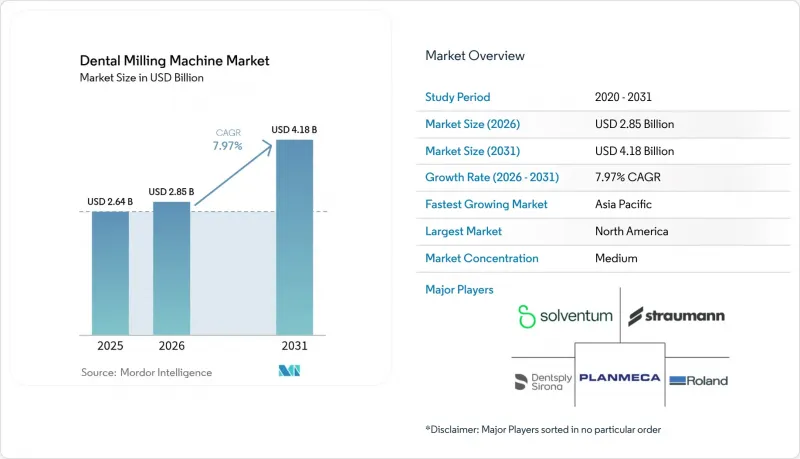
This report is Segmented by Machine Type (In Lab Milling Machines and In-Office Milling Machines), Size (Tabletop, Bench-Top, and Stand-Alone), Axis Configuration (4-Axis Machines and 5-Axis Machines), Technology (Copying Milling and CAD/CAM Milling), End-User (Dental Laboratories, and More), and Geography (North America, Europe, and More). The Market Forecasts are Provided in Terms of Value (USD).
Global Dental Milling Machine Market Trends and Insights
Rising Global Burden of Untreated Dental Caries & Tooth Loss
An estimated 2.3 billion people live with untreated caries, and clinicians increasingly choose milled restorations because they can be delivered in a single visit and achieve long-term survival rates above 95% for zirconia crowns. The workflow efficiency is critical as case volumes grow, with practices reporting up to 60% chair-time reduction when milling replaces conventional lab work. Developing economies feel the greatest impact because a growing middle class now seeks aesthetic prosthetics rather than extractions. Clinics that adopted same-day solutions report measurable patient preference and willingness to pay premium fees, reinforcing revenue potential for providers.
Rapid Digitization of Dental Workflows
Scanner-to-mill connectivity has accelerated due to cloud platforms that move design files in seconds instead of minutes, allowing remote designers to finalize crowns and bridges while patients remain in the chair. Automated design tools now achieve a 94% acceptance rate for crown proposals, slashing the CAD learning curve and widening access among non-specialist teams. Integrated quality-control routines inside the mill reduce remakes and create a data feedback loop that refines preparations over time. Consequently, clinics view digital transformation less as a discretionary upgrade and more as a requirement for competitive parity.
High Up-Front & Maintenance Costs of Multi-Axis Mills
Entry-level chairside packages start near USD 100,000 before software, training, and facility upgrades are added. Diamond bur replacements can equal 20% of running costs each year, pressuring return-on-investment calculations for low-volume clinics. Leasing and pay-per-restoration schemes are gaining traction, but residual value uncertainties and service commitments still deter some buyers. Capital shortages are more acute in emerging markets, where financing rates remain higher and currency volatility raises import costs. Vendors respond with modular designs that let practices add spindles or tool magazines over time, aligning cash flow with growing case loads.
Other drivers and restraints analyzed in the detailed report include:
- Expansion of Dental Service Organizations & Centralized Milling Hubs
- Escalating Demand for High-Aesthetic Materials Requiring Precision Milling
- Digital Workflow Integration & Training Barriers for Small Clinics
For complete list of drivers and restraints, kindly check the Table Of Contents.
Segment Analysis
In-Lab platforms generated 64.40% of 2025 revenue, underscoring their central role in high-capacity laboratories that supply multiple clinics. The typical installation supports multi-material carousels, continuous spindle operation, and automatic disc management, enabling daily output far above chairside units. Laboratories leverage this scale to deliver consistent restorations for broad patient groups, keeping the dental milling machine market anchored in centralized production.
The In-Office category expands at 10.36% CAGR because same-day dentistry improves scheduling and increases case acceptance. Modern compact mills now handle zirconia bridges alongside single crowns, closing the gap with laboratory systems. Practices report that monthly production doubles within four months of adoption as teams gain confidence in digital steps. This productivity spike strengthens the economic case for ownership, sustaining robust demand.
Four-axis equipment held 55.30% of the dental milling machine market share in 2025 due to affordability and ease of use, offering sufficient articulation for standard crowns and inlays. Users appreciate straightforward toolpaths and shorter setup times that support lean laboratory operations.
Five-axis solutions, however, expand at 11.55% CAGR because they cut undercuts, screw-access channels, and full-arch frameworks without repositioning. The extra degrees of freedom improve cervical fit and margin integrity, reducing chairside adjustments after delivery. Laboratories that incorporate five-axis stations secure more implant and aesthetic work, a profitable niche that propels equipment upgrades across the dental milling machine industry.
Geography Analysis
North America contributed 37.60% of global revenue in 2025, supported by sophisticated insurance reimbursement and early CAD/CAM rollout. Approximately 15% of clinics perform in-office milling, and service organizations have standardized equipment procurement to streamline support contracts. Capital spending also benefits from favorable leasing conditions that make hardware renewal predictable every five years.
Europe stands as the second-largest region, with regulatory harmonization accelerating product launches. German and Scandinavian manufacturers pioneer multi-layer zirconia and energy-efficient spindles that appeal to laboratories focused on sustainability. Strict data-privacy rules encourage vendors to build secure cloud connectors, improving adoption among practice networks that exchange designs across borders. The dental milling machine market here is shaped by independent labs that stress craft quality, creating demand for precision upgrades rather than outright capacity expansion.
Asia-Pacific records a 12.95% CAGR, the fastest worldwide, fueled by rising disposable income and vibrant dental tourism in Thailand and India. China quickly scales domestic production, narrowing the technology gap with Western incumbents, while Japan applies its expertise in precision engineering to develop compact five-axis mills tailored for small urban clinics. Public health initiatives in several countries now reimburse CAD/CAM crowns, spurring clinics to add mills. Middle East and Africa and South America show moderate growth; Brazil leads South America due to its established dental manufacturing cluster, whereas Gulf Cooperation Council nations invest heavily in modern clinics aimed at medical tourists.
- Solventum Corporation
- Dentsply Sirona
- Amann Girrbach
- Planmeca
- Roland DG Corp. (DGSHAPE)
- Zirkonzahn GmbH
- vhf camfacture AG
- Datron
- imes-icore GmbH
- Straumann Group
- Renishaw plc
- Pritidenta GmbH
- Axsys Dental Solutions
- Yenadent Ltd.
- B&D Dental Technologies
- Ivoclar Vivadent
- Zimmer Biomet
- KaVo Kerr (Envista)
Additional Benefits:
- The market estimate (ME) sheet in Excel format
- 3 months of analyst support
TABLE OF CONTENTS
1 Introduction
- 1.1 Study Assumptions & Market Definition
- 1.2 Scope of the Study
2 Research Methodology
3 Executive Summary
4 Market Landscape
- 4.1 Market Overview
- 4.2 Market Drivers
- 4.2.1 Rising Global Burden of Untreated Dental Caries & Tooth Loss
- 4.2.2 Rapid Digitization of Dental Workflows (Scanner-CAD-Mill-Sinter)
- 4.2.3 Expansion of Dental Service Organizations & Centralized Milling Hubs
- 4.2.4 Escalating Demand for High-Aesthetic Materials (Zirconia, Li-disilicate) Requiring Precision Milling
- 4.2.5 Government-Backed Insurance Expansion for Prosthetic Restorations
- 4.3 Market Restraints
- 4.3.1 High Up-Front & Maintenance Costs of Multi-Axis Mills
- 4.3.2 Digital Workflow Integration & Training Barriers for Small Clinics
- 4.3.3 Competition from Additive Manufacturing and Outsourced Labs
- 4.4 Supply-Chain Analysis
- 4.5 Technological Outlook
- 4.6 Porter's Five Forces
- 4.6.1 Threat of New Entrants
- 4.6.2 Bargaining Power of Buyers
- 4.6.3 Bargaining Power of Suppliers
- 4.6.4 Threat of Substitutes
- 4.6.5 Competitive Rivalry
5 Market Size & Growth Forecasts (Value, USD)
- 5.1 By Machine Type
- 5.1.1 In-Lab Milling Machines
- 5.1.2 In-Office Milling Machines
- 5.2 By Axis Configuration
- 5.2.1 4-Axis Machines
- 5.2.2 5-Axis Machines
- 5.3 By Size
- 5.3.1 Table-top
- 5.3.2 Bench-top
- 5.3.3 Stand-alone
- 5.4 By Technology
- 5.4.1 CAD/CAM Milling
- 5.4.2 Copying Milling
- 5.5 By End-User
- 5.5.1 Dental Laboratories
- 5.5.2 Dental Clinics (Chair-side)
- 5.5.3 Academic & Research Institutes
- 5.6 Geography
- 5.6.1 North America
- 5.6.1.1 United States
- 5.6.1.2 Canada
- 5.6.1.3 Mexico
- 5.6.2 Europe
- 5.6.2.1 Germany
- 5.6.2.2 United Kingdom
- 5.6.2.3 France
- 5.6.2.4 Italy
- 5.6.2.5 Spain
- 5.6.2.6 Rest of Europe
- 5.6.3 Asia-Pacific
- 5.6.3.1 China
- 5.6.3.2 Japan
- 5.6.3.3 India
- 5.6.3.4 South Korea
- 5.6.3.5 Australia
- 5.6.3.6 Rest of Asia-Pacific
- 5.6.4 Middle East and Africa
- 5.6.4.1 GCC
- 5.6.4.2 South Africa
- 5.6.4.3 Rest of Middle East and Africa
- 5.6.5 South America
- 5.6.5.1 Brazil
- 5.6.5.2 Argentina
- 5.6.5.3 Rest of South America
- 5.6.1 North America
6 Competitive Landscape
- 6.1 Market Concentration
- 6.2 Market Share Analysis
- 6.3 Company Profiles (includes Global level Overview, Market level overview, Core Business Segments, Financials, Headcount, Key Information, Market Rank, Market Share, Products and Services, and analysis of Recent Developments)
- 6.3.1 Solventum Corporation
- 6.3.2 Dentsply Sirona
- 6.3.3 Amann Girrbach AG
- 6.3.4 Planmeca Oy
- 6.3.5 Roland DG Corp. (DGSHAPE)
- 6.3.6 Zirkonzahn GmbH
- 6.3.7 vhf camfacture AG
- 6.3.8 Datron AG
- 6.3.9 imes-icore GmbH
- 6.3.10 Institut Straumann AG
- 6.3.11 Renishaw plc
- 6.3.12 Pritidenta GmbH
- 6.3.13 Axsys Dental Solutions
- 6.3.14 Yenadent Ltd.
- 6.3.15 B&D Dental Technologies
- 6.3.16 Ivoclar Vivadent AG
- 6.3.17 Zimmer Biomet Holdings Inc.
- 6.3.18 KaVo Kerr (Envista)
7 Market Opportunities & Future Outlook
- 7.1 White-space & Unmet-Need Assessment

