
PUBLISHER: Mordor Intelligence | PRODUCT CODE: 2061724

PUBLISHER: Mordor Intelligence | PRODUCT CODE: 2061724
Femtech - Market Share Analysis, Industry Trends & Statistics, Growth Forecasts (2026 - 2031)
According to Mordor Intelligence, the femtech market size is expected to grow from USD 8.56 billion in 2025 to USD 9.78 billion in 2026 and is forecast to reach USD 18.98 billion by 2031 at 14.20% CAGR over 2026-2031.
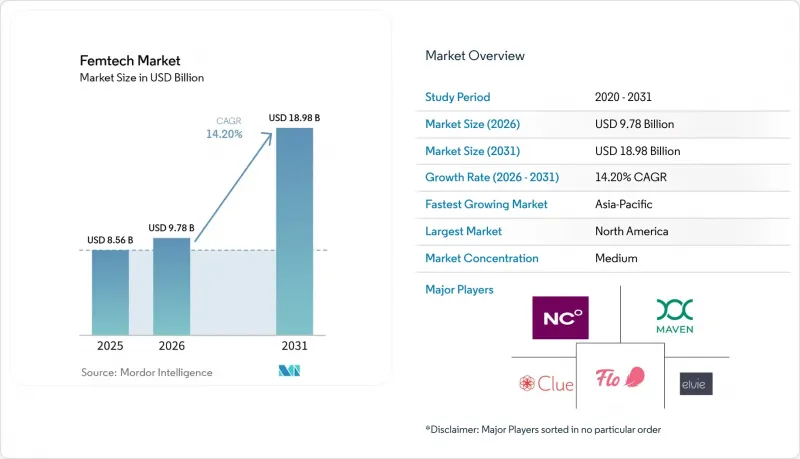
This report is Segmented by Type (Devices, Software, and Services), Application (Reproductive Health & Contraception, Pregnancy & Nursing Care, Menstrual Health Management, Pelvic & Uterine Health, and More), End User (Hospitals & Maternal Centers, and More), and Geography (North America, Europe, Asia-Pacific, Middle East & Africa, South America). The Market Forecasts are Provided in Terms of Value (USD).
Global Femtech Market Trends and Insights
Growing Adoption of Digital Health Technologies
Consumers are embracing app-based and connected solutions, helped by worldwide smartphone penetration and normalized telehealth use. Wearable technology revenues are expected to reach USD 380.5 billion by 2028, with women comprising more than 70% of active users. Hardware innovation improves privacy and usability; the University of Hong Kong's organic electrochemical transistors enable near-body data processing, removing the need to upload sensitive information to external servers. Clinical-grade accuracy is no longer confined to hospital settings as IoT fetal monitoring systems demonstrate 90% sensitivity and 87.46% precision, allowing continuous in-home prenatal surveillance. Digital therapeutics add a regulatory seal of approval: Curio Digital Therapeutics won FDA clearance for MamaLift Plus, the first prescription app for postpartum depression, highlighting the Femtech market's capability to deliver evidence-based mental health support. Together these innovations create platform effects that reward integrated ecosystems over point solutions, reinforcing recurring revenue models across the Femtech market.
Rising Venture Capital and Corporate Funding
Capital allocation to women's health is moving from niche to mainstream as more female investors occupy partner-level roles and identify underpriced opportunities. Flo Health's USD 200 million raise from General Atlantic produced Europe's first Femtech unicorn and validated data-driven cycle tracking at scale. Incumbent healthcare companies are also entering via acquisition; LifeMD added women's health services after purchasing Optimal Human Health MD in 2025. Early-stage money remains active, illustrated by Trellis Health's USD 1.8 million pre-seed round to build AI-first platforms. Nevertheless, 65% of global Femtech funding still lands in the United States, hinting at untapped capital formation across Europe and Asia.
Data Privacy and Cybersecurity Concerns
Trust remains fragile when personal reproductive data are in play. The Financial Times warned in 2024 that privacy woes have slowed several fertility-tech rollouts. A study in Frontiers found many apps still lack robust consent architecture, exposing users in the UK, EU, and Switzerland to data exploitation. Menstruation-tracking tools are under extra scrutiny because they fall outside traditional HIPAA protections, as noted by the California Law Review. The December 2024 HIPAA amendments add new attestations for data requests, raising compliance complexity for caregivers and platform operators. Cross-border data rules further complicate global scaling, making local partnerships vital for Femtech market entrants.
Other drivers and restraints analyzed in the detailed report include:
- Increasing Incidence of Fertility and Menstrual Disorders
- Expanding Employer-Sponsored Women's Health Benefits
- Limited Awareness in Emerging Economies
For complete list of drivers and restraints, kindly check the Table Of Contents.
Segment Analysis
Devices generated the largest slice of revenue in 2025 at 51.62%, illustrating how physical products that carry regulatory clearance continue to anchor the Femtech market. Breakthroughs such as Bone Health Technologies' OsteoBoost translate strong evidence into prescriber confidence and target a USD 30 billion domestic addressable field. The Femtech market size for device-based bone health interventions alone is expected to grow robustly as postmenopausal populations rise. Wearable ultrasound patches developed at MIT permit radiation-free breast screening, while therapy units like Myoovi use TENS currents for drug-free menstrual pain relief, catering to consumers who favour non-pharmacological care.
The software category, buoyed by AI and cloud analytics, is projected to book a 16.12% CAGR through 2031 as digital subscriptions unlock predictable revenue and global reach. Service models, especially telehealth, benefited from FDA recognition of digital therapeutics such as MamaLift Plus, which treats postpartum depression without medication. Integrated ecosystems exemplify future direction, blending sensors, mobile apps, and data dashboards to drive adherence and evidence generation within the Femtech market. Fertility innovations remain vivid; kegg's cervical-mucus analyser is scaling to Japan after assisting 50,000 US users. Likewise, identifyHer's Peri wearable debuts in 2025 to quantify hot flash patterns through proprietary algorithms, extending device relevance into menopause care.
Geography Analysis
North America maintained 41.95% of revenue in 2025, supported by FDA breakthrough pathways, HIPAA data-security amendments, and a USD 500 million federal research allocation for women's health. Employer benefits amplify market pull: fertility benefits adoption climbed to 40% in 2024, and Progyny's Q4 2024 revenue reached USD 298.4 million across 473 clients, underscoring corporate appetite for specialised plans. Venture capital remains concentrated in the region, capturing 65% of global Femtech funding, although that concentration also implies competitive intensity and valuation pressure.
Asia-Pacific is projected to register a 15.12% CAGR, the highest globally, thanks to smartphone ubiquity and regulatory receptivity. Menstrual-health apps alone could hit USD 9.37 billion by 2033 at a 19.67% CAGR as rural internet access expands. Japan's planned launch of kegg in 2025 exemplifies how clinical validation fuels market entry, particularly in countries grappling with rising infertility. Regional investment is climbing; Baker McKenzie notes escalating health-transformation deals likely to push Asia-Pacific healthcare spending to USD 138 billion by 2027. Cultural taboos, however, still restrain penetration in segments like sexual wellness, making education campaigns critical.
Europe combines strong privacy regimes with growing investor attention. Flo Health became the first regional Femtech unicorn in 2024 after a USD 200 million round, highlighting an ecosystem on the brink of scale. Roughly one-fifth of the world's Femtech firms sit in Europe, but female founders receive only 10% of venture capital, signalling room for funding equity. CE-Mark pathways are smoothing cross-border distribution, as seen with Femasys' approvals. Compliance costs under GDPR are higher, yet these same standards give European apps a trust dividend, especially for privacy-sensitive use cases within the Femtech market.
- Flo Health
- Clue by BioWink
- Elvie
- Maven Clinic
- Natural Cycles
- Nuvo Cares
- HeraMED
- iSono Health
- Sera Prognostics
- Athena Feminine Technologies
- Canopie
- Willow
- OCON Healthcare
- Carrot Fertility
- Progyny
- Glow
- Qvin
- NextGen Jane
- Claria Medical
Additional Benefits:
- The market estimate (ME) sheet in Excel format
- 3 months of analyst support
TABLE OF CONTENTS
1 Introduction
- 1.1 Study Assumptions & Market Definition
- 1.2 Scope of the Study
2 Research Methodology
3 Executive Summary
4 Market Landscape
- 4.1 Market Overview
- 4.2 Market Drivers
- 4.2.1 Growing Adoption of Digital Health Technologies
- 4.2.2 Rising Venture Capital and Corporate Funding
- 4.2.3 Increasing Incidence of Fertility and Menstrual Disorders
- 4.2.4 Expanding Employer-Sponsored Women's Health Benefits
- 4.2.5 Integration of Artificial Intelligence Across Femtech Solutions
- 4.2.6 Regulatory Support for Fast-Track Women's Health Devices
- 4.3 Market Restraints
- 4.3.1 Data Privacy and Cybersecurity Concerns
- 4.3.2 Limited Awareness In Emerging Economies
- 4.3.3 Fragmented Reimbursement and Insurance Coverage
- 4.3.4 Algorithmic Bias and Validation Challenges in Women's Health Data
- 4.4 Regulatory Landscape
- 4.5 Porter's Five Forces Analysis
- 4.5.1 Threat of New Entrants
- 4.5.2 Bargaining Power of Buyers
- 4.5.3 Bargaining Power of Suppliers
- 4.5.4 Threat of Substitutes
- 4.5.5 Competitive Rivalry
5 Market Size & Growth Forecasts (Value, USD)
- 5.1 By Type
- 5.1.1 Devices
- 5.1.2 Software
- 5.1.3 Services
- 5.2 By Application
- 5.2.1 Reproductive Health & Contraception
- 5.2.2 Pregnancy & Nursing Care
- 5.2.3 Menstrual Health Management
- 5.2.4 Pelvic & Uterine Health
- 5.2.5 Menopause & Longevity
- 5.2.6 Sexual Health & Wellness
- 5.2.7 Other Applications
- 5.3 By End User
- 5.3.1 Hospitals & Maternal Centers
- 5.3.2 Fertility & IVF Clinics
- 5.3.3 Specialty Women's Health Clinics
- 5.3.4 Other End Users
- 5.4 Geography
- 5.4.1 North America
- 5.4.1.1 United States
- 5.4.1.2 Canada
- 5.4.1.3 Mexico
- 5.4.2 Europe
- 5.4.2.1 Germany
- 5.4.2.2 United Kingdom
- 5.4.2.3 France
- 5.4.2.4 Italy
- 5.4.2.5 Spain
- 5.4.2.6 Rest of Europe
- 5.4.3 Asia-Pacific
- 5.4.3.1 China
- 5.4.3.2 Japan
- 5.4.3.3 India
- 5.4.3.4 Australia
- 5.4.3.5 South Korea
- 5.4.3.6 Rest of Asia-Pacific
- 5.4.4 Middle East & Africa
- 5.4.4.1 GCC
- 5.4.4.2 South Africa
- 5.4.4.3 Rest of Middle East & Africa
- 5.4.5 South America
- 5.4.5.1 Brazil
- 5.4.5.2 Argentina
- 5.4.5.3 Rest of South America
- 5.4.1 North America
6 Competitive Landscape
- 6.1 Market Concentration
- 6.2 Market Share Analysis
- 6.3 Company Profiles (includes Global level Overview, Market level overview, Core Business Segments, Financials, Headcount, Key Information, Market Rank, Market Share, Products and Services, and analysis of Recent Developments)
- 6.3.1 Flo Health
- 6.3.2 Clue by BioWink
- 6.3.3 Elvie
- 6.3.4 Maven Clinic
- 6.3.5 Natural Cycles
- 6.3.6 Nuvo Cares
- 6.3.7 HeraMED
- 6.3.8 iSono Health
- 6.3.9 Sera Prognostics
- 6.3.10 Athena Feminine Technologies
- 6.3.11 Canopie
- 6.3.12 Willow
- 6.3.13 OCON Healthcare
- 6.3.14 Carrot Fertility
- 6.3.15 Progyny
- 6.3.16 Glow
- 6.3.17 Qvin
- 6.3.18 NextGen Jane
- 6.3.19 Claria Medical
7 Market Opportunities & Future Outlook
- 7.1 White-space & Unmet-need Assessment

