PUBLISHER: Mordor Intelligence | PRODUCT CODE: 2061741

PUBLISHER: Mordor Intelligence | PRODUCT CODE: 2061741
Motion Control - Market Share Analysis, Industry Trends & Statistics, Growth Forecasts (2026 - 2031)
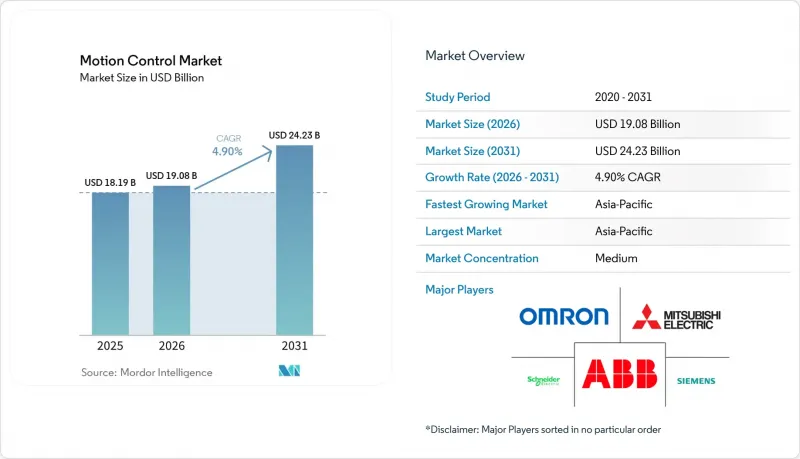
According to Mordor Intelligence, the motion control market size is expected to increase from USD 18.19 billion in 2025 to USD 19.08 billion in 2026 and reach USD 24.23 billion by 2031, growing at a CAGR of 4.90% over 2026-2031.
This report is Segmented by Product Type (Motors, Drives, and More), Technology (Electromechanical, Hydraulic, Pneumatic), System Type (Open Loop, Closed Loop), Axis Type (Single Axis, Multi-Axis), Application (Material Handling, Packaging, and More), End-User Industry (Electronics and Semiconductor, Oil and Gas, and More), and Geography. The Market Forecasts are Provided in Terms of Value (USD).
Global Motion Control Market Trends and Insights
Surge in Demand for Smart Conveyance and Machine-Integrated Robotics
Manufacturers are deploying autonomous mobile robots and AI-driven conveyors to raise throughput and offset labor shortages. Global robotics spending is projected to climb from USD 71.78 billion in 2025 to USD 150.84 billion by 2030, intensifying the need for controllers that manage multi-axis path planning and collision avoidance. With 83% of producers planning to embed generative AI on the plant floor, motion-control firmware now incorporates predictive algorithms that schedule maintenance, balance loads, and self-tune servo gains. These capabilities position smart robotics as a primary catalyst for the motion control market.
Rapid Transition to Decentralised Servo Drives
Moving intelligence from the cabinet to the motor slashes cabling by up to 86% and improves electromagnetic compatibility in the motion control market. Advanced drives now integrate safety PLC, data logging, and edge computing, cutting panel space and boosting line flexibility. SEW-EURODRIVE's MOVIMOT range, rated 0.37-7.5 kW, illustrates this shift with digital motor interfaces and built-in safe torque off functions.
Price Spikes from Rare-Earth Magnet Supply Volatility
Neodymium and dysprosium price swings have inflated servo motor costs by up to 25%, squeezing margins for high-torque motion platforms. Supplier diversification programs and ferrite-based motor R&D are under way, but commercial roll-out will trail the forecast window.
Other drivers and restraints analyzed in the detailed report include:
- Semiconductor Fab Expansions in South Korea and Taiwan
- Electrification of Mobile Hydraulics Upgrading Motion Controllers
- OT-Network Cyber-Security Certification Delays in Europe
For complete list of drivers and restraints, kindly check the Table Of Contents.
Segment Analysis
Motors held 20.78% of the motion control market in 2025, underscoring their status as universal actuators. Growth stems from compact servomotors for robotics, large torque motors for semiconductor steppers, and frameless motors for medical devices. Drives, the intelligence layer between power and position, are the fastest risers at 6.65% CAGR, evolving into edge computers that analyze vibration, temperature, and load in real time. This hardware-software fusion enlarges service revenues as vendors sell predictive algorithms on subscription.
Miniaturization is critical in medical robots that navigate inside MRI bores, while high-power modules like Mitsubishi Electric's 1,500 A HVIGBT raise inverter efficiency for steel mills and wind turbines. Controllers and mechanical systems enjoy steady demand as OEMs retrofit legacy lines to accommodate higher servo bandwidths and safety-rated drives.
Electromechanical platforms dominated the motion control market with a 60.55% share in 2025, favored for clean operation, scalable precision, and straightforward integration with digital twins. The shift toward net-zero processes and lower utility bills accelerates adoption of servo-electric presses, replacing hydraulic counterparts. Pneumatic solutions, now equipped with pressure sensors and IO-Link valves, are expanding at 6.85% CAGR by satisfying low-force pick-and-place tasks where speed trumps accuracy.
The hybridization trend marries electric actuators with proportional hydraulics, allowing force-dense yet energy-efficient motion. Electric linear actuator revenues are projected to climb from USD 20.5 billion in 2022 to USD 34.3 billion by 2032, mirroring sustainability mandates in automotive stamping and food packaging.
Geography Analysis
Asia Pacific held 37.65% of global revenue in 2025, propelled by China's shift from low-cost assembly to high-automation production and South Korea's record semiconductor outlays. India's Production Linked Incentive program is catalyzing electronics parks that specify servo-electric pick-and-place units in SMT lines. Regional policy support, low-cost engineering talent, and rising wages converge to make automation pay back in under two years for many factories.
North America leverages reshoring incentives and tax credits to upgrade brownfield plants with energy-efficient drives. U.S. OEMs emphasize cyber-secure architectures, a response to high-profile ransomware attacks on OT networks. ABB's USD 100 million Wisconsin campus exemplifies investment aimed at shortening supply chains and supporting quick-turn customization.
Europe prioritizes green manufacturing; German automakers retrofit servo presses with energy-recuperation modules to meet Scope 1 targets. The NIS2 directive introduces strict encryption for motion networks, slowing some projects but ultimately fostering resilient architectures. Collaborative robot adoption is high as demographic aging creates skilled-labor gaps, particularly in Italy and Spain.
- ABB Ltd.
- Siemens AG
- Mitsubishi Electric Corporation
- Rockwell Automation, Inc.
- Yaskawa Electric Corporation
- Schneider Electric SE
- Omron Corporation
- Parker Hannifin Corp
- Fanuc Corporation
- Bosch Rexroth AG
- Delta Electronics, Inc.
- Emerson Electric Co.
- Kollmorgen Corporation
- Inovance Technology
- Nidec Corporation
- Novanta Inc.
- Danfoss A/S
- Altra Industrial Motion
- Moog Inc.
- Beckhoff Automation GmbH & Co. KG
- Lenze SE
- Aerotech Inc.
- Allied Motion Technologies Inc.
- NSK Ltd.
- Hiwin Technologies Corp.
Additional Benefits:
- The market estimate (ME) sheet in Excel format
- 3 months of analyst support
TABLE OF CONTENTS
1 INTRODUCTION
- 1.1 Study Assumptions and Market Definition
- 1.2 Scope of the Study
2 RESEARCH METHODOLOGY
3 EXECUTIVE SUMMARY
4 MARKET LANDSCAPE
- 4.1 Market Overview
- 4.2 Market Drivers
- 4.2.1 Surge in demand for smart conveyance and machine-integrated robotics
- 4.2.2 Rapid transition to decentralised servo drives
- 4.2.3 Semiconductor fab expansions in South Korea and Taiwan
- 4.2.4 Electrification of mobile hydraulics upgrading motion controllers
- 4.2.5 Post-FDA Annex 1 modernisation of pharma fill-finish lines
- 4.2.6 India's PLI-backed electronics clusters accelerating servo demand
- 4.3 Market Restraints
- 4.3.1 Price spikes from rare-earth magnet supply volatility
- 4.3.2 OT-network cyber-security certification delays in Europe
- 4.3.3 IGBT and MCU shortages constraining drive shipments
- 4.3.4 Lack of unified programming standards in South America
- 4.4 Value / Supply-Chain Analysis
- 4.5 Regulatory Outlook
- 4.6 Technological Advancements
- 4.7 Porter's Five Forces
- 4.7.1 Bargaining Power of Suppliers
- 4.7.2 Bargaining Power of Buyers
- 4.7.3 Threat of New Entrants
- 4.7.4 Threat of Substitutes
- 4.7.5 Intensity of Competitive Rivalry
5 MARKET SIZE AND GROWTH FORECASTS (VALUE)
- 5.1 By Product Type
- 5.1.1 Motors
- 5.1.2 Drives
- 5.1.3 Controllers
- 5.1.4 Actuators and Mechanical Systems
- 5.1.5 Sensors and Feedback Devices
- 5.1.6 Software and Services
- 5.2 By Technology
- 5.2.1 Electromechanical
- 5.2.2 Hydraulic
- 5.2.3 Pneumatic
- 5.3 By System Type
- 5.3.1 Open Loop
- 5.3.2 Closed Loop
- 5.4 By Axis Type
- 5.4.1 Single Axis
- 5.4.2 Multi-Axis
- 5.5 By Application
- 5.5.1 Material Handling
- 5.5.2 Packaging
- 5.5.3 Assembly and Disassembly
- 5.5.4 Inspection and Testing
- 5.5.5 Robotics
- 5.5.6 3D Printing / Additive Manufacturing
- 5.6 By End-user Industry
- 5.6.1 Electronics and Semiconductor
- 5.6.2 Pharmaceutical / Life Sciences / Medical Devices
- 5.6.3 Oil and Gas
- 5.6.4 Metal and Mining
- 5.6.5 Food and Beverage
- 5.6.6 Automotive
- 5.6.7 Aerospace and Defense
- 5.6.8 Logistics and Warehousing
- 5.7 By Geography
- 5.7.1 North America
- 5.7.1.1 United States
- 5.7.1.2 Canada
- 5.7.1.3 Mexico
- 5.7.2 Europe
- 5.7.2.1 United Kingdom
- 5.7.2.2 Germany
- 5.7.2.3 France
- 5.7.2.4 Italy
- 5.7.2.5 Rest of Europe
- 5.7.3 Asia-Pacific
- 5.7.3.1 China
- 5.7.3.2 Japan
- 5.7.3.3 India
- 5.7.3.4 South Korea
- 5.7.3.5 Rest of Asia-Pacific
- 5.7.4 Middle East and Africa
- 5.7.4.1 Middle East
- 5.7.4.1.1 Israel
- 5.7.4.1.2 Saudi Arabia
- 5.7.4.1.3 United Arab Emirates
- 5.7.4.1.4 Turkey
- 5.7.4.1.5 Rest of Middle East
- 5.7.4.2 Africa
- 5.7.4.2.1 South Africa
- 5.7.4.2.2 Egypt
- 5.7.4.2.3 Rest of Africa
- 5.7.4.1 Middle East
- 5.7.5 South America
- 5.7.5.1 Brazil
- 5.7.5.2 Argentina
- 5.7.5.3 Rest of South America
- 5.7.1 North America
6 COMPETITIVE LANDSCAPE
- 6.1 Market Concentration
- 6.2 Strategic Moves
- 6.3 Market Share Analysis
- 6.4 Company Profiles (includes Global level Overview, Market level overview, Core Segments, Financials as available, Strategic Information, Market Rank/Share for key companies, Products and Services, and Recent Developments)
- 6.4.1 ABB Ltd.
- 6.4.2 Siemens AG
- 6.4.3 Mitsubishi Electric Corporation
- 6.4.4 Rockwell Automation, Inc.
- 6.4.5 Yaskawa Electric Corporation
- 6.4.6 Schneider Electric SE
- 6.4.7 Omron Corporation
- 6.4.8 Parker Hannifin Corp
- 6.4.9 Fanuc Corporation
- 6.4.10 Bosch Rexroth AG
- 6.4.11 Delta Electronics, Inc.
- 6.4.12 Emerson Electric Co.
- 6.4.13 Kollmorgen Corporation
- 6.4.14 Inovance Technology
- 6.4.15 Nidec Corporation
- 6.4.16 Novanta Inc.
- 6.4.17 Danfoss A/S
- 6.4.18 Altra Industrial Motion
- 6.4.19 Moog Inc.
- 6.4.20 Beckhoff Automation GmbH & Co. KG
- 6.4.21 Lenze SE
- 6.4.22 Aerotech Inc.
- 6.4.23 Allied Motion Technologies Inc.
- 6.4.24 NSK Ltd.
- 6.4.25 Hiwin Technologies Corp.
7 MARKET OPPORTUNITIES AND FUTURE OUTLOOK
- 7.1 White-space and Unmet-need Assessment

