PUBLISHER: Mordor Intelligence | PRODUCT CODE: 2061742

PUBLISHER: Mordor Intelligence | PRODUCT CODE: 2061742
Europe Organic Baby Food - Market Share Analysis, Industry Trends & Statistics, Growth Forecasts (2026 - 2031)
According to Mordor Intelligence, the europe organic baby food market size was valued at USD 1.04 billion in 2025 and estimated to grow from USD 1.13 billion in 2026 to reach USD 1.73 billion by 2031, at a CAGR of 8.88% during the forecast period (2026-2031).
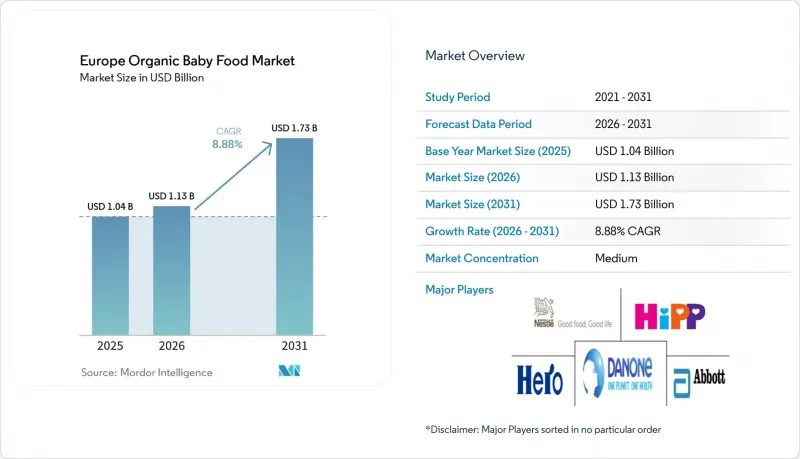
This report is Segmented by Product Type (Milk Formula, Prepared Baby Food, and Dried Baby Food), Age Group (0-6 Months, 6-12 Months, 12-18 Months, and Others), Distribution Channel (Supermarkets/Hypermarkets, Convenience Stores, Specialty Stores, and More), and by Geography (United Kingdom, Germany, France and More). The Market Forecasts are Provided in Terms of Value (USD).
Europe Organic Baby Food Market Trends and Insights
Rise in Parent Awareness for Infant Nutrition
The Europe organic baby food market is experiencing growth driven by increased parental awareness of infant nutrition. European parents are seeking organic, nutrient-rich, and allergen-free baby food options due to concerns about the health impacts of processed foods, artificial additives, and chemical residues. This has led to a preference for organic baby foods with clear labeling that demonstrate safety and quality standards. The market has evolved to meet these consumer needs by developing products enhanced with functional ingredients like probiotics, prebiotics, DHA, ARA, and human milk oligosaccharides (HMOs), which support immune function, cognitive development, and digestive health. In October 2023, Little Freddie introduced a new line of dairy-free yogurt alternatives in the baby food category, featuring two organic yogurt-style pouches in Banana & Raspberry and Strawberry flavors.
EU Organic Certification Stringency Elevates Consumer Trust & Demand
The European Union's organic certification framework, established through Regulation (EU) 2018/848, sets comprehensive standards that enhance consumer trust in organic baby food products . The regulation specifies strict requirements for organic production and labeling, including the prohibition of hydroponic crop production and the requirement for organic livestock feed, ensuring ingredient quality in baby food. This regulatory framework influences parents' purchasing decisions, as they prioritize product safety and reliable certification. The European Union standards, being more stringent than those in other regions, provide European producers with market advantages and attract consumers seeking high-quality products worldwide. The certification process includes strict pesticide residue limits for infant and young children's food, with a general maximum residue level (MRL) of 0.01 mg/kg (European Food Safety Authority, 2024).
Volatility in Organic Raw Material Prices after Ukraine Conflict
The Europe organic baby food market faces significant constraints due to volatile organic raw material prices, intensified by the Ukraine conflict. Ukraine, a major exporter of agricultural commodities like grains and sunflower oil, plays a crucial role in supplying essential ingredients for organic baby food production. The disruption in Ukraine's agricultural operations, distribution networks, and trade routes has created persistent supply chain bottlenecks and shortages across Europe. The termination of the Black Sea Grain Initiative in July 2023 amplified these challenges, as alternative trade routes increased shipping and warehousing costs, which manufacturers transferred to consumers . The combination of supply instability, rising input costs, and inflation has reduced profit margins for organic baby food producers, affecting their ability to maintain stable pricing and consistent supply.
Other drivers and restraints analyzed in the detailed report include:
- Growing Demand for Goat Milk-based Organic Formula
- Strategic Investment by Players
- Regulatory Cap on Sugar Content Restricting Formulation Flexibility
For complete list of drivers and restraints, kindly check the Table Of Contents.
Segment Analysis
Milk formula holds a dominant 46.68% share in for 2025 in Europe organic baby food market, serving as the primary alternative to breastfeeding. This position is strengthened by continuous innovation in organic formulations and strict EU regulations, specifically Delegated Regulation (EU) 2016/127, which enforces high safety and nutritional standards. European organic milk formulas adhere to stringent guidelines on sugar content, with regulations mandating lactose as the main carbohydrate source and restricting certain sugars common in non-European formulas.
Dried baby food is expected to grow at a CAGR of 11.45% from 2026-2031. This growth is attributed to its convenience, long shelf life, and ability to maintain nutritional value without artificial preservatives. The segment benefits from improved freeze-drying and air-drying technologies that preserve nutrients more effectively than traditional heat processing. While prepared baby food maintains a substantial market presence, it faces challenges in shelf-life and cold chain requirements, particularly for organic products. However, high-pressure processing (HPP) technology is helping overcome these limitations by extending product life while maintaining nutritional and sensory qualities.
List of Companies Covered in this Report:
- Danone S.A.
- Nestle S.A.
- HiPP GmbH & Co. Vertrieb KG
- Hero Group
- Abbott Laboratories
- Holle baby food AG
- Andros & Cie
- Little Tummy GmbH
- Piccolo Foods Ltd
- Pumpkin Organics GmbH
- The Hain Celestial Group, Inc.
- Vitagermine SAS
- Royal FrieslandCampina N.V.
- Kendal Nutricare Ltd
- Annabel Karmel Group Holdings Ltd
- Arla Foods amba
- Topfer GmbH
- Kraft Heinz Company
- Orkla ASA
- DMK Baby
Additional Benefits:
- The market estimate (ME) sheet in Excel format
- 3 months of analyst support
TABLE OF CONTENTS
1 INTRODUCTION
- 1.1 Study Assumptions and Market Definition
- 1.2 Scope of the Study
2 RESEARCH METHODOLOGY
3 EXECUTIVE SUMMARY
4 MARKET LANDSCAPE
- 4.1 Market Overview
- 4.2 Market Drivers
- 4.2.1 Rise in Parent Awareness for Infant Nutrition
- 4.2.2 EU Organic Certification Stringency Elevates Consumer Trust & Demand
- 4.2.3 Growing Demand for Goat Milk-based Organic Formula
- 4.2.4 Strategic Investment by Players
- 4.2.5 Enhanced retail distribution networks for organic baby food
- 4.2.6 Growing demand for sustainable and eco-friendly food options
- 4.3 Market Restraints
- 4.3.1 Volatility in Organic Raw Material Prices after Ukraine Conflict
- 4.3.2 Limited Shelf-life Challenges for Fresh/Frozen Organic Baby Food Logistics
- 4.3.3 Regulatory Cap on Sugar Content Restricting Formulation Flexibility
- 4.3.4 Organic farming land scarcity affects ingredient availability
- 4.4 Consumer Behavior Analysis
- 4.5 Regulatory & Technological Outlook
- 4.6 Porter's Five Forces Analysis
- 4.6.1 Threat of New Entrants
- 4.6.2 Bargaining Power of Buyers/Consumers
- 4.6.3 Bargaining Power of Suppliers
- 4.6.4 Threat of Substitute Products
- 4.6.5 Intensity of Competitive Rivalry
5 MARKET SIZE AND GROWTH FORECASTS (VALUE)
- 5.1 By Product Type
- 5.1.1 Milk Formula
- 5.1.2 Prepared Baby Food
- 5.1.3 Dried Baby Food
- 5.2 By Age Group
- 5.2.1 0-6 Months
- 5.2.2 6-12 Months
- 5.2.3 12-18 Months
- 5.2.4 18-24 Months
- 5.2.5 More than 24 months
- 5.3 By Distribution Channel
- 5.3.1 Supermarkets /Hypermarkets
- 5.3.2 Convenience Stores
- 5.3.3 Specialty Stores
- 5.3.4 Pharmacies & Drugstores
- 5.3.5 Online Retail Channels
- 5.3.6 Other Distribution Channels
- 5.4 By Country
- 5.4.1 United Kingdom
- 5.4.2 Germany
- 5.4.3 France
- 5.4.4 Spain
- 5.4.5 Italy
- 5.4.6 Netherlands
- 5.4.7 Sweden
- 5.4.8 Denmark
- 5.4.9 Poland
- 5.4.10 Rest of Europe
6 COMPETITIVE LANDSCAPE
- 6.1 Market Concentration
- 6.2 Strategic Moves
- 6.3 Market Share Analysis
- 6.4 Company Profiles (includes Global level Overview, Market level overview, Core Segments, Financials as available, Strategic Information, Market Rank/Share for key companies, Products and Services, and Recent Developments)
- 6.4.1 Danone S.A.
- 6.4.2 Nestle S.A.
- 6.4.3 HiPP GmbH & Co. Vertrieb KG
- 6.4.4 Hero Group
- 6.4.5 Abbott Laboratories
- 6.4.6 Holle baby food AG
- 6.4.7 Andros & Cie
- 6.4.8 Little Tummy GmbH
- 6.4.9 Piccolo Foods Ltd
- 6.4.10 Pumpkin Organics GmbH
- 6.4.11 The Hain Celestial Group, Inc.
- 6.4.12 Vitagermine SAS
- 6.4.13 Royal FrieslandCampina N.V.
- 6.4.14 Kendal Nutricare Ltd
- 6.4.15 Annabel Karmel Group Holdings Ltd
- 6.4.16 Arla Foods amba
- 6.4.17 Topfer GmbH
- 6.4.18 Kraft Heinz Company
- 6.4.19 Orkla ASA
- 6.4.20 DMK Baby
7 MARKET OPPORTUNITIES AND FUTURE OUTLOOK

