PUBLISHER: Mordor Intelligence | PRODUCT CODE: 2061802

PUBLISHER: Mordor Intelligence | PRODUCT CODE: 2061802
Organic Spices - Market Share Analysis, Industry Trends & Statistics, Growth Forecasts (2026 - 2031)
According to Mordor Intelligence, the organic spices market size is expected to grow from USD 23.12 billion in 2025 to USD 24.57 billion in 2026 and is forecast to reach USD 33.34 billion by 2031 at 6.29% CAGR over 2026-2031.
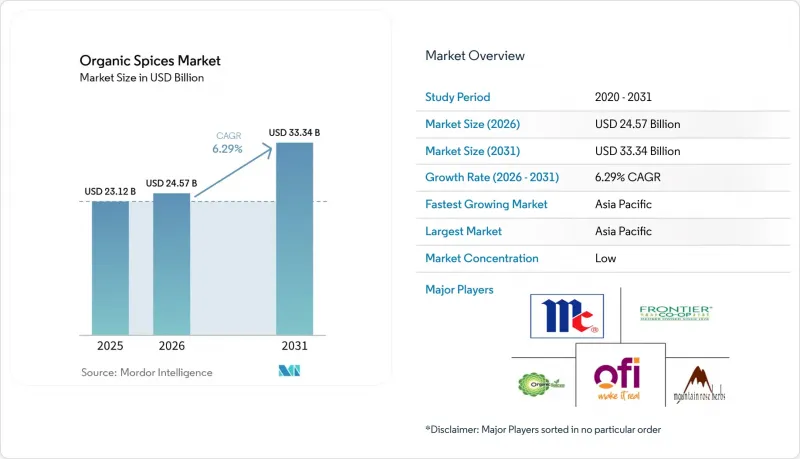
This report is Segmented by Product Type (Pepper, Turmeric, Ginger, Chili, Cinnamon, and More), Form (Whole, Powder, Crushed/Flakes, Others), End User (Food and Beverages, Retail, Foodservice, and Others ), and Geography (North America, Europe, Asia-Pacific, South America, Middle East and Africa). The Market Forecasts are Provided in Terms of Value (USD).
Global Organic Spices Market Trends and Insights
Rising demand for natural, chemical-free, and clean-label food products
The global organic spices market is experiencing significant growth, driven by a strong consumer shift toward natural, chemical-free, and clean-label food products. Ingredient transparency has become a standard expectation. In Europe, this trend has reached maturity, with organic food retail sales accounting for 12% in Denmark and 11% in Switzerland. This growth is fueled by consumers' willingness to pay a premium for certified organic ingredients, as reported by the IFOAM Organization. To meet this demand, food manufacturers are reformulating their offerings with certified organic spices, avoiding synthetic residues. Buyers are increasingly prepared to pay higher prices for verified compliance. Vertically integrated players are well-positioned to capitalize on this trend by securing certified acreage and ensuring a stable long-term supply. Conversely, smaller exporters face challenges due to the financial and administrative burdens of certification. Initiatives aimed at training farmers in sustainable practices and developing certified supply pipelines are enhancing market resilience. However, the market is also consolidating, as only well-capitalized processors can manage the multi-year conversion periods and rigorous audit requirements. Ultimately, the growing preference for clean-label products in the organic spices market is not only influencing consumer behavior but also redefining competitive dynamics, driving the industry toward sustainability, transparency, and long-term supply security.
Stringent government regulations and certifications promoting organic farming
Stringent government regulations and certification frameworks, emphasizing documentation, traceability, and fraud prevention, are increasingly shaping the global organic spices market. In the United States, the European Union, and India, updated rules are elevating compliance demands. This shift in the organic spices market poses challenges for smallholder farmers and under-capitalized exporters, while larger, vertically integrated players, adept at absorbing certification costs and navigating intricate audits, find themselves at an advantage. Beginning March 2024, the USDA's Strengthening Organic Enforcement (SOE) rule is set to redefine compliance within the organic spice supply chain. As underscored by SCS Global Services, the new regulation requires NOP Import Certificates for all imported organic products and extends certification mandates to include brokers and traders. Rather than mere obstacles, these intertwined regulatory layers serve as competitive moats, granting disciplined suppliers assured market access and premium positioning. Consequently, the industry is gravitating towards well-capitalized processors and multinational collaborations, with sustainability and compliance emerging as cornerstones for enduring growth.
Higher production costs compared to conventional spices
The global organic spices market is constrained by higher production costs compared to conventional spices. Organic farming involves labor-intensive practices, lower yields, and reliance on expensive inputs such as biofertilizers and biopesticides. Furthermore, the certification process adds financial and administrative challenges. Smallholder farmers, in particular, face difficulties due to lengthy conversion periods and audit expenses, often lacking the scale to absorb these costs. This has resulted in a fragmented supply base, where well-capitalized grower groups and multinational-linked contract farmers gain a competitive edge, while smaller producers struggle to remain viable or exit the market. The high cost structure limits market penetration into price-sensitive segments, concentrating demand in affluent markets where consumers prioritize health and sustainability. Processors can address some of these challenges by offering value-added services such as sterilization, private labeling, and advanced packaging. However, these services require significant scale and investment capacity, which many regional players lack, further strengthening the competitive position of larger, integrated suppliers.
Other drivers and restraints analyzed in the detailed report include:
- Surge in ethnic and convenience cuisine consumption
- Rapid expansion of organized retail and e-commerce
- Risk of contamination or adulteration in the supply chain
For complete list of drivers and restraints, kindly check the Table Of Contents.
Segment Analysis
In 2025, pepper will hold a commanding 38.62% share of the global organic spices market, driven by its extensive culinary applications and versatility. However, turmeric is set to redefine the organic spices market dynamics, achieving a strong CAGR of 8.40% through 2031 as it transitions toward functional-wellness applications. Valued for its anti-inflammatory and antioxidant properties, turmeric is experiencing increased demand from nutraceutical manufacturers and health-focused food processors. Nonetheless, climate variability and yield-related risks pose challenges to scaling production. Concurrently, spices such as ginger, chili, and cinnamon continue to witness stable demand across culinary and medicinal segments but face supply chain disruptions and competitive pressures from lower-cost producers. On the other hand, cardamom, cloves, and cumin are gaining traction, supported by the growing popularity of ethnic cuisines and premium single-origin offerings.
Turmeric's functional shift underscores a broader market trend where product growth is diverging from traditional culinary demand and aligning with health and wellness priorities. Buyers are increasingly seeking high-curcumin varieties and comprehensive certificates of analysis, incentivizing suppliers to invest in varietal optimization, controlled drying techniques, and advanced quality testing. Additionally, industry-led initiatives focused on enhancing farmer capabilities, sustainability, and transparency are emerging as critical competitive advantages. This evolution indicates that future growth in the organic spices market will favor spices with documented bioactive properties and certified-organic traceability. These developments are reshaping the competitive landscape, positioning wellness-driven applications as the primary growth driver for the organic spices market.
Geography Analysis
Asia-Pacific, accounting for a 41.34% share in 2025, stands as the dominant force in the global organic spices market, with projections of a 7.80% growth rate extending through 2031. Central to this growth is India, bolstered by its robust certification frameworks and export infrastructure. The region's significance is underscored by rising demands in China and Japan, alongside premium niches in Australia and New Zealand. However, challenges persist: fragmented smallholder farming and contamination risks threaten credibility, underscoring the critical need for traceability and compliance to ensure sustained growth.
North America and Europe lead as the primary import markets, imposing stringent certification and traceability standards. While these standards elevate barriers to entry, they also reward those suppliers who maintain discipline. In the United States, organized retail chains emphasize consistency and packaging integrity. Conversely, Europe's fragmented market landscape provides opportunities for artisanal and single-origin brands. Both continents are witnessing a surge in e-commerce, facilitating direct-to-consumer models. This shift amplifies the influence of brands adept at cultivating loyalty through narratives of provenance and sustainability.
Regions like South America, the Middle East, and Africa are emerging as new frontiers of opportunity. Brazil and Argentina are ramping up cultivation efforts, aiming to rival traditional Asian sources. Meanwhile, the Middle East is not only consuming but also re-exporting, aligning its offerings with Halal and clean-label trends. Africa, with its wild collection areas, harbors immense potential in the organic spices market, though it grapples with certification and infrastructure hurdles. These developments illustrate a clear divide: established markets prioritize stringent compliance, while emerging regions boast cost advantages and untapped supply opportunities.
- McCormick & Company, Inc.
- Olam Group Limited
- Frontier Co-op
- Organic Spices Inc.
- Mountain Rose Herbs
- Associated British Foods plc
- Pacific Spice Company, Inc.
- Starwest Botanicals, LLC
- Red Monkey Foods, Inc.
- Banyan Botanicals
- Badia Spices
- The Alma Food Group LLC (Loisa)
- Whole Spice Inc.
- Spicy Organic LLC
- Organic India Pvt. Ltd.
- Smith & Truslow
- The Spice Lab
- The Watkins Co.
- Morton & Bassett
- JustIngredients Limited
Additional Benefits:
- The market estimate (ME) sheet in Excel format
- 3 months of analyst support
TABLE OF CONTENTS
1 INTRODUCTION
- 1.1 Study Assumptions and Market Definition
- 1.2 Scope of the Study
2 RESEARCH METHODOLOGY
3 EXECUTIVE SUMMARY
4 MARKET LANDSCAPE
- 4.1 Market Overview
- 4.2 Market Drivers
- 4.2.1 Rising demand for natural, chemical-free, and clean-label food products
- 4.2.2 Stringent government regulations and certifications promoting organic farming
- 4.2.3 Surge in ethnic and convenience cuisine consumption
- 4.2.4 Rapid expansion of organized retail and e-commerce
- 4.2.5 Growth in international trade and export opportunities
- 4.2.6 Increasing demand from food processing and packaged food industries
- 4.3 Market Restraints
- 4.3.1 Higher production costs compared to conventional spices
- 4.3.2 Risk of contamination or adulteration in the supply chain
- 4.3.3 Climate-induced yield volatility in key origins
- 4.3.4 Competition from conventional and non-certified "natural" spice products
- 4.4 Supply Chain Analysis
- 4.5 Regulatory Outlook
- 4.6 Porter's Five Forces
- 4.6.1 Threat of New Entrants
- 4.6.2 Bargaining Power of Buyers/Consumers
- 4.6.3 Bargaining Power of Suppliers
- 4.6.4 Threat of Substitute Products
- 4.6.5 Intensity of Competitive Rivalry
5 MARKET SIZE & GROWTH FORECASTS (VALUE)
- 5.1 Product Type
- 5.1.1 Pepper
- 5.1.2 Turmeric
- 5.1.3 Ginger
- 5.1.4 Chili
- 5.1.5 Cinnamon
- 5.1.6 Coriander
- 5.1.7 Cumin
- 5.1.8 Mustard
- 5.1.9 Cardamom
- 5.1.10 Cloves
- 5.1.11 Others
- 5.2 Form
- 5.2.1 Whole
- 5.2.2 Powder
- 5.2.3 Crushed/Flakes
- 5.2.4 Others
- 5.3 End User
- 5.3.1 Food and Beverages
- 5.3.2 Retail
- 5.3.3 Foodservice
- 5.3.4 Others
- 5.4 Geography
- 5.4.1 North America
- 5.4.1.1 United States
- 5.4.1.2 Canada
- 5.4.1.3 Mexico
- 5.4.1.4 Rest of North America
- 5.4.2 Europe
- 5.4.2.1 Germany
- 5.4.2.2 United Kingdom
- 5.4.2.3 Italy
- 5.4.2.4 France
- 5.4.2.5 Spain
- 5.4.2.6 Netherlands
- 5.4.2.7 Poland
- 5.4.2.8 Belgium
- 5.4.2.9 Sweden
- 5.4.2.10 Rest of Europe
- 5.4.3 Asia-Pacific
- 5.4.3.1 China
- 5.4.3.2 India
- 5.4.3.3 Japan
- 5.4.3.4 Australia
- 5.4.3.5 Indonesia
- 5.4.3.6 South Korea
- 5.4.3.7 Thailand
- 5.4.3.8 Singapore
- 5.4.3.9 Rest of Asia-Pacific
- 5.4.4 South America
- 5.4.4.1 Brazil
- 5.4.4.2 Argentina
- 5.4.4.3 Colombia
- 5.4.4.4 Chile
- 5.4.4.5 Peru
- 5.4.4.6 Rest of South America
- 5.4.5 Middle East and Africa
- 5.4.5.1 South Africa
- 5.4.5.2 Saudi Arabia
- 5.4.5.3 United Arab Emirates
- 5.4.5.4 Nigeria
- 5.4.5.5 Egypt
- 5.4.5.6 Morocco
- 5.4.5.7 Turkey
- 5.4.5.8 Rest of Middle East and Africa
- 5.4.1 North America
6 COMPETITIVE LANDSCAPE
- 6.1 Market Concentration
- 6.2 Strategic Moves
- 6.3 Market Ranking Analysis
- 6.4 Company Profiles (includes Global-level Overview, Market-level Overview, Core Segments, Financials (if available), Strategic Information, Market Rank/Share, Products and Services, Recent Developments)
- 6.4.1 McCormick & Company, Inc.
- 6.4.2 Olam Group Limited
- 6.4.3 Frontier Co-op
- 6.4.4 Organic Spices Inc.
- 6.4.5 Mountain Rose Herbs
- 6.4.6 Associated British Foods plc
- 6.4.7 Pacific Spice Company, Inc.
- 6.4.8 Starwest Botanicals, LLC
- 6.4.9 Red Monkey Foods, Inc.
- 6.4.10 Banyan Botanicals
- 6.4.11 Badia Spices
- 6.4.12 The Alma Food Group LLC (Loisa)
- 6.4.13 Whole Spice Inc.
- 6.4.14 Spicy Organic LLC
- 6.4.15 Organic India Pvt. Ltd.
- 6.4.16 Smith & Truslow
- 6.4.17 The Spice Lab
- 6.4.18 The Watkins Co.
- 6.4.19 Morton & Bassett
- 6.4.20 JustIngredients Limited
7 MARKET OPPORTUNITIES & FUTURE OUTLOOK

