PUBLISHER: Mordor Intelligence | PRODUCT CODE: 2061803

PUBLISHER: Mordor Intelligence | PRODUCT CODE: 2061803
Sneakers - Market Share Analysis, Industry Trends & Statistics, Growth Forecasts (2026 - 2031)
According to Mordor Intelligence, the sneakers market size is expected to grow from USD 94.61 billion in 2025 and USD 100.48 billion in 2026 to USD 143.66 billion by 2031, registering a CAGR of 7.41% between 2026 and 2031.
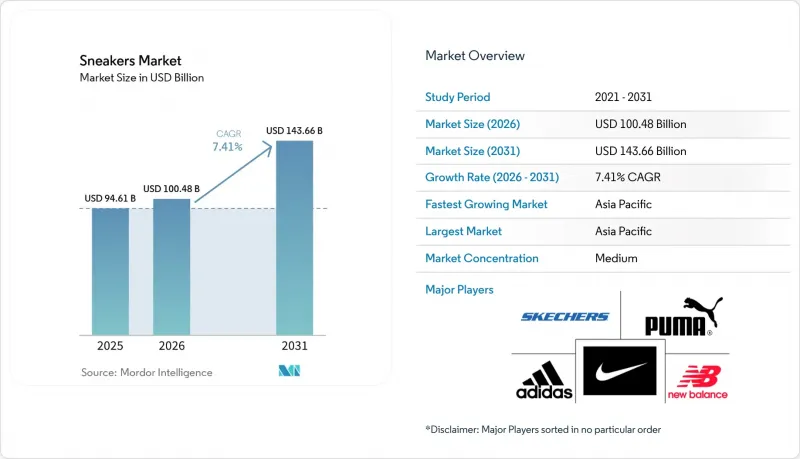
This report is Segmented by Product Type (Athletic Sneakers and Lifestyle and Fashion Sneakers), End User (Men, Women and Children), Price Range (Mass and Premium), Distribution Channel (Supermarkets/Hypermarkets, Specialty Stores, and More), and Geography (North America, Europe, Asia-Pacific, South America, and Middle East and Africa). The Market Forecasts are Provided in Terms of Value (USD).
Global Sneakers Market Trends and Insights
Growing trends in athleisure and lifestyle-oriented fashion
Athleisure has transitioned from a niche trend to a central driver of growth in the global sneaker industry, with footwear increasingly designed to move seamlessly between workouts, workplaces, and social settings. Easing dress codes in the post-pandemic era has further accelerated this shift, as consumers prioritize versatility alongside style. Lifestyle-oriented sneaker categories are now expanding faster than purely performance-driven segments, reflecting demand for products that balance everyday wear with athletic functionality. Reflecting deeper wellness-oriented trends, Americans aged 15 and over spent an average of 5.5 hours per day on leisure and sports activities in 2024, marking a continued rise in active lifestyles . Brands in the sneakers market are responding by integrating performance innovations such as advanced cushioning and lightweight materials with premium finishes and fashion-led aesthetics. At the same time, retro-inspired designs are gaining traction, driven by nostalgia among consumers with higher disposable incomes. The growing popularity of platform sneakers, particularly among women, highlights demand for comfort combined with style enhancement. Moving forward, companies must strike a balance between innovation, affordability, and multi-functional appeal to sustain growth across diverse consumer segments.
Escalating focus on health, wellness, and active lifestyles
The global sneaker market is increasingly shaped by casual fitness participants and wellness-focused consumers, rather than just professional athletes. A growing base of runners, walkers, and everyday users is expanding demand for footwear that prioritizes comfort, injury prevention, and durability over purely performance-driven features. According to the World Health Organization, 31% of adults do not meet recommended activity levels, projected to reach 35% by 2030, implying that nearly 69% of the population engages in some form of physical activity . This broad participation in the sneakers market is encouraging brands to invest in advanced cushioning technologies and energy-return materials to enhance everyday movement. Recent product innovations highlight a strong focus on resilience and long-distance comfort, catering to users with consistent, moderate activity levels. The emergence of lifestyle-oriented sports and informal fitness routines is also driving demand for versatile sneakers that combine functionality with style. As a result, consumers are increasingly willing to pay premium prices for footwear that delivers tangible health and comfort benefits. Sustained growth in this segment will depend on how effectively brands balance technical innovation with real-world usability.
Premium product pricing limiting accessibility
In the sneakers market, economic pressures and shifting purchasing power are reshaping footwear demand, particularly in emerging markets where consumers are becoming increasingly value-conscious. High-end products remain inaccessible to a large share of buyers, driving many toward mid-tier or alternative options. While premiumization supports stronger margins, it also constrains volume growth and limits penetration across broader consumer segments. In response, brands are introducing more accessible premium offerings to attract aspirational consumers without diluting their core identity. However, maintaining brand equity amid rising price sensitivity remains a critical challenge, especially as promotional strategies risk conditioning consumers to expect discounts. Long-term success will depend on optimizing manufacturing processes, improving supply chain efficiencies, and adopting smarter value engineering to manage costs effectively. Additionally, brands must strengthen perceived value through durability, innovation, and design differentiation rather than relying solely on branding. Striking the right balance between exclusivity and accessibility will be key to sustaining growth in a constrained consumer environment.
Other drivers and restraints analyzed in the detailed report include:
- Increasing emphasis on sustainable and eco-conscious innovations
- Expansion of digital platforms and e-commerce channels
- Widespread counterfeit products undermining brand trust
For complete list of drivers and restraints, kindly check the Table Of Contents.
Segment Analysis
Athletic sneakers remain the cornerstone of the sneakers market, accounting for 55.87% of total share in 2025, underscoring their continued importance in driving overall category performance. Their leadership is anchored in continuous advancements in cushioning systems, stability features, and high-performance materials that cater to both serious athletes and everyday users. Increasing participation in fitness activities, particularly running, is further reinforcing demand, while brands are elevating value perception through innovations focused on comfort and injury prevention. At the same time, the integration of performance technologies into mainstream designs is making athletic footwear more versatile, extending its relevance beyond purely sports-driven use cases.
In parallel, lifestyle and fashion sneakers are emerging as the fastest-growing segment, projected to expand at a CAGR of 7.85% through 2031, fueled by rising consumer preference for multi-functional footwear. Buyers are increasingly seeking designs that seamlessly transition from active settings to casual and social environments, driving the popularity of hybrid silhouettes. This has led brands to blend technical features with minimalist aesthetics, retro influences, and trend-driven elements to capture younger demographics. The growing overlap between performance and lifestyle categories is reshaping market dynamics, pushing companies to strike a balance between maintaining technical credibility and delivering strong visual appeal to sustain differentiation in an increasingly competitive landscape.
In 2025, the men's category continues to lead the athletic sneaker market, accounting for 53.45% of total volume, underpinned by strong demand in performance-driven categories such as basketball and training. Despite this dominance, the market landscape is gradually evolving as brands rebalance their focus across demographics. The children's segment remains stable, supported by consistent replacement cycles due to rapid foot growth and increasing parental emphasis on durability, comfort, and foot health. Features such as reinforced materials and appealing designs further strengthen demand in this category. As a result, companies are increasingly tailoring product portfolios and retail strategies to address distinct usage occasions and consumer expectations across age groups.
At the same time, the women's segment is emerging as the fastest-growing, projected to expand at a CAGR of 7.93%, signaling a meaningful shift in consumer dynamics. This growth is driven by greater female participation in sports, rising demand for performance-equivalent products, and a shift away from legacy design approaches toward inclusive sizing and purpose-built innovation. Leading brands are strengthening their positioning through athlete partnerships, community engagement, and enhanced customization options that align with lifestyle and fashion preferences. While men continue to prioritize performance and brand legacy, women increasingly value a balance of comfort, aesthetics, and authenticity, prompting brands to refine research and development, marketing, and merchandising strategies to better capture this accelerating opportunity.
Geography Analysis
Asia-Pacific stands as both the largest and fastest-expanding sneakers market, accounting for 32.28% of global revenue in 2025 and projected to grow at a robust 8.52% CAGR through 2031. This momentum is fueled by rising disposable incomes, rapid urbanization, and a large youth population that increasingly views sneakers as lifestyle and status symbols. Markets such as China, India, and Southeast Asia are witnessing strong traction, supported by a mix of global brands and competitive regional players offering value-driven innovation. Expansion into tier-2 and tier-3 cities, along with the rise of affordable-premium offerings, is further accelerating penetration. However, supply chain dependencies and geopolitical uncertainties continue to pose structural risks.
North America and Europe represent mature yet highly profitable markets, driven by premiumization, strong brand equity, and evolving consumer expectations. In these regions, sneakers are positioned at the intersection of performance, fashion, and identity, supported by influencer culture and a well-established resale ecosystem that amplifies exclusivity. Europe, in particular, is at the forefront of sustainability, with consumers actively demanding eco-friendly materials and transparent sourcing practices. While market saturation limits volume growth, continuous innovation, limited-edition launches, and sustainability-led differentiation are key levers for maintaining engagement and pricing power.
Emerging regions including the Middle East, South America, and Africa present significant long-term growth opportunities, albeit from a smaller base. The Middle East is rapidly developing into a high-value market, driven by affluent consumers and a growing appetite for exclusive sneaker drops and resale culture. Meanwhile, South America and Africa benefit from young, urbanizing populations with increasing interest in global fashion and sports trends. Despite challenges such as economic volatility, lower purchasing power, and underdeveloped retail infrastructure, brands can unlock growth through localized strategies, flexible pricing models, and improved distribution networks tailored to regional dynamics.
- Nike, Inc.
- Adidas AG
- Puma SE
- Skechers USA, Inc.
- New Balance Athletics, Inc.
- ASICS Corporation
- Under Armour Inc.
- VF Corporation
- Mizuno Corporation
- Authentic Brands Group LLC
- Misto Holdings Corp.
- Li-Ning Company Limited
- Anta Sports Products Limited
- On Holding AG
- Brooks Sports, Inc.
- Deckers Outdoor Corporation
- Wolverine Worldwide, Inc.
- E-Land Group
- Golden Goose Group S.p.A.
- Allbirds Inc.
Additional Benefits:
- The market estimate (ME) sheet in Excel format
- 3 months of analyst support
TABLE OF CONTENTS
1 INTRODUCTION
- 1.1 Study Assumptions and Market Definition
- 1.2 Scope of the Study
2 RESEARCH METHODOLOGY
3 EXECUTIVE SUMMARY
4 MARKET LANDSCAPE
- 4.1 Market Overview
- 4.2 Market Drivers
- 4.2.1 Growing trends in athleisure and lifestyle-oriented fashion
- 4.2.2 Escalating focus on health, wellness, and active lifestyles
- 4.2.3 Increasing emphasis on sustainable and eco-conscious innovations
- 4.2.4 Popularity of limited releases, brand collaborations, and hype-driven culture
- 4.2.5 Expansion of digital platforms and e-commerce channels
- 4.2.6 Risng demand for personalized and customizable products
- 4.3 Market Restraints
- 4.3.1 Premium product pricing limiting accessibility
- 4.3.2 Short-lived fashion trends limiting long-term demand
- 4.3.3 Widespread counterfeit products undermining brand trust
- 4.3.4 Supply chain challenges disrupting product availability
- 4.4 Consumer Behavior Analysis
- 4.5 Regulatory Landscape
- 4.6 Technological Outlook
- 4.7 Porter's Five Forces
- 4.7.1 Threat of New Entrants
- 4.7.2 Bargaining Power of Suppliers
- 4.7.3 Bargaining Power of Buyers
- 4.7.4 Threat of Substitutes
- 4.7.5 Competitive Rivalry
5 MARKET SIZE AND GROWTH FORECASTS (VALUE)
- 5.1 By Product Type
- 5.1.1 Atheltic Sneakers
- 5.1.2 Lifestyle and Fashion Sneakers
- 5.2 By End User
- 5.2.1 Men
- 5.2.2 Women
- 5.2.3 Children
- 5.3 By Price Range
- 5.3.1 Mass
- 5.3.2 Premium
- 5.4 By Distribution Channel
- 5.4.1 Supermarkets/Hypermarkets
- 5.4.2 Specialty Stores
- 5.4.3 Online Retail Stores
- 5.4.4 Other Distribution Channels
- 5.5 By Geography
- 5.5.1 North America
- 5.5.1.1 United States
- 5.5.1.2 Canada
- 5.5.1.3 Mexico
- 5.5.1.4 Rest of North America
- 5.5.2 Europe
- 5.5.2.1 Germany
- 5.5.2.2 United Kingdom
- 5.5.2.3 Italy
- 5.5.2.4 France
- 5.5.2.5 Spain
- 5.5.2.6 Netherlands
- 5.5.2.7 Poland
- 5.5.2.8 Belgium
- 5.5.2.9 Sweden
- 5.5.2.10 Rest of Europe
- 5.5.3 Asia-Pacific
- 5.5.3.1 China
- 5.5.3.2 India
- 5.5.3.3 Japan
- 5.5.3.4 Australia
- 5.5.3.5 Indonesia
- 5.5.3.6 South Korea
- 5.5.3.7 Thailand
- 5.5.3.8 Singapore
- 5.5.3.9 Rest of Asia-Pacific
- 5.5.4 South America
- 5.5.4.1 Brazil
- 5.5.4.2 Argentina
- 5.5.4.3 Colombia
- 5.5.4.4 Chile
- 5.5.4.5 Peru
- 5.5.4.6 Rest of South America
- 5.5.5 Middle East and Africa
- 5.5.5.1 South Africa
- 5.5.5.2 Saudi Arabia
- 5.5.5.3 United Arab Emirates
- 5.5.5.4 Nigeria
- 5.5.5.5 Egypt
- 5.5.5.6 Morocco
- 5.5.5.7 Turkey
- 5.5.5.8 Rest of Middle East and Africa
- 5.5.1 North America
6 COMPETITIVE LANDSCAPE
- 6.1 Market Concentration
- 6.2 Strategic Moves
- 6.3 Market Share Analysis
- 6.4 Company Profiles (includes Global level Overview, Market level overview, Core Segments, Financials as available, Strategic Information, Market Rank/Share for key companies, Products and Services, and Recent Developments)
- 6.4.1 Nike, Inc.
- 6.4.2 Adidas AG
- 6.4.3 Puma SE
- 6.4.4 Skechers USA, Inc.
- 6.4.5 New Balance Athletics, Inc.
- 6.4.6 ASICS Corporation
- 6.4.7 Under Armour Inc.
- 6.4.8 VF Corporation
- 6.4.9 Mizuno Corporation
- 6.4.10 Authentic Brands Group LLC
- 6.4.11 Misto Holdings Corp.
- 6.4.12 Li-Ning Company Limited
- 6.4.13 Anta Sports Products Limited
- 6.4.14 On Holding AG
- 6.4.15 Brooks Sports, Inc.
- 6.4.16 Deckers Outdoor Corporation
- 6.4.17 Wolverine Worldwide, Inc.
- 6.4.18 E-Land Group
- 6.4.19 Golden Goose Group S.p.A.
- 6.4.20 Allbirds Inc.
7 MARKET OPPORTUNITIES AND FUTURE OUTLOOK

