PUBLISHER: Mordor Intelligence | PRODUCT CODE: 2061806

PUBLISHER: Mordor Intelligence | PRODUCT CODE: 2061806
Fast Food - Market Share Analysis, Industry Trends & Statistics, Growth Forecasts (2026 - 2031)
According to Mordor Intelligence, the fast food market is projected to grow significantly, increasing from USD 1.65 trillion in 2025 to USD 1.78 trillion in 2026 and reaching USD 2.57 trillion by 2031, reflecting a CAGR of 7.62% over the 2026-2031 period.
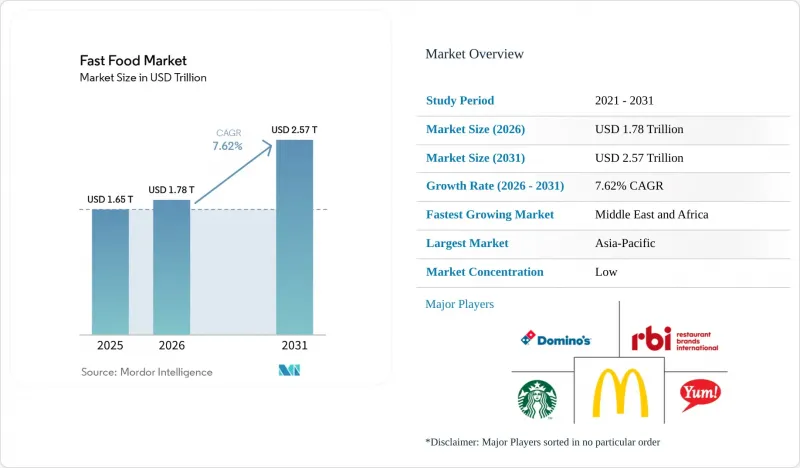
This report is Segmented by Product Type (Burger and Sandwiches, Pizza, and More), Cuisine Type (Asian, American, and More), Restaurant Type (Kiosks and Vending, Fast-Casual Restaurants, and More), Ordering Channel (Dine-In, Drive-Thru/Takeaway, and More), Outlet Type (Independent Outlets and Chain Outlets), and Geography (North America, Europe, and More). The Market Forecasts are Provided in Terms of Value (USD).
Global Fast Food Market Trends and Insights
Increasingly hectic lifestyles are driving demand for convenient, ready-to-eat meal options
Increasing employment levels and busier lifestyles are driving global demand for convenient, ready-to-eat fast food options. With global employment projected to reach 95.1% in July 2025, according to the Organisation for Economic Co-operation and Development, more dual-income households and longer commutes are reducing the time available for home cooking, leading consumers to replace full meals with snacks. To address this trend, operators are introducing portable, high-protein products, such as protein cups, for on-the-go consumption. Chains such as Chipotle launched high-protein bowls in December 2025 to meet rising demand for quick, protein-rich meals. Similarly, Starbucks expanded its protein beverage lineup, offering options with up to 30 grams per serving to attract consumers seeking convenient nutrition. Furthermore, modular menu strategies enable large chains to quickly adjust offerings across dayparts, aligning with a broader market trend favoring portability and convenience over traditional dine-in experiences.
Technological advancements such as mobile ordering, digital payments, and self-service kiosks
Technological advancements, including mobile ordering, digital payments, AI, and self-service kiosks, are reshaping efficiency and the customer experience in the fast food market. According to Phys.org, approximately two-thirds of American consumers used a food-ordering app at least once for takeout or delivery in 2024, demonstrating strong digital adoption. Operators are expanding these capabilities, with Yum! Brands are processing over 2 million AI-powered voice orders across 300 Taco Bell locations in 2024. Additionally, McDonald's reported digital sales surpassing USD 10 billion in 2025, accounting for nearly 20% of system revenue, while Starbucks implemented Smart Queue sequencing and AI-based scheduling to cut peak service times to under four minutes, as noted by Starbucks. These digital systems improve accuracy, reduce labor dependency, and provide valuable customer insights, positioning them as key growth drivers in the fast food market.
Rising concerns regarding obesity, diabetes, and lifestyle-related diseases
Growing concerns about obesity, diabetes, and other lifestyle-related diseases are hindering the growth of the fast food market. According to the World Obesity Federation's 2025 Atlas, the number of adults with obesity is expected to rise by over 115%, from 524 million in 2010 to 1.13 billion by 2030, increasing public health scrutiny. In response, governments are implementing stricter regulations. For instance, the U.S. Food and Drug Administration's plans to introduce front-of-pack labeling rules in spring 2026, requiring clear icons for saturated fat, sodium, and added sugars. Similarly, Canada implemented comparable warning measures in January 2026. While fast food chains are introducing healthier options, such as high-protein and reduced-sugar products, these reformulations increase costs. Additionally, heightened consumer awareness is driving a shift toward healthier alternatives, such as meal kits, thereby limiting growth in fast food demand.
Other drivers and restraints analyzed in the detailed report include:
- Global Cuisine Offerings Attract Adventurous And Diverse Customer Bases
- Growing exposure to global cuisines and western food culture
- Increasing competition from healthier alternatives such as home-cooked meals, and meal kits
For complete list of drivers and restraints, kindly check the Table Of Contents.
Segment Analysis
Burgers and sandwiches accounted for the largest share of the fast food market in 2025, contributing 38.75% of total revenue. This breakdown shows that consumers prefer quick, portable meal options, though there is growing interest in diverse menu choices. Despite the rise of niche offerings, traditional fast food items like burgers and pizza continue to dominate the market due to their widespread popularity and convenience.
Looking ahead, pizza is expected to grow the fastest, with a CAGR of 8.18% during 2026-2031. This growth is driven by innovations in flavors and premium product offerings. Burgers and sandwiches are projected to grow steadily, supported by consistent consumer demand and new product launches by major brands. On the other hand, niche categories such as meat-based snacks and seafood are likely to grow more slowly. This slower growth is primarily due to challenges in managing supply chains and maintaining consistent quality across multiple outlets, which makes scaling these categories more difficult.
In 2025, American-style fast food accounted for 42.54% of the market share. This was largely due to the widespread appeal of items like burgers, fried chicken, and fries. Italian food, including pizza and pasta, also captured a significant portion of the market, thanks to its global popularity and suitability for delivery services. The remaining market share was split between Asian cuisines and other categories, such as Middle Eastern, fusion, and emerging regional options. This distribution highlights the strong presence of Western fast food while also showcasing the growing interest in diverse food choices.
Asian cuisine is expected to grow the fastest through 2031, with a projected CAGR of 9.58%. This growth is driven by increasing demand for bold flavors and the perception of healthier meal options. Italian food is expected to grow at a moderate pace, supported by the continued popularity of pizza across delivery channels. Meanwhile, American fast food is likely to see steady but slower growth as consumers explore a wider variety of cuisines. These trends indicate a gradual shift in global fast food preferences, with more people seeking diverse, unique dining experiences.
Geography Analysis
Asia-Pacific led the global fast food market in 2025, accounting for 43.82% of total revenue. This dominance is due to the region's large urban population and growing demand for convenient food options. The rapid growth of organized fast food chains and the increasing presence of international brands are key drivers of this market. Additionally, rising disposable incomes and changing eating habits are boosting demand. The region's market position is further strengthened by the continuous opening of new outlets and consolidation among players, making it the most dynamic contributor globally.
The Middle East and Africa are expected to grow the fastest in the fast food market, with a projected CAGR of 8.95% over the forecast period. This growth is fueled by a young, growing population and increasing urbanization. Global fast food companies are investing heavily in the region, supported by favorable business conditions. Lower real estate and operational costs are also helping brands expand more easily. As a result, the region is becoming a key focus for fast food companies seeking high-growth opportunities.
North America remains a mature and highly competitive market, supported by strong brand presence and a dense network of outlets. Growth in this region is driven by menu innovations, value-based offerings, and efforts to improve customer experiences. Europe is expected to see steady growth, driven by premiumization trends and shifting consumer preferences, despite regulatory challenges. In South America, urbanization and a growing middle class are contributing to gradual market expansion. The increasing presence of international fast food chains in these regions is further supporting stable and consistent growth.
- McDonald's Corporation
- Starbucks Corporation
- Yum! Brands Inc.
- Restaurant Brands International Inc.
- Domino's Pizza Inc.
- Wendy's International LLC
- Chipotle Mexican Grill Inc.
- CFA Properties Inc. (Chick-fil-A)
- Papa John's International Inc.
- Roark Capital (Inspire Brands, Arby's, Dunkin', etc.)
- Jollibee Foods Corporation
- JAB Holding Company (Pret, Panera)
- Panda Restaurant Group Inc.
- Five Guys Enterprises LLC
- Ilitch Holdings Inc. (Little Caesars)
- Greggs plc
- Nando's Group Holdings Ltd.
- Roark Capital Group (CKE)
- Krispy Kreme Inc.
- Berkshire Hathaway Inc.
Additional Benefits:
- The market estimate (ME) sheet in Excel format
- 3 months of analyst support
TABLE OF CONTENTS
1 INTRODUCTION
- 1.1 Study Assumptions and Market Definition
- 1.2 Scope of the Study
2 RESEARCH METHODOLOGY
3 EXECUTIVE SUMMARY
4 MARKET LANDSCAPE
- 4.1 Market Overview
- 4.2 Market Drivers
- 4.2.1 Increasingly hectic lifestyles are driving demand for convenient, ready-to-eat meal options
- 4.2.2 Strong branding, promotional strategies, and value meal offerings
- 4.2.3 Continuous menu innovation, including the introduction of healthier and fusion options
- 4.2.4 Growing exposure to global cuisines and western food culture
- 4.2.5 Aggressive expansion of quick service restaurant chains
- 4.2.6 Technological advancements such as mobile ordering, digital payments, and self-service kiosks
- 4.3 Market Restraints
- 4.3.1 Rising concerns regarding obesity, diabetes, and lifestyle-related diseases
- 4.3.2 Increasing competition from healthier alternatives such as home-cooked meals, and meal kits
- 4.3.3 Stringent government regulations related to food safety, labeling, and nutritional disclosures
- 4.3.4 Fluctuations in raw material prices, including edible oils, meat, and dairy
- 4.4 Supply Chain Analysis
- 4.5 Regulatory Outlook
- 4.6 Porter's Five Forces
- 4.6.1 Threat of New Entrants
- 4.6.2 Bargaining Power of Buyers
- 4.6.3 Bargaining Power of Suppliers
- 4.6.4 Threat of Substitute Products
- 4.6.5 Intensity of Competitive Rivalry
5 MARKET SIZE AND GROWTH FORECASTS (VALUE)
- 5.1 By Product Type
- 5.1.1 Burgers and Sandwiches
- 5.1.2 Meat-Based Products
- 5.1.3 Seafood
- 5.1.4 Pasta and Noodles
- 5.1.5 Pizza
- 5.1.6 Desserts and Ice-Creams
- 5.1.7 Others
- 5.2 By Cuisine Type
- 5.2.1 Asian
- 5.2.2 American
- 5.2.3 Italian
- 5.2.4 Chinese
- 5.2.5 Mexican
- 5.2.6 Others
- 5.3 By Restaurant Type
- 5.3.1 Quick Service Restaurants (QSRs)
- 5.3.2 Fast Casual Restaurants
- 5.3.3 Food Trucks and Mobile Units
- 5.3.4 Cafeterias and Buffets
- 5.3.5 Kiosks and Vending
- 5.3.6 Delivery-Only Virtual Kitchens
- 5.4 By Ordering Channel
- 5.4.1 Dine-In
- 5.4.2 Drive Thru/Takeaway
- 5.4.3 Third Party Delivery Apps
- 5.4.4 First Party Brand Apps
- 5.5 By Outlet Type
- 5.5.1 Independent Outlets
- 5.5.2 Chained Outlets
- 5.6 By Geography
- 5.6.1 North America
- 5.6.1.1 United States
- 5.6.1.2 Canada
- 5.6.1.3 Mexico
- 5.6.1.4 Rest of North America
- 5.6.2 South America
- 5.6.2.1 Brazil
- 5.6.2.2 Argentina
- 5.6.2.3 Colombia
- 5.6.2.4 Chile
- 5.6.2.5 Peru
- 5.6.2.6 Rest of South America
- 5.6.3 Europe
- 5.6.3.1 Germany
- 5.6.3.2 United Kingdom
- 5.6.3.3 Italy
- 5.6.3.4 France
- 5.6.3.5 Spain
- 5.6.3.6 Poland
- 5.6.3.7 Belgium
- 5.6.3.8 Sweden
- 5.6.3.9 Rest of Europe
- 5.6.4 Asia-Pacific
- 5.6.4.1 China
- 5.6.4.2 Japan
- 5.6.4.3 India
- 5.6.4.4 Australia
- 5.6.4.5 Indonesia
- 5.6.4.6 South Korea
- 5.6.4.7 Thailand
- 5.6.4.8 Singapore
- 5.6.4.9 Rest of Asia-Pacific
- 5.6.5 Middle East and Africa
- 5.6.5.1 South Africa
- 5.6.5.2 Saudi Arabia
- 5.6.5.3 United Arab Emirates
- 5.6.5.4 Nigeria
- 5.6.5.5 Egypt
- 5.6.5.6 Morocco
- 5.6.5.7 Turkey
- 5.6.5.8 Rest of Middle East and Africa
- 5.6.1 North America
6 COMPETITIVE LANDSCAPE
- 6.1 Market Concentration
- 6.2 Strategic Moves
- 6.3 Market Share Analysis
- 6.4 Company Profiles (includes Global-level Overview, Market-level Overview, Core Segments, Financials (if available), Strategic Information, Market Rank/Share, Products and Services, Recent Developments)
- 6.4.1 McDonald's Corporation
- 6.4.2 Starbucks Corporation
- 6.4.3 Yum! Brands Inc.
- 6.4.4 Restaurant Brands International Inc.
- 6.4.5 Domino's Pizza Inc.
- 6.4.6 Wendy's International LLC
- 6.4.7 Chipotle Mexican Grill Inc.
- 6.4.8 CFA Properties Inc. (Chick-fil-A)
- 6.4.9 Papa John's International Inc.
- 6.4.10 Roark Capital (Inspire Brands, Arby's, Dunkin', etc.)
- 6.4.11 Jollibee Foods Corporation
- 6.4.12 JAB Holding Company (Pret, Panera)
- 6.4.13 Panda Restaurant Group Inc.
- 6.4.14 Five Guys Enterprises LLC
- 6.4.15 Ilitch Holdings Inc. (Little Caesars)
- 6.4.16 Greggs plc
- 6.4.17 Nando's Group Holdings Ltd.
- 6.4.18 Roark Capital Group (CKE)
- 6.4.19 Krispy Kreme Inc.
- 6.4.20 Berkshire Hathaway Inc.
7 MARKET OPPORTUNITIES AND FUTURE OUTLOOK

