PUBLISHER: Mordor Intelligence | PRODUCT CODE: 2061811

PUBLISHER: Mordor Intelligence | PRODUCT CODE: 2061811
Cultured Meat - Market Share Analysis, Industry Trends & Statistics, Growth Forecasts (2026 - 2031)
According to Mordor Intelligence, the cultured meat market size was valued at USD 35.67 million in 2025 and estimated to grow from USD 43.27 million in 2026 to reach USD 114.51 million by 2031, at a CAGR of 21.48% during the forecast period (2026-2031).
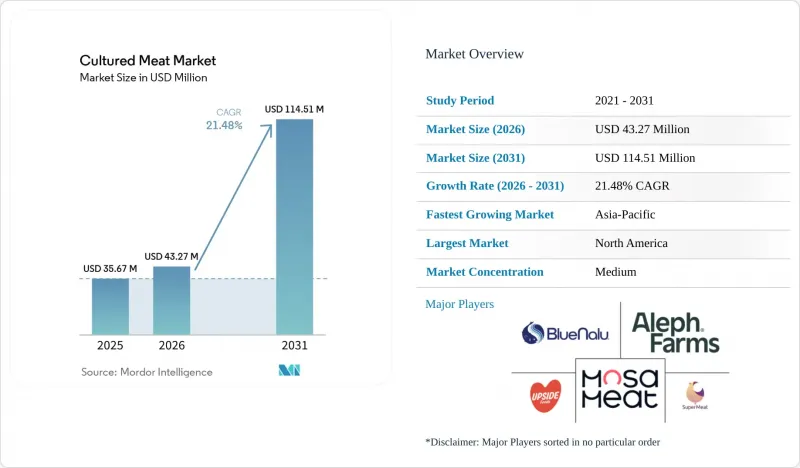
This report is Segmented by Source (Red Meat, Poultry, Seafood, Pork, Others), Product Form (Nuggets, Burgers and Patties, Sausages and Hot-Dogs, Meatballs and Mince, Fillets and Whole-Cuts), End User (Foodservice, Retail/Household), and Geography (North America, Europe, Asia-Pacific, Rest of World). The Market Forecasts are Provided in Terms of Value (USD) and Volume (Tons).
Global Cultured Meat Market Trends and Insights
Hybrid (Cultured + Plant) Formulations Lowering Cost-to-Market Barriers
Hybrid products in the cultured meat market that combine cultivated cells with plant-based matrices are compressing the capital intensity of pure-cell commercialization by reducing the proportion of expensive bioreactor output required per serving. GOOD Meat's Singapore retail launch in 2025 featured a formulation containing 3% cultivated chicken cells blended with plant proteins, allowing the company to claim "cultivated meat" status while slashing production costs by an order of magnitude compared to 100% cell-based products. This approach in the cultured meat market sidesteps the bioreactor-capacity bottleneck that has delayed scale-up across the sector, enabling producers to generate revenue before achieving the 10,000-liter-plus fermenter volumes needed for pure-cell economics.
Regulatory acceptance in the cultured meat market varies: Singapore's SFA permits hybrid labeling under its 2020 framework, whereas the USDA's Food Safety and Inspection Service has not issued formal guidance on minimum cell-content thresholds, creating compliance uncertainty for U.S. market entrants. The strategy also mitigates texture deficits inherent in early-stage cell cultivation, as plant scaffolding provides structural integrity that immature cell-culture techniques cannot yet replicate. Mosa Meat's December 2025 funding round explicitly earmarked resources for hybrid R&D, signaling that even well-capitalized pure-play firms recognize the commercial necessity of blended formats during the pre-scale phase.
Foodservice Pilots (QSRs, Fine Dining) Accelerating Consumer Validation Loops
Restaurant partnerships in the cultured meat market are functioning as low-risk market-testing vehicles that bypass the shelf-life, packaging, and distribution complexities of retail channels while generating qualitative feedback from culinarily sophisticated audiences. Mission Barns debuted its cultivated pork sausage at Fiorella, a San Francisco restaurant, in September 2025, three months before its November 2025 retail launch at Berkeley Bowl, using the foodservice window to refine flavor profiles and gauge willingness-to-pay among early adopters, according to the Wall Street Journal. UPSIDE Foods formalized a partnership with Pat LaFrieda Meat Purveyors in January 2025 to co-develop shredded chicken and sausage formats for restaurant distribution, leveraging the distributor's 95-year reputation to confer legitimacy on a novel protein category.
Celebrity-chef endorsements amplify validation: GOOD Meat's collaboration with Jose Andres, who integrated cultivated chicken into his ThinkFoodGroup menus, generated media coverage that conventional advertising budgets could not replicate. Foodservice pilots in the cultured meat market also compress the consumer-education timeline by embedding cultivated meat into familiar dishes, tacos, dumplings, pasta, rather than asking diners to reimagine meal structures around an unfamiliar ingredient. QSR interest remains exploratory, with no major chains announcing menu commitments as of early 2026, but pilot programs with regional operators are underway in Singapore and California, where regulatory clearances and supply volumes align.
Limited Availability of Food-Grade, Large-Scale Bioreactors
The cultured meat market confronts a bioreactor supply bottleneck as pharmaceutical-grade fermenter manufacturers lack food-safety certifications and capacity to meet projected demand, while food-grade equipment suppliers have not yet developed vessels exceeding 10,000 liters optimized for adherent or suspension cell culture. Believer Meats' 22,000-liter bioreactor installation at its Wilson, North Carolina, facility represented the sector's largest deployment as of mid-2025, yet the company shuttered operations in late 2025 after failing to secure follow-on capital, removing the industry's flagship scale-up reference from active production, according to Financial Times. Vow operates a 15,000-liter bioreactor in Singapore, and Mosa Meat is developing a 50,000-liter capacity targeting 2026 commissioning, but these remain isolated examples rather than evidence of a mature supply ecosystem. Pharmaceutical bioreactor manufacturers such as Sartorius and Eppendorf produce stainless-steel vessels up to 2,000 liters certified under FDA Good Manufacturing Practice standards, but these units are designed for high-value biologics (monoclonal antibodies, vaccines) where cost-per-liter is secondary to sterility and batch traceability, making them economically unsuitable for commodity protein production.
Food-grade equipment suppliers like GEA and Alfa Laval manufacture fermenters for brewing and dairy applications, but adapting these designs for mammalian or avian cell culture requires modifications to temperature control, dissolved-oxygen monitoring, and shear-stress management that extend lead times to 18-24 months and inflate capital costs by 30-50%. The constraint in the cultured meat market is compounded by limited engineering talent: bioreactor design for adherent cell culture at 10,000-liter-plus scale remains a niche discipline with fewer than 200 practitioners globally, per industry estimates, creating a human-capital bottleneck that persists even when financial capital is available.
Other drivers and restraints analyzed in the detailed report include:
- Poultry Cell Lines Offering Faster Proliferation Cycles vs Bovine Cells
- Shift Toward Ground/Minced Formats for Faster Scale-Up and Early Revenue Capture
- Regulatory Fragmentation Across Regions Delaying Global Commercialization
For complete list of drivers and restraints, kindly check the Table Of Contents.
Segment Analysis
Poultry cell lines in the cultured meat market exhibit 18-24 hour doubling time, versus 36-48 hours for bovine myoblasts, translates into 40-50% shorter bioreactor occupancy cycles, compressing capital intensity and explaining why poultry captured 48.18% of 2025 market share. Upside Foods, GOOD Meat, and Believer Meats all prioritized chicken in their initial commercial launches, recognizing that avian cells tolerate lower serum concentrations in growth media and reduce reliance on fetal bovine serum, a cost input that historically represented 80-90% of production expenses. Red meat is forecast to grow at 22.73% CAGR through 2031, propelled by Mosa Meat's 99.999% cost reduction achieved in December 2025 and Aleph Farms' 97% cost decline since 2020, which together demonstrate that bovine economics are converging toward viability as serum-free media formulations mature. Seafood products are gaining traction as Wildtype's cultivated salmon received FDA clearance on May 28, 2025, and BlueNalu continues pilot-scale production of yellowtail and mahi-mahi, targeting premium sushi and sashimi segments where consumers accept higher price points and flavor differentiation is less pronounced than in commodity beef or chicken.
Singapore's Food Agency and Australia's FSANZ have emerged as the most permissive regulators for novel species, approving Vow's quail and Parima's chicken in 2025 under pre-market frameworks that compress review timelines to 9-12 months, whereas the USDA's species-specific inspection protocols extend approval cycles for each new animal type by 12-18 months. Poultry's structural advantage persists even as bovine costs decline because chicken's lower temperature requirements (37-39°C versus 38-40°C for beef) yield energy savings that compound over multi-year production runs, and the global chicken-consumption base of 130 million tonnes annually dwarfs beef's 70 million tonnes, offering a larger addressable market for producers targeting conventional-meat substitution. Pork remains underpenetrated despite its status as the world's most-consumed meat by volume, with only Mission Barns and Hoxton Farms pursuing commercial-scale production; Mission Barns launched cultivated pork sausage at Berkeley Bowl in November 2025, while Hoxton Farms submitted a pork-fat dossier to Singapore's SFA in November 2025, signaling that lipid components may precede whole-muscle pork products.
Geography Analysis
North America in the cultured meat market retained 41.21% geographic share in 2025, anchored by the FDA and USDA's dual-track regulatory framework that cleared Upside Foods, GOOD Meat, Believer Meats, and Mission Barns between 2022 and 2025, though the U.S. Department of Defense withdrew up to USD 500 million in BioMADE funding for military-ration development after livestock-industry lobbying intensified in mid-2025. The United States' approval pathway requires FDA evaluation of cell-line safety and production processes followed by USDA-FSIS facility inspection and labeling review, a bifurcated system that has generated timelines ranging from 18 months (Upside Foods, November 2022) to 36 months (Believer Meats, July 2025), but once cleared, producers gain access to a USD 200 billion annual meat market. However, 7 states, Florida, Alabama, Indiana, Mississippi, Montana, Nebraska, Texas, and South Dakota, enacted outright bans in 2024-2025, prohibiting sale even after federal clearance and fragmenting the domestic market in ways that deter capital investment in production facilities unable to serve entire regions. Canada's Health Canada is reviewing a regulatory framework analogous to the U.S. dual-track system, but no approvals have been issued as of early 2026, and the absence of domestic cultivated-meat producers limits political momentum for expedited clearances. Mission Barns' November 2025 retail launch at Berkeley Bowl in California and subsequent Sprouts Farmers Market partnership demonstrate that coastal urban markets, San Francisco, Los Angeles, New York, Seattle, offer the demographic and psychographic profiles conducive to early adoption, with household incomes exceeding USD 100,000 and high concentrations of flexitarian and environmentally motivated consumers. Believer Meats' shutdown of its 200,000-square-foot Wilson, North Carolina, facility in late 2025, despite securing FDA and USDA approvals and commissioning 22,000-liter bioreactor capacity, illustrates the capital-intensity challenge: the company required an estimated USD 150-200 million in follow-on funding to reach commercial scale, an amount that proved unattainable in the 2025 venture environment where aggregate cultivated-meat investment collapsed to USD 36 million in the first nine months.
In the cultured meat market, Asia-Pacific is forecast to grow at 23.27% CAGR through 2031, propelled by Singapore's 9-12 month pre-market approval cycle and Australia's June 2025 FSANZ clearance, which together create a regulatory corridor absent in slower-moving jurisdictions. Singapore's Food Agency approved GOOD Meat's chicken in 2020, Vow's quail in April 2024, and Parima's Vital Meat chicken in 2025, establishing the city-state as the global leader in cultivated-meat commercialization despite its 5.6 million population and USD 400 million annual meat market. The SFA's pre-market consultation process compresses review timelines by allowing producers to submit data iteratively rather than in a single dossier, and the agency's willingness to approve hybrid formulations, GOOD Meat's retail product contains 3% cultivated cells blended with plant proteins, reduces the technical and financial barriers to market entry. Australia's FSANZ approved Vow's quail in June 2025 under a trans-Tasman framework that extends clearance to New Zealand, and the agency is reviewing additional applications from Vow and international producers, signaling that the Australia-New Zealand market (combined population 31 million, USD 15 billion annual meat consumption) will become the second major Asia-Pacific beachhead after Singapore. Japan's Ministry of Health, Labour and Welfare is conducting regulatory reviews, and domestic producers IntegriCulture and Nissin Foods are active in research and development, but no approvals have been issued as of early 2026, and cultural acceptance challenges, consumer surveys indicate 40-50% of Japanese respondents express discomfort with "lab-grown" meat, may slow adoption even after regulatory clearance. South Korea's Ministry of Food and Drug Safety is developing a framework, and government biotech initiatives have allocated funding to domestic startups CellMEAT and SpaceF, but regulatory timelines remain undefined and the country's strong conventional livestock sector (USD 8 billion annual production) generates political resistance to cultivated-meat imports. China represents the region's largest long-term opportunity, 1.4 billion population, 28% of global meat consumption, but the regulatory pathway is undefined as of early 2026, and the absence of clear approval mechanisms has deterred international producers from investing in market-entry strategies.
Europe's trajectory remains bifurcated between supportive jurisdictions such as the Netherlands and obstructionist member states led by Italy, which enacted a national ban in December 2023. The Netherlands channeled EUR 15 million (USD 16.2 million) into Mosa Meat via state-backed Invest-NL in December 2025, and regional development agency LIOF co-invested, reflecting the Dutch government's strategic positioning of cultivated meat as a sustainability and export opportunity. Mosa Meat is developing 50,000-liter bioreactor capacity targeting 2026 commissioning and has submitted regulatory dossiers to the UK, EU, Switzerland, and Singapore, but the European Union's Novel Foods Regulation requires EFSA scientific assessment exceeding 18 months followed by member-state voting that can extend total timelines beyond 30 months. Fourteen EU member states lodged formal concerns with the European Commission in January 2024, citing agricultural-sector impacts and consumer-acceptance risks, and Italy's December 2023 ban, which prohibits production, sale, and import of cultivated meat, remains in force despite challenges from industry groups arguing that it violates single-market principles. Germany's Innocent Meat raised USD 7 million in February 2026 for scale-up and regulatory submissions targeting 2028 commercialization, and the UK's post-Brexit regulatory independence allows the Food Standards Agency to develop an approval pathway distinct from the EU, potentially accelerating clearances for Mosa Meat and other applicants. France has not issued formal guidance, and the country's powerful agricultural lobby, which represents a USD 80 billion annual sector, has signaled opposition to cultivated meat, suggesting that even if EU-level approval is granted, implementation may be delayed by member-state resistance. Rest of World markets, including the Middle East, South America, and Africa, lack regulatory frameworks as of early 2026, and cultivated-meat producers have not prioritized these regions given the absence of clear approval pathways and the capital constraints limiting geographic expansion.
- Upside Foods, Inc.
- Eat Just, Inc. (GOOD Meat)
- Mosa Meat B.V.
- Aleph Farms Ltd
- BlueNalu, Inc.
- Supermeat The Essence of Meat Ltd.
- Umami Bioworks Pte Ltd.
- Vow
- Meatable B.V.
- Future Meat Technologies Ltd. (Believer Meats)
- Finless Foods, Inc.
- Mission Barns
- Ever After Foods
- Orbillion Bio, Inc.
- Cellx Limited LLC
- Ivy Farm Technologies Limited
- BioTech Foods SL
- Wildtype
- Avant Meats Company Limited
Additional Benefits:
- The market estimate (ME) sheet in Excel format
- 3 months of analyst support
TABLE OF CONTENTS
1 INTRODUCTION
- 1.1 Study Assumptions and Market Definition
- 1.2 Scope of the Study
2 RESEARCH METHODOLOGY
3 EXECUTIVE SUMMARY
4 MARKET LANDSCAPE
- 4.1 Market Overview
- 4.2 Market Drivers
- 4.2.1 Hybrid (cultured + plant) formulations lowering cost-to-market barriers
- 4.2.2 Foodservice pilots (QSRs, fine dining) accelerating consumer validation loops
- 4.2.3 Poultry cell lines offering faster proliferation cycles vs bovine cells
- 4.2.4 Shift toward ground/minced formats for faster scale-up and early revenue capture
- 4.2.5 Government procurement for space/defense menus
- 4.2.6 Venture funding driving scale-up bioreactors
- 4.3 Market Restraints
- 4.3.1 Limited availability of food-grade, large-scale bioreactors
- 4.3.2 Regulatory fragmentation across regions delaying global commercialization
- 4.3.3 Texture and structure limitations for whole-cut meat replication
- 4.3.4 Supply chain immaturity for cell culture inputs
- 4.4 Supply Chain Analysis
- 4.5 Regulatory Outlook
- 4.6 Technological Outlook
- 4.7 Porter's Five Forces
- 4.7.1 Threat of New Entrants
- 4.7.2 Bargaining Power of Buyers
- 4.7.3 Bargaining Power of Suppliers
- 4.7.4 Threat of Substitute Products
- 4.7.5 Intensity of Competitive Rivalry
5 MARKET SIZE AND GROWTH FORECASTS (VALUE AND VOLUME)
- 5.1 By Source
- 5.1.1 Red Meat
- 5.1.2 Poultry
- 5.1.3 Seafood
- 5.1.4 Pork
- 5.1.5 Others
- 5.2 By Product Form
- 5.2.1 Nuggets
- 5.2.2 Burgers and Patties
- 5.2.3 Sausages and Hot-dogs
- 5.2.4 Meatballs and Mince
- 5.2.5 Fillets and Whole-cuts
- 5.3 By End User
- 5.3.1 Foodservice
- 5.3.2 Retail/Household
- 5.4 By Geography
- 5.4.1 North America
- 5.4.1.1 United States
- 5.4.1.2 Canada
- 5.4.1.3 Rest of North America
- 5.4.2 Europe
- 5.4.2.1 Germany
- 5.4.2.2 United Kingdom
- 5.4.2.3 France
- 5.4.2.4 Netherlands
- 5.4.2.5 Rest of Europe
- 5.4.3 Asia-Pacific
- 5.4.3.1 China
- 5.4.3.2 Japan
- 5.4.3.3 Australia
- 5.4.3.4 Singapore
- 5.4.3.5 South Korea
- 5.4.3.6 Rest of Asia-Pacific
- 5.4.4 Rest of World
- 5.4.1 North America
6 COMPETITIVE LANDSCAPE
- 6.1 Market Concentration
- 6.2 Strategic Moves
- 6.3 Market Share Analysis
- 6.4 Company Profiles (includes Global level Overview, Market level overview, Core Segments, Financials, Strategic Information, Market Rank/Share, Products and Services, Recent Developments)
- 6.4.1 Upside Foods, Inc.
- 6.4.2 Eat Just, Inc. (GOOD Meat)
- 6.4.3 Mosa Meat B.V.
- 6.4.4 Aleph Farms Ltd
- 6.4.5 BlueNalu, Inc.
- 6.4.6 Supermeat The Essence of Meat Ltd.
- 6.4.7 Umami Bioworks Pte Ltd.
- 6.4.8 Vow
- 6.4.9 Meatable B.V.
- 6.4.10 Future Meat Technologies Ltd. (Believer Meats)
- 6.4.11 Finless Foods, Inc.
- 6.4.12 Mission Barns
- 6.4.13 Ever After Foods
- 6.4.14 Orbillion Bio, Inc.
- 6.4.15 Cellx Limited LLC
- 6.4.16 Ivy Farm Technologies Limited
- 6.4.17 BioTech Foods SL
- 6.4.18 Wildtype
- 6.4.19 Avant Meats Company Limited
7 MARKET OPPORTUNITIES AND FUTURE TRENDS

