
PUBLISHER: Mordor Intelligence | PRODUCT CODE: 2061824

PUBLISHER: Mordor Intelligence | PRODUCT CODE: 2061824
Smoked Fish - Market Share Analysis, Industry Trends & Statistics, Growth Forecasts (2026 - 2031)
According to Mordor Intelligence, despite facing cost challenges and evolving consumer preferences, the Smoked Fish Market is poised for steady growth. This report is Segmented by Smoking Method (Hot-Smoked, Cold-Smoked, Liquid-Smoked/Smoke-Flavoured), Species (Salmon, Mackerel, Trout, Herring, Others), Product Type (Ready-To-Eat, Ready-To-Cook), Distribution Channel (On-Trade, Off-Trade), and Geography (North America, Europe, Asia-Pacific, South America, Middle East and Africa). The Market Forecasts are Provided in Terms of Value (USD) and Volume (Units).
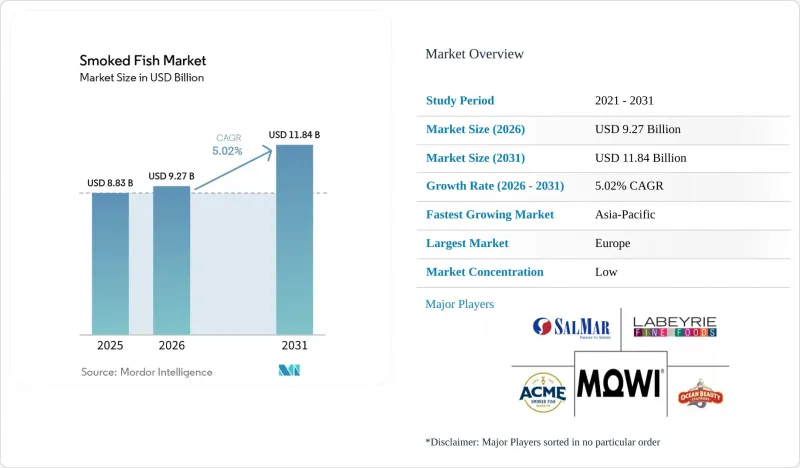
Global Smoked Fish Market Trends and Insights
Demand for ready-to-eat and ready-to-cook seafood aligns with busy lifestyles.
As urbanization accelerates and dual-income households face tighter meal-preparation windows, consumers increasingly prefer proteins requiring minimal effort. Ready-to-cook smoked fish, such as Echo Falls' Smoked Norwegian Atlantic Salmon Party Slices, lightly smoked and ready in 10-15 minutes, gained significant retail shelf space in 2025. These products, launched in January 2026, cater to the growing demand for convenient options suited for weeknight dinners and impromptu gatherings. In Japan, the Ministry of Agriculture, Forestry, and Fisheries reported that 70% of the seafood supply consists of processed products, highlighting a strong consumer preference for convenience over raw preparation. Additionally, per-capita seafood consumption stabilized at 22.0 kilograms in 2022 after years of decline, suggesting that value-added formats like smoked fish are helping to reverse this trend. In China, e-commerce platforms such as Freshippo, Meituan Grocery, and Douyin have transformed seafood distribution by enabling same-day delivery of chilled smoked salmon to inland cities, bypassing traditional wet markets and reducing spoilage risks. This shift is particularly evident in tier-2 and tier-3 cities, where significant improvements in cold-chain infrastructure between 2024 and 2026 have expanded access to premium smoked products for previously underserved consumers.
Growth in pescatarian and flexitarian diets boosts seafood as a meat alternative
As plant-based and flexitarian diets continue to grow in popularity, many consumers are shifting towards animal proteins with a lower environmental impact, such as fish and seafood, instead of traditional beef or pork. In Germany, research conducted in May 2025 revealed that 38% of adults planned to increase their plant-based consumption, while 34% intended to reduce their intake of animal meat and dairy. Notably, fish and seafood experienced only an 8% net decline compared to the 19% drop for red meat, highlighting their sustained appeal among reducetarians. Smoked fish, in particular, benefits from this trend as the smoking process enhances umami flavors and extends shelf life without relying on additives commonly found in processed red meats, aligning with the clean-label preferences of modern consumers. Additionally, the Norwegian Seafood Council reported that over 30% of global seafood consumers began eating more seafood at home during inflationary periods to save costs, with many opting for premium options like smoked salmon meal kits and subscription boxes that offer restaurant-quality experiences at lower prices. Younger consumers aged 25-34 are leading this shift, showing the strongest intent to increase both plant-based and seafood consumption, creating a significant opportunity for smoked fish brands that emphasize sustainability and high-protein nutrition.
Regulatory and food safety challenges
New food safety regulations and compliance requirements are posing operational challenges for the smoked fish market. Changes within the FDA have led to a reduction in specialized expertise, potentially causing delays in seafood trade and import approvals, thereby disrupting supply chain operations. Due to heightened risks of Listeria monocytogenes contamination in cold-smoked fish products compared to their hot-smoked counterparts, the UK's Food Standards Agency is mandating stricter HACCP protocols. In a parallel move, the USDA's actions against meat smoking operations, including recalls due to creosote and black particle contamination, have cast a shadow of regulatory uncertainty over fish smoking processes. Additionally, the market is witnessing a surge in demand for certifications such as BRCGS, MSC, and ISO 22000, creating higher barriers to entry in the premium segment. As a result, these stringent regulatory standards tend to benefit larger companies equipped with dedicated compliance departments and robust food safety systems. In contrast, smaller processors find it challenging to navigate these requirements, potentially paving the way for market consolidation.
Other drivers and restraints analyzed in the detailed report include:
- E-commerce and online retail growth enables wider reach and direct-to-consumer sales
- Sustainable sourcing, certifications like MSC/ASC, and traceability build consumer trust
- Short shelf life leads to spoilage risks and higher waste during storage
For complete list of drivers and restraints, kindly check the Table Of Contents.
Segment Analysis
In 2025, hot-smoked products captured a dominant 57.01% share of the market, leading both retail and foodservice sectors. This method not only fully cooks the fish but also extends its shelf life and imparts a robust flavor, reminiscent of traditional smokehouse techniques. The widespread adoption of hot smoking can be traced back to decades of investments in brick kilns and automated smoking chambers. However, this process isn't without its drawbacks: it produces polycyclic aromatic hydrocarbons and demands 8-12 hours of fuel combustion, raising both environmental and health concerns. On the other hand, cold-smoked variants, often chosen for premium salmon and trout, maintain the fish's delicate texture and translucent look. Yet, they require meticulous temperature management (staying below 30°C) and extended curing durations, which can limit production rates and inflate labor expenses.
Forecasted to grow at a 6.01% CAGR through 2031, liquid-smoked and smoke-flavored products are leading the pack among smoking methods. This surge is largely attributed to processors embracing innovations like Sensient's SmokeLess Smoke, introduced in March 2024. This solution slashes flavoring time by 40-60% and cuts down ingredient additives by 85%, all while preserving the essence of natural smoke. Meanwhile, products like Ruitenberg's FumX range and proFagus's Pure Smoke, both derived from regenerated beech-wood liquid smokes, adhere to the European Union's clean-label standards and successfully eliminate carcinogenic compounds. This move aligns with retailer demands for safer product formulations. While liquid smoke commands a 20-25% premium over artificial flavors, high-volume producers, especially those catering to health-conscious consumers, find value in this trade-off. The savings from bypassing kiln maintenance, fuel expenses, and emissions permits make it a lucrative choice. In 2025, hickory-flavored liquid smoke dominated the global liquid smoke arena, holding a 35% share, a testament to North American palate preferences. In contrast, European processors leaned towards beech and oak flavor profiles.
In 2025, salmon dominated the species market with a 43.81% share, supported by Norway's 815,300-ton Atlantic salmon harvest, which marked a 16.0% year-on-year increase, and Chile's total salmon production of 1.5 million tons, including Coho and Atlantic varieties. Smoked salmon maintained its premium positioning, with vacuum-packed fillets priced at EUR 36.00-38.00 per kilogram in December 2025, enabling vertically integrated producers like Mowi and SalMar to achieve high margins through their control over farming, processing, and distribution. Salmon's popularity is driven by its omega-3 content, strong brand recognition, and adaptability in ready-to-eat formats, ensuring consistent demand across retail, foodservice, and e-commerce channels. Meanwhile, mackerel and herring remain staples in European diets, with the Netherlands consuming 76 million herring annually, and smoked kippers being a traditional breakfast choice. However, wild-catch volatility and quota restrictions continue to limit supply growth for these species.
Trout, on the other hand, is projected to grow at a 6.52% CAGR through 2031, making it the fastest-growing species. This growth is attributed to the adoption of recirculating aquaculture systems (RAS), which enable year-round production while mitigating risks like sea-lice and algae blooms that affect marine salmon farms. Blue Aqua's RAS trout facility in Singapore, operational by the end of 2025 with an annual capacity of 1,025 tons, is Southeast Asia's first and targets premium smoked-trout demand in Japan and Singapore, where freshness and traceability are highly valued. In Europe, Finnforel introduced RAS-farmed trout with smoked fillets in 2025, emphasizing a low-carbon footprint and antibiotic-free production, which appeal to environmentally conscious consumers. Smoked trout fillets, priced at EUR 21.00 per kilogram in December 2025, offer a 44% discount compared to salmon, making them an attractive option for price-sensitive consumers and foodservice operators seeking cost-effective menu items. Additionally, trout's milder flavor and smaller fillet size are well-suited for single-serve packaging and snack formats, aligning with the growing demand for convenience-focused products.
Geography Analysis
In 2025, Europe held 40.03% of the market share, driven by Norway's 815,300-ton Atlantic salmon harvest, a 16.0% year-on-year increase, and the Netherlands' Urk hub, which processes smoked herring and mackerel for European retail chains. Major markets like the UK, Germany, France, and Spain have made smoked salmon a staple, while EU regulations requiring MSC and ASC certifications ensure quality despite a 69% reliance on third-country imports, with 80% of salmon sourced from Norway. Poland and the Netherlands re-export bulk smoked fish from Norway and Iceland to key markets. In North America, Alaska's MSC-certified wild salmon fisheries (recertified in 2024) and Canada's lobster and shrimp exports support the market, though smoked fish remains a smaller segment compared to Europe.
Asia-Pacific, projected to grow at a 7.45% CAGR through 2031, benefits from rising incomes, urbanization, and e-commerce in China, Japan, and Singapore. In 2023, China imported USD 23.2 billion in seafood, with Norway supplying 50.8% of its USD 1.06 billion fresh salmon imports. Platforms like Douyin and Xiaohongshu streamline smoked product sales, while Japan's stabilized seafood consumption at 22.0 kilograms per capita in 2022 and Singapore's upcoming Blue Aqua RAS trout farm (1,025 tons annual capacity by 2025) highlight demand for premium, traceable products. South America and the Middle East, though smaller markets, show potential with Chile's 1.5 million tons of salmon production in 2025 and Saudi Arabia's plan to raise per-capita seafood consumption from 11.7 kilograms in 2020 to 20 kilograms by 2030, supported by expanding cold-chain infrastructure.
North America represents an established smoked fish market with developed distribution infrastructure, regulatory compliance requirements, and consumer health considerations. In 2024, salmon led U.S. fish consumption, with Alaska supplying 99% of the nation's production, supported by sustainability certification programs. Market participants include integrated corporations and specialized producers, utilizing cold-chain logistics and digital marketing operations. Market developments reflect regulatory requirements and consumer demand for product transparency. E-commerce distribution channels enable market access for premium smoked fish products to specific consumer segments.
- Mowi ASA
- Acme Smoked Fish Corp.
- SalMar ASA
- Labeyrie Fine Foods
- The Boston Smoked Fish Company, LLC
- Ocean Beauty Seafoods
- Multi X S.A.
- Bakkafrost
- Trident Seafoods
- Delpeyrat
- Thai Union Group
- SeaBear Smokehouse
- H. Forman & Son
- Ducktrap River of Maine
- TSIALIOS Smoked Fish
- Bakkafrost
- Verlasso Salmon
- Fishwife Tinned Seafood Co.
- Finn's Smoked Fish
- Osprey Seafood
Additional Benefits:
- The market estimate (ME) sheet in Excel format
- 3 months of analyst support
TABLE OF CONTENTS
1 INTRODUCTION
- 1.1 Study Assumptions and Market Definition
- 1.2 Scope of the Study
2 RESEARCH METHODOLOGY
3 EXECUTIVE SUMMARY
4 MARKET LANDSCAPE
- 4.1 Market Overview
- 4.2 Market Drivers
- 4.2.1 Demand for ready-to-eat and ready-to-cook seafood aligns with busy lifestyles.
- 4.2.2 Growth in pescatarian and flexitarian diets boosts seafood as a meat alternative
- 4.2.3 E-commerce and online retail growth enables wider reach and direct-to-consumer sales
- 4.2.4 Sustainable sourcing, certifications like MSC/ASC, and traceability build consumer trust
- 4.2.5 Seafood's high protein, omega-3s, and vitamins support heart health and weight management.
- 4.2.6 Increasing popularity of gourmet and artisanal foods
- 4.3 Market Restraints
- 4.3.1 Regulatory and food safety challenges
- 4.3.2 Short shelf life leads to spoilage risks and higher waste during storage
- 4.3.3 Environmental impact of traditional smoking
- 4.3.4 Competition from fresh, frozen, or alternative seafood products
- 4.4 Supply Chain Analysis
- 4.5 Regulatory Landscape
- 4.6 Technological Outlook
- 4.7 Porter's Five Forces Analysis
- 4.7.1 Threat of New Entrants
- 4.7.2 Bargaining Power of Buyers
- 4.7.3 Bargaining Power of Suppliers
- 4.7.4 Threat of Substitutes
- 4.7.5 Intensity of Competitive Rivalry
5 MARKET SIZE AND GROWTH FORECASTS (VALUE AND VOLUME)
- 5.1 By Smoking Method
- 5.1.1 Hot-Smoked
- 5.1.2 Cold-Smoked
- 5.1.3 Liquid-Smoked/Smoke-Flavoured
- 5.2 By Species
- 5.2.1 Salmon
- 5.2.2 Mackerel
- 5.2.3 Trout
- 5.2.4 Herring
- 5.2.5 Others (Sablefish, Eel, Haddock, etc.)
- 5.3 By Product Type
- 5.3.1 Ready-to-Eat
- 5.3.2 Ready-to-Cook
- 5.4 By Distribution Channel
- 5.4.1 On-Trade
- 5.4.2 Off-Trade
- 5.4.2.1 Supermarkets/Hypermarkets
- 5.4.2.2 Specialty Stores
- 5.4.2.3 Online Retail Stores
- 5.4.2.4 Other Distribution Channel
- 5.5 By Geography
- 5.5.1 North America
- 5.5.1.1 United States
- 5.5.1.2 Canada
- 5.5.1.3 Mexico
- 5.5.1.4 Rest of North America
- 5.5.2 Europe
- 5.5.2.1 United Kingdom
- 5.5.2.2 Germany
- 5.5.2.3 Italy
- 5.5.2.4 France
- 5.5.2.5 Spain
- 5.5.2.6 Netherlands
- 5.5.2.7 Poland
- 5.5.2.8 Belgium
- 5.5.2.9 Sweden
- 5.5.2.10 Rest of Europe
- 5.5.3 Asia-Pacific
- 5.5.3.1 China
- 5.5.3.2 India
- 5.5.3.3 Japan
- 5.5.3.4 Australia
- 5.5.3.5 Indonesia
- 5.5.3.6 South Korea
- 5.5.3.7 Thailand
- 5.5.3.8 Singapore
- 5.5.3.9 Rest of Asia-Pacific
- 5.5.4 South America
- 5.5.4.1 Brazil
- 5.5.4.2 Argentina
- 5.5.4.3 Colombia
- 5.5.4.4 Chile
- 5.5.4.5 Peru
- 5.5.4.6 Rest of South America
- 5.5.5 Middle East and Africa
- 5.5.5.1 United Arab Emirates
- 5.5.5.2 Saudi Arabia
- 5.5.5.3 South Africa
- 5.5.5.4 Nigeria
- 5.5.5.5 Egypt
- 5.5.5.6 Morocco
- 5.5.5.7 Turkey
- 5.5.5.8 Rest of Middle East and Africa
- 5.5.1 North America
6 COMPETITIVE LANDSCAPE
- 6.1 Market Concentration
- 6.2 Strategic Moves
- 6.3 Market Share Analysis
- 6.4 Company Profiles (includes Global level Overview, Market level overview, Core Segments, Financials as available, Strategic Information, Market Rank/Share for key companies, Products and Services, and Recent Developments)
- 6.4.1 Mowi ASA
- 6.4.2 Acme Smoked Fish Corp.
- 6.4.3 SalMar ASA
- 6.4.4 Labeyrie Fine Foods
- 6.4.5 The Boston Smoked Fish Company, LLC
- 6.4.6 Ocean Beauty Seafoods
- 6.4.7 Multi X S.A.
- 6.4.8 Bakkafrost
- 6.4.9 Trident Seafoods
- 6.4.10 Delpeyrat
- 6.4.11 Thai Union Group
- 6.4.12 SeaBear Smokehouse
- 6.4.13 H. Forman & Son
- 6.4.14 Ducktrap River of Maine
- 6.4.15 TSIALIOS Smoked Fish
- 6.4.16 Bakkafrost
- 6.4.17 Verlasso Salmon
- 6.4.18 Fishwife Tinned Seafood Co.
- 6.4.19 Finn's Smoked Fish
- 6.4.20 Osprey Seafood
7 MARKET OPPORTUNITIES AND FUTURE OUTLOOK

