PUBLISHER: Mordor Intelligence | PRODUCT CODE: 2061830

PUBLISHER: Mordor Intelligence | PRODUCT CODE: 2061830
Chocolate Syrup - Market Share Analysis, Industry Trends & Statistics, Growth Forecasts (2026 - 2031)
According to Mordor Intelligence, the chocolate syrup market size in 2026 is estimated at USD 11.91 billion, growing from the 2025 value of USD 11.21 billion, with 2031 projections showing USD 16.31 billion, growing at a 6.49% CAGR over 2026-2031.
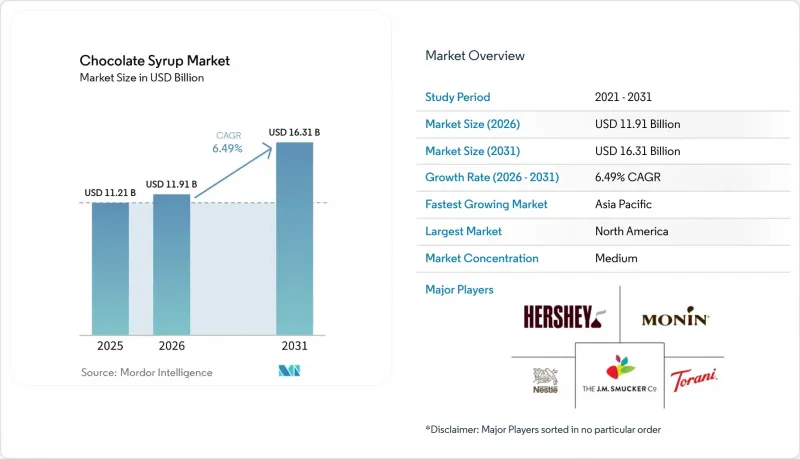
This report is Segmented by Flavor (Milk Chocolate, Dark Chocolate), Category (Premium, Mass), Packaging (PET Bottles, Pouches and Sachets, Others), End-User (Foodservice/HoReCa, Industrial, Retail), and Geography (North America, Europe, Asia-Pacific, South America, Middle East and Africa). The Market Forecasts are Provided in Terms of Value (USD) and Volume (Tons).
Global Chocolate Syrup Market Trends and Insights
Increasing demand for convenient ready-to-use toppings
The shift toward convenience-oriented consumption is reshaping distribution dynamics, favoring squeeze-bottle and single-serve formats. The growing expansion of online grocery channels is significantly benefiting ready-to-use chocolate syrups, as consumers increasingly bundle pantry staples with premium toppings, driving higher ship-to-home average order values. Additionally, foodservice operators have indicated that improved packaging quality could lead to increased orders, highlighting the demand for portion-controlled sachets and tamper-evident closures that minimize waste and enhance food safety. This trend aligns with the broader consumer preference for sustainable and functional packaging solutions. The convergence of omnichannel fulfillment and premiumization is transforming chocolate syrup from a basic commodity to a differentiated product. This shift is particularly evident in quick-service restaurants and coffee chains, where menu innovation increasingly relies on flavor layering to attract customers. Furthermore, the rising consumer interest in clean-label and organic formulations is driving manufacturers to innovate, offering syrups with reduced sugar content and natural ingredients.
Increasing popularity of chocolate-based beverages
Specialty coffee's growth is driving increased demand for premium chocolate syrups in higher-margin applications. Premium coffee platforms are creating pull-through demand for complementary syrups, with mocha beverages blending espresso and chocolate, gaining a larger share of cafe menus. Operators are leveraging diverse syrup flavor profiles, such as salted caramel, dark chocolate, and hazelnut, to command higher price points per drink. Additionally, the increasing popularity of plant-based and vegan beverages is further boosting the demand for chocolate syrups that cater to these preferences. Suppliers that offer proprietary flavor signatures are gaining a competitive edge, as coffee chains increasingly seek differentiation in a saturated market. Furthermore, the rise of health-conscious consumers and the demand for clean-label, reduced-sugar syrups are expected to further shape product innovation and market dynamics. The integration of functional ingredients, such as protein or adaptogens, into chocolate syrups is also emerging as a key trend, aligning with the growing consumer interest in health and wellness.
Rising health concerns over high sugar intake
Epidemiological evidence linking sugar-sweetened beverages to type 2 diabetes, cardiovascular disease, and obesity is significantly influencing consumer behavior and regulatory frameworks. The International Food Information Council reported in 2025 that 75% of United States consumers are actively limiting or avoiding sugar, signaling a growing shift toward healthier alternatives . Additionally, the FDA's proposed front-of-package labeling rule will mandate high-sugar products to display warning symbols, potentially curbing impulse purchases in retail settings . This regulatory push, combined with evolving consumer preferences, is compelling manufacturers to adapt. Companies must either reformulate their products to align with health-conscious trends or face potential margin pressures as demand shifts toward premium, reduced-sugar variants. Furthermore, the rise of plant-based and natural sweeteners, such as stevia and monk fruit, is creating opportunities for innovation.
Other drivers and restraints analyzed in the detailed report include:
- Growing home baking and DIY dessert trends
- Strong demand from bakery and confectionery sectors
- Competition from alternative sweeteners and toppings
For complete list of drivers and restraints, kindly check the Table Of Contents.
Segment Analysis
Milk chocolate flavor accounted for 86.77% of the market share in 2025. Its dominance continues due to its widespread appeal and lower cocoa content, which shields manufacturers from price fluctuations. Additionally, milk chocolate's versatility in various applications, such as desserts, beverages, and confectionery, further strengthens its market position. Oat milk chocolate syrups, which substitute dairy with oat cream, are gaining popularity in Europe, where Oatly's success has normalized oat-based indulgence categories. This trend is particularly appealing to health-conscious consumers and those with dietary restrictions, as it offers a plant-based alternative without compromising taste. This trend is growing rapidly as foodservice operators seek allergen-free toppings that cater to dietary restrictions while maintaining flavor and quality.
Dark chocolate is projected to grow at an annual rate of 7.24% through 2031, driven by a strategic shift among manufacturers toward higher-cacao formulations that align with functional food trends. The European Food Safety Authority's approval of a health claim linking cocoa flavanols to cardiovascular health, requiring 200 milligrams of flavanols per serving, has positioned dark chocolate syrup as a wellness ingredient. This has enabled brands to command price premiums over milk chocolate variants. Furthermore, the increasing consumer preference for healthier and premium products has fueled innovation in dark chocolate syrups, with manufacturers focusing on clean-label formulations and organic certifications to attract a broader audience. Flavor segmentation is evolving, with mass-market players focusing on defending milk chocolate's volume base, while premium entrants capitalize on margin expansion through dark chocolate innovation.
Mass-category products held 68.23% of the market share in 2025. The mass category's resilience is attributed to its strong presence in discount retailers and dollar stores, where affordability takes precedence over sustainability concerns. This segment benefits from economies of scale, enabling manufacturers to offer competitive pricing while maintaining widespread availability. Mass-market players often rely on aggressive promotional strategies and partnerships with large retail chains to sustain their dominance. However, the segment faces increasing margin pressures as private-label brands replicate premium features at competitive price points. This trend is compelling mass-market players to either innovate through reformulation, enhance product packaging, or risk losing market share to these emerging competitors.
Premium chocolate syrup variants are projected to grow at a compound annual growth rate (CAGR) of 8.05% through 2031, driven by evolving consumer preferences for transparency, sustainability, and product provenance. According to the Sustainable Packaging Coalition's 2025 report, 90% of consumers favor eco-friendly packaging, and 43% are willing to pay a premium for products demonstrating environmental responsibility. Premium chocolate syrups are capitalizing on this trend by incorporating sustainable practices such as using glass bottles, compostable pouches, and carbon-neutral certifications. These attributes not only align with consumer values but also justify higher price points compared to mass-market alternatives. Additionally, the premium segment is leveraging digital marketing and direct-to-consumer channels to enhance brand storytelling, further strengthening its appeal among environmentally conscious and quality-focused consumers.
Geography Analysis
North America held a 33.04% market share in 2025, driven by mature consumption patterns and well-established distribution networks. However, growth in the region is slowing due to health-driven reformulations and regulatory pressures impacting volume. In the United States, the largest market in the region, the FDA finalized front-of-package labeling rules in 2026, mandating warning symbols for high-sugar products, which could reduce impulse purchases in retail channels. In Canada, premiumization trends mirror those in the U.S., with consumers increasingly opting for organic and clean-label syrups. Meanwhile, Mexico's price-sensitive market continues to favor mass-market products, despite rising obesity rates and the implementation of sugar taxes. Hershey's opening of a 250,000-square-foot Reese Chocolate Processing facility in the United States in April 2025, as part of a USD 1 billion capital program, reflects confidence in North American demand while also serving as a defensive strategy to mitigate cocoa price volatility through vertical integration.
Europe's market dynamics are shaped by stringent sustainability mandates and sugar-reduction initiatives, with Germany, the United Kingdom, and France leading the premiumization trend. The European Union's Packaging and Packaging Waste Regulation, which requires all packaging to be recyclable or reusable by 2030, is accelerating the adoption of mono-material pouches and compostable formats. Growth in specialty coffee chains in Spain, Italy, and the Netherlands is driving demand for chocolate syrup in higher-margin beverage applications, while industrial bakery expansion in Poland and Belgium supports Central and Eastern European markets. Although population stagnation and mature consumption patterns constrain growth in the region, premiumization and functional innovation present opportunities for value creation.
Asia-Pacific is projected to grow at a rate of 6.74% through 2031, supported by rising disposable incomes, the Westernization of diets, and the expansion of modern retail in countries such as China, India, Indonesia, and Thailand. Monin's September 2025 investment of INR 35 billion in a 40-acre Hyderabad facility highlights confidence in South Asian demand and the strategic benefits of localized production. In China, the quick-service restaurant sector is increasingly using chocolate syrup as a topping for bubble tea and shaved ice, while Japan's specialty coffee culture drives demand for single-origin dark chocolate syrups. Australia and South Korea exhibit consumption patterns similar to North America, with premiumization and e-commerce penetration driving growth. Southeast Asia remains the highest-growth frontier, as urbanization and exposure to Western dessert formats through social media normalize the use of chocolate syrup.
- The Hershey Company
- Nestle S.A.
- The J.M. Smucker Company
- Torani
- Monin S.A.S.
- LG (American Garden)
- Hollander Chocolate, Inc.
- Kerry Group plc
- Tate & Lyle PLC
- Generational Group (King's Cupboard)
- The Kraft Heinz Company
- Amoretti
- NuNaturals Ltd.
- Conagra Brands, Inc.
- Saraya Co. Ltd. (Lakanto)
- Mountain Food S.A.S
- Bosco Products, Inc.
- Fox's U-Bet (Gold's Pure Food)
- Walden Farms
- Baldwin Richardson Foods Co.
Additional Benefits:
- The market estimate (ME) sheet in Excel format
- 3 months of analyst support
TABLE OF CONTENTS
1 INTRODUCTION
- 1.1 Study Assumptions and Market Definition
- 1.2 Scope of the Study
2 RESEARCH METHODOLOGY
3 EXECUTIVE SUMMARY
4 MARKET LANDSCAPE
- 4.1 Market Overview
- 4.2 Market Drivers
- 4.2.1 Increasing demand for convenient ready-to-use toppings
- 4.2.2 Product innovation in flavors and formulations
- 4.2.3 Increasing popularity of chocolate-based beverages
- 4.2.4 Growing home baking and DIY dessert trends
- 4.2.5 Strong demand from bakery and confectionery sectors
- 4.2.6 Westernization of diets in emerging markets
- 4.3 Market Restraints
- 4.3.1 Competition from alternative sweeteners and toppings
- 4.3.2 Rising health concerns over high sugar intake
- 4.3.3 Fluctuating cocoa and raw material prices
- 4.3.4 Stringent regulations on sugar and additives
- 4.4 Consumer Demand Analysis
- 4.5 Regulatory Outlook
- 4.6 Technological Outlook
- 4.7 Porter's Five Forces
- 4.7.1 Threat of New Entrants
- 4.7.2 Bargaining Power of Buyers
- 4.7.3 Bargaining Power of Suppliers
- 4.7.4 Threat of Substitute Products
- 4.7.5 Intensity of Competitive Rivalry
5 MARKET SIZE AND GROWTH FORECASTS (VALUE AND VOLUME)
- 5.1 By Flavor
- 5.1.1 Milk Chocolate
- 5.1.2 Dark Chocolate
- 5.2 By Category
- 5.2.1 Premium
- 5.2.2 Mass
- 5.3 By Packaging
- 5.3.1 PET Bottles
- 5.3.2 Pouches and Sachets
- 5.3.3 Others
- 5.4 By End-User
- 5.4.1 Foodservice/HoReCa
- 5.4.2 Industrial
- 5.4.3 Retail
- 5.4.3.1 Supermarkets/Hypermarkets
- 5.4.3.2 Specialty Stores
- 5.4.3.3 Online Retail Stores
- 5.4.3.4 Other Distribution Channels
- 5.5 By Geography
- 5.5.1 North America
- 5.5.1.1 United States
- 5.5.1.2 Canada
- 5.5.1.3 Mexico
- 5.5.1.4 Rest of North America
- 5.5.2 Europe
- 5.5.2.1 Germany
- 5.5.2.2 United Kingdom
- 5.5.2.3 Italy
- 5.5.2.4 France
- 5.5.2.5 Spain
- 5.5.2.6 Netherlands
- 5.5.2.7 Poland
- 5.5.2.8 Belgium
- 5.5.2.9 Sweden
- 5.5.2.10 Rest of Europe
- 5.5.3 Asia-Pacific
- 5.5.3.1 China
- 5.5.3.2 India
- 5.5.3.3 Japan
- 5.5.3.4 Australia
- 5.5.3.5 Indonesia
- 5.5.3.6 South Korea
- 5.5.3.7 Thailand
- 5.5.3.8 Singapore
- 5.5.3.9 Rest of Asia-Pacific
- 5.5.4 Middle East and Africa
- 5.5.4.1 South Africa
- 5.5.4.2 Saudi Arabia
- 5.5.4.3 United Arab Emirates
- 5.5.4.4 Nigeria
- 5.5.4.5 Egypt
- 5.5.4.6 Morocco
- 5.5.4.7 Turkey
- 5.5.4.8 Rest of Middle East and Africa
- 5.5.5 South America
- 5.5.5.1 Brazil
- 5.5.5.2 Argentina
- 5.5.5.3 Colombia
- 5.5.5.4 Chile
- 5.5.5.5 Peru
- 5.5.5.6 Rest of South America
- 5.5.1 North America
6 COMPETITIVE LANDSCAPE
- 6.1 Market Concentration
- 6.2 Strategic Moves
- 6.3 Market Share Analysis
- 6.4 Company Profiles (includes Global level Overview, Market level overview, Core Segments, Financials as available, Strategic Information, Market Rank/Share for key companies, Products and Services, and Recent Developments)
- 6.4.1 The Hershey Company
- 6.4.2 Nestle S.A.
- 6.4.3 The J.M. Smucker Company
- 6.4.4 Torani
- 6.4.5 Monin S.A.S.
- 6.4.6 LG (American Garden)
- 6.4.7 Hollander Chocolate, Inc.
- 6.4.8 Kerry Group plc
- 6.4.9 Tate & Lyle PLC
- 6.4.10 Generational Group (King's Cupboard)
- 6.4.11 The Kraft Heinz Company
- 6.4.12 Amoretti
- 6.4.13 NuNaturals Ltd.
- 6.4.14 Conagra Brands, Inc.
- 6.4.15 Saraya Co. Ltd. (Lakanto)
- 6.4.16 Mountain Food S.A.S
- 6.4.17 Bosco Products, Inc.
- 6.4.18 Fox's U-Bet (Gold's Pure Food)
- 6.4.19 Walden Farms
- 6.4.20 Baldwin Richardson Foods Co.
7 MARKET OPPORTUNITIES AND FUTURE OUTLOOK

