PUBLISHER: Mordor Intelligence | PRODUCT CODE: 2061863

PUBLISHER: Mordor Intelligence | PRODUCT CODE: 2061863
Citrus Flavors - Market Share Analysis, Industry Trends & Statistics, Growth Forecasts (2026 - 2031)
According to Mordor Intelligence, the citrus flavors market reached USD 5.10 billion in 2025, valued at USD 5.39 billion in 2026, and is forecast to expand to USD 7.10 billion by 2031, registering a CAGR of 5.67% from 2026 to 2031.
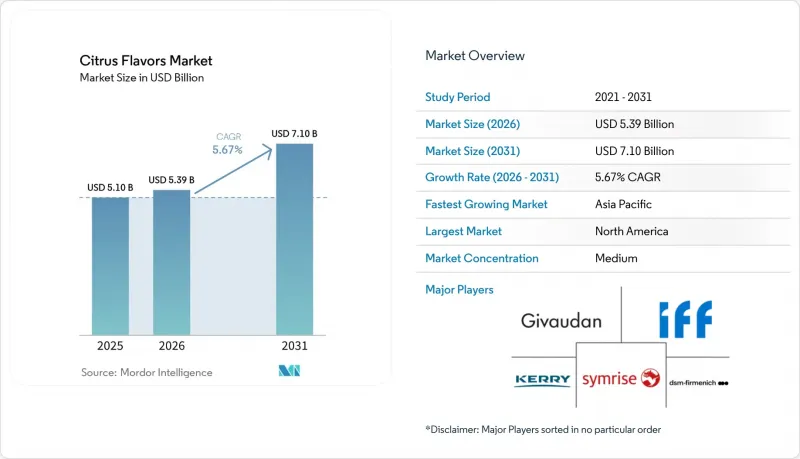
This report is Segmented by Flavor Type (Orange, Lemon, Lime, Grapefruit, Others), Nature (Natural, Artificial), Form (Liquid, Powder), Application (Food and Beverage, Personal Care and Cosmetics, Pharmaceutical and Nutraceutical, Others), and Geography (North America, Europe, Asia-Pacific, South America, Middle East and Africa). The Market Forecasts are Provided in Terms of Value (USD).
Global Citrus Flavors Market Trends and Insights
Rising demand for natural and clean-label ingredients in food and beverages
Consumer distrust of synthetic additives has elevated natural citrus flavors from a premium option to a baseline expectation, particularly in North America and Europe. Consumers are increasingly checking ingredient lists and preferring products that feel simple, familiar, and less processed. This has made natural citrus flavors more attractive because they can deliver a recognizable fruit profile while fitting clean-label positioning. Food and beverage manufacturers are responding by reformulating products with natural flavor solutions and reducing reliance on artificial additives. Citrus flavors benefit from this shift because they support both taste and marketing claims around freshness, authenticity, and better-for-you products. Brands are responding by shortening ingredient decks: Coca-Cola's reformulated Sprite variants across ASEAN markets in 2025 replaced artificial lemon-lime flavor with natural citrus extracts, a shift that required partnerships with regional suppliers to secure non-GMO certification. Additionally, the rising demand for organic and sustainably sourced ingredients has further propelled the adoption of natural citrus flavors.
Demand for fresh, tangy, and refreshing flavor profiles
Citrus flavors are widely associated with brightness, freshness, and a crisp taste experience, making them highly sought after in beverages, confectionery, dairy, and snacks. Brands increasingly aim to create an uplifting, refreshing sensory appeal, aligning with changing consumer lifestyles that favor lighter, more invigorating flavors. Citrus notes such as lemon, lime, orange, and grapefruit are particularly versatile, adding a vibrant, modern touch to a wide range of products. The shift toward tangy, low-sugar profiles is reshaping the citrus flavor landscape, with lime and grapefruit gaining prominence over sweeter orange variants in beverage applications. For instance, Siggi's introduced a yuzu-flavored skyr in March 2025, leveraging the Japanese citrus's tart profile to stand out in the competitive high-protein dairy segment and appeal to home bakers seeking bakery-quality tang. The growing popularity of citrus-based hard seltzers further underscores this trend, with brands like White Claw and Truly expanding lime and grapefruit SKUs, which are outperforming traditional orange offerings.
Strict food safety and labeling regulations
The FDA's and the EU's regulations impose analytical burdens that disproportionately affect mid-tier suppliers lacking in-house mass spectrometry and isotopic ratio analysis capabilities, effectively raising barriers to entry and consolidating market share among vertically integrated majors. The European Food Safety Authority's 2025 guidance requires documentation of every processing step, from harvest to distillation, to substantiate "natural" claims, a standard that has forced smaller European flavor houses to either invest in lab upgrades or exit the natural segment entirely. Allergen labeling for citral (above 0.001% in leave-on cosmetics per EU Regulation 1223/2009) and limonene (above 0.01% in rinse-off products) has fragmented product portfolios, with brands reformulating or discontinuing SKUs rather than navigating complex disclosure requirements. Paradoxically, stringent rules may benefit the sector in the long term by eliminating low-quality competitors and restoring consumer trust, yet the near-term effect is margin compression and delayed product launches as formulations undergo iterative testing to meet evolving standards.
Other drivers and restraints analyzed in the detailed report include:
- Growth of functional and fortified beverages
- Rising popularity of exotic citrus varieties
- Seasonal supply fluctuations and price volatility in citrus crops
For complete list of drivers and restraints, kindly check the Table Of Contents.
Segment Analysis
Orange flavors dominate the market with a substantial 66.43% share in 2025, reflecting decades of supply-chain optimization around Florida, Brazil, and Spain, where cold-press infrastructure and co-product economics (juice, oil, peel) create cost advantages that newer varieties cannot match. The versatility of orange flavor across multiple applications, including beverages, confectionery, bakery, and dairy, further strengthens its market position. Its natural sweetness and widespread consumer acceptance make it a preferred choice for manufacturers aiming to cater to both health-conscious and indulgent segments.
Lime flavors are advancing at a 5.58% CAGR through 2031, as manufacturers incorporate these flavors into premium product formulations to meet evolving consumer preferences. Brands are reformulating lemonades and seltzers to reduce sugar content, relying on lime's sharper acidity to maintain flavor intensity without sweetness. Lime's supply is more geographically dispersed in Mexico, India, and Egypt, collectively producing 8 million metric tons annually, reducing single-origin risk and stabilizing prices, a structural advantage that supports its faster growth trajectory. Grapefruit's resurgence in craft cocktails and functional waters, driven by its naringin content, which modulates cytochrome P450 enzymes and enhances drug bioavailability, has prompted flavor houses to invest in debittering technologies. Lemon remains the workhorse in bakery and dairy.
The natural citrus flavors commanded a 70.05% share in 2025, growing at a 5.17% CAGR. The natural segment's growth is driven by increasing consumer demand for clean-label products and stringent regulatory frameworks. Regulatory bodies, such as the U.S. FDA's CFR 101.22 and the European Union's Regulation 2025/1112, have emphasized the importance of natural flavor authentication, compelling manufacturers to invest in advanced extraction technologies and traceable supply chains. Additionally, rising awareness of the health benefits of natural citrus flavors, such as their antioxidant properties and vitamin C content, has further fueled their adoption across beverages, confectionery, and functional food applications.
Artificial flavors, once stigmatized, are regaining ground in cost-sensitive applications where sensory parity with natural equivalents has significantly improved. Biotechnology advancements are playing a pivotal role in bridging the gap between natural and artificial flavors, enabling the production of cost-effective, high-quality artificial citrus flavors. These flavors are increasingly being utilized in processed foods, carbonated beverages, and snacks, where cost efficiency and consistent flavor profiles are critical. The artificial segment also benefits from its ability to offer unique and customizable flavor combinations, catering to evolving consumer preferences in niche markets.
Geography Analysis
North America dominated the market with a 38.41% share in 2025, driven by robust vertically integrated supply chains connecting Florida and California citrus growers to flavor houses through advanced cold-press extraction hubs. The region's growing demand for clean-label products continues to drive innovation in citrus-based flavors. The United States remains the largest contributor, with citrus flavors being widely used in beverages such as sparkling waters, energy drinks, and functional beverages, catering to the increasing health-conscious consumer base. While Canada and Mexico contribute modestly, Mexico's annual lime production of 2.5 million metric tons positions it as a key supplier, especially as Florida grapples with the ongoing citrus greening crisis.
The Asia-Pacific region is expected to register the fastest CAGR of 5.38%, fueled by urbanization, rising disposable incomes, and the commercialization of local citrus varieties such as yuzu, calamansi, and finger lime. China and India, the region's largest markets, exhibit distinct trends. In China, the premiumization of products has driven demand for imported citrus varieties like yuzu and blood orange, particularly in craft cocktails and artisanal desserts. Meanwhile, India's price-sensitive market focuses on lemon and lime for traditional beverages like nimbu pani and masala soda. Additionally, Australia's growing exports of finger lime to North America highlight the increasing global demand for unique citrus flavors.
Europe's stringent regulatory environment has reshaped the market, consolidating share among vertically integrated players while creating barriers for smaller suppliers lacking advanced analytical capabilities. This dynamic has bolstered consumer trust in the region's flavor houses. Germany, the UK, and France lead in functional beverage innovation, leveraging citrus acids to mask bitterness in plant-based proteins and fortified waters. Meanwhile, Italy and Spain focus on traditional applications such as limoncello and orange-infused olive oils, which command premium pricing in export markets. The region's emphasis on sustainability and traceability further enhances its competitive edge in the global market.
- Givaudan SA
- DSM-Firmenich
- International Flavors & Fragrances (IFF)
- Kerry Group plc
- Symrise AG
- Takasago International Corp.
- Sensient Technologies
- Mane
- ADM (Archer-Daniels-Midland)
- Dohler Group
- Citromax
- Florida Food Products
- Treatt PLC
- T. Hasegawa Co., Ltd
- Flavorchem & Orchidia Fragrances
- Blue Pacific Flavors
- Prodalim Group
- Huabao International
- Synergy Flavours
- Alpha Aromatics
Additional Benefits:
- The market estimate (ME) sheet in Excel format
- 3 months of analyst support
TABLE OF CONTENTS
1 INTRODUCTION
- 1.1 Study Assumptions and Market Definition
- 1.2 Scope of the Study
2 RESEARCH METHODOLOGY
3 EXECUTIVE SUMMARY
4 MARKET LANDSCAPE
- 4.1 Market Overview
- 4.2 Market Drivers
- 4.2.1 Rising demand for natural and clean-label ingredients in food and beverages
- 4.2.2 Demand for fresh, tangy, and refreshing flavor profiles
- 4.2.3 Growth of functional and fortified beverages
- 4.2.4 Rising popularity of exotic citrus varieties
- 4.2.5 Increasing use of citrus flavors in personal care and pharmaceuticals
- 4.2.6 Advancements in flavor extraction and formulation technologies
- 4.3 Market Restraints
- 4.3.1 Increasing risks of adulteration and authenticity
- 4.3.2 Strict food safety and labeling regulations
- 4.3.3 Seasonal supply fluctuations and price volatility in citrus crops
- 4.3.4 Oxidation/stability challenges in high-acid matrices
- 4.4 Supply Chain Analysis
- 4.5 Regulatory Outlook
- 4.6 Porter's Five Forces
- 4.6.1 Threat of New Entrants
- 4.6.2 Bargaining Power of Buyers/Consumers
- 4.6.3 Bargaining Power of Suppliers
- 4.6.4 Threat of Substitute Products
- 4.6.5 Intensity of Competitive Rivalry
5 MARKET SIZE AND GROWTH FORECASTS (VALUE)
- 5.1 By Flavor Type
- 5.1.1 Orange
- 5.1.2 Lemon
- 5.1.3 Lime
- 5.1.4 Grapefruit
- 5.1.5 Others
- 5.2 By Nature
- 5.2.1 Natural
- 5.2.2 Artificial
- 5.3 By Form
- 5.3.1 Liquid
- 5.3.2 Powder
- 5.4 By Application
- 5.4.1 Food and Beverage
- 5.4.1.1 Bakery and Confectionery
- 5.4.1.2 Dairy and Frozen Desserts
- 5.4.1.3 Beverage
- 5.4.1.4 Savory and Snacks
- 5.4.1.5 Others
- 5.4.2 Personal Care and Cosmetics
- 5.4.3 Pharmaceutical and Nutraceutical
- 5.4.4 Others
- 5.4.1 Food and Beverage
- 5.5 By Geography
- 5.5.1 North America
- 5.5.1.1 United States
- 5.5.1.2 Canada
- 5.5.1.3 Mexico
- 5.5.1.4 Rest of North America
- 5.5.2 Europe
- 5.5.2.1 Germany
- 5.5.2.2 United Kingdom
- 5.5.2.3 Italy
- 5.5.2.4 France
- 5.5.2.5 Spain
- 5.5.2.6 Netherlands
- 5.5.2.7 Poland
- 5.5.2.8 Belgium
- 5.5.2.9 Sweden
- 5.5.2.10 Rest of Europe
- 5.5.3 Asia-Pacific
- 5.5.3.1 China
- 5.5.3.2 India
- 5.5.3.3 Japan
- 5.5.3.4 Australia
- 5.5.3.5 Indonesia
- 5.5.3.6 South Korea
- 5.5.3.7 Thailand
- 5.5.3.8 Singapore
- 5.5.3.9 Rest of Asia-Pacific
- 5.5.4 South America
- 5.5.4.1 Brazil
- 5.5.4.2 Argentina
- 5.5.4.3 Colombia
- 5.5.4.4 Chile
- 5.5.4.5 Peru
- 5.5.4.6 Rest of South America
- 5.5.5 Middle East and Africa
- 5.5.5.1 South Africa
- 5.5.5.2 Saudi Arabia
- 5.5.5.3 United Arab Emirates
- 5.5.5.4 Nigeria
- 5.5.5.5 Egypt
- 5.5.5.6 Morocco
- 5.5.5.7 Turkey
- 5.5.5.8 Rest of Middle East and Africa
- 5.5.1 North America
6 COMPETITIVE LANDSCAPE
- 6.1 Market Concentration
- 6.2 Strategic Moves
- 6.3 Market Ranking Analysis
- 6.4 Company Profiles (includes Global-level Overview, Market-level Overview, Core Segments, Financials (if available), Strategic Information, Market Ranking, Products and Services, Recent Developments)
- 6.4.1 Givaudan SA
- 6.4.2 DSM-Firmenich
- 6.4.3 International Flavors & Fragrances (IFF)
- 6.4.4 Kerry Group plc
- 6.4.5 Symrise AG
- 6.4.6 Takasago International Corp.
- 6.4.7 Sensient Technologies
- 6.4.8 Mane
- 6.4.9 ADM (Archer-Daniels-Midland)
- 6.4.10 Dohler Group
- 6.4.11 Citromax
- 6.4.12 Florida Food Products
- 6.4.13 Treatt PLC
- 6.4.14 T. Hasegawa Co., Ltd
- 6.4.15 Flavorchem & Orchidia Fragrances
- 6.4.16 Blue Pacific Flavors
- 6.4.17 Prodalim Group
- 6.4.18 Huabao International
- 6.4.19 Synergy Flavours
- 6.4.20 Alpha Aromatics
7 MARKET OPPORTUNITIES AND FUTURE OUTLOOK

