PUBLISHER: Mordor Intelligence | PRODUCT CODE: 2061881

PUBLISHER: Mordor Intelligence | PRODUCT CODE: 2061881
Mixed Tocopherols - Market Share Analysis, Industry Trends & Statistics, Growth Forecasts (2026 - 2031)
According to Mordor Intelligence, the mixed tocopherols market size is projected to expand from USD 6.28 billion in 2025 and USD 6.58 billion in 2026 to USD 8.28 billion by 2031, registering a CAGR of 4.71% between 2026 and 2031.
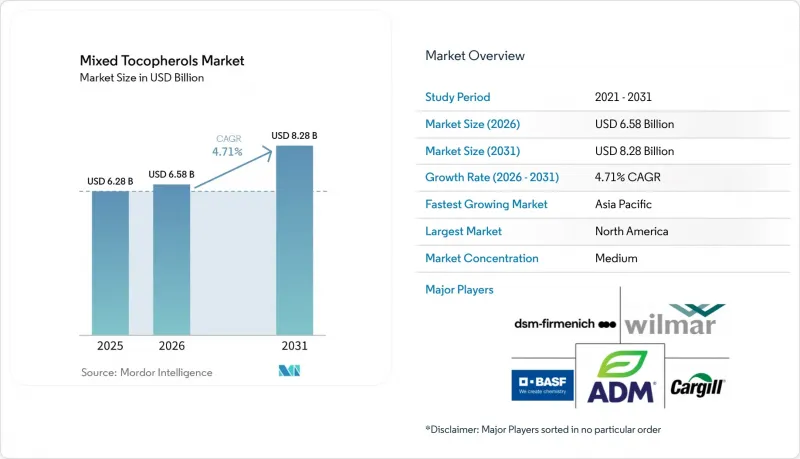
This report is Segmented by Source (Soybean Oil, Rapeseed Oil, and More), Compound (Alpha-Rich, Gamma-Rich, Delta-Rich, Other Blends), Form (Liquid, Powder, Others), Application (Food and Beverage, Animal Feed, Dietary Supplements, and More), and Geography (North America, Europe, Asia-Pacific, South America, Middle East and Africa). The Market Forecasts are Provided in Terms of Value (USD).
Global Mixed Tocopherols Market Trends and Insights
Growing demand for natural antioxidant preservatives in processed and functional foods
Formulators incorporate tocopherols into bakery products, processed meats, and edible oils at concentrations up to 1,000 ppm to enhance shelf life while meeting clean-label requirements without E-numbers. Blends containing alpha-, gamma-, and delta-homologs demonstrate superior performance in lipid oxidation assays compared to a single alpha-rich tocopherol. This is due to the ability of gamma- and delta-species to regenerate alpha-radicals, thereby restoring antioxidant capacity. Regulatory frameworks support this shift, with the U.S. Food and Drug Administration permitting up to 300 ppb across most food categories and EFSA maintaining positive safety opinions for E306-E309, enabling multinational companies to transition seamlessly . Combining tocopherols with ascorbic acid or rosemary extract provides additive protection, particularly in high-moisture ready-meal lines where fat oxidation accelerates under modified-atmosphere packaging. This layered approach not only extends product shelf life but also aligns with consumer demand for natural and clean-label solutions.
Rising health-conscious consumer preference for vitamin-E fortified dietary supplements
Rising health-conscious consumer preferences are driving demand for vitamin E-fortified dietary supplements, particularly in North America, Europe, and the Asia-Pacific. Consumers are increasingly aware of vitamin E's role in supporting immune, skin, and cardiovascular health, leading to a surge in the adoption of tocopherol-based supplements. The growing trend of preventive healthcare and the rising prevalence of lifestyle-related diseases, such as diabetes and hypertension, are further fueling this demand. Additionally, the aging population is seeking supplements to address age-related oxidative stress and maintain overall vitality, creating a robust market for vitamin E-enriched products. Manufacturers are responding to this trend by introducing innovative formulations, such as gamma-rich tocopherol blends and water-soluble vitamin E, to cater to diverse consumer needs.
Increasing price volatility of vegetable-oil distillates
The Food and Agriculture Organization Vegetable Oil Price Index surged 5.1% to 183.1 points in March 2026, driven by Indonesian palm-oil export restrictions, Ukrainian sunflower-crop shortfalls, and biofuel-mandate absorption of soybean and rapeseed volume. These factors have significantly impacted the availability and pricing of key feedstocks for tocopherol production. Deodorizer-distillate spot prices, which closely track crude-oil quotations with a 3- to 6-month lag, have led to substantial margin compression for tocopherol producers, particularly those without long-term feedstock contracts. Additionally, biofuel mandates in the EU and the United States are diverting soybean and rapeseed oil into biodiesel and renewable diesel production, further tightening the supply of deodorizer distillates and driving up costs. Smaller tocopherol producers, especially those without captive crushing operations, face heightened working-capital challenges as distillate costs fluctuate unpredictably.
Other drivers and restraints analyzed in the detailed report include:
- Regulatory shift away from BHA/BHT increasing natural-tocopherol uptake
- Expanding applications in cosmetics and personal care
- Supply-chain disruptions for high-purity delta-tocopherol fractionation
For complete list of drivers and restraints, kindly check the Table Of Contents.
Segment Analysis
Soybean oil accounted for 46.51% of the Mixed Tocopherols Market in 2025, underscoring its dominance as the most-crushed oilseed globally and the primary source of deodorizer distillate. This abundance ensures a steady supply of raw materials for tocopherol extraction. However, sunflower oil is emerging as a significant competitor, projected to grow at a robust CAGR of 6.18% through 2031, the fastest among all sources. Sunflower oil has a tocopherol content of 150-957 mg/kg, significantly higher than that of soybean or rapeseed oil. Its deodorizer distillates can be enriched by molecular distillation, reducing downstream purification costs and enhancing its appeal for high-value applications.
Cold-pressed sunflower oils retain approximately 729 mg/kg of tocopherols, compared to 645 mg/kg in refined grades, creating a premium-quality tier increasingly leveraged by supplement and cosmetics brands targeting health-conscious consumers. Rapeseed oil, on the other hand, offers gamma-rich and delta-rich tocopherol profiles, which are particularly valued for their anti-inflammatory properties and applications in nutraceuticals. Corn oil and palm oil cater to cost-sensitive segments, primarily in food preservation, where mixed-tocopherol blends are sufficient to meet functional requirements.
Alpha-rich tocopherols held 43.19% of the market share in 2025, anchored by their dominance in dietary supplements and cosmetics. Alpha-tocopherols are highly bioavailable due to their preferential binding to alpha-tocopherol transfer protein, making them a preferred choice for addressing oxidative stress and supporting immune health. In the cosmetics sector, alpha-tocopherol is widely used for its skin-repairing and anti-aging properties, as it helps neutralize free radicals and improve skin elasticity. Advancements in encapsulation technologies have enhanced the stability of alpha-tocopherols, enabling their incorporation into high-performance skincare formulations.
Gamma-rich tocopherols are expanding at 7.52% CAGR through 2031, the fastest among all compound types, propelled by clinical evidence that gamma-tocopherol scavenges reactive nitrogen species, inhibits cyclooxygenase-2 and 5-lipoxygenase, and reduces leukotriene B4 formation in leukocytes. This mechanistic differentiation is driving formulators to layer gamma-rich concentrates into cardiovascular and joint-health supplements, where anti-inflammatory positioning commands price premiums over generic vitamin E. Delta-rich tocopherols exhibit the highest antioxidant activity in lipid systems due to their unsubstituted aromatic ring, yet supply constraints limit adoption to premium cosmetics and pharmaceutical applications.
Geography Analysis
North America held 33.04% of the Mixed Tocopherols Market in 2025, anchored by integrated oilseed processors such as Archer Daniels Midland and Cargill that embed tocopherol recovery into soybean and corn crushing operations, and by the FDA's BHA reassessment, which catalyzed rapid snack-food reformulation. Canada and Mexico contribute through canola (rapeseed) distillate exports and maquiladora-based encapsulation of supplements, respectively. The region's mature regulatory framework, such as GRAS status under 21 CFR, and established health-claim pathways, reduces compliance friction, yet strict labeling requirements for organic and non-GMO certifications add to procurement costs.
Asia-Pacific is expanding at a 5.68% CAGR through 2031, the fastest among all regions, driven by rising dietary-supplement penetration in China and India, clean-label mandates, and the production of tocotrienol-rich palm derivatives in Malaysia and Indonesia. Wilmar's February 2026 acquisition of Natural Oleochemicals for USD 192 million consolidated Malaysian palm-distillate capacity, positioning the company to serve Southeast Asian and Middle Eastern markets with shorter lead times. Japan and Australia enforce stringent mycotoxin limits, favoring sunflower and soybean distillates over rapeseed, while India's supplement market is adopting gamma-rich tocopherols for cardiovascular and joint-health positioning.
Europe is growing, constrained by the region's structural rapeseed deficit, 18.5-18.8 million tonnes of domestic production versus 25 million tonnes of demand, and tightening mycotoxin regulations. DSM-Firmenich's Swiss plant remains Europe's primary high-purity fractionation hub, supplying pharmaceutical and cosmetics customers with Certificate of European Pharmacopoeia-compliant concentrates. South America is led by Brazil and Argentina, which host 60% of global soybean crushing capacity and are installing molecular-distillation units at refinery gates to capture tocopherol value before exporting crude oil. The Middle East and Africa market is driven by halal-certified supplement demand and fortified-food programs in the United Arab Emirates and South Africa.
- BASF SE
- DSM-Firmenich N.V.
- Archer Daniels Midland (ADM)
- Cargill Inc.
- Wilmar International Ltd.
- KLK Oleo (Davos Life Science)
- Kemin Industries Inc.
- Nanjing NutriHerb BioTech Co.,Ltd
- Vance Group Ltd.
- BTSA Biotecnologias Aplicadas
- Fenchem Biotek Ltd.
- The Scoular Company
- Zhejiang Medicine Co., Ltd.
- B&D Nutritional Ingredients Inc.
- Vitae Caps S.A.
- Kangcare Bioindustry Co. Ltd.
- Xi'an Healthful Biotech Co. Ltd.
- Nutralliance Inc.
- American River Nutrition
- Suzhou GreenTech
- Riken Vitamin Co. Ltd.
Additional Benefits:
- The market estimate (ME) sheet in Excel format
- 3 months of analyst support
TABLE OF CONTENTS
1 INTRODUCTION
- 1.1 Study Assumptions and Market Definition
- 1.2 Scope of the Study
2 RESEARCH METHODOLOGY
3 EXECUTIVE SUMMARY
4 MARKET LANDSCAPE
- 4.1 Market Overview
- 4.2 Market Drivers
- 4.2.1 Growing demand for natural antioxidant preservatives in processed and functional foods
- 4.2.2 Rising health-conscious consumer preference for vitamin-E fortified dietary supplements
- 4.2.3 Increasing preference for plant-based and non-synthetic additives
- 4.2.4 Regulatory shift away from BHA/BHT increasing natural-tocopherol uptake
- 4.2.5 Surplus soybean distillate valorization lowering cost curves
- 4.2.6 Expanding applications in cosmetics and personal care
- 4.3 Market Restraints
- 4.3.1 Increasing price volatility of vegetable-oil distillates
- 4.3.2 Strict regulatory requirements and complex EU and US labeling/claim compliance
- 4.3.3 Supply-chain disruptions for high-purity delta-tocopherol fractionation
- 4.3.4 Risk of mycotoxin co-contamination in rapeseed distillates
- 4.4 Supply-Chain Analysis
- 4.5 Regulatory and Technological Outlook
- 4.6 Porter's Five Forces Analysis
- 4.6.1 Threat of New Entrants
- 4.6.2 Bargaining Power of Buyers
- 4.6.3 Bargaining Power of Suppliers
- 4.6.4 Threat of Substitutes
- 4.6.5 Intensity of Competitive Rivalry
5 MARKET SIZE AND GROWTH FORECASTS (VALUE)
- 5.1 By Source
- 5.1.1 Soybean Oil
- 5.1.2 Rapeseed Oil
- 5.1.3 Sunflower Oil
- 5.1.4 Corn Oil
- 5.1.5 Palm Oil
- 5.1.6 Others
- 5.2 By Compound
- 5.2.1 Alpha-Rich Tocopherols
- 5.2.2 Gamma-Rich Tocopherols
- 5.2.3 Delta-Rich Tocopherols
- 5.2.4 Other Blends
- 5.3 By Form
- 5.3.1 Liquid
- 5.3.2 Powder
- 5.3.3 Others
- 5.4 By Application
- 5.4.1 Food and Beverage
- 5.4.2 Animal Feed
- 5.4.3 Dietary Supplements
- 5.4.4 Pharmaceuticals
- 5.4.5 Cosmetics and Personal Care
- 5.4.6 Others
- 5.5 By Geography
- 5.5.1 North America
- 5.5.1.1 United States
- 5.5.1.2 Canada
- 5.5.1.3 Mexico
- 5.5.1.4 Rest of North America
- 5.5.2 Europe
- 5.5.2.1 Germany
- 5.5.2.2 France
- 5.5.2.3 United Kingdom
- 5.5.2.4 Spain
- 5.5.2.5 Italy
- 5.5.2.6 Russia
- 5.5.2.7 Rest of Europe
- 5.5.3 Asia-Pacific
- 5.5.3.1 China
- 5.5.3.2 India
- 5.5.3.3 Japan
- 5.5.3.4 Australia
- 5.5.3.5 Thailand
- 5.5.3.6 Rest of Asia-Pacific
- 5.5.4 South America
- 5.5.4.1 Brazil
- 5.5.4.2 Argentina
- 5.5.4.3 Rest of South America
- 5.5.5 Middle East and Africa
- 5.5.5.1 United Arab Emirates
- 5.5.5.2 South Africa
- 5.5.5.3 Rest of Middle East and Africa
- 5.5.1 North America
6 COMPETITIVE LANDSCAPE
- 6.1 Market Concentration
- 6.2 Strategic Moves
- 6.3 Market Ranking Analysis
- 6.4 Company Profiles {(includes Global level Overview, Market level overview, Core Segments, Financials as available, Strategic Information, Market Rank for key companies, Products and Services, and Recent Developments)}
- 6.4.1 BASF SE
- 6.4.2 DSM-Firmenich N.V.
- 6.4.3 Archer Daniels Midland (ADM)
- 6.4.4 Cargill Inc.
- 6.4.5 Wilmar International Ltd.
- 6.4.6 KLK Oleo (Davos Life Science)
- 6.4.7 Kemin Industries Inc.
- 6.4.8 Nanjing NutriHerb BioTech Co.,Ltd
- 6.4.9 Vance Group Ltd.
- 6.4.10 BTSA Biotecnologias Aplicadas
- 6.4.11 Fenchem Biotek Ltd.
- 6.4.12 The Scoular Company
- 6.4.13 Zhejiang Medicine Co., Ltd.
- 6.4.14 B&D Nutritional Ingredients Inc.
- 6.4.15 Vitae Caps S.A.
- 6.4.16 Kangcare Bioindustry Co. Ltd.
- 6.4.17 Xi'an Healthful Biotech Co. Ltd.
- 6.4.18 Nutralliance Inc.
- 6.4.19 American River Nutrition
- 6.4.20 Suzhou GreenTech
- 6.4.21 Riken Vitamin Co. Ltd.
7 MARKET OPPORTUNITIES AND FUTURE OUTLOOK

