PUBLISHER: Mordor Intelligence | PRODUCT CODE: 2061894

PUBLISHER: Mordor Intelligence | PRODUCT CODE: 2061894
Hazelnut Milk - Market Share Analysis, Industry Trends & Statistics, Growth Forecasts (2026 - 2031)
According to Mordor Intelligence, the hazelnut milk market size was USD 0.74 billion in 2025 and is expected to reach USD 0.83 billion in 2026 and USD 1.33 billion by 2031, growing at a CAGR of 10.29% over 2026-2031.
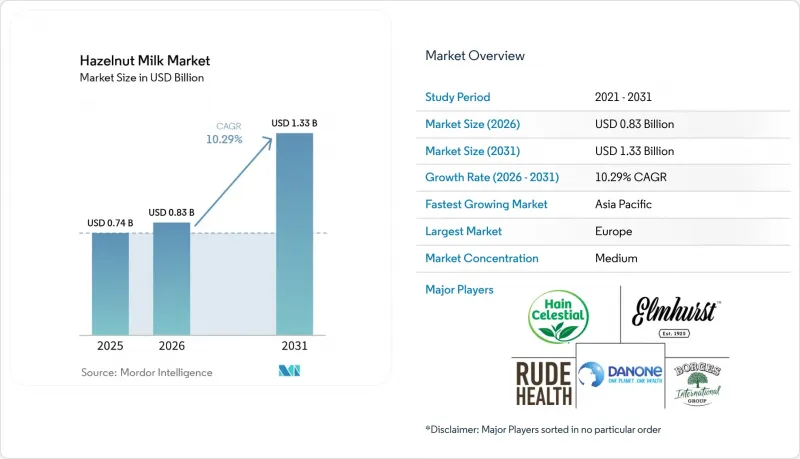
This report is Segmented by Category (Conventional, Organic), Flavor (Unflavored, Flavored), Packaging (Cartons/Tetra Pak, Bottles, Cans, Pouch), Distribution Channel (Foodservice, Retail), and Geography (North America, Europe, Asia-Pacific, Middle East and Africa, South America). The Market Forecasts are Provided in Terms of Value (USD) and Volume (Liters).
Global Hazelnut Milk Market Trends and Insights
Growing adoption of vegan and flexitarian diets
The growing shift toward plant-based diets has significantly increased the demand for hazelnut milk, appealing to a wider audience beyond traditional lactose-intolerant consumers. This trend is driven by the rising popularity of flexitarian lifestyles in the Netherlands and the United Kingdom, confirming that the hazelnut milk market can transcend niche vegan demand. Additionally, the increasing awareness of environmental sustainability and the health benefits of plant-based alternatives has further fueled this growth. Denmark's national action plan mandates plant-based foods in public procurement across 77 municipalities serving 1.03 million meals daily. It has introduced 133 new plant-based products in schools, resulting in increased plant-based food consumption and demonstrating that institutional demand can de-risk the scale-up of production. Furthermore, advancements in processing technologies and innovative product formulations are enabling manufacturers to enhance the taste, texture, and nutritional profile of hazelnut milk, making it more appealing to a broader consumer base.
Increasing lactose-intolerance awareness
Lactose intolerance affects a large portion of the global population, driving demand for plant-based milk alternatives such as hazelnut milk. According to the U.S. National Institute of Diabetes and Digestive and Kidney Diseases, about 36% of people in the United States have lactose intolerance. Recent clinical evidence indicates that consumers of alternative milk may produce fewer beneficial gut metabolites, prompting producers to fortify hazelnut milk with essential nutrients such as calcium and vitamin D to comply with the U.S. Food and Drug Administration's draft labeling guidance. Additionally, the growing consumer preference for functional foods has encouraged manufacturers to incorporate ingredients such as omega-3 fatty acids and probiotics into hazelnut milk formulations, thereby enhancing the product's nutritional profile. This trend highlights the need for producers to strike a balance between clean-label positioning and strategic fortification to meet regulatory standards, address nutritional gaps, and cater to health-conscious consumers. By aligning with these evolving consumer demands, hazelnut milk producers can strengthen their market position while mitigating potential regulatory or reputational risks.
Competition from alternative plant-based milks
Almond milk continues to dominate the U.S. plant-based milk category, with oat milk experiencing significant growth, leaving hazelnut milk to compete in a crowded market alongside cashew, coconut, macadamia, and emerging bases like pistachio. This is further intensified by established players like Blue Diamond Growers, which recently revamped its almond milk with a simplified three-ingredient recipe to strengthen its market position. Hazelnut milk faces challenges in carving out a distinct niche, as it must position itself as a premium, flavor-forward alternative. To succeed, it needs to emphasize unique taste profiles, creamy texture, and sustainability credentials that justify its higher price points. However, competing on cost with well-established almond and oat milk options remains a significant restraint, particularly as consumers increasingly seek affordable plant-based alternatives. Additionally, limited consumer awareness and availability in mainstream retail channels further hinder hazelnut milk's market penetration, requiring targeted marketing efforts and strategic partnerships to drive growth.
Other drivers and restraints analyzed in the detailed report include:
- Government support for nut-based beverage production
- Enhanced shelf life through UHT and aseptic packaging technologies
- Susceptibility to supply chain disruptions
For complete list of drivers and restraints, kindly check the Table Of Contents.
Segment Analysis
Conventional hazelnut milk accounted for 70.03% of the market share in 2025, driven by its affordability and established supply chains. Its competitive pricing appeals to mainstream consumers and foodservice operators, making it a preferred choice in the market. Mainstream grocers strategically price conventional hazelnut milk at an affordable premium, attracting flexitarians who prioritize value. However, the cost gap between conventional and organic hazelnuts is narrowing as more Turkish and Georgian orchards pursue organic certification to meet EU demand. Forward contracts increasingly include sustainability scorecards, indicating a shift toward reduced pesticide use and regenerative practices, even within the conventional segment.
Organic hazelnut milk is projected to grow at a CAGR of 10.03% during 2026-2031, supported by the European Union's organic market recovery, which increased in 2024 following inflation stabilization. Western and Northern European countries are driving higher per-capita organic spending, reflecting a growing consumer preference for products perceived as healthier, environmentally friendly, and ethically sourced. However, organic certification costs and lower agricultural yields limit supply elasticity, creating opportunities for brands that can secure long-term organic hazelnut contracts from Turkish, Azerbaijani, or Georgian growers. Additionally, the EU's target of 25% farmland under organic cultivation by 2030 remains ambitious, with Austria being the only country currently exceeding this threshold, signaling strong policy support for organic ingredient supply.
Unflavored hazelnut milk captured 60.14% of the market share in 2025, serving as a versatile base for coffee, cereal, smoothies, and cooking applications. Its dominance reflects its functional adaptability and appeal to consumers seeking neutral bases for customization. However, its growth rate lags behind flavored variants due to direct competition with established almond and oat milk offerings, which are often priced more competitively and have broader availability. To sustain growth, unflavored hazelnut milk producers are focusing on improving supply chain efficiencies and promoting their nutritional benefits, such as their high vitamin E content and lower calorie count compared to other plant-based milk options.
Flavored variants are expanding at a robust 10.18% CAGR for 2026-2031, driven by rising consumer demand for indulgent, cafe-style experiences at home and Gen Z's preference for personalization. Flavored hazelnut milk differentiates itself through unique profiles such as chocolate-hazelnut (leveraging the classic Nutella association), vanilla-hazelnut, or coffee-hazelnut blends that emphasize the nut's inherent richness while complementing its natural flavor. The segment is also benefiting from innovations in natural flavoring and sweetening, which cater to health-conscious consumers seeking indulgence without added sugars. Furthermore, as chocolate confectioners increasingly adopt dairy-free couvertures, co-branding opportunities are emerging for flavored hazelnut bases in bakery and dessert kits. This expansion into adjacent categories, such as ready-to-drink beverages and plant-based dessert toppings, is expected to further drive the growth of flavored hazelnut milk.
Geography Analysis
In 2025, Europe accounted for 37.65% of the market share, driven by increasing consumer preference for plant-based beverages, rising awareness of lactose intolerance, and the growing trend of veganism. Key markets in Europe include Germany, the United Kingdom, Italy, France, the Netherlands, Poland, Belgium, and Sweden. Germany and the United Kingdom lead the region due to their well-established retail infrastructure and high consumer spending on premium plant-based products. Southern European markets, such as Spain, are witnessing growing demand for barista-grade hazelnut milk, particularly within cafe culture. Additionally, the European Union's stringent sustainability regulations and consumer demand for eco-friendly packaging have further propelled the adoption of hazelnut milk.
The Asia-Pacific region is the fastest-growing, with a projected CAGR of 10.67% for 2026-2031, driven by young urban demographics, rising e-commerce penetration, and a strong coffee-shop culture in countries such as South Korea and Australia. In China, demand is rebounding post-lockdown, although regulatory uncertainties surrounding the use of dairy-related terms remain a challenge. Localization efforts, such as Singapore-based production for regional supply, along with grants and brand tariffs, provide competitive advantages in the region.
North America, while facing category maturity, continues to maintain momentum through clean-label reformulations and private-label diversification. Latin America and the Middle East present growth opportunities, particularly where UHT functionality addresses refrigeration constraints. However, brands must adapt packaging sizes to align with lower per capita incomes in these regions. Turkey, serving as both a major raw-nut exporter and an emerging domestic beverage market, holds a unique position as a critical hub for both supply and demand in the hazelnut milk market.
- Danone S.A. (Alpro)
- Borges International Group
- Elmhurst Milked, LLC
- Pacific Foods (The Campbell's Company)
- Rude Health Foods Ltd
- Hazelicious, Inc.
- Al Naturale
- Fomilk
- Ecomil
- The Hain Celestial Group
- Provamel
- Isola Bio
- Bjorg
- Riso Scotti
- Vemendo
- Nilky
- Alnatura Produktion und Handel GmbH
- ReRooted Organic
- McCarter, a.s.
- Unigra S.p.A. (OraSi)
Additional Benefits:
- The market estimate (ME) sheet in Excel format
- 3 months of analyst support
TABLE OF CONTENTS
1 INTRODUCTION
- 1.1 Study Assumptions and Market Definition
- 1.2 Scope of the Study
2 RESEARCH METHODOLOGY
3 EXECUTIVE SUMMARY
4 MARKET LANDSCAPE
- 4.1 Market Overview
- 4.2 Market Drivers
- 4.2.1 Growing adoption of vegan and flexitarian diets
- 4.2.2 Increasing lactose intolerance awareness
- 4.2.3 Expansion of plant-based milks in retail and e-commerce
- 4.2.4 Advancements in product formats and flavor innovations
- 4.2.5 Government support for nut-based beverage production
- 4.2.6 Enhanced shelf life through UHT and aseptic packaging technologies
- 4.3 Market Restraints
- 4.3.1 Competition from alternative plant-based milks
- 4.3.2 Concerns regarding limited shelf life and quality preservation
- 4.3.3 Susceptibility to supply chain disruptions
- 4.3.4 Regulatory complexities and challenges related to food safety
- 4.4 Consumer Demand Analysis
- 4.5 Regulatory Landscape
- 4.6 Porter's Five Forces
- 4.6.1 Threat of New Entrants
- 4.6.2 Bargaining Power of Buyers
- 4.6.3 Bargaining Power of Suppliers
- 4.6.4 Threat of Substitute Products
- 4.6.5 Intensity of Competitive Rivalry
5 MARKET SIZE AND GROWTH FORECASTS (VALUE and VOLUME)
- 5.1 By Category
- 5.1.1 Conventional
- 5.1.2 Organic
- 5.2 By Flavor
- 5.2.1 Unflavored
- 5.2.2 Flavored
- 5.3 By Packaging
- 5.3.1 Cartons/Tetra Pak
- 5.3.2 Bottles
- 5.3.3 Cans
- 5.3.4 Pouch
- 5.4 By Distribution Channel
- 5.4.1 Foodservice
- 5.4.2 Retail
- 5.4.2.1 Supermarkets/Hypermarkets
- 5.4.2.2 Convenience Stores
- 5.4.2.3 Online Retail Stores
- 5.4.2.4 Specialty Stores
- 5.4.2.5 Other Distribution Channels
- 5.5 By Geography
- 5.5.1 North America
- 5.5.1.1 United States
- 5.5.1.2 Canada
- 5.5.1.3 Mexico
- 5.5.1.4 Rest of North America
- 5.5.2 Europe
- 5.5.2.1 Germany
- 5.5.2.2 United Kingdom
- 5.5.2.3 Italy
- 5.5.2.4 France
- 5.5.2.5 Spain
- 5.5.2.6 Netherlands
- 5.5.2.7 Poland
- 5.5.2.8 Belgium
- 5.5.2.9 Sweden
- 5.5.2.10 Rest of Europe
- 5.5.3 Asia-Pacific
- 5.5.3.1 China
- 5.5.3.2 India
- 5.5.3.3 Japan
- 5.5.3.4 Australia
- 5.5.3.5 Indonesia
- 5.5.3.6 South Korea
- 5.5.3.7 Thailand
- 5.5.3.8 Singapore
- 5.5.3.9 Rest of Asia-Pacific
- 5.5.4 Middle East and Africa
- 5.5.4.1 South Africa
- 5.5.4.2 Saudi Arabia
- 5.5.4.3 United Arab Emirates
- 5.5.4.4 Nigeria
- 5.5.4.5 Egypt
- 5.5.4.6 Morocco
- 5.5.4.7 Turkey
- 5.5.4.8 Rest of Middle East and Africa
- 5.5.5 South America
- 5.5.5.1 Brazil
- 5.5.5.2 Argentina
- 5.5.5.3 Colombia
- 5.5.5.4 Chile
- 5.5.5.5 Peru
- 5.5.5.6 Rest of South America
- 5.5.1 North America
6 COMPETITIVE LANDSCAPE
- 6.1 Market Concentration
- 6.2 Strategic Moves
- 6.3 Market Share Analysis
- 6.4 Company Profiles (includes Global level Overview, Market level overview, Core Segments, Financials as available, Strategic Information, Market Rank/Share for key companies, Products and Services, and Recent Developments)
- 6.4.1 Danone S.A. (Alpro)
- 6.4.2 Borges International Group
- 6.4.3 Elmhurst Milked, LLC
- 6.4.4 Pacific Foods (The Campbell's Company)
- 6.4.5 Rude Health Foods Ltd
- 6.4.6 Hazelicious, Inc.
- 6.4.7 Al Naturale
- 6.4.8 Fomilk
- 6.4.9 Ecomil
- 6.4.10 The Hain Celestial Group
- 6.4.11 Provamel
- 6.4.12 Isola Bio
- 6.4.13 Bjorg
- 6.4.14 Riso Scotti
- 6.4.15 Vemendo
- 6.4.16 Nilky
- 6.4.17 Alnatura Produktion und Handel GmbH
- 6.4.18 ReRooted Organic
- 6.4.19 McCarter, a.s.
- 6.4.20 Unigra S.p.A. (OraSi)
7 MARKET OPPORTUNITIES AND FUTURE OUTLOOK

