PUBLISHER: Mordor Intelligence | PRODUCT CODE: 2061897

PUBLISHER: Mordor Intelligence | PRODUCT CODE: 2061897
Glufosinate - Market Share Analysis, Industry Trends & Statistics, Growth Forecasts (2026 - 2031)
According to Mordor Intelligence, the glufosinate market size is projected to increase from USD 2.1 billion in 2025 to USD 2.3 billion in 2026 and reach USD 3.4 billion by 2031, growing at a CAGR of 7.2% over 2026-2031.
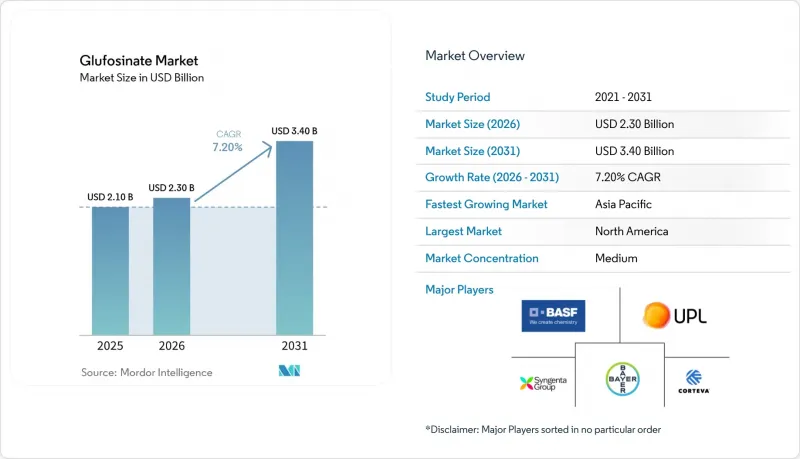
This report is Segmented by Crop Type (Cereals and Grains, and More), by Formulation (Aqueous Suspension Concentrate, and More), by Treatment Stage (Pre-Emergence, and More), by Distribution Channel (Online Platforms and More), and by Geography (North America, Europe, Asia-Pacific, South America, Africa, and Middle East). The Market and Forecasts are Provided in Terms of Value (USD).
Global Glufosinate Market Trends and Insights
Impact of Glyphosate-Resistant Weed Proliferation on the Market
Palmer amaranth nowadays infests 31 United States states and waterhemp 25 states, both showing confirmed glyphosate resistance that slashes soybean yields by up to 90% when unmanaged. The increasing prevalence of glyphosate-resistant weeds is a significant driver for the glufosinate market. Farmers dealing with resistant weed populations are turning to glufosinate as an effective alternative herbicide. It offers control over a broad spectrum of weeds that no longer respond to glyphosate. This trend is particularly prominent in regions with high glyphosate usage, where resistance management strategies are essential to maintaining crop yield and quality.
Expansion of Glufosinate-Tolerant Biotech Crops
The growth of glufosinate-tolerant genetically modified crops is driving market demand. These biotech crops, such as soybeans, maize, and cotton, enable farmers to apply glufosinate without harming the crop. The adoption of these tolerant varieties is expanding globally, particularly in North and South America, as they facilitate effective weed control while supporting higher productivity and flexibility in crop management practices. Furthermore, the increasing investments in biotechnology research and development are leading to the introduction of new glufosinate-tolerant crop varieties, which is projected to further boost market growth. The compatibility of glufosinate with sustainable farming practices also makes it a preferred choice for farmers aiming to balance productivity with environmental stewardship.
Emergence of Next-gen Hydroxyphenylpyruvate Dioxygenase (HPPD) and Bio-Herbicides
The introduction of next-generation Hydroxyphenylpyruvate Dioxygenase (HPPD) inhibitors and bio-herbicides is intensifying competition in the glufosinate market. Hydroxyphenylpyruvate Dioxygenase (HPPD) inhibitors are effective at controlling broadleaf weeds, while bioherbicides derived from natural sources, such as microbes or plant extracts, appeal to farmers prioritizing environmentally sustainable weed control methods. As these advanced alternatives gain popularity, particularly in organic, precision, or sustainable agricultural practices, they may partially replace glufosinate in certain crop applications. In response, manufacturers are focusing on improving formulations, enhancing tank-mix compatibility, and implementing targeted marketing strategies to retain market share.
Other drivers and restraints analyzed in the detailed report include:
- Impact of Paraquat and Dicamba Regulatory Exit on the Market
- Precision-Spraying Adoption Boosting Post-Emergence Demand
- Rainfastness Concerns Under Increasingly Erratic Rainfall Patterns
For complete list of drivers and restraints, kindly check the Table Of Contents.
Segment Analysis
Cereals and grains led the largest segment, with 44% of the glufosinate market share in 2025, this leadership is attributed to the extensive cultivation of staple crops such as wheat, rice, and maize, which require effective herbicidal solutions to manage weeds and enhance yield. Glufosinate's broad-spectrum weed control and low residual activity make it particularly suitable for cereal and grain farming. Furthermore, the segment benefits from established application practices and widespread adoption among large-scale cereal producers, solidifying its position as the largest crop-type segment.
Oilseeds and pulses are the fastest growing, advancing at a 9.8% CAGR through 2026-2031. This growth is driven by increasing global demand for plant-based oils and protein-rich pulses, coupled with expanded cultivation in regions such as Asia-Pacific and South America. Farmers are increasingly adopting glufosinate to enhance weed management efficiency and minimize crop losses, particularly in rotation systems involving oilseeds and legumes. Additionally, the transition toward sustainable and no-till farming practices is boosting glufosinate usage in these crops, as it supports soil conservation while ensuring effective weed control.
Aqueous suspension concentrate led largest segment, with 52% of glufosinate market share in 2025, because they integrate smoothly into existing tank mixes and distribution infrastructure. This dominance is attributed to their ease of handling, uniform dispersion in water, and reliable weed control performance. Suspension concentrates are widely utilized by farmers for cereal, grain, and oilseed crops due to their consistent efficacy and compatibility with standard spraying equipment.
Dry formulation (water-dispersible granules) is fastest growing, projected to grow at an 11.2% CAGR to 2026-2031, aligning with e-commerce shipping models favored by large farms. This growth is driven by their extended shelf life, ease of transport, and compatibility with precision and mechanized spraying systems. WDGs are increasingly adopted in regions with high rainfall or irrigation variability, as they minimize runoff and enhance rainfastness compared to liquid formulations. Additionally, advancements in dry formulation technology are improving solubility and efficacy, making them a preferred choice for large-scale and resource-efficient farming practices.
Geography Analysis
North America remains the largest regional contributor in 2025, with a 32.5% share of the glufosinate market. This dominance is attributed to the widespread adoption of herbicide-tolerant crops, advanced agricultural infrastructure, and a well-established agrochemical supply chain. Farmers in the United States and Canada utilize glufosinate for its broad-spectrum weed control, effectiveness against glyphosate-resistant weeds, and compatibility with biotech crop systems. Additionally, robust distribution networks and strong regulatory frameworks ensure the availability and consistent use of glufosinate products across the region.
Asia-Pacific is the fastest-growing region, with a 11.2% CAGR through 2026-2031. This growth is driven by the increasing cultivation of cereals, grains, oilseeds, and pulses, alongside the adoption of glufosinate-tolerant crop varieties and the rapid implementation of modern farming techniques in countries such as China, India, and Southeast Asia. The expansion of agri-retail infrastructure, adoption of digital farming solutions, and advancements in precision spraying technologies further support the uptake of glufosinate.
South America glufosinate market growing propelled by Brazilian sugarcane, coffee and soybean segments that filled the paraquat void and by Argentine double-hit programs for multi-resistant weeds. Currency swings and Chinese oversupply create input-cost rollercoasters, but trait adoption and stacked programs counterbalance price-induced hesitancy. Europe countries like Germany and France remain core users in corn and cereals, yet high-value fruit growers may pivot if endocrine-disruptor rules tighten.
- BASF SE
- Bayer AG
- UPL Limited
- Syngenta AG
- Nufarm Limited
- Jiangsu Seven-continent Green Chemical Co., Ltd.
- Zhejiang Yongnong Chemical Co., Ltd.
- Fuhua Tongda Chemical Co., Ltd.
- Sumitomo Chemical Co., Ltd.
- Albaugh, LLC
- Limin Chemical Co., Ltd. (Limin Group Co., Ltd.)
- FMC Corporation
- Corteva, Inc.
- Shandong Weifang Rainbow Chemical Co., Ltd.
Additional Benefits:
- The market estimate (ME) sheet in Excel format
- 3 months of analyst support
TABLE OF CONTENTS
1 Introduction
- 1.1 Study Assumptions and Market Definition
- 1.2 Scope of the Study
2 Research Methodology
3 Executive Summary
4 Market Landscape
- 4.1 Market Overview
- 4.2 Market Drivers
- 4.2.1 Impact of glyphosate-resistant weed proliferation on the market
- 4.2.2 Expansion of glufosinate-tolerant biotech crops
- 4.2.3 Impact of paraquat and dicamba regulatory exit on the market
- 4.2.4 Precision-spraying adoption boosting post-emergence demand
- 4.2.5 Rapid uptake of nano-microencapsulated glufosinate formulations
- 4.2.6 Stacked-trait seed mixes enabling dual-mode herbicide programs
- 4.3 Market Restraints
- 4.3.1 Price volatility driven by Chinese oversupply affects the market
- 4.3.2 Stringent toxicology reviews in the European Union
- 4.3.3 Hydroxyphenylpyruvate Dioxygenase (HPPD) impact on the market
- 4.3.4 Rainfastness concerns under increasingly erratic rainfall patterns
- 4.4 Regulatory Landscape
- 4.5 Technological Outlook
- 4.6 Porter's Five Forces Analysis
- 4.6.1 Threat of New Entrants
- 4.6.2 Bargaining Power of Suppliers
- 4.6.3 Bargaining Power of Buyers
- 4.6.4 Threat of Substitutes
- 4.6.5 Intensity of Competitive Rivalry
5 Market Size and Growth Forecasts (Value)
- 5.1 By Crop Type
- 5.1.1 Cereals and Grains
- 5.1.2 Oilseeds and Pulses
- 5.1.3 Fruits and Vegetables
- 5.1.4 Other Crop Types
- 5.2 By Formulation
- 5.2.1 Aqueous Suspension Concentrate
- 5.2.2 Liquid (Soluble) Concentrate
- 5.2.3 Dry Formulation (Water-Dispersible Granules)
- 5.3 By Treatment Stage
- 5.3.1 Pre-Emergence
- 5.3.2 Post-Emergence
- 5.4 By Distribution Channel
- 5.4.1 Agri-Retailers and Cooperatives
- 5.4.2 Online Platforms
- 5.4.3 Other Distribution Channels
- 5.5 By Geography
- 5.5.1 North America
- 5.5.1.1 United States
- 5.5.1.2 Canada
- 5.5.1.3 Mexico
- 5.5.1.4 Rest of North America
- 5.5.2 South America
- 5.5.2.1 Brazil
- 5.5.2.2 Argentina
- 5.5.2.3 Rest of South America
- 5.5.3 Europe
- 5.5.3.1 Germany
- 5.5.3.2 France
- 5.5.3.3 United Kingdom
- 5.5.3.4 Russia
- 5.5.3.5 Italy
- 5.5.3.6 Spain
- 5.5.3.7 Rest of Europe
- 5.5.4 Asia-Pacific
- 5.5.4.1 China
- 5.5.4.2 India
- 5.5.4.3 Australia
- 5.5.4.4 Japan
- 5.5.4.5 Thailand
- 5.5.4.6 Vietnam
- 5.5.4.7 Philippines
- 5.5.4.8 Rest of Asia-Pacific
- 5.5.5 Middle East
- 5.5.5.1 Turkey
- 5.5.5.2 Saudi Arabia
- 5.5.5.3 Rest of Middle East
- 5.5.6 Africa
- 5.5.6.1 South Africa
- 5.5.6.2 Egypt
- 5.5.6.3 Rest of Africa
- 5.5.1 North America
6 Competitive Landscape
- 6.1 Market Concentration
- 6.2 Strategic Moves
- 6.3 Market Share Analysis
- 6.4 Company Profiles (Includes Global Level Overview, Market Level Overview, Core Segments, Financials as Available, Strategic Information, Market Rank/Share, Products And Services, And Recent Developments)
- 6.4.1 BASF SE
- 6.4.2 Bayer AG
- 6.4.3 UPL Limited
- 6.4.4 Syngenta AG
- 6.4.5 Nufarm Limited
- 6.4.6 Jiangsu Seven-continent Green Chemical Co., Ltd.
- 6.4.7 Zhejiang Yongnong Chemical Co., Ltd.
- 6.4.8 Fuhua Tongda Chemical Co., Ltd.
- 6.4.9 Sumitomo Chemical Co., Ltd.
- 6.4.10 Albaugh, LLC
- 6.4.11 Limin Chemical Co., Ltd. (Limin Group Co., Ltd.)
- 6.4.12 FMC Corporation
- 6.4.13 Corteva, Inc.
- 6.4.14 Shandong Weifang Rainbow Chemical Co., Ltd.
7 Market Opportunities and Future Outlook

