PUBLISHER: Mordor Intelligence | PRODUCT CODE: 2061902

PUBLISHER: Mordor Intelligence | PRODUCT CODE: 2061902
Textile Printers - Market Share Analysis, Industry Trends & Statistics, Growth Forecasts (2026 - 2031)
According to Mordor Intelligence, the textile printers market size was valued at USD 1.11 billion in 2025 and was estimated to grow from USD 1.14 billion in 2026 to reach USD 1.34 billion by 2031, at a CAGR of 3.13% during the forecast period (2026-2031).
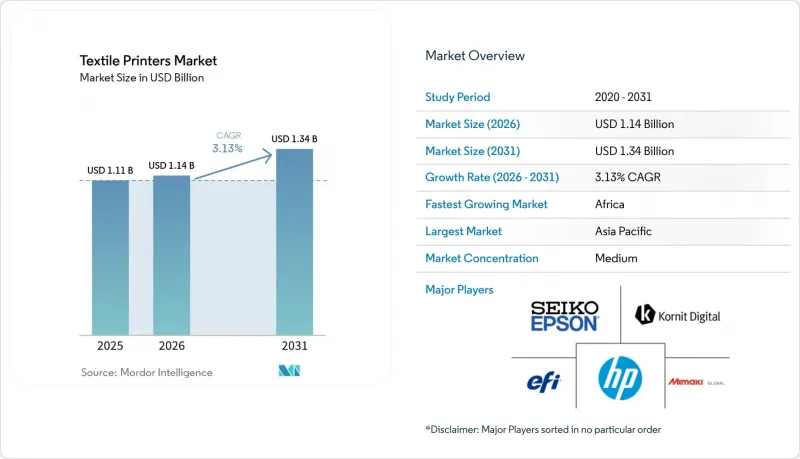
This report is Segmented by Printing Technology (Digital Inkjet Printing, Screen Printing, and More), Ink Type (Reactive Dye Inks, Acid Dye Inks, Pigment Inks, Disperse and Sublimation Inks, and More), Application (Garments and Apparel, Home Textiles, Signage and Display Graphics, More), Fabric (Cotton, Polyester, Silk, and More), and Geography. The Market Forecasts are Provided in Terms of Value (USD).
Global Textile Printers Market Trends and Insights
Growing Demand for Fast Fashion and Customized Apparel
Weekly micro-drops now replace seasonal collections, pushing converters toward low-minimum orders that analog screens cannot satisfy. Digital devices eliminate screen engraving and allow pattern changes in minutes, enabling European brands to nearshore production for rapid replenishment. Operators that adopted single-pass pigment printers in 2025 reported double-digit reductions in inventory write-offs after shifting to print-on-demand models. Logistics savings also mount as fabric is printed closer to the point of sale, a factor that aligns with upcoming Europe traceability mandates.
Shift From Analog to Digital Printing in Textiles
Digital penetration is accelerating once job lengths fall below 1 000 meters, the economic break-even against rotary screens. Platforms such as the Epson SureColor F10070H integrate inline pretreatment and fixation, combining multiple wet processes into a single dry pass. Polyester sportswear has moved fastest because dye sublimation avoids post-print washing, but cotton and viscose are catching up now that inline curing achieves comparable fastness. These dynamics explain why direct-to-fabric inkjet systems outsold rotary screens for the first time in China during 2025.
High Initial Capital Investment for Industrial-Scale Machines
Single-pass printers priced between USD 500 000 and USD 2 million are out of reach for many small and medium enterprises. Even where leasing is available, required credit guarantees keep adoption uneven, prolonging reliance on rotary screens in South America and Africa. Equipment-as-a-service models gained traction in 2025, yet payback still depends on volumes above 500 000 m2 per year, a threshold few emerging-market converters can reach.
Other drivers and restraints analyzed in the detailed report include:
- Advancements in High-Speed Inkjet Heads and Sublimation Inks
- Expanding E-Commerce and Web-to-Print Platforms
- Volatility in Textile Ink Raw Material Prices
For complete list of drivers and restraints, kindly check the Table Of Contents.
Segment Analysis
Digital inkjet solutions accounted for 62.51% of 2025 revenue, making the segment a key driver of the textile printers market's growth. Between 2026 and 2031, the segment is projected to grow at a 3.45% CAGR, as single-pass machines match analog speed while offering unlimited pattern flexibility. The textile printers market now rewards software-driven uptime more than purely mechanical attributes, prompting suppliers to couple predictive-maintenance analytics with hardware leases.
Screen printing still dominates high-volume commodity runs because rotary units exceed 100 m min-1, but their relevance erodes each time brands push for localized production or smaller order lots. Flatbed screens persist for textured effects unattainable with inkjet drops, though even this moat is narrowing as multi-layer digital varnish evolves. Hybrid platforms that hold a base screen station followed by inkjet heads are gaining share among converters unwilling to scrap legacy assets overnight.
Pigment chemistries, expanding at a 4.22% CAGR, are enabling the textile printers market to achieve grade 4-5 wash-fastness without relying on water-intensive steaming processes. This advancement is crucial to helping the market comply with Zero Discharge of Hazardous Chemicals (ZDHC) limits and with upcoming EU disclosure regulations. NeoPigment inks, combined with inline pretreatment modules, have now achieved cotton yields previously achieved only with reactive dyes. As a result, several textile mills across Asia have begun decommissioning their steamers, a trend that gained momentum in 2025, reflecting a significant shift in production practices driven by sustainability and regulatory compliance.
Disperse and sublimation inks, which accounted for 41.08% of 2025 revenue, continue to dominate the polyester sportswear segment due to their compatibility with synthetic fabrics and vibrant color output. However, the growth rate in this segment is slowing as brands diversify their fabric choices to include multiple blends, reducing dependency on polyester alone. Meanwhile, UV-curable ink sets are gaining traction in the signage industry, particularly in applications where outdoor durability and resistance to environmental factors are critical. Additionally, bio-based binders, though currently a small share of the market, are gradually gaining adoption as brands incorporate life-cycle assessments into their purchasing decisions, aligning with sustainability goals and regulatory requirements.
Geography Analysis
Asia-Pacific accounted for 39.34% of the 2025 value and is projected to grow significantly through 2031, as China's digital penetration surpasses 35% by 2030 and India's incentive scheme refunds up to 25% of capital outlays. Investment clusters in Surat and Guangdong lead installations of single-pass dye-sublimation lines, with software upgrades driving incremental demand in Japan and South Korea. Southeast Asian exporters, notably Vietnam and Bangladesh, are installing hybrid platforms to remain competitive amid near-shoring in Europe.
Africa is experiencing the fastest regional growth, at 3.91%, driven by the WTO Cotton Initiative, which is channeling USD 5 billion into the development of integrated textile parks in Ethiopia, Egypt, Morocco, and Kenya. In Ethiopia, mills within the Hawassa Industrial Park installed pigment-inkjet corridors in 2025 to meet the growing demand of European retailers for traceability in their supply chains. Meanwhile, Morocco is capitalizing on its geographical proximity to Spain and France, enabling it to deliver printed fabric to these markets within 72 hours, thereby strengthening its position as a key supplier in the region.
North America and Europe expand more slowly, at 2.8% and 2.9% respectively, yet remain technology incubators. AI-based color-matching and digital product passports accelerate digital retrofits in these mature markets. South America and the Middle East lag due to import tariffs and limited technical support, although premium hospitality refurbishments in the United Arab Emirates now specify waterless pigment lines to meet internal sustainability charters.
- Seiko Epson Corporation
- Kornit Digital Ltd.
- Electronics For Imaging (EFI Reggiani)
- HP Inc.
- Mimaki Engineering Co., Ltd.
- Brother Industries, Ltd.
- Roland DG Corporation
- Durst Group AG
- Ricoh Company, Ltd.
- Mutoh Holdings Co., Ltd.
- MS Printing Solutions S.r.l.
- Aeoon Technologies GmbH
- ColorJet India Ltd.
- SPGPrints B.V.
- DGI Co., Ltd.
- Sawgrass Technologies, Inc.
- JHF Technology Group Co., Ltd.
- Shenzhen Homer Textile Digital Printing Co., Ltd.
- Fujifilm Holdings Corporation
- Zhejiang Atexco Digital Technology Co., Ltd.
Additional Benefits:
- The market estimate (ME) sheet in Excel format
- 3 months of analyst support
TABLE OF CONTENTS
1 INTRODUCTION
- 1.1 Study Assumptions and Market Definition
- 1.2 Scope of the Study
2 RESEARCH METHODOLOGY
3 EXECUTIVE SUMMARY
4 MARKET LANDSCAPE
- 4.1 Market Overview
- 4.2 Market Drivers
- 4.2.1 Growing Demand for Fast Fashion and Customized Apparel
- 4.2.2 Shift From Analog to Digital Printing in Textiles
- 4.2.3 Advancements in High-Speed Inkjet Heads and Sublimation Inks
- 4.2.4 Expanding E-Commerce and Web-to-Print Platforms
- 4.2.5 Adoption of Waterless Pigment Ink Printers to Meet ZDHC Guidelines
- 4.2.6 Integration of AI-Based Print Workflow Automation in Textile Mills
- 4.3 Market Restraints
- 4.3.1 High Initial Capital Investment for Industrial-Scale Machines
- 4.3.2 Volatility in Textile Ink Raw Material Prices
- 4.3.3 Limited Color Gamut and Fastness for Certain Digital Inks
- 4.3.4 Regulatory Scrutiny on Wastewater Nanoparticles From Polyester Sublimation
- 4.4 Industry Value-Chain Analysis
- 4.5 Regulatory Landscape
- 4.6 Technological Outlook
- 4.7 Impact of Macroeconomic Factors on the Market
- 4.8 Porter's Five Forces Analysis
- 4.8.1 Threat of New Entrants
- 4.8.2 Bargaining Power of Suppliers
- 4.8.3 Bargaining Power of Buyers
- 4.8.4 Threat of Substitutes
- 4.8.5 Competitive Rivalry
5 MARKET SIZE AND GROWTH FORECASTS (VALUE)
- 5.1 By Printing Technology
- 5.1.1 Digital Inkjet Printing
- 5.1.1.1 Direct-to-Fabric (DTF)
- 5.1.1.2 Direct-to-Garment (DTG)
- 5.1.1.3 Dye-Sublimation
- 5.1.1.4 Single-Pass and Others
- 5.1.2 Screen Printing
- 5.1.2.1 Rotary Screen
- 5.1.2.2 Flatbed Screen
- 5.1.3 Other Printing Technologies
- 5.1.1 Digital Inkjet Printing
- 5.2 By Ink Type
- 5.2.1 Reactive Dye Inks
- 5.2.2 Acid Dye Inks
- 5.2.3 Pigment Inks
- 5.2.4 Disperse and Sublimation Inks
- 5.2.5 UV-Curable and Hybrid Inks
- 5.2.6 Other Ink Types
- 5.3 By Application
- 5.3.1 Garments and Apparel
- 5.3.2 Home Textiles
- 5.3.3 Signage and Display Graphics
- 5.3.4 Technical Textiles
- 5.3.5 Other Applications
- 5.4 By Fabric
- 5.4.1 Cotton
- 5.4.2 Polyester
- 5.4.3 Silk
- 5.4.4 Blends
- 5.4.5 Other Fabrics
- 5.5 By Geography
- 5.5.1 North America
- 5.5.1.1 United States
- 5.5.1.2 Canada
- 5.5.1.3 Mexico
- 5.5.2 South America
- 5.5.2.1 Brazil
- 5.5.2.2 Argentina
- 5.5.2.3 Rest of South America
- 5.5.3 Europe
- 5.5.3.1 United Kingdom
- 5.5.3.2 Germany
- 5.5.3.3 France
- 5.5.3.4 Italy
- 5.5.3.5 Rest of Europe
- 5.5.4 Asia-Pacific
- 5.5.4.1 China
- 5.5.4.2 Japan
- 5.5.4.3 India
- 5.5.4.4 South Korea
- 5.5.4.5 Rest of Asia-Pacific
- 5.5.5 Middle East
- 5.5.5.1 United Arab Emirates
- 5.5.5.2 Saudi Arabia
- 5.5.5.3 Turkey
- 5.5.5.4 Israel
- 5.5.5.5 Rest of Middle East
- 5.5.6 Africa
- 5.5.6.1 South Africa
- 5.5.6.2 Egypt
- 5.5.6.3 Rest of Africa
- 5.5.1 North America
6 COMPETITIVE LANDSCAPE
- 6.1 Market Concentration
- 6.2 Strategic Moves
- 6.3 Market Share Analysis
- 6.4 Company Profiles (includes Global Level Overview, Market Level Overview, Core Segments, Financials as available, Strategic Information, Market Rank/Share, Products and Services, Recent Developments)
- 6.4.1 Seiko Epson Corporation
- 6.4.2 Kornit Digital Ltd.
- 6.4.3 Electronics For Imaging (EFI Reggiani)
- 6.4.4 HP Inc.
- 6.4.5 Mimaki Engineering Co., Ltd.
- 6.4.6 Brother Industries, Ltd.
- 6.4.7 Roland DG Corporation
- 6.4.8 Durst Group AG
- 6.4.9 Ricoh Company, Ltd.
- 6.4.10 Mutoh Holdings Co., Ltd.
- 6.4.11 MS Printing Solutions S.r.l.
- 6.4.12 Aeoon Technologies GmbH
- 6.4.13 ColorJet India Ltd.
- 6.4.14 SPGPrints B.V.
- 6.4.15 DGI Co., Ltd.
- 6.4.16 Sawgrass Technologies, Inc.
- 6.4.17 JHF Technology Group Co., Ltd.
- 6.4.18 Shenzhen Homer Textile Digital Printing Co., Ltd.
- 6.4.19 Fujifilm Holdings Corporation
- 6.4.20 Zhejiang Atexco Digital Technology Co., Ltd.
7 MARKET OPPORTUNITIES AND FUTURE OUTLOOK
- 7.1 White-Space and Unmet-Need Assessment

